
There are 28 Companies in France
that provide CRM Consulting Services!
France's IT services market is the sixth-largest in the world. It currently occupies around 4.4% of the global IT services market. The market value of IT services accounts for around 45.7% of the overall market of IT. The IT services market is expected to grow at a CAGR of around 16.45% from 2025 - 2030, potentially reaching $81.21 billion by 2030.
Discover Top IT Companies in France specialized in CRM Consulting including Hubspot, IBM CRM, Microsoft Dynamics CRM, Marketo, Salesforce, Sugar CRM, Zoho CRM and more.
Customer relationship management (CRM) lies at the heart of any successful business strategy, enabling companies to cultivate meaningful connections with their customers and drive sustainable growth. However, implementing and optimizing a CRM system can be a complex endeavor without the right expertise. CRM Consulting services offer invaluable guidance and support, helping businesses harness the full potential of CRM solutions. Below we explore the realm of CRM Consulting and how getting these services can be useful (or not) for your business.
Handpicked companies • No obligation to hire • 100% risk-free
Featured Companies in France
This month, the following CRM Consulting companies managed to provide an outstanding service and support. It's worth taking a look.

SDLC Corp is a global IT solutions provider offering custom software, apps, blockchain, AI, Odoo, Salesforce, and game development services.
Innowise is a custom software development company based in Poland, Germany, Lithuania, Switzerland, Italy, Georgia, and the USA.
LeverX is an SAP Gold Partner with SAP as its core area of expertise.
Explore Top CRM Consulting Companies in France
Where People and AI Unite to Deliver Exceptional Customer Experiences
Delloweb International delivers innovative digital solutions worldwide, specializing in web development, cloud services & App, and digital marketing.

Toronto design and development agency that specializes in full-stack solutions across marketing, data, and technology.

We are Artefact. Marketing Engineers.
Full-service ecommerce agency Experts in Web & Shopify /Plus. Headless solutions

AI-for-commerce studio: AI agents & chatbots, process automation, websites & e-commerce. Remote, worldwide, from 500 EUR.
We are Makeitfuture, a Business Digital Transformation Agency that specializes in innovative, custom solutions using no-code tools and AI technology.
We map long-lasting growth strategies that we implement over time with a dedicated team of specialists.

Bienvenue chez BraindCode, votre partenaire de choix pour toutes vos ambitions digitales !
ROI-driven growth marketing agency helping B2B & B2C brands scale with Paid Ads, SEO, Outbound, and RevOps.
Persistent Systems Verified Company
Rhône-Alpes, France Head office in: India
See Beyond, Rise Above
As a trusted managed services provider (MSP), Tradister delivers advanced IT solutions and seamless support to businesses worldwide.
Inventing your future self isn’t about consulting firms getting things done and evaporating. It’s about true individual talent helping you learn and...
Services:

Grow your business with Inbound Marketing! We help you accelerate your growth with a digital marketing strategy that finally brings together marketing...

Aryvart is an International IT Company specialized in providing services includes CRM, E-Business, Business Intelligence & BPO. We are highly expe...

At Domeneo our goal is to bring your remote team closer to you, providing highly skilled labor and many benefits to your business: similar or same tim...
Nurun is the digital design and technology network of Publicis Worldwide. With over 4,000 experts in 30 offices across 15 countries, Nurun provides a...

Chez DIGITALISIM, nous avons l'intime conviction que la réussite des entreprises passe par l’innovation web, le marketing digital, et la relation clie...
Services:
We turn your impact into exceptional experiences. We are a full-service development studio, dedicated to creating digital solutions.

We’re Brand Advocate, an integrated agency. Our clients are world-class brands like Montblanc, A. Lange & Söhne, Shiseido, Seimens, Totalgaz, Nesp...
Founded in 2009, Polydea is a 360° communications agency, specialized in public relations, marketing and digital creation. A young, independent, Euro...
Services:
- 1
- 2
Filter CRM Consulting Companies in France by Cities
Find the right tech company near you or from a specific city. Some of the best companies might be located in smaller cities.
Find more CRM Consulting companies around the world
TechBehemoths is the world's most advanced and user-friendly platform to match IT Companies with real clients without hustle.
The French ICT Industry: Data & Insights
France's IT services market is the sixth-largest in the world. It currently occupies around 4.4% of the global IT services market. The market value of IT services accounts for around 45.7% of the overall IT market, and is expected to grow from over $41 billion in 2016 to over $64.27 billion in 2025.
The IT services market grew at a CAGR of around 1.1% in the historic period and is predicted to grow at a CAGR of around 16.45% from 2025 - 2030. potentially reaching $81.21 billion by 2030.
Why Should You Work With a French IT Company?
France’s biggest advantage in the region is the growing number of young professionals who are enrolled in the IT industry. In Western Europe, France has the lowest outsourcing rate and is relying on its own professionals mainly to provide the entire range of IT services. Along with the increasing number of human resources, the French IT infrastructure is among the leading in Europe, and having these factors combined, France has the third-largest IT sector in Europe, with a share of 16.5% in 2025.
What to Be Aware of When Working With French IT Companies
Good IT infrastructure, well-developed business culture, and skilled professionals - France has it all to continue its IT growth in the following years. So, what’s the missing puzzle that makes France the third-largest IT market in Europe and not the first?!
Basically, the cultural differences and especially linguistic rigidity make French companies less attractive. In this way, the IT industry continues to rely on Francophone and French-speaking countries, but with good progress made, especially by young companies and IT startups that have started to focus more on development and growth and less on cultural aspects.
How Reliable Are French IT Companies
The strong business culture and tradition, along with local specialties made French companies some of the most trustworthy in Europe, and in the world. Looking back at the European IT market share, France has an incontestable reputation, and it attracts all types of businesses to have IT services done there, by local professionals.
How the French IT Industry Relates to the Neighboring Countries
With Germany and the UK in the leading positions, France’s IT industry continues to grow and possibly pose a good challenge to the UK IT industry. After Brexit, a consistent number of IT companies fled from the UK and relocated to Germany, Ireland, and France, giving to their last chance to take second place in the European IT market share. In the long run, France’s IT industry has two big competitors - the UK and Spain, which share the neighboring position in the European IT ranking.
What is CRM Consulting and what are its benefits for your projects?
Customer relationship management (CRM) is one of the key elements of any successful business strategy, enabling companies to enable meaningful connections with their customers and drive sustainable growth. However, implementing and optimizing a CRM system can be a complex task without the right expertise. CRM Consulting services offer valuable guidance and support, helping businesses benefit from the full potential of CRM solutions. Below we explore CRM Consulting and how getting these services can be useful for your business.
CRM consulting services provide a wide range of expert solutions designed to help businesses enhance customer interactions, streamline processes, and boost overall sales and marketing efficiency. From CRM strategy development to system integration and customization, CRM Consulting caters to the entire CRM implementation lifecycle. Key services related to CRM Consulting include CRM assessment and planning, CRM customization and integration, data migration, user training, and ongoing support.
To provide better CRM Consulting services, companies leverage a variety of tools and technologies. These may include popular CRM platforms such as Salesforce, Microsoft Dynamics 365, HubSpot, and Zoho CRM. Additionally, integration tools, data migration solutions, and analytics software play a crucial role in optimizing CRM implementation and performance.
Companies seeking CRM Consulting services have the flexibility to choose between specialized IT companies and digital agencies. Specialized IT companies often have deep expertise in CRM technologies and provide niche solutions for CRM implementation and optimization. Digital agencies, on the other hand, may offer a broader suite of services, including CRM Consulting, making them a suitable option for businesses seeking comprehensive digital transformation.
Contracting CRM Consulting services may bring a set of advantages for businesses aiming to strengthen customer relationships and achieve sustainable growth. By implementing an effective CRM system, companies can centralize customer data, enabling a 360-degree view of their interactions. This enhanced visibility empowers sales and marketing teams to deliver personalized and targeted campaigns, resulting in improved customer satisfaction and increased sales. Moreover, CRM Consulting streamlines processes, enhances productivity, and facilitates data-driven decision-making, ultimately driving long-term profitability.
Selecting the right CRM Consulting partner is crucial to ensure a successful project. Consider the following criteria:
-
Expertise and Experience: Look for a provider with proven experience in CRM implementation, integration, and support, ideally with a track record in your industry
-
Customization: Ensure the provider can tailor CRM solutions to meet your specific business needs and processes.
-
Scalability: Choose a partner who can support your business as it grows and evolves.
-
Client References: Request client references to gain insights into the provider's performance and customer satisfaction.
TechBehemoths is your go-to platform for finding the best CRM Consulting companies worldwide. With over 982 companies listed across 70+ countries and territories, the platform offers a vast selection of reliable consulting partners. TechBehemoths provides valuable information such as client reviews, ratings, and detailed profiles, enabling you to make an informed decision and select the right CRM Consulting provider for your project.
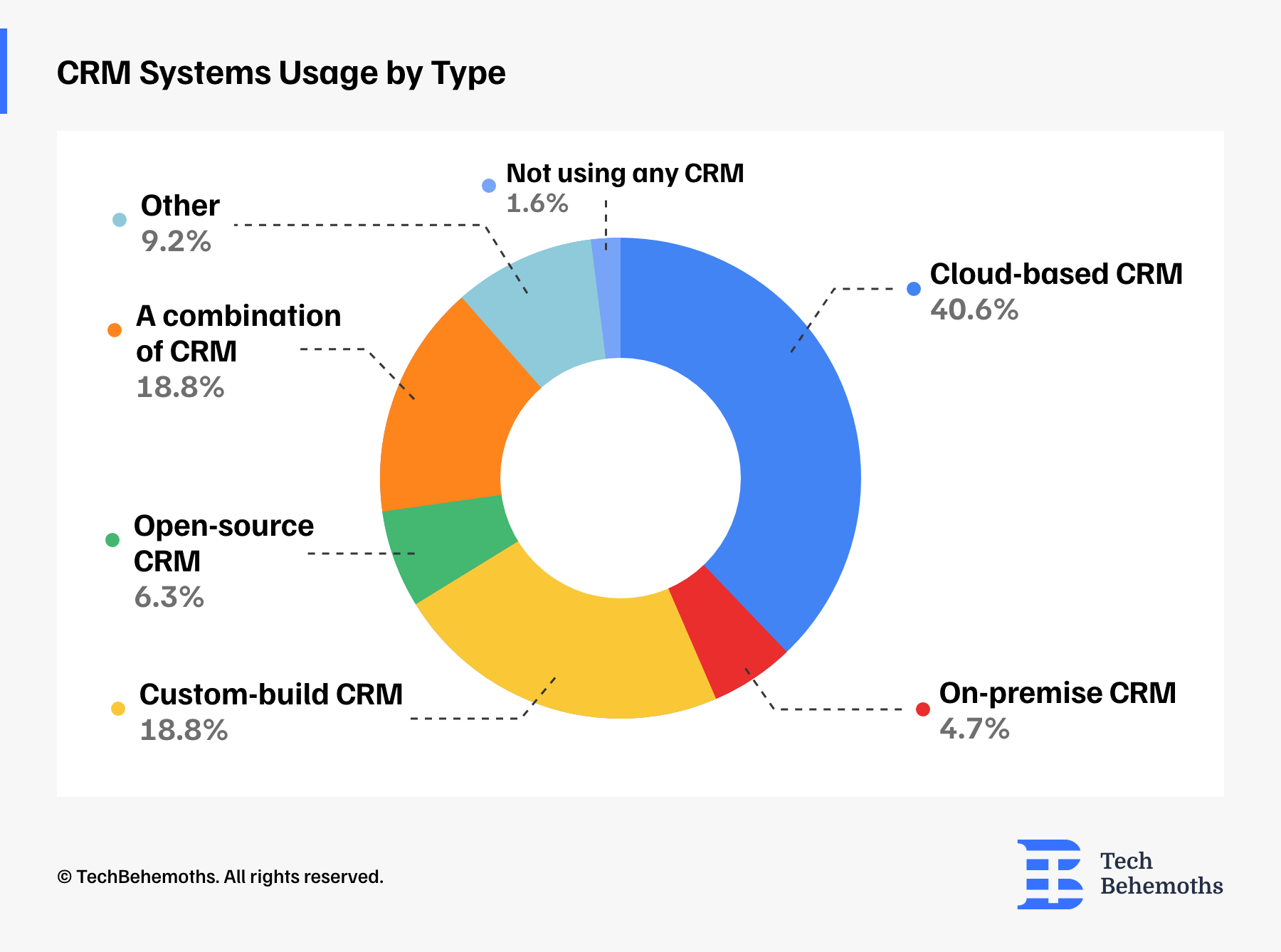
What type of CRM systems do businesses use?
According to a recent survey, over 40% of businesses prefer to use cloud-based CRM systems, due to scalability, ease of integration, and automatic updates. Examples include Salesforce, HubSpot CRM, and Zoho CRM.
Around 19% of businesses use custom built CRMs and 1.6% don’t use any CRMs. This means that about 20% of businesses need flexible solutions to address their unique workflows and integrate seamlessly with their existing systems.
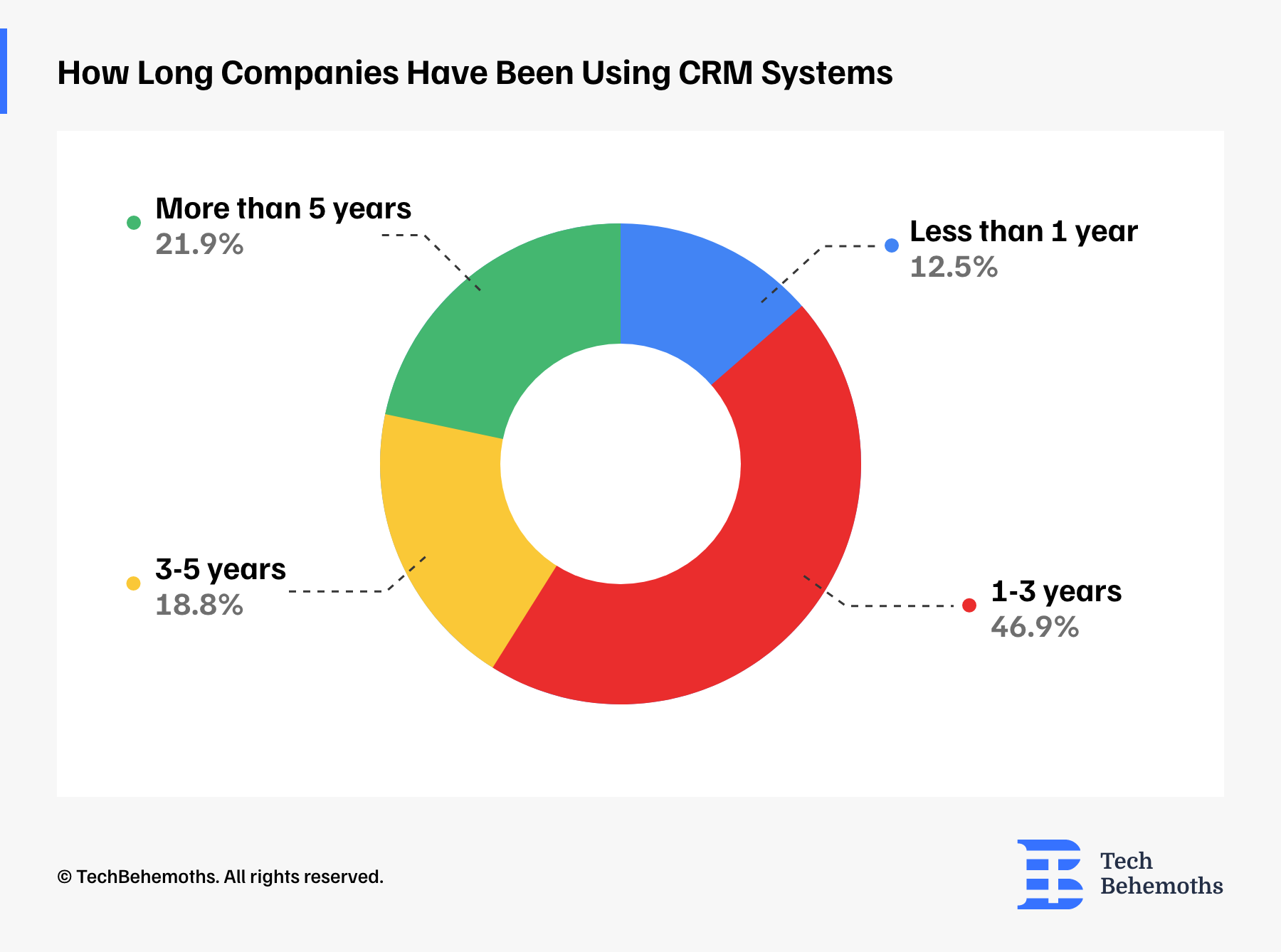
How long have companies been using CRMs?
The survey data shows that CRM adoption is still work in progress for many tech companies. The largest group of respondents , around 47% have been using CRM systems for 1-3 years. Another 12 % have been using CRM systems for less than 1 year, meaning that some companies are just getting started with CRM.
Why do tech businesses use CRMs?
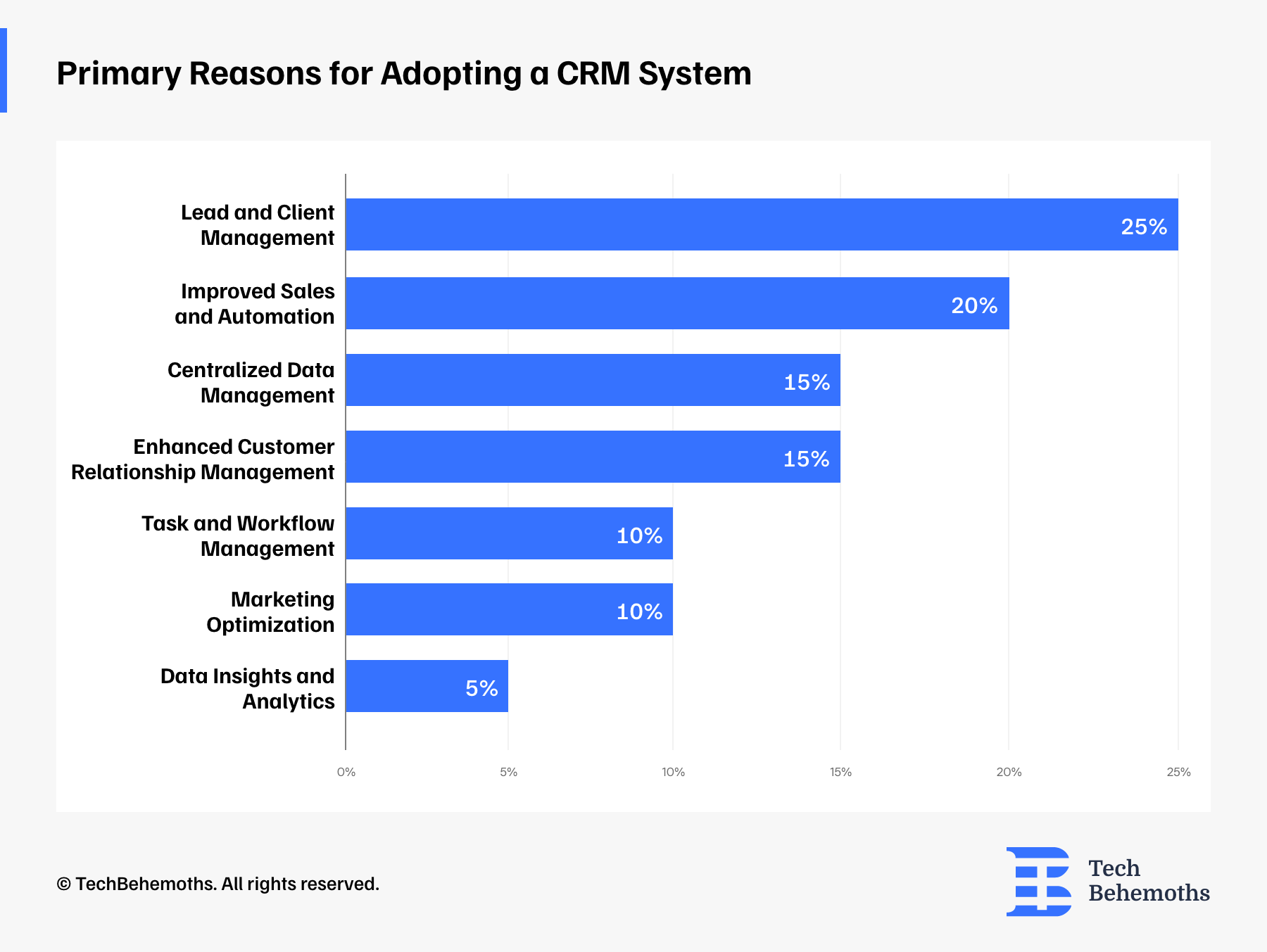
Many professionals think that CRM systems are essential for lead and client management. They help track contacts, organize information, and effectively strengthen customer relationships.
How to measure the success of a CRM system?
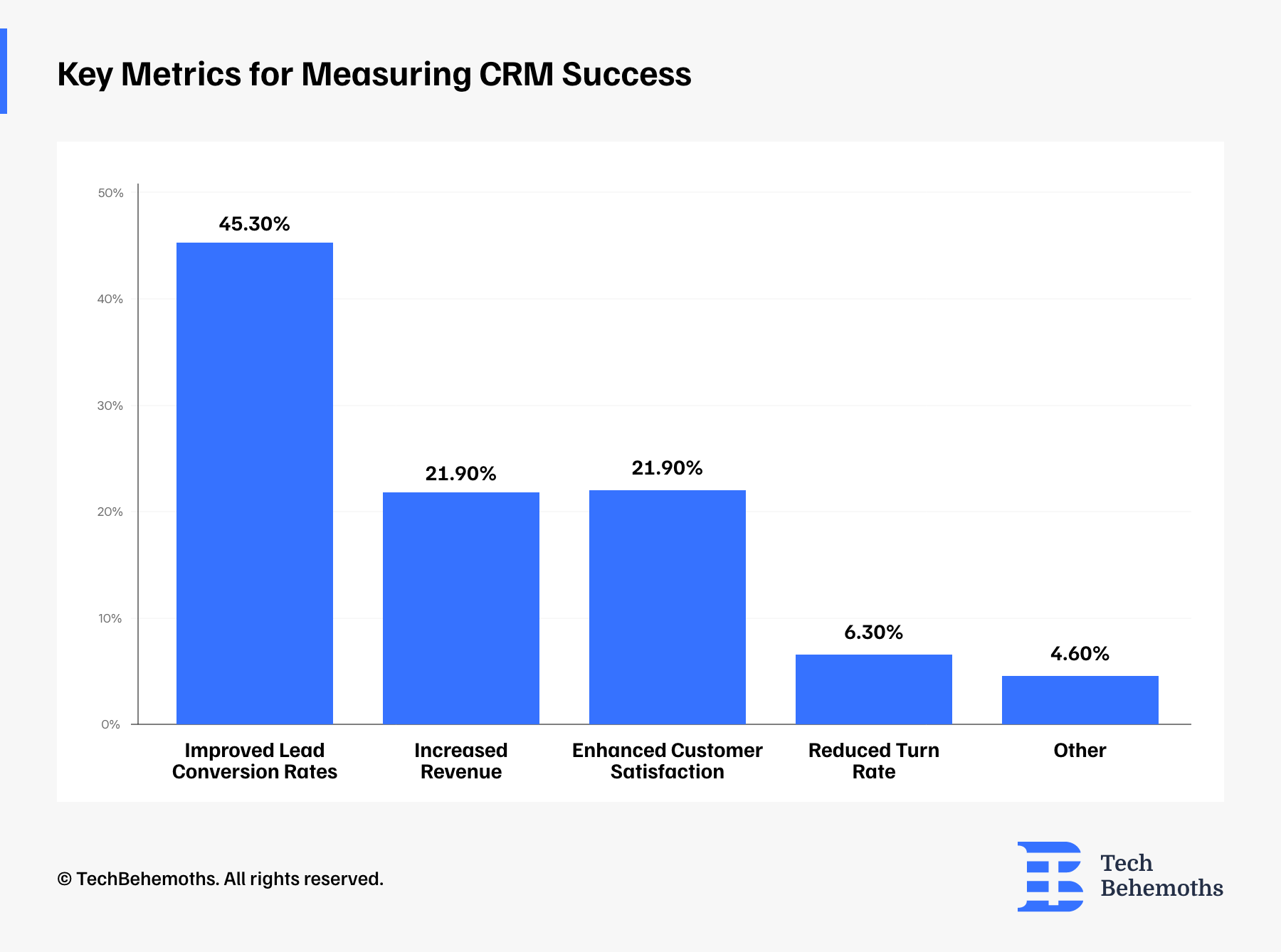
Here are some metrics that you can use to measure the success of your CRM system, based on survey data.
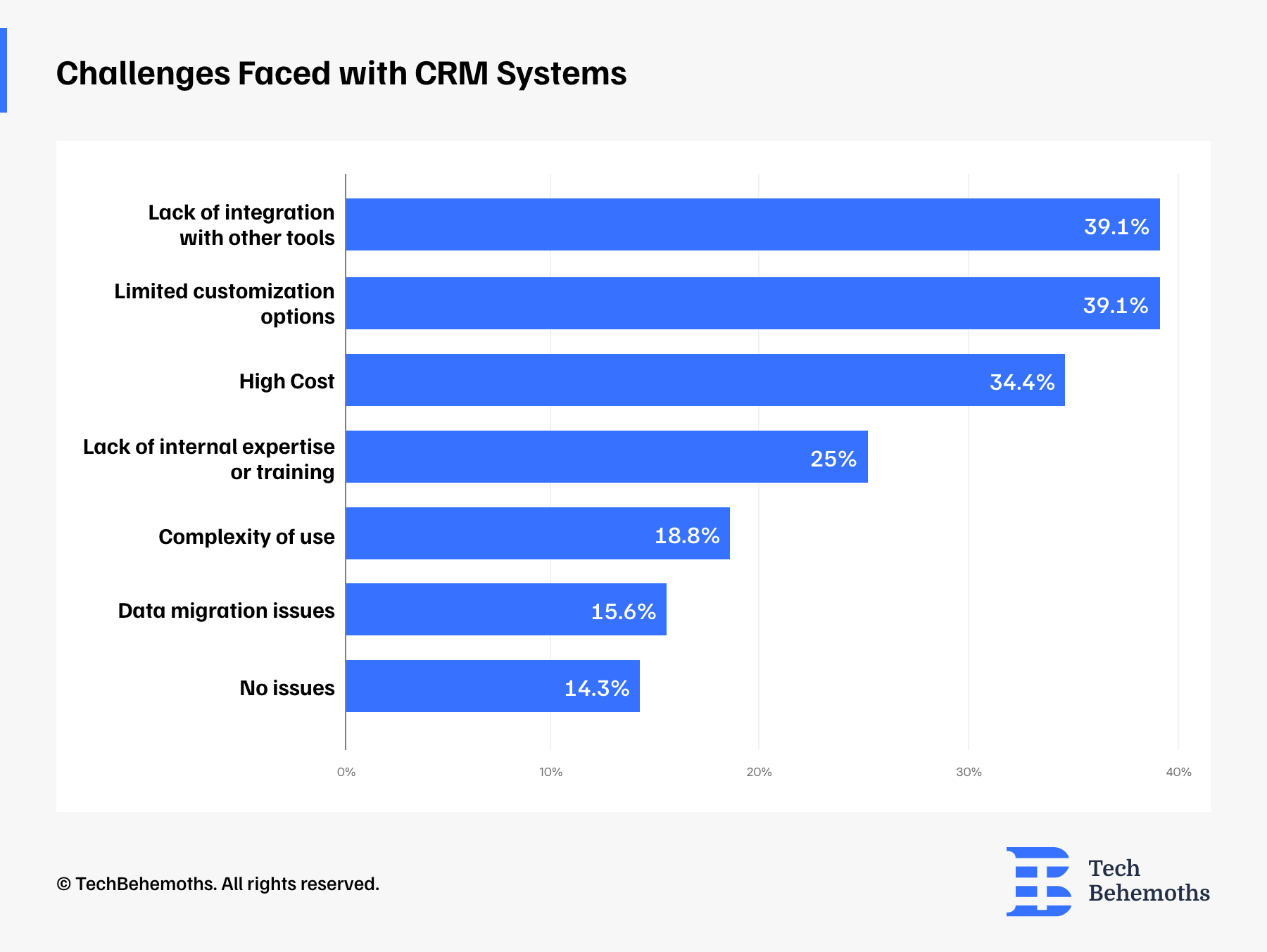
Almost 40% of IT businesses struggle with CRM integration/customization
Most survey respondents noted that lack of integrations with other tools and limited customization options are major issues. This might be an opportunity to work with the right CRM consulting partners that will map the right tools and processes when implementing a CRM system.
Another challenge is the high cost of CRM systems, and the lack of in-house expertise or training. This highlights the need for user-friendly designs and training programs to help users.
Complexity is also an issue, affecting 19% of respondents who find CRMs hard to use. Data migration problems concern around 16% of users when switching to new systems.
What to look for when choosing a CRM?
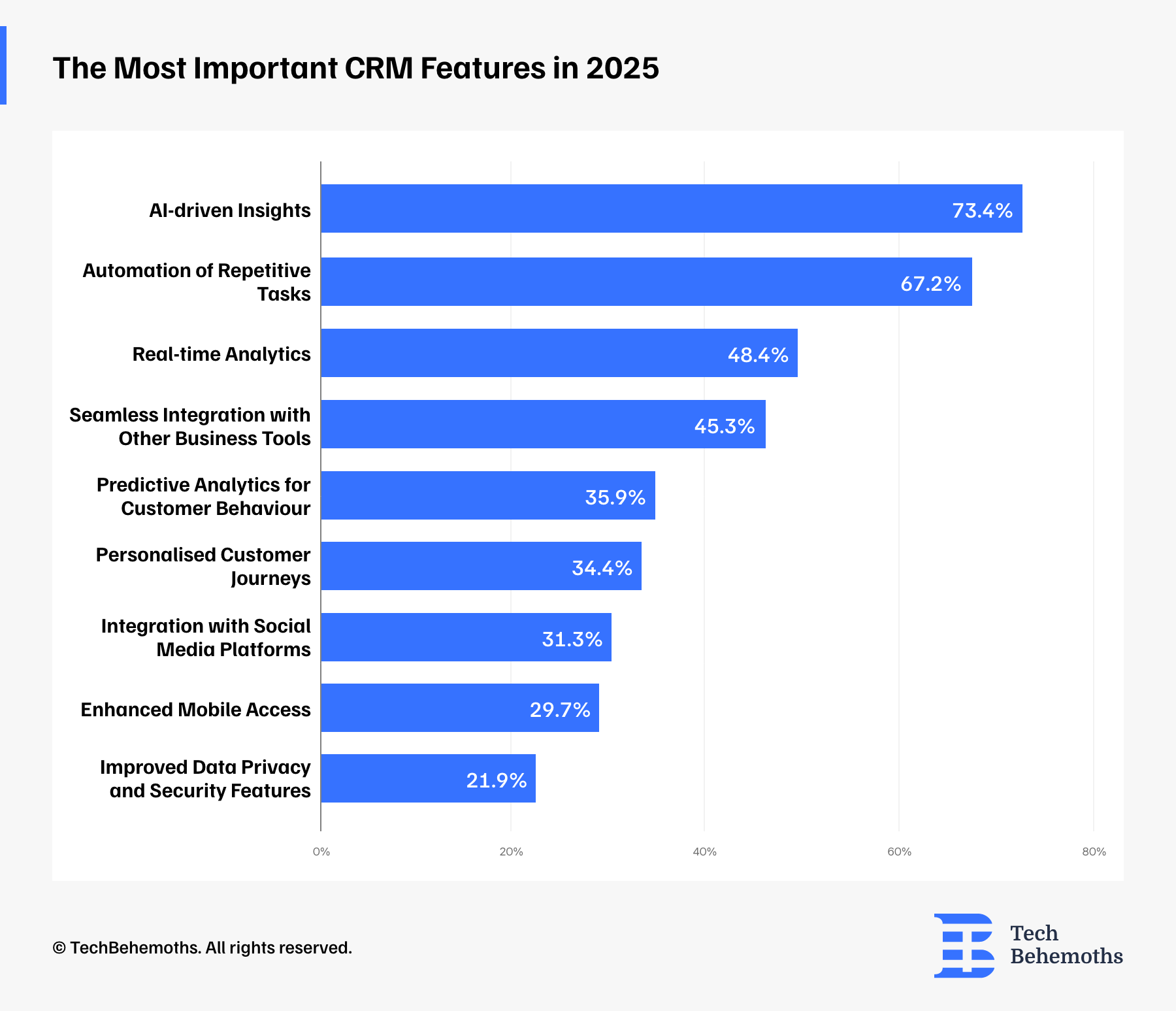
The most important CRM features reflect a strong focus on innovation, efficiency, and connectivity. AI-driven insights, automation, real-time analytics are among the top desired features for efficient CRMs.
Useful CRM and other tools for sales teams
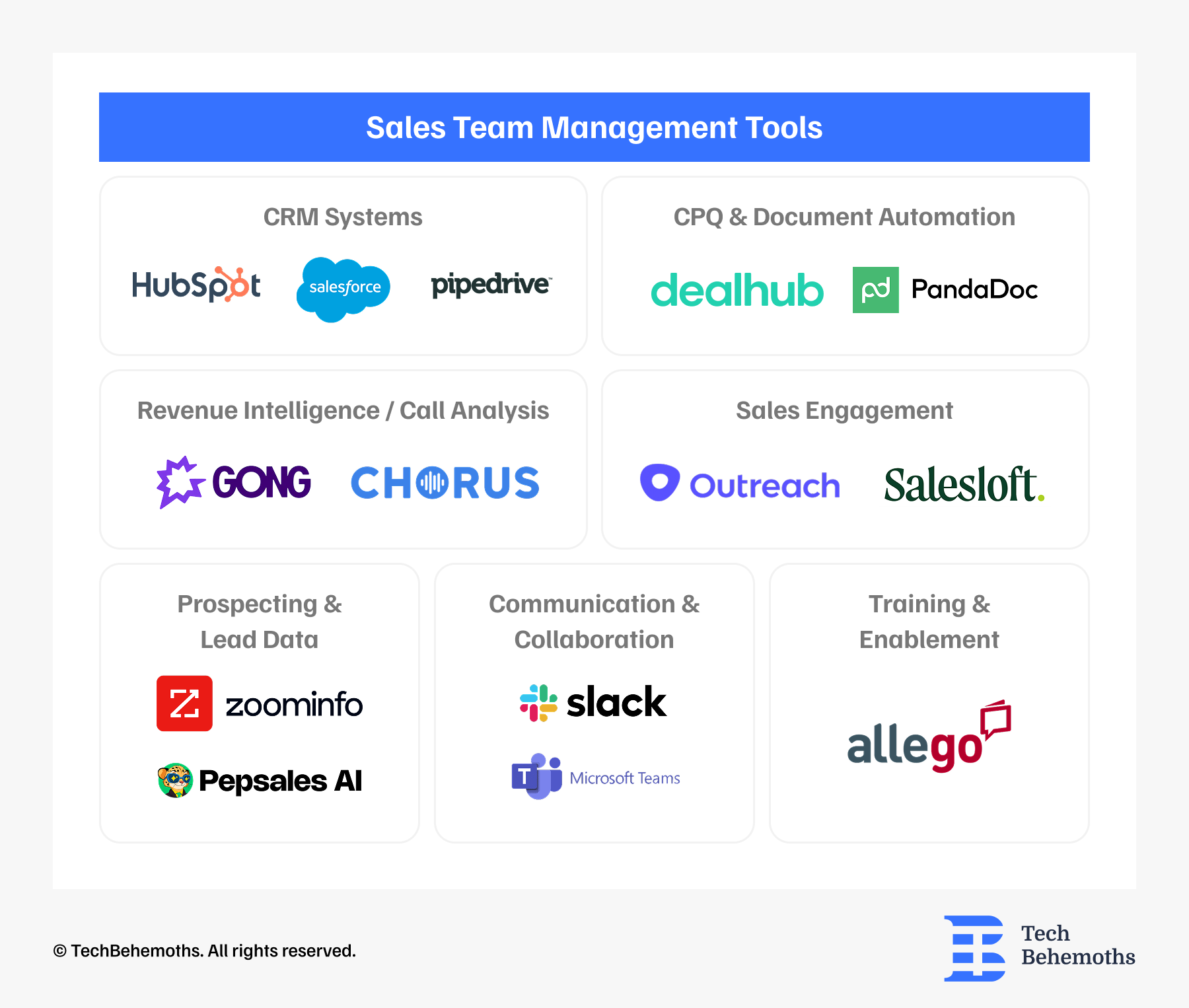
Here is the recommended list of tools that will help you monitor, manage and properly evaluate all sales processes and details, including communication and customer service of the sales team.
1. CRM Systems
These are the systems that keep track of all your customers and offers in one place. Examples: Salesforce, HubSpot, Pipedrive
2. CPQ & Document Automation
These tools automatically generate prices, offers, and contracts, saving you time spent on manually created PDFs. Examples: DealHub, PandaDoc
3. Revenue Intelligence / Call Analysis
These are programs that record and analyze sales calls, so you can see what works and better estimate the chances of closing deals. Examples: Gong, Chorus.ai
4. Sales Engagement
Tools that help automate messages, follow-ups, and contact sequences with potential customers. Examples: Outreach.io, SalesLoft
5. Prospecting & Lead Data
Platforms that find and verify potential customers (including emails, positions, company, etc.). Examples: ZoomInfo, Pepsales AI
6. Training & Enablement
Platforms for training the sales team, which provide materials, coaching and examples of best practices. Examples: Allego
Use advanced filters on TechBehemoths platform or submit your project requirements to get relevant service providers for your next CRM related integrations or customizations.