
There are 5 Companies in Finland
that provide CRM Consulting Services!
Finland’s IT sector is one of the most advanced in Europe and the second-largest IT hub in Northern Europe. The country has been through a strong digitalization process in the early 2000s, and skilled specialists are more and more attracted to discover the digital and tech possibilities the country has to offer.
Discover Top IT Companies in Finland specialized in CRM Consulting including Hubspot, IBM CRM, Microsoft Dynamics CRM, Marketo, Salesforce, Sugar CRM, Zoho CRM and more.
Customer relationship management (CRM) lies at the heart of any successful business strategy, enabling companies to cultivate meaningful connections with their customers and drive sustainable growth. However, implementing and optimizing a CRM system can be a complex endeavor without the right expertise. CRM Consulting services offer invaluable guidance and support, helping businesses harness the full potential of CRM solutions. Below we explore the realm of CRM Consulting and how getting these services can be useful (or not) for your business.
Handpicked companies • No obligation to hire • 100% risk-free
Explore Top CRM Consulting Companies in Finland
Your Final DESTINATION of Software Outsourcing

Helping technology companies grow.
We solve complex business problems through integrated technology, digital, and infrastructure solutions.

Our mission: To foster customer-centricity and help enterprises grow and face the future. We are a transformation partner for enterprises looking to t...

Pitkospuu Productions kehittää ja jalkauttaa kasvuhaluisten yritysten markkinointia. Huomasimme nopeasti, että markkinointikenttä on jatkuvassa myller...
Filter CRM Consulting Companies in Finland by Cities
Find the right tech company near you or from a specific city. Some of the best companies might be located in smaller cities.
Find more CRM Consulting companies around the world
TechBehemoths is the world's most advanced and user-friendly platform to match IT Companies with real clients without hustle.
The Finnish IT Industry: Country Profile & Companies
Finland’s IT sector is one of the most advanced in Europe and the second-largest IT hub in Northern Europe. The country has been through a strong digitalization process in the early 2000s, and skilled specialists are more and more attracted to discover the digital and tech possibilities the country has to offer.
Among other things, Finland ranked 1st globally in the happiness index 4 years in a row, which gives another reason for skilled IT specialists to enter the local market, and the native Finnish professionals to remain and continue to develop the country's IT and the entire business ecosystem.
Finland’s contribution to the world's digitalization is huge - they brought the SMS, 5G, and Linux OS. This highlights, even more, the capabilities of Finnish tech workers in the field.
Why Work With Finnish IT Companies
Finnish IT companies made their way through the European IT market in 2008-2010, but at that time the market only started to grow and didn’t provide enough possibilities to Finnish companies to gain a world name. However, in 2015, IT companies from Finland managed to break the market with improved UI/UX solutions, high performance in software and web development, and also numerous startup incubators that relaunched the country’s IT sector and made it one of the most famous in the world.
From Finnish IT companies and digital agencies, you can expect everything from excellent and outstanding services. The 3400+ IT companies provide high-quality services for the local market via public-private partnerships, and for the international market via BPO, and direct services due to the open European Market.
Most Finnish IT companies are SME’s which are supported and facilitated by the government and local policies. In Finland, companies usually join IT parks and tech communities that help businesses find and benefit from local digital services.
What You Should Be Aware of When Working With Finnish IT Companies
According to Glassdoor, the average annual salary in the Finnish IT sector is 92,290 euros, which is also makes it higher than the average salary and hourly rate, which is 44 euros. In these regards, you may want to pay attention to prices before working with a digital agency from Finland.
Everything else, from project management and dev skills, should not be a reason for concern since Finnish skilled workers are enough, and everywhere in the local companies.
Are Finnish Companies Reliable?
The most well-known thing about Finnish IT companies is their high-quality services and products. This is why reliability is not a question for local digital agencies and companies from Finland. Also, due to market stability and reliability, foreign investors and IT companies are choosing Finland as their next location for new offices.
How Does the Finnish IT Sector Relate to the Neighboring Countries?
Across Europe, there are traditional IT sectors and more innovative ones. Finland focuses more on innovation and tries to bring digitalization to new sectors of the economy. There are eight pillars of the Finnish digital economy, and all of them connect each part of the economy and society to the web:
- Digital Trust
- AI
- Intelligent Connectivity
- New Space Economy
- Smart Mobility
- Data Centers
- Retail Tech and Ecommerce
- Financial Technology.
Some of these pillars are present in the traditional IT sectors such as FinTech, E-commerce, and Data Centers. The neighboring Sweden, for example, focuses more on e-commerce and FinTech, but lacks other digital directions that Finland has.
The latest Finnish sector that goes through digital transformation is the medical sector. Finnish digital agencies and IT companies focus now on providing a comfortable place for doctors and patients using digital technologies. This comfort touches aspects like interior design, acoustics, access to information, entertainment, and extends up to neural networks and involves AI in the surgery processes.
What is CRM Consulting and what are its benefits for your projects?
Customer relationship management (CRM) is one of the key elements of any successful business strategy, enabling companies to enable meaningful connections with their customers and drive sustainable growth. However, implementing and optimizing a CRM system can be a complex task without the right expertise. CRM Consulting services offer valuable guidance and support, helping businesses benefit from the full potential of CRM solutions. Below we explore CRM Consulting and how getting these services can be useful for your business.
CRM consulting services provide a wide range of expert solutions designed to help businesses enhance customer interactions, streamline processes, and boost overall sales and marketing efficiency. From CRM strategy development to system integration and customization, CRM Consulting caters to the entire CRM implementation lifecycle. Key services related to CRM Consulting include CRM assessment and planning, CRM customization and integration, data migration, user training, and ongoing support.
To provide better CRM Consulting services, companies leverage a variety of tools and technologies. These may include popular CRM platforms such as Salesforce, Microsoft Dynamics 365, HubSpot, and Zoho CRM. Additionally, integration tools, data migration solutions, and analytics software play a crucial role in optimizing CRM implementation and performance.
Companies seeking CRM Consulting services have the flexibility to choose between specialized IT companies and digital agencies. Specialized IT companies often have deep expertise in CRM technologies and provide niche solutions for CRM implementation and optimization. Digital agencies, on the other hand, may offer a broader suite of services, including CRM Consulting, making them a suitable option for businesses seeking comprehensive digital transformation.
Contracting CRM Consulting services may bring a set of advantages for businesses aiming to strengthen customer relationships and achieve sustainable growth. By implementing an effective CRM system, companies can centralize customer data, enabling a 360-degree view of their interactions. This enhanced visibility empowers sales and marketing teams to deliver personalized and targeted campaigns, resulting in improved customer satisfaction and increased sales. Moreover, CRM Consulting streamlines processes, enhances productivity, and facilitates data-driven decision-making, ultimately driving long-term profitability.
Selecting the right CRM Consulting partner is crucial to ensure a successful project. Consider the following criteria:
-
Expertise and Experience: Look for a provider with proven experience in CRM implementation, integration, and support, ideally with a track record in your industry
-
Customization: Ensure the provider can tailor CRM solutions to meet your specific business needs and processes.
-
Scalability: Choose a partner who can support your business as it grows and evolves.
-
Client References: Request client references to gain insights into the provider's performance and customer satisfaction.
TechBehemoths is your go-to platform for finding the best CRM Consulting companies worldwide. With over 982 companies listed across 70+ countries and territories, the platform offers a vast selection of reliable consulting partners. TechBehemoths provides valuable information such as client reviews, ratings, and detailed profiles, enabling you to make an informed decision and select the right CRM Consulting provider for your project.
What type of CRM systems do businesses use?
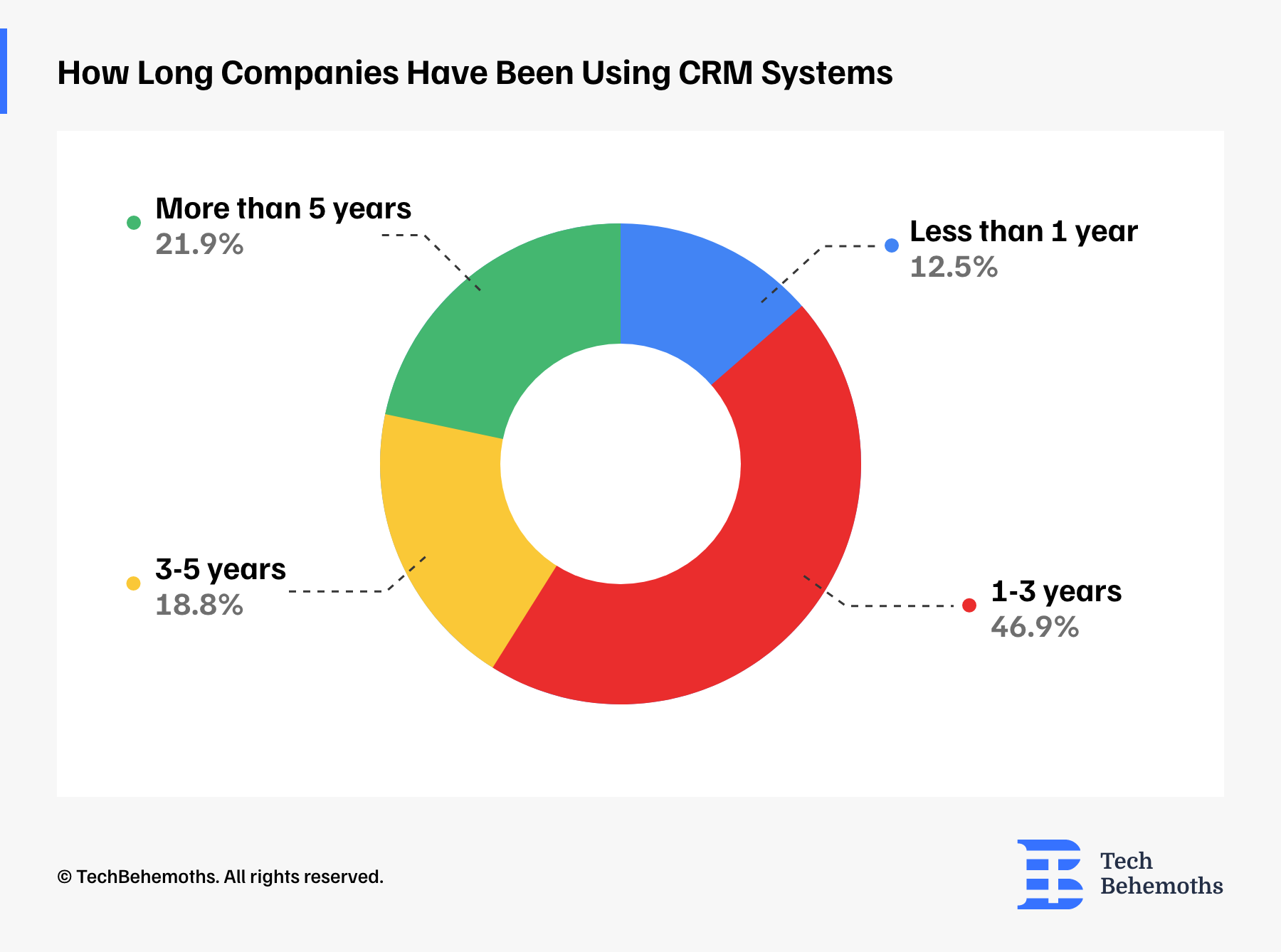
According to a recent survey, over 40% of businesses prefer to use cloud-based CRM systems, due to scalability, ease of integration, and automatic updates. Examples include Salesforce, HubSpot CRM, and Zoho CRM.
Around 19% of businesses use custom built CRMs and 1.6% don’t use any CRMs. This means that about 20% of businesses need flexible solutions to address their unique workflows and integrate seamlessly with their existing systems.
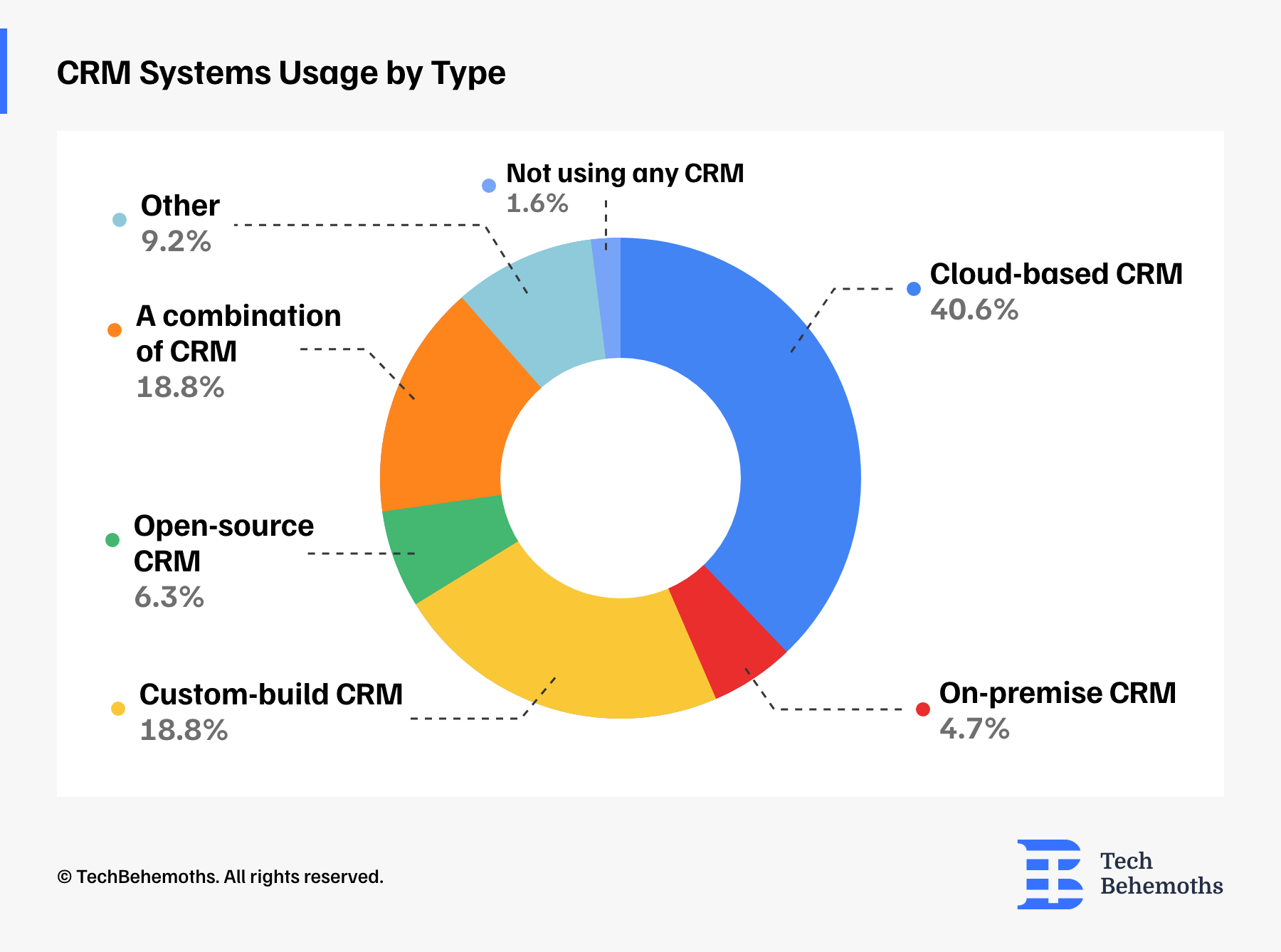
How long have companies been using CRMs?
The survey data shows that CRM adoption is still work in progress for many tech companies. The largest group of respondents , around 47% have been using CRM systems for 1-3 years. Another 12 % have been using CRM systems for less than 1 year, meaning that some companies are just getting started with CRM.
Why do tech businesses use CRMs?
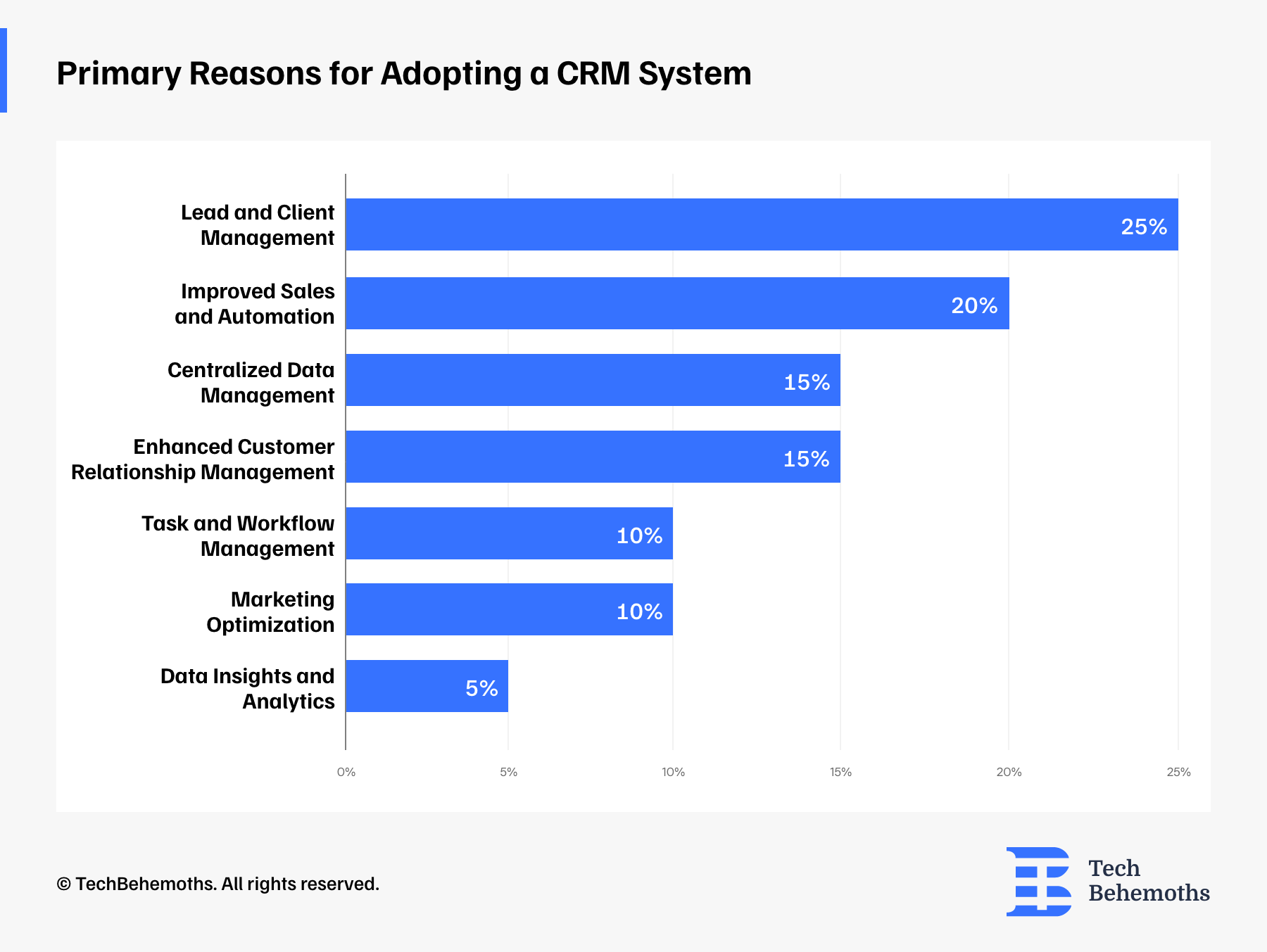
Many professionals think that CRM systems are essential for lead and client management. They help track contacts, organize information, and effectively strengthen customer relationships.
How to measure the success of a CRM system?
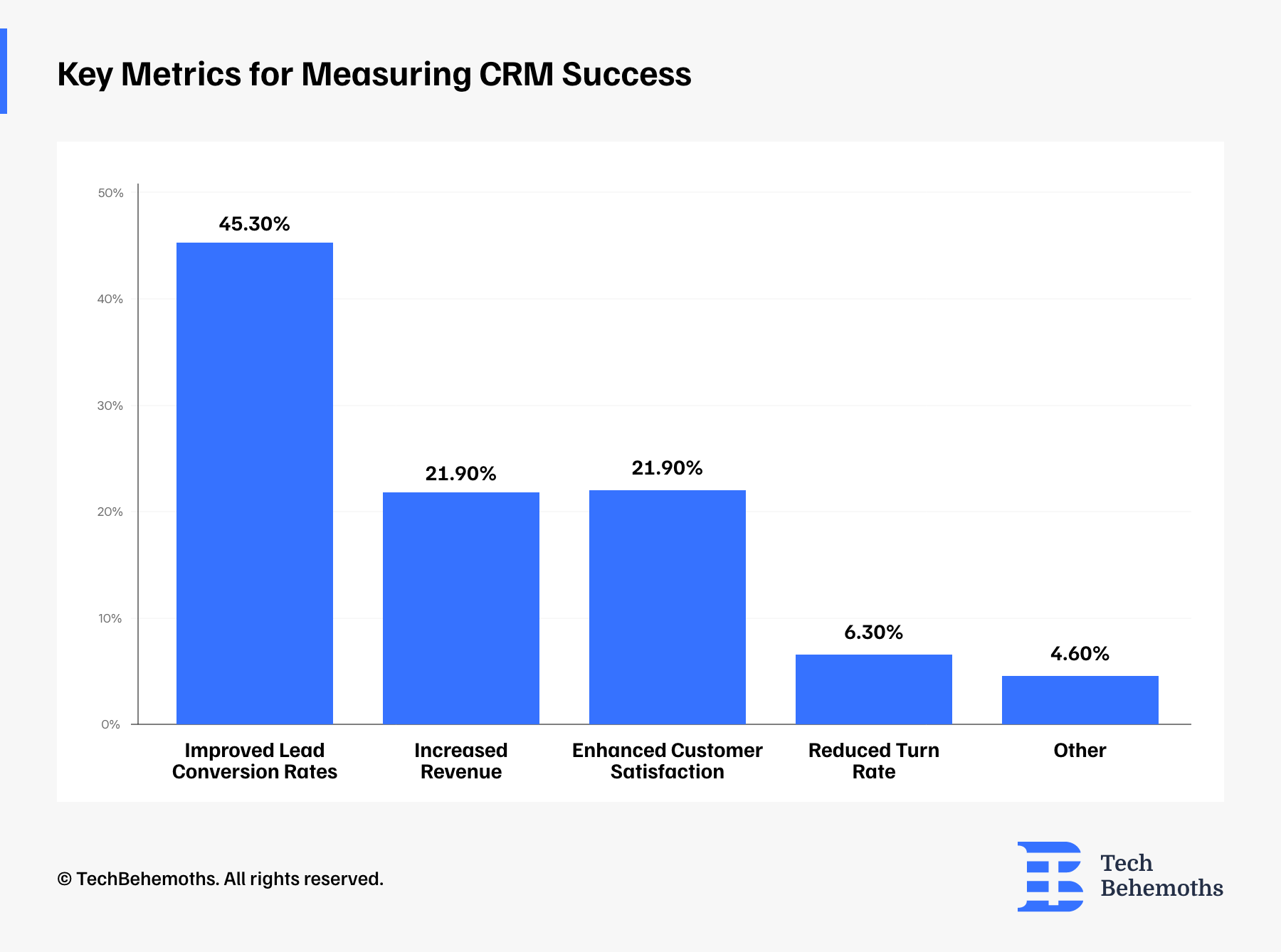
Here are some metrics that you can use to measure the success of your CRM system, based on survey data.
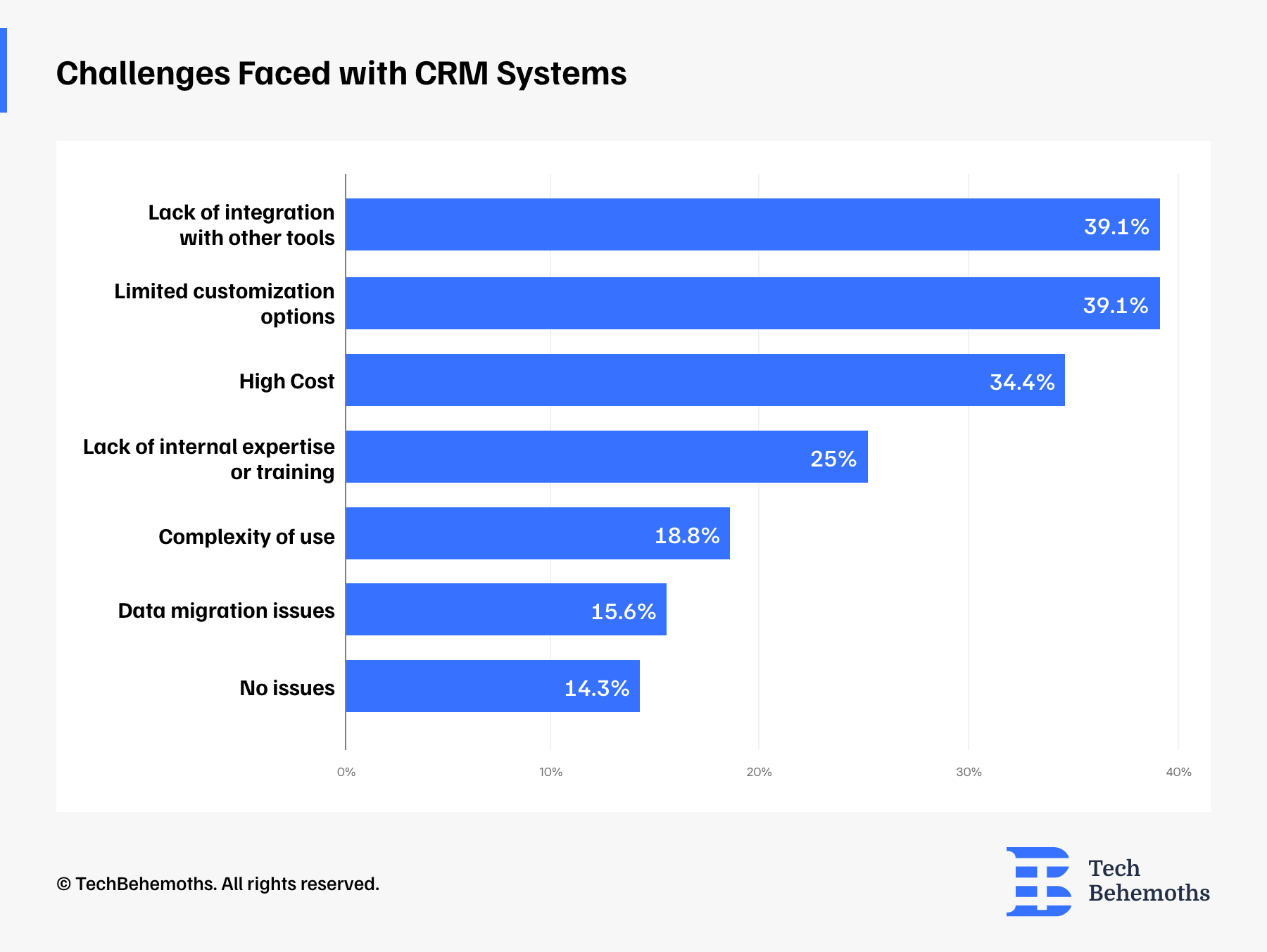
Almost 40% of IT businesses struggle with CRM integration/customization
Most survey respondents noted that lack of integrations with other tools and limited customization options are major issues. This might be an opportunity to work with the right CRM consulting partners that will map the right tools and processes when implementing a CRM system.
Another challenge is the high cost of CRM systems, and the lack of in-house expertise or training. This highlights the need for user-friendly designs and training programs to help users.
Complexity is also an issue, affecting 19% of respondents who find CRMs hard to use. Data migration problems concern around 16% of users when switching to new systems.
What to look for when choosing a CRM?
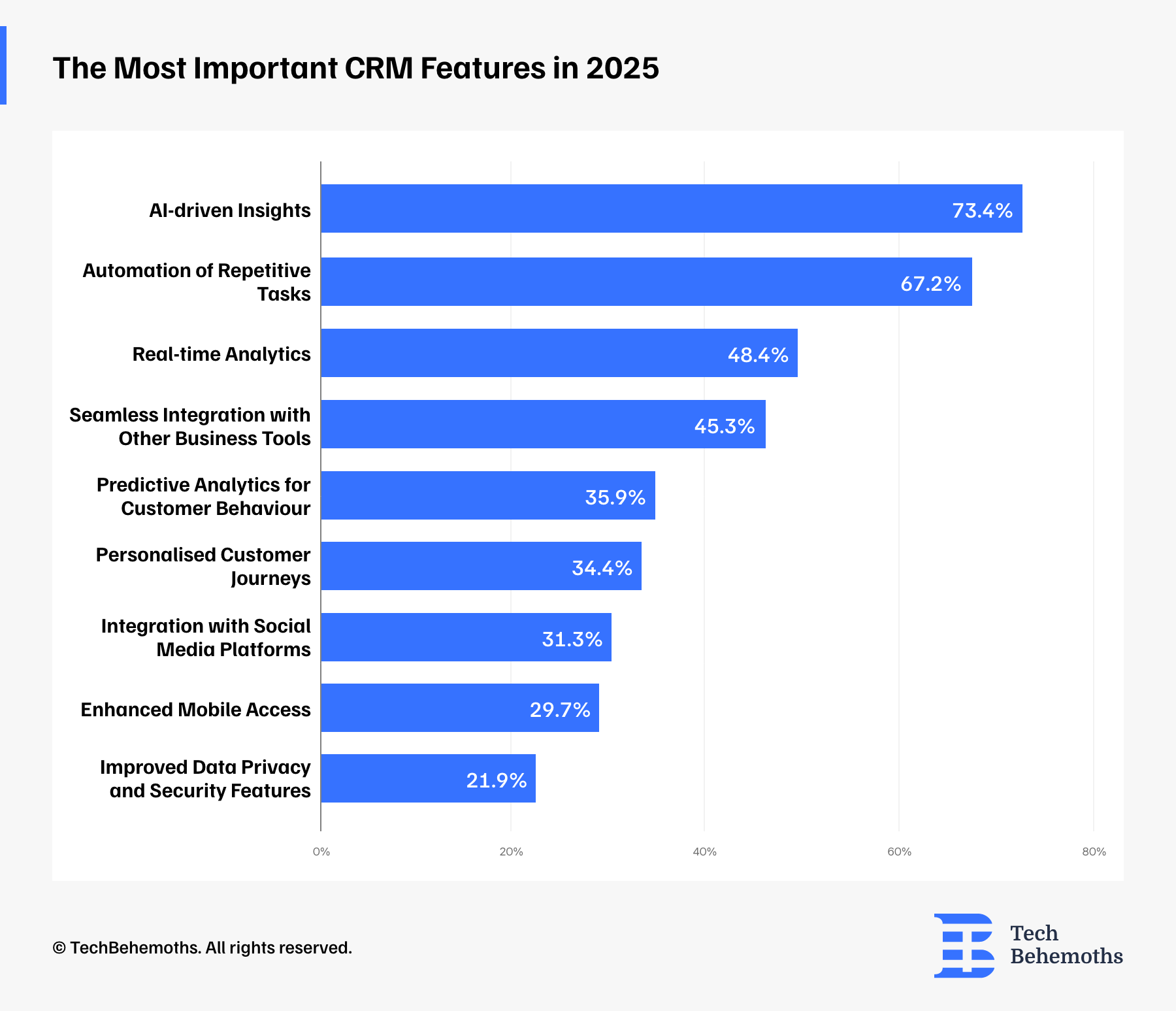
The most important CRM features reflect a strong focus on innovation, efficiency, and connectivity. AI-driven insights, automation, real-time analytics are among the top desired features for efficient CRMs.
Useful CRM and other tools for sales teams
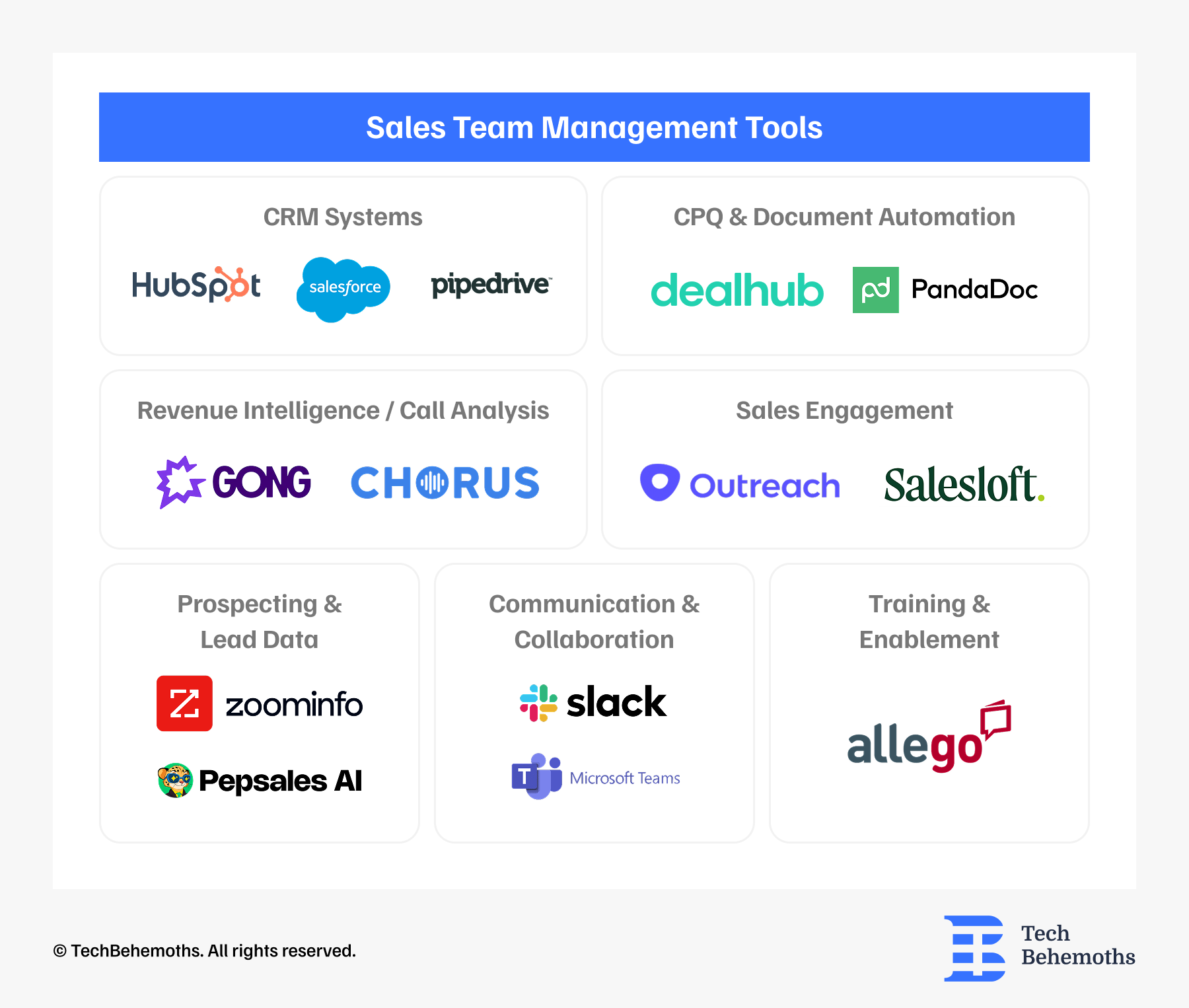
Here is the recommended list of tools that will help you monitor, manage and properly evaluate all sales processes and details, including communication and customer service of the sales team.
1. CRM Systems
These are the systems that keep track of all your customers and offers in one place. Examples: Salesforce, HubSpot, Pipedrive
2. CPQ & Document Automation
These tools automatically generate prices, offers, and contracts, saving you time spent on manually created PDFs. Examples: DealHub, PandaDoc
3. Revenue Intelligence / Call Analysis
These are programs that record and analyze sales calls, so you can see what works and better estimate the chances of closing deals. Examples: Gong, Chorus.ai
4. Sales Engagement
Tools that help automate messages, follow-ups, and contact sequences with potential customers. Examples: Outreach.io, SalesLoft
5. Prospecting & Lead Data
Platforms that find and verify potential customers (including emails, positions, company, etc.). Examples: ZoomInfo, Pepsales AI
6. Training & Enablement
Platforms for training the sales team, which provide materials, coaching and examples of best practices. Examples: Allego
Use advanced filters on TechBehemoths platform or submit your project requirements to get relevant service providers for your next CRM related integrations or customizations.