There are 53 Companies in Thailand
that provide UX/UI Design Services!
The Thai IT industry is one of the fastest-growing in the region and boosts the country’s economy each year. In 2025, the IT Services market is predicted to reach $2.5 billion, with a CAGR 2025-2030 of 3.31%. IT Outsourcing is the biggest contributor with $1.03 billion, while digital services will have the highest growth at 34 percent.
Discover Top IT Companies in Thailand specialized in UX/UI Design including Usability Testing, User Research, UX Strategy and more.
Have you ever noticed how some websites and apps just feel easier to use than others? - That's because of the UX/UI design - basically, the people who make sure everything looks good and is easy to navigate. UX/UI design services are closely connected, but they are not the same.
UI (user interface) design concentrates on visual elements. It is all about how things look and work on a product, like colors, fonts, and buttons. UX (user experience) refers to the overall experience a person has with a product – how easy it is to use the product, how it makes the user feel, and whether it is possible to easily get what is needed from it.
Handpicked companies • No obligation to hire • 100% risk-free
Featured Companies in Thailand
This month, the following UX/UI Design companies managed to provide an outstanding service and support. It's worth taking a look.

Cyber Infrastructure (CISIN) is a custom software development company founded in 2003 and headquartered in San Jose, California.
Digital Design Consultancy based in Bangkok specialises in User Experience and Service Design. Your User-centric Design Partner.
Wizeline delivers software development and AI-powered process acceleration — helping enterprises automate workflows with purpose-built agents.
Explore Top UX/UI Design Companies in Thailand
SDLC Corp is a global IT solutions provider offering custom software, apps, blockchain, AI, Odoo, Salesforce, and game development services.

Bangkok digital marketing agency building SEO, web design and paid campaigns that get Thai and English businesses found on Google and AI search.

Web Design & Development and Automations, Bangkok Your Partners in B2B & B2C Solutions, Web Expertise and Transformative Digital Experiences.

Techgropse is a leading Mobile App and Web Development Company, dedicated to turning innovative ideas into remarkable digital solutions. 500+ Clients
Your Premier Phuket Web Design Company. We offer a comprehensive suite of services to elevate your business online, all within one unified company.
Services:
Manao Software builds custom web & mobile apps with care and precision, helping global clients turn ideas into reliable, scalable digital solutions.

Thai software house since 2012: AI Assistants for organisations, production iOS/Android apps and web systems for SCG, CP ALL, Central, True and Big C.
Best PR and Digital Marketing Agency in Thailand. We deliver measurable influence through results-driven strategy and execution.
Zero Tech Innovations Co., Ltd. delivers world-class AI, Software Engineering, and Business Architecture services from Bangkok, Thailand
We craft technology that turns ideas into fulfilling experiences

Exzy is a Thai enterprise technology company delivering AI, Smart Office, software, and digital experiences for modern organizations.

Bangkok-based full-spectrum software & cloud partner since 2013 — custom development, AI/LLM, DevOps/SRE, and 24/7 managed services for enterprise.
Wattana Bangkok, Thailand Head office in: Japan
Tokyo-based web production company (est. 2004) offering full-service web design, development, digital marketing. Offices in Shibuya & Bangkok.
We Do Product Development From Concept to Exit. Your one-stop digital product development agency in Bangkok.

A Nordic design firm creating product experiences that inspire people - and define companies.
Services:

AI solutions and digital product studio building intelligent web, mobile, and automation solutions for businesses.
Branding consultancy. ::* aim to create memorable, functional, and beautiful. branding experiences that both we and our clients can be proud of.
DNA Maker is a Bangkok software company building AI agents, AI automation, websites and apps for Thai enterprises. 500+ projects since 2010.

Outsourcify is a Thailand-based web agency specializing in custom web/mobile design and development, delivering tailored digital solutions.

Connect with customers and support “NEXT” for them as IT One-Stop Solution Service Provider and developer.
Pattaya Web Design & SEO Company
Services:
Filter UX/UI Design Companies in Thailand by Cities
Find the right tech company near you or from a specific city. Some of the best companies might be located in smaller cities.
Find more UX/UI Design companies around the world
TechBehemoths is the world's most advanced and user-friendly platform to match IT Companies with real clients without hustle.
The ICT Industry in Thailand: Digital Agencies Data & General Profile
The Thai IT industry is one of the fastest-growing in the region and boosts the country’s economy each year. In 2025, the IT Services market is predicted to reach $2.5 billion, with a CAGR 2025-2030 of 3.31%. IT Outsourcing is the biggest contributor with $1.03 billion, while digital services will have the highest growth at 34 percent.
Meanwhile, software services will account for $1.13 billion, with a CAGR for 2025-2030 of 4.46%.
The factors that drive the total IT market are business transformation from traditional to digital, government policies, or the Thailand 4.0 scheme, the coming of new technologies, including big data, robotics, cloud, software as a service, smart devices such as CCTV and smart Bluetooth.
Why You Should Work With Thai IT Companies
In addition to the market growth and extensive range of services Thai IT companies and software agencies provide, there are also several other reasons why you should work with them.
For example, skilled workers. Thailand has a large pool of young professionals working in the IT sector, which enables companies to attract and get a growing number of clients with different types of digital projects.
Also, IT companies from Thailand enjoy a great industry-specialized infrastructure and apply the latest technologies in designing and developing new digital projects. In fact, the Thai IT market is one of the largest and most attractive in the region.
What to Pay Attention to When Working With Thai IT Companies
At the same time, there are several challenges when working with Thai IT companies. Among the biggest barriers clients face when working with Thai digital agencies are the language barrier and the project management issues, which hold other potential clients back from continuing their cooperation with these companies, and also lower the chances of being recommended to other potential clients.
How Reliable Are Thai IT Companies
With a lot of consumers and clients both in the internal and external markets, Thai digital agencies and IT companies enjoy a good reputation. In spite of having a lot of regional competitors, local companies still manage to attract a big share of the market, and this makes them more reliable than untrustworthy.
How Does the Thai IT Industry Relate to the Neighboring Countries?
With Cambodia, Laos, Malaysia, and Myanmar as neighboring countries, Thailand has a lot of chances to become the regional tech hub that will lead the market to a better, more performant level, which increases the chances of getting more visible outside the region.
Also, neighboring countries would benefit from promoting Thailand’s digital industry and joining their efforts to create a regional hub in this direction.
What is UX/UI Design and what are its benefits for your projects?
Have you ever noticed how some websites and apps just feel easier to use than others? That's because of the UX/UI design - basically, the people who make sure everything looks good and is easy to navigate.
UX/UI design services are closely connected, but they are not the same. They are actually about different parts of the design and to be effective they must work together.
-
UI (user interface) design concentrates on visual elements. It is all about how things look and work on a product, like colors, fonts, and buttons.
-
UX (user experience) refers to the overall experience a person has with a product - how easy it is to use the product, how it makes the user feel, and whether it is possible to easily get what is needed from it.
According to research conducted by Forrester, a well-designed user interface (UI) can increase a website's conversion rate by 200%, whereas a better user experience (UX) design could raise it by up to 400%.
In this connection, the importance of UX/UI Design cannot be overstated. Nowadays users have high expectations for the products they use, if a product is not easy to use or enjoyable, users will quickly abandon it.
UX/UI design can help:
-
Enhance user satisfaction
-
Reduce bounce rates
-
Lead to higher customer retention and revenue
UX Design has also an important role in Inclusive Government Design, which makes government services accessible and user-friendly for diverse and marginalized communities.
But how do choose the right UX/UI Company?
-
Review the company's portfolio and make sure they have experience in your industry
-
Look for companies that understand your target audience to meet their needs.
-
Inquire about their design process: research, wireframing, prototyping, and testing.
-
Choose a company that maintains transparent and open communication and keeps you involved throughout the design process.
-
Read client reviews to check their reputation and client satisfaction.
-
A good design company should be up-to-date with the latest design trends and technologies.
Taking into consideration all these tips you will manage to select the right UX/UI Design Company that will help to achieve your goals.
There are over 13,800 UX/UI Design companies on TechBehemoths platform. Check their profiles, their strong portfolios, and previous clients' reviews before you make a decision. With the help of smart filters, you can easily find suitable partners to deliver exceptional digital experiences. Alternatively, you can submit your project, and the system will find the best match on your behalf.
UI/UX design in the AI era
As AI tools evolve and become more capable of prototyping and designing layouts, the human/emotional aspect will become even more important. AI can't experience and tell and illustrate personal stories, while UI/UX designers can. This human/personal touch will become a valuable part of UI/UX work.
You can interact with the web in multiple ways: using text, voice, images, videos, VR, etc. All these require user interfaces adapted to different needs and scenarios. Professional design agencies should be able to deliver interfaces and UX for multiple interaction modes and devices like smartphones, VR headsets, smart glasses, etc.
The importance of UI/UX for your leads/sales
Lots of websites lose their visitors without a single click. Poor UX design is almost always the reason, and most business owners don't even know where the problem is.
On average, websites convert only 2–3% of visitors. This means the majority of visitors land on a site, browse for a few seconds, and leave without taking any action. Business owners express this as one of their most common frustrations.
How to solve this problem?
The answer is simple: make it easy for visitors to take desired actions on your website, such as viewing a product page or service, completing a purchase, or downloading a resource.
Your website should communicate effectively, guide users, and convince them to take a specific action.
Why your website doesn't convert
There might be multiple reasons, but here are the most common ones + some tips on how to improve your UX to convert visits into leads/conversions.
1. The first seconds count
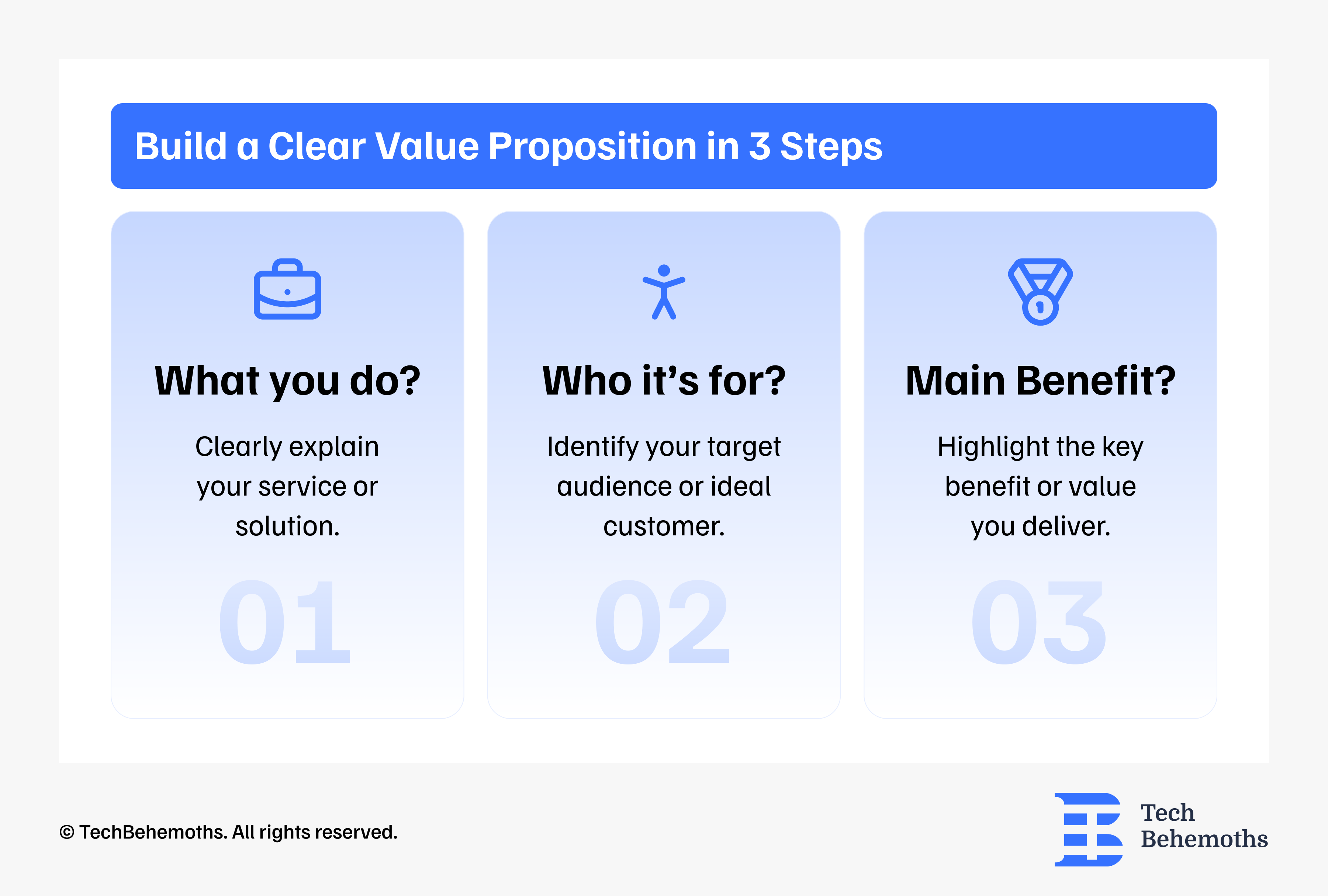
How to fix? Start with a clear value proposition that shows the benefits and answers these three questions right away.
2. No call to actions (CTAs)
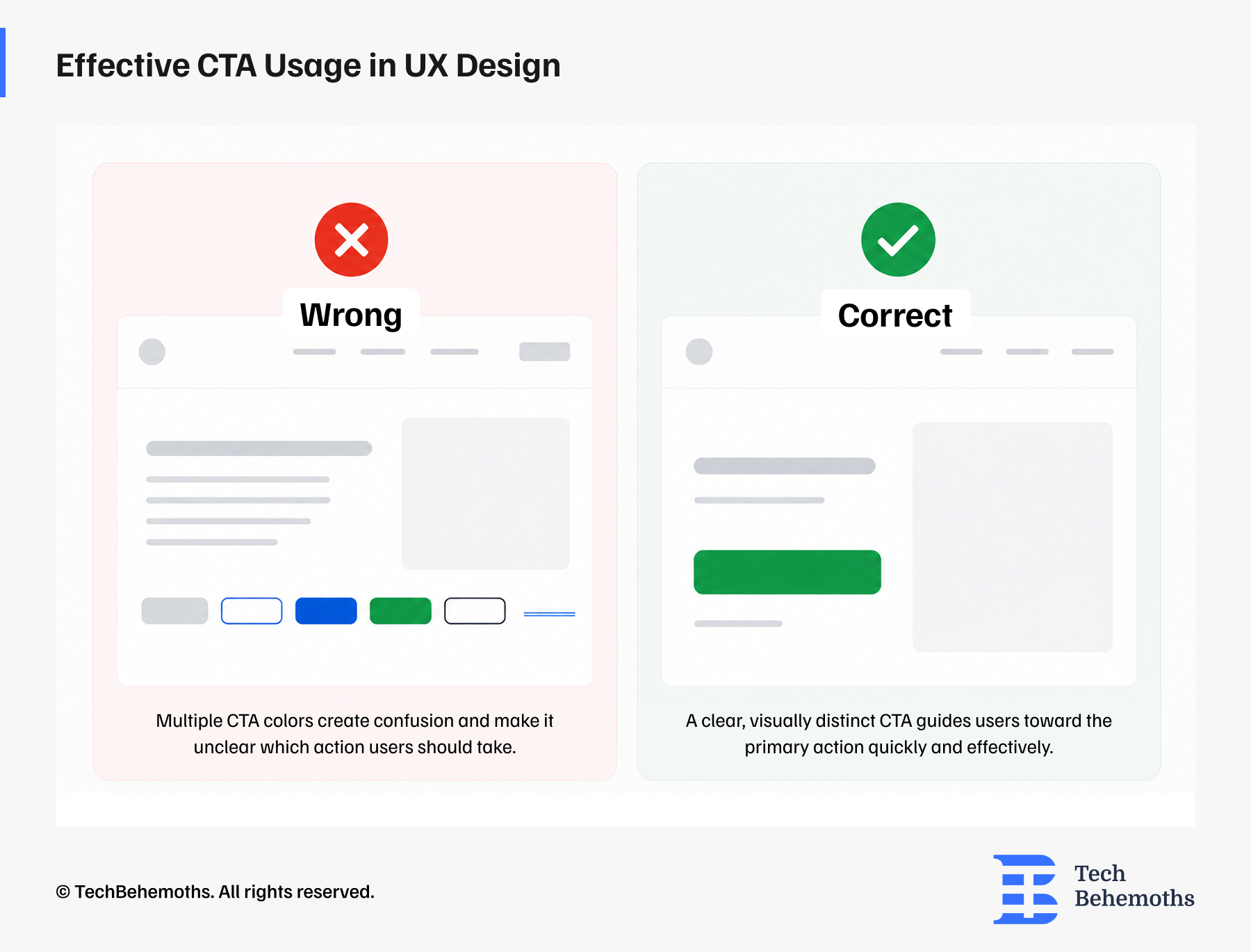
How to fix? Your service/product and other important pages should have one primary CTA, and it should be: specific, prominent, smooth/short. Example: Get a free quote.
3. Poor mobile UI/UX
How to fix? Focus on mobile-first UX design, which means designing the mobile experience first and then adapting it for the desktop experience.
4. No social proof
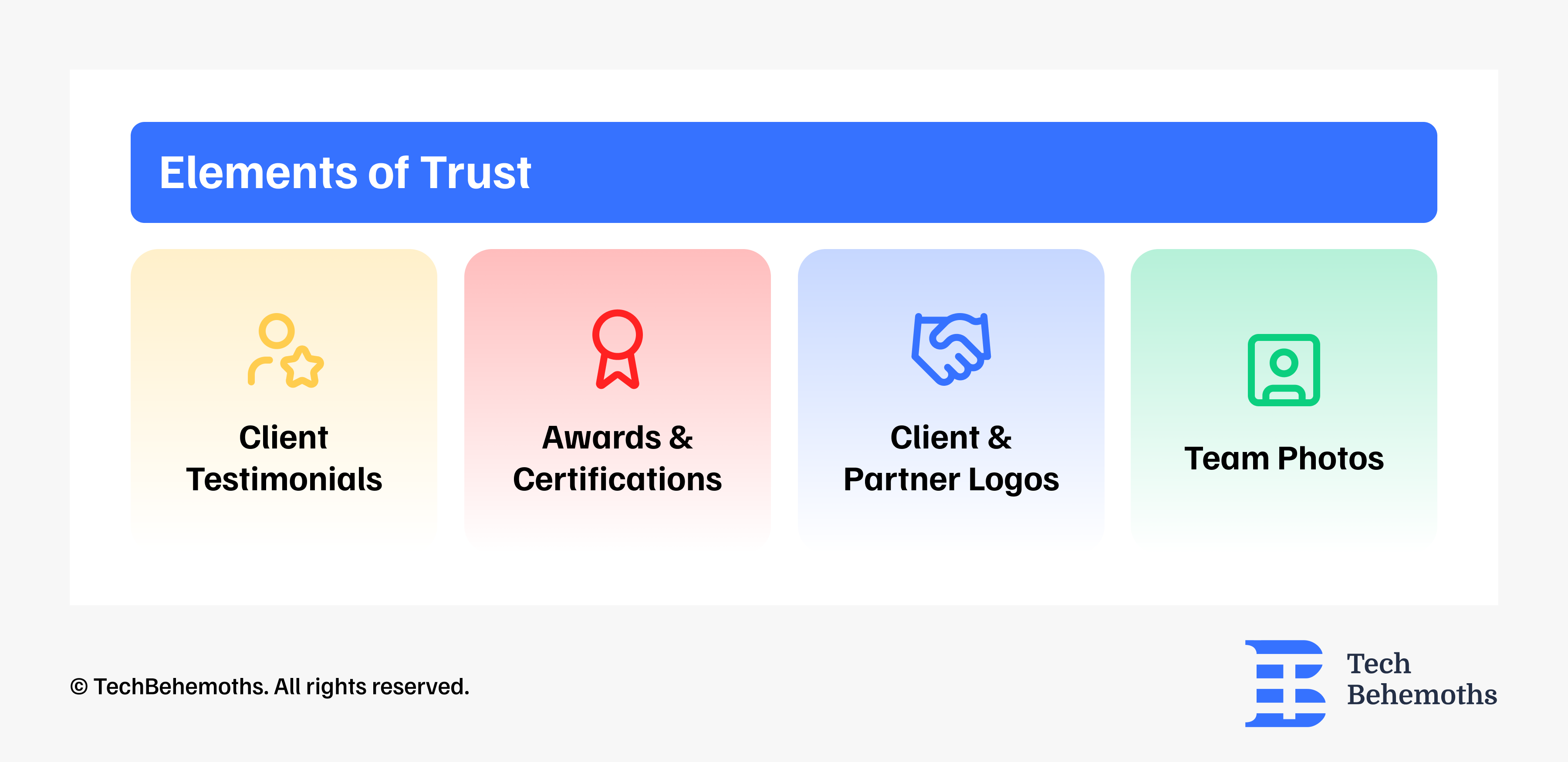
How to fix? Place trust signals throughout the conversion path: client testimonials, reviews, awards, certifications, team photos, etc.
5. Complex navigation/structure
How to fix? Simplify your navigation and content structure by limiting menu items, using plain language, making contact options visible and accessible from everywhere, using proper visual hierarchy.
6. Slow loading time
How to fix? Optimize your web pages for speed, especially for mobile devices. Use modern image formats like webp, compress images, use reliable/fast hosting, minify JavaScript/CSS, don't usee too many 3rd party services.
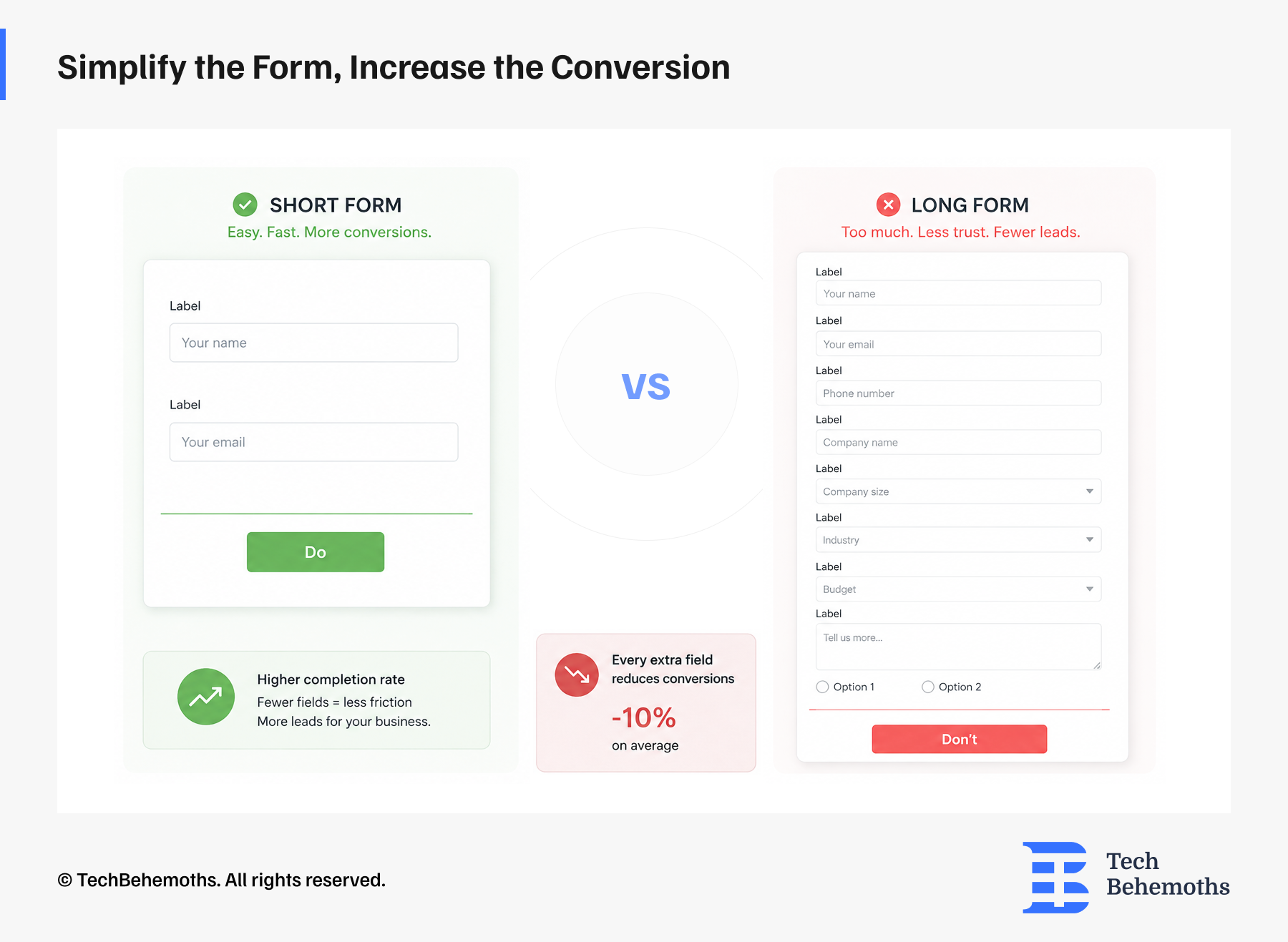
7. Too long forms
How to fix? Use the minimum required number of input fields: name, email, and one open field. Don;t overwhelm users withh too many questions and options.
How to choose the right UX/UI agency?
Choosing a UX/UI agency is a business decision with consequences that show up months after the contract is signed. Most companies evaluate agencies based solely on portfolios and presentations, which are the things easiest to polish and hardest to verify.
What separates a good hire from an expensive mistake is usually visible before you sign anything. You just have to know where to look.
How to do research UX/UI agencies, the right way
Most users go straight to the portfolio, and that's ok, but it's not the whole picture. Here are the criteria that actually matter before you reach out to anyone.
1. Portfolio, look past the aesthetics
Good UX agencies solve different problems differently.
2. Research, visuals are not enough
Any agency can show you Figma files. Ask them to walk you through how they got there. If there's no mention of user interviews, usability testing, or data, the work is decoration, not design.
3. Industry experience is useful, but not mandatory
For fintech, healthcare, or anything with compliance layers, prior domain experience saves valuable time. Sometimes, an agency coming in fresh can be the better bet, having a different perspective
4. Negative client reviews
A profile with an ideal five stars rating is worth questioning.
5. Who's exactly working on your project
The number one complaint in the agency world is the bait-and-switch, a senior partner sells the deal, but junior interns do the work. Before moving forward, ask who's actually doing the work. Thirty minutes of reference calls can save you thousands in wasted fees.
6. Not all UX/UI projects are the same
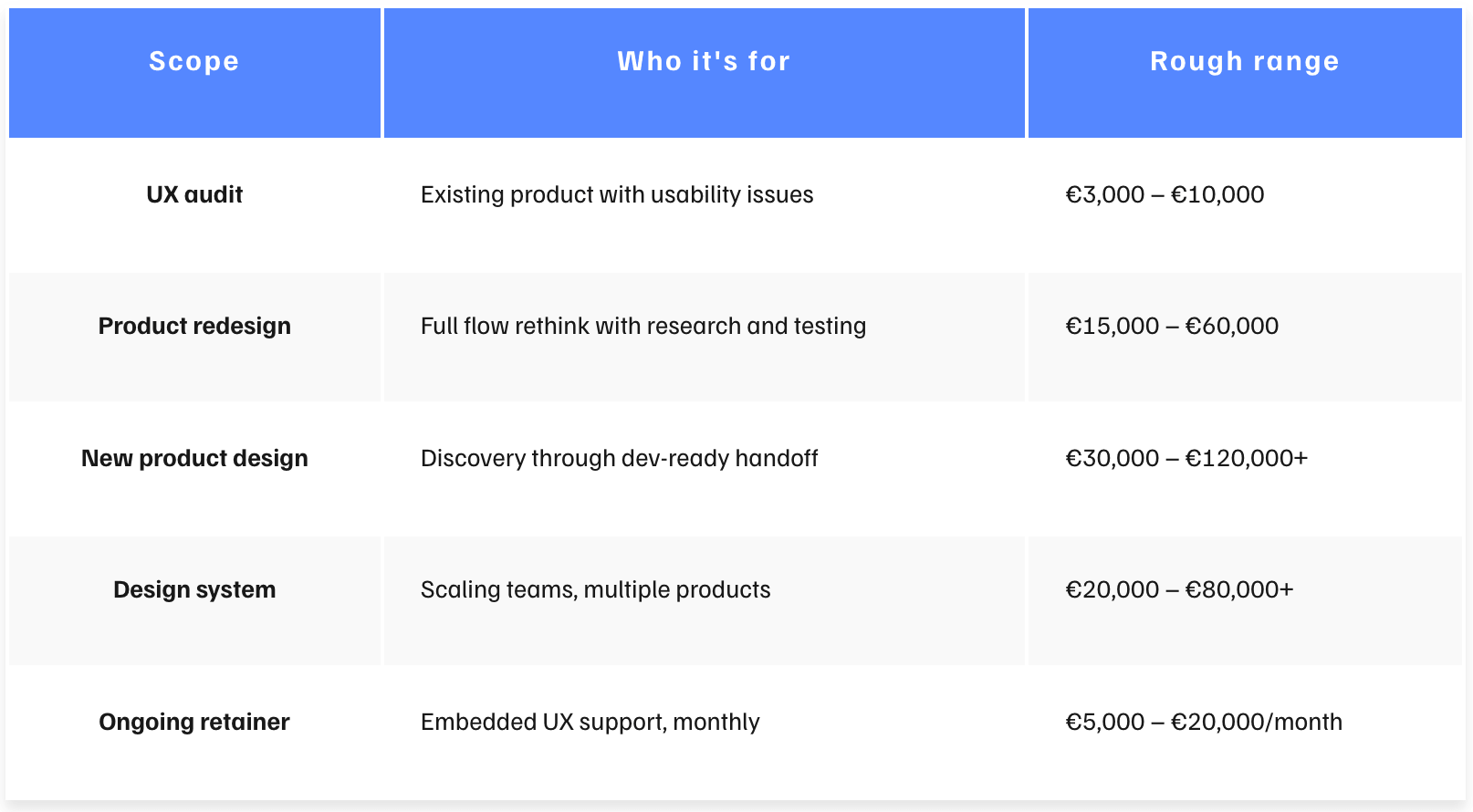
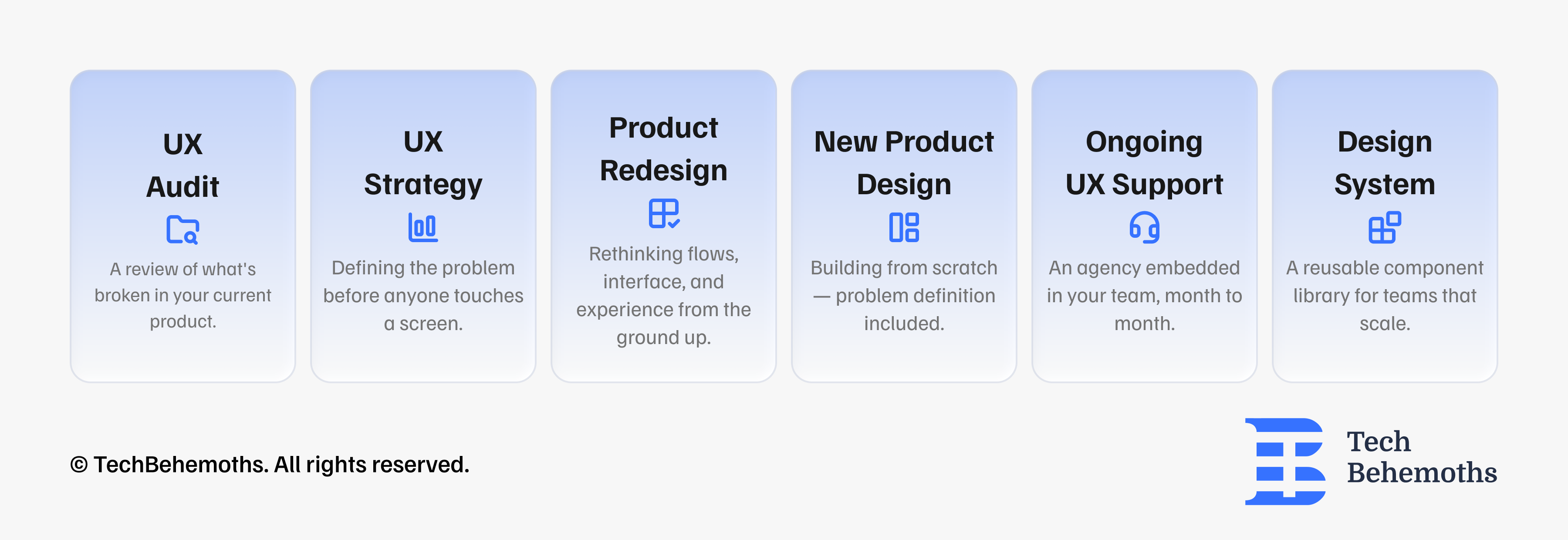
Before you talk to anyone, get specific about what you're buying. UX covers a wide range of work, and the type of agency you need depends on what the actual problem is.
Here is a set of common UX/UI tasks to keep in mind.
How to shortlist the right agencies?
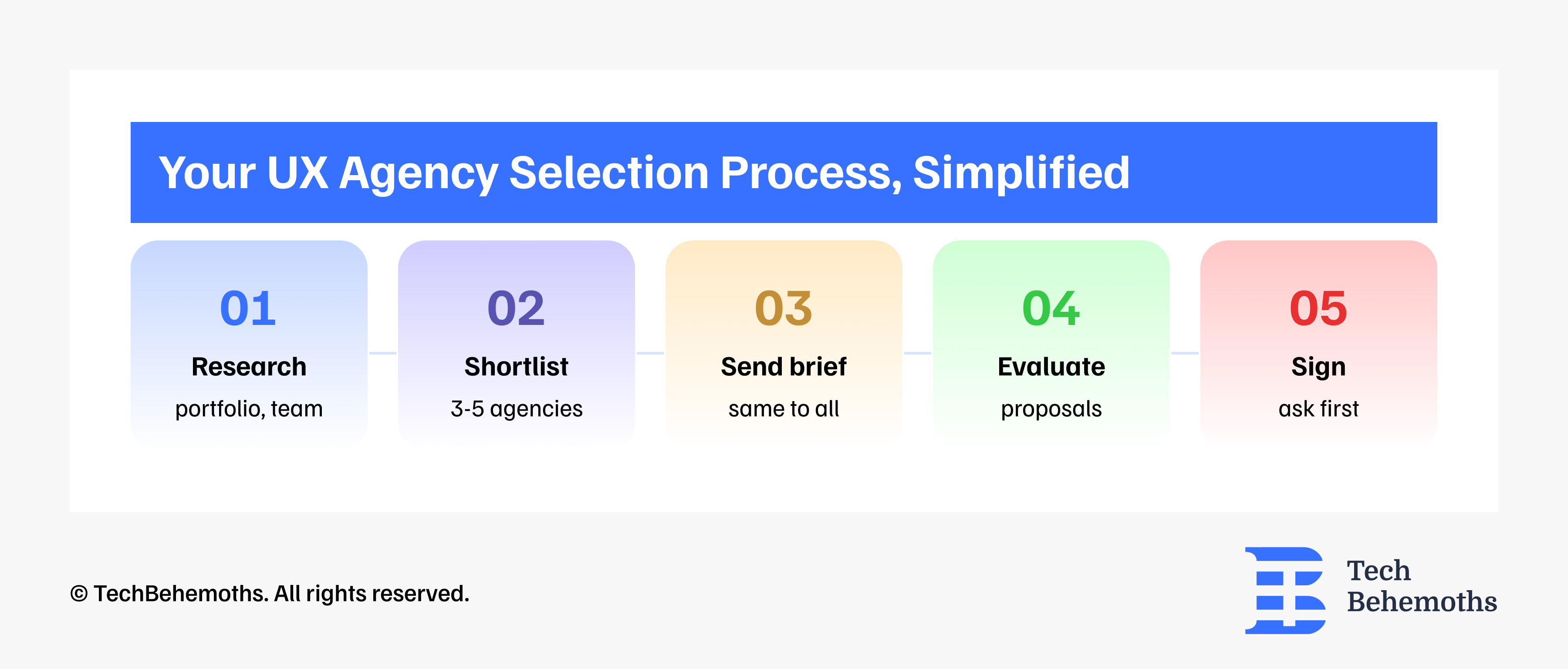
Many clients speak with 15 - 20 agencies and end up more confused than when they started. A practical approach looks like this:
-
Start with a larger pool of companies
-
Narrow it to around 10 agencies
-
Shortlist 3-5 agencies
-
Send the same brief to everyone
-
Compare proposals and communication styles
-
Choose one partner
A poorly scoped engagement can lead to a bad return/outcome. A bad agency hire costs approximately €115,000 when you calculate wasted fees, the cost of a redo, and months of lost market time.