There are 6 Companies in Taiwan
that provide UX/UI Design Services!
Despite its relatively small population of 23.11 million citizens, Taiwan continues to strengthen its position as a technological powerhouse. Since the 1980s, Taiwan has taken a proactive approach to the development of emerging technologies. And while this history of manufacturing prowess still accurately defines the island, an economic revolution is underway.
Discover Top IT Companies in Taiwan specialized in UX/UI Design including Usability Testing, User Research, UX Strategy and more.
Have you ever noticed how some websites and apps just feel easier to use than others? - That's because of the UX/UI design - basically, the people who make sure everything looks good and is easy to navigate. UX/UI design services are closely connected, but they are not the same.
UI (user interface) design concentrates on visual elements. It is all about how things look and work on a product, like colors, fonts, and buttons. UX (user experience) refers to the overall experience a person has with a product – how easy it is to use the product, how it makes the user feel, and whether it is possible to easily get what is needed from it.
Handpicked companies • No obligation to hire • 100% risk-free
Explore Top UX/UI Design Companies in Taiwan

Toronto design and development agency that specializes in full-stack solutions across marketing, data, and technology.
Web development company in Linkou, Taiwan. Custom websites, React, Next.js, WordPress, SEO & hosting since 2004.
Services:

Taichung Digital Agency
Services:
GlobalSense is an international web development and SEO agency praised for its exceptional project management and client-focused approach.

"Not just a good-looking website" is just a part of a digital brand. You also need a strong brand visual image to truly connect with customers. GogoSh...
Creative design studio founded in Taiwan. We emphasizes building the right image to take company’s international competitiveness to the next level.
Filter UX/UI Design Companies in Taiwan by Cities
Find the right tech company near you or from a specific city. Some of the best companies might be located in smaller cities.
Find more UX/UI Design companies around the world
TechBehemoths is the world's most advanced and user-friendly platform to match IT Companies with real clients without hustle.
The IT Industry in Taiwan: Software Agencies and Companies Information
Despite its relatively small population of 23.11 million citizens in 2025, Taiwan continues to strengthen its position as a technological powerhouse. Since the 1980s, Taiwan has taken a proactive approach to the development of emerging technologies. And while this history of manufacturing prowess still accurately defines the island, an economic revolution is underway.
According to a World Economic Forum report, Taiwan is in the midst of an innovation-driven economy. These findings are unsurprising given its position as a future-thinking hub of technology and engineering.
Hints of this high-tech excellence are prevalent throughout the Taiwanese economy. According to Statista, in 2023, it was ranked first with an average download speed of 153.51 Mbps, but in 2025, it dropped to 17th place. Further reflecting its robust manufacturing industry, the country produces 70 percent of the world's integrated circuits and 90 percent of laptops sold around the globe.
Why Should You Work With a Taiwanese IT Company?
Companies like Microsoft continue to invest heavily in Taiwan’s IoT industry. Taiwan’s ample supply of engineering talents and reasonable wages make it a desirable tech hub. In response to this growth, the government’s Asia Silicon Valley Development Agency (ASVDA) endeavors to raise Taiwan's global market share in IoT from 3.8 percent in 2015 to 4.2 percent by 2020 and 5 percent by 2025.
In addition to that, local companies continue to provide digital services such as software development, digital design, and cybersecurity, among others, especially for foreign companies. Why do international customers choose to work with Taiwanese IT companies?! It’s simple - in the region, is really tough to find better options as price/quality offers.
What to Be Aware of When Working With Taiwanese IT Companies
Taking into consideration that the local IT industry performs above the regional average, Taiwan is a place where IT companies are extremely competitive, and their density is high. Probably higher than you might get used to in the US or Europe. For this reason, a very important and required action for customers is to pay attention to companies’ specifications, which may be the decisive factor for the result of the project.
How Does the Taiwanese IT Industry Relate to the Neighboring Countries?
According to the Organization for Economic Development, Taiwan has a 98.5 percent literacy rate and the fourth-highest standardized math test scores in the world. Further, over 25 percent of all university degrees are in engineering. As a result, many continue to see Taiwan as a desirable hub for further investment.
Compared to the neighboring countries, including China, Japan, and the Philippines, the digits are close when it comes to literacy; however, in terms of the number of engineers, Taiwan surpasses all its neighbors and has one of the highest chances to become the regional tech hub leader, at least in some branches of IT.
What is UX/UI Design and what are its benefits for your projects?
Have you ever noticed how some websites and apps just feel easier to use than others? That's because of the UX/UI design - basically, the people who make sure everything looks good and is easy to navigate.
UX/UI design services are closely connected, but they are not the same. They are actually about different parts of the design and to be effective they must work together.
-
UI (user interface) design concentrates on visual elements. It is all about how things look and work on a product, like colors, fonts, and buttons.
-
UX (user experience) refers to the overall experience a person has with a product - how easy it is to use the product, how it makes the user feel, and whether it is possible to easily get what is needed from it.
According to research conducted by Forrester, a well-designed user interface (UI) can increase a website's conversion rate by 200%, whereas a better user experience (UX) design could raise it by up to 400%.
In this connection, the importance of UX/UI Design cannot be overstated. Nowadays users have high expectations for the products they use, if a product is not easy to use or enjoyable, users will quickly abandon it.
UX/UI design can help:
-
Enhance user satisfaction
-
Reduce bounce rates
-
Lead to higher customer retention and revenue
UX Design has also an important role in Inclusive Government Design, which makes government services accessible and user-friendly for diverse and marginalized communities.
But how do choose the right UX/UI Company?
-
Review the company's portfolio and make sure they have experience in your industry
-
Look for companies that understand your target audience to meet their needs.
-
Inquire about their design process: research, wireframing, prototyping, and testing.
-
Choose a company that maintains transparent and open communication and keeps you involved throughout the design process.
-
Read client reviews to check their reputation and client satisfaction.
-
A good design company should be up-to-date with the latest design trends and technologies.
Taking into consideration all these tips you will manage to select the right UX/UI Design Company that will help to achieve your goals.
There are over 13,800 UX/UI Design companies on TechBehemoths platform. Check their profiles, their strong portfolios, and previous clients' reviews before you make a decision. With the help of smart filters, you can easily find suitable partners to deliver exceptional digital experiences. Alternatively, you can submit your project, and the system will find the best match on your behalf.
UI/UX design in the AI era
As AI tools evolve and become more capable of prototyping and designing layouts, the human/emotional aspect will become even more important. AI can't experience and tell and illustrate personal stories, while UI/UX designers can. This human/personal touch will become a valuable part of UI/UX work.
You can interact with the web in multiple ways: using text, voice, images, videos, VR, etc. All these require user interfaces adapted to different needs and scenarios. Professional design agencies should be able to deliver interfaces and UX for multiple interaction modes and devices like smartphones, VR headsets, smart glasses, etc.
The importance of UI/UX for your leads/sales
Lots of websites lose their visitors without a single click. Poor UX design is almost always the reason, and most business owners don't even know where the problem is.
On average, websites convert only 2–3% of visitors. This means the majority of visitors land on a site, browse for a few seconds, and leave without taking any action. Business owners express this as one of their most common frustrations.
How to solve this problem?
The answer is simple: make it easy for visitors to take desired actions on your website, such as viewing a product page or service, completing a purchase, or downloading a resource.
Your website should communicate effectively, guide users, and convince them to take a specific action.
Why your website doesn't convert
There might be multiple reasons, but here are the most common ones + some tips on how to improve your UX to convert visits into leads/conversions.
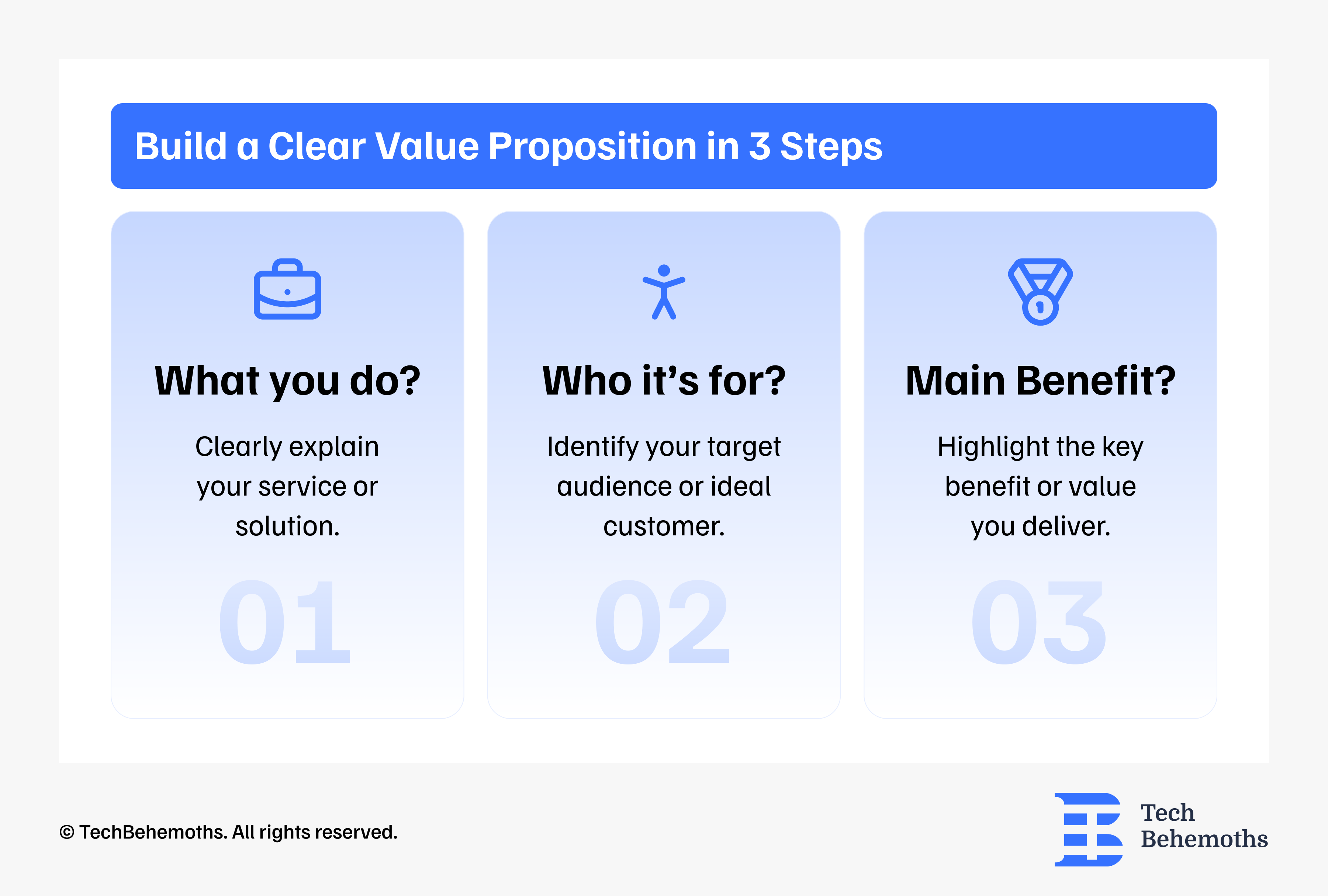
1. The first seconds count
How to fix? Start with a clear value proposition that shows the benefits and answers these three questions right away.
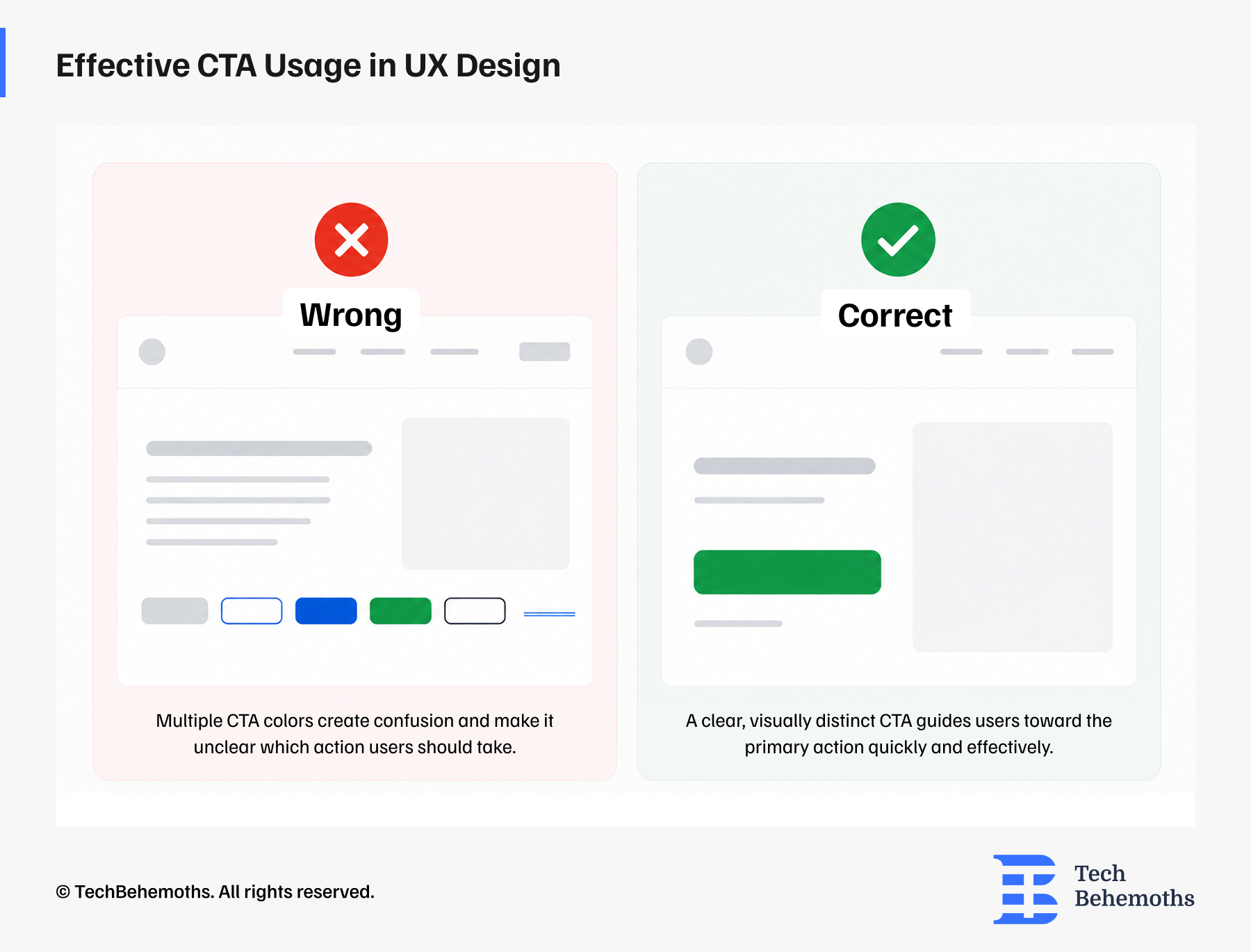
2. No call to actions (CTAs)
How to fix? Your service/product and other important pages should have one primary CTA, and it should be: specific, prominent, smooth/short. Example: Get a free quote.
3. Poor mobile UI/UX
How to fix? Focus on mobile-first UX design, which means designing the mobile experience first and then adapting it for the desktop experience.
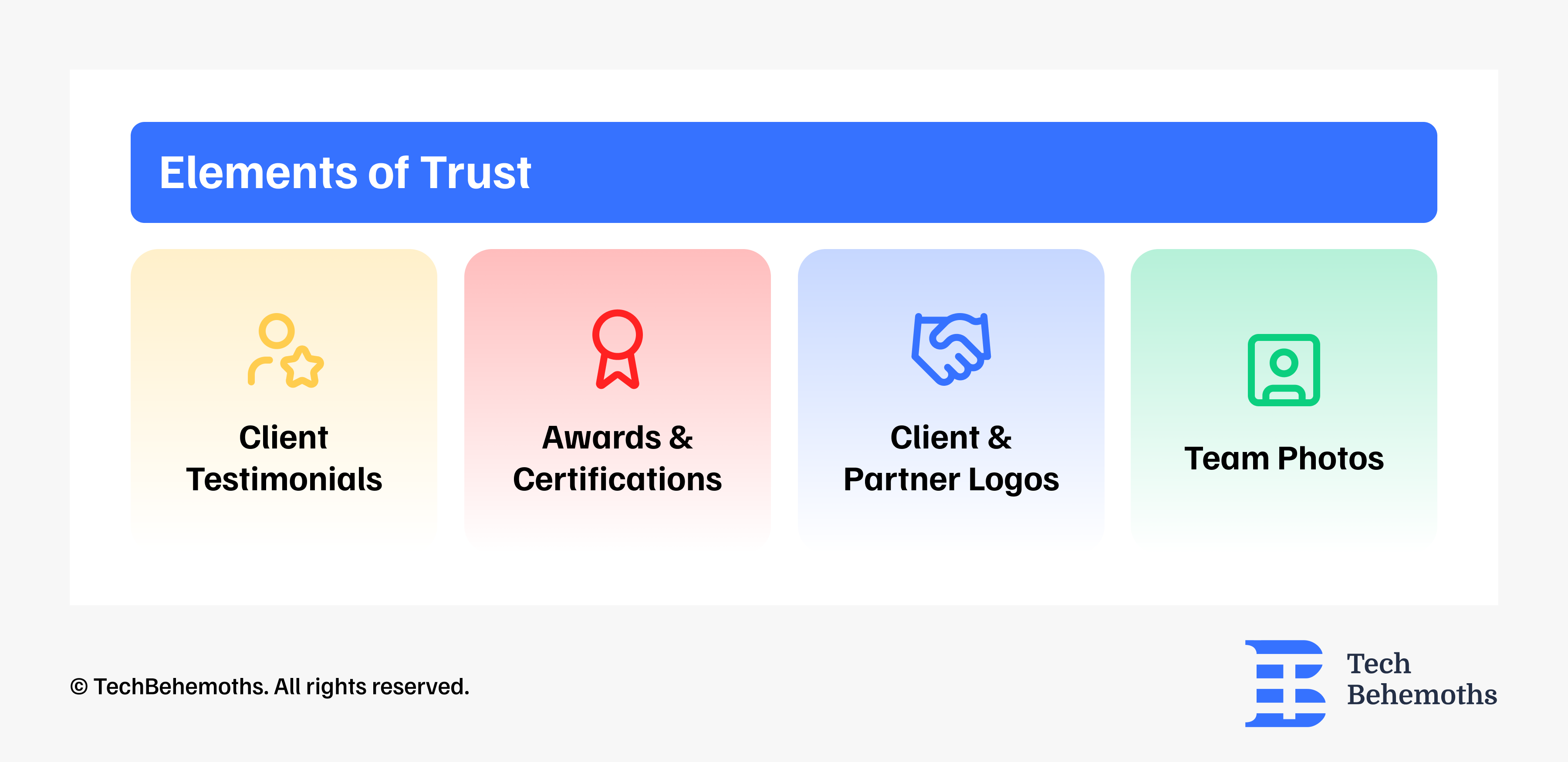
4. No social proof
How to fix? Place trust signals throughout the conversion path: client testimonials, reviews, awards, certifications, team photos, etc.
5. Complex navigation/structure
How to fix? Simplify your navigation and content structure by limiting menu items, using plain language, making contact options visible and accessible from everywhere, using proper visual hierarchy.
6. Slow loading time
How to fix? Optimize your web pages for speed, especially for mobile devices. Use modern image formats like webp, compress images, use reliable/fast hosting, minify JavaScript/CSS, don't usee too many 3rd party services.
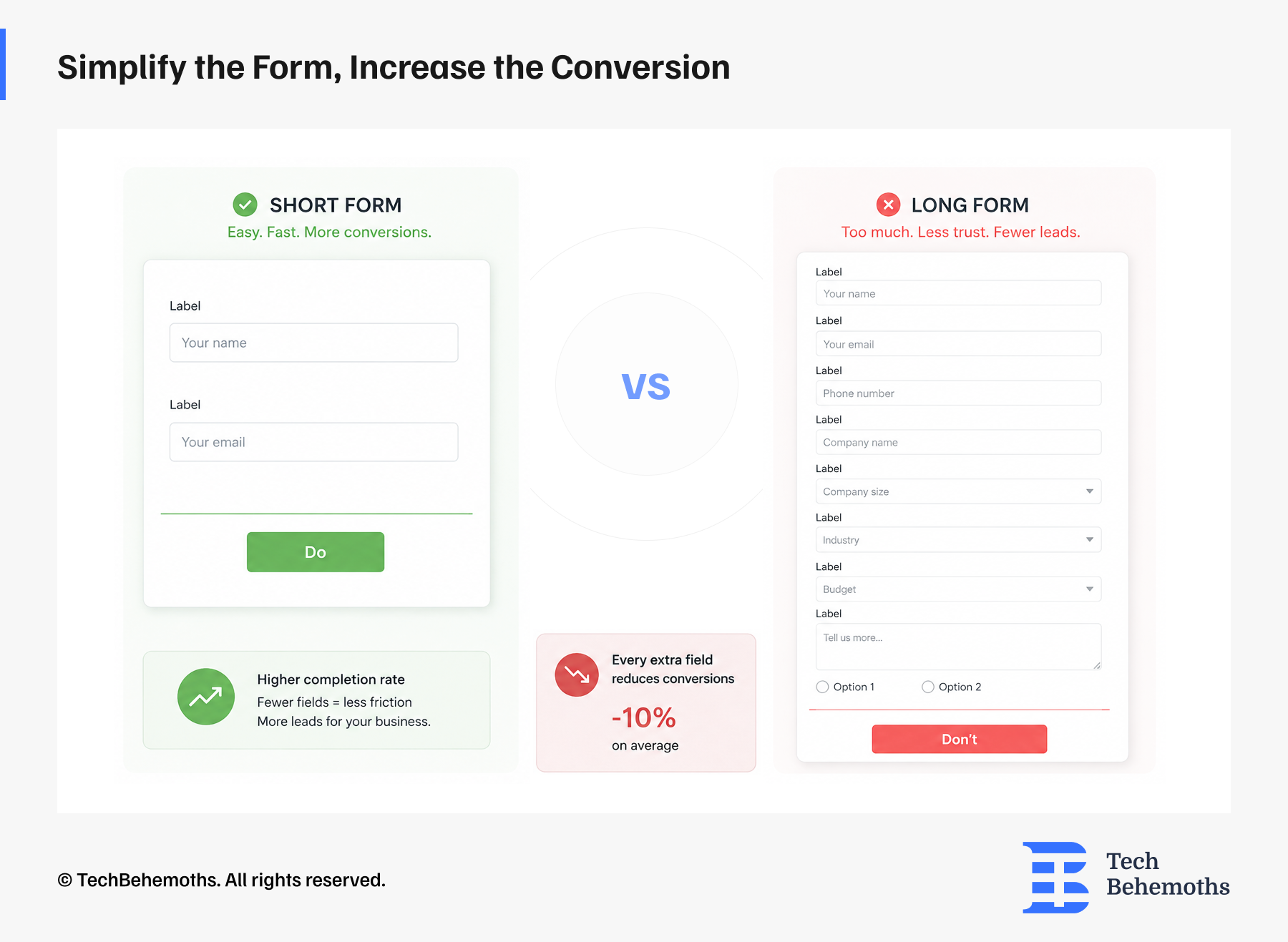
7. Too long forms
How to fix? Use the minimum required number of input fields: name, email, and one open field. Don;t overwhelm users withh too many questions and options.
How to choose the right UX/UI agency?
Choosing a UX/UI agency is a business decision with consequences that show up months after the contract is signed. Most companies evaluate agencies based solely on portfolios and presentations, which are the things easiest to polish and hardest to verify.
What separates a good hire from an expensive mistake is usually visible before you sign anything. You just have to know where to look.
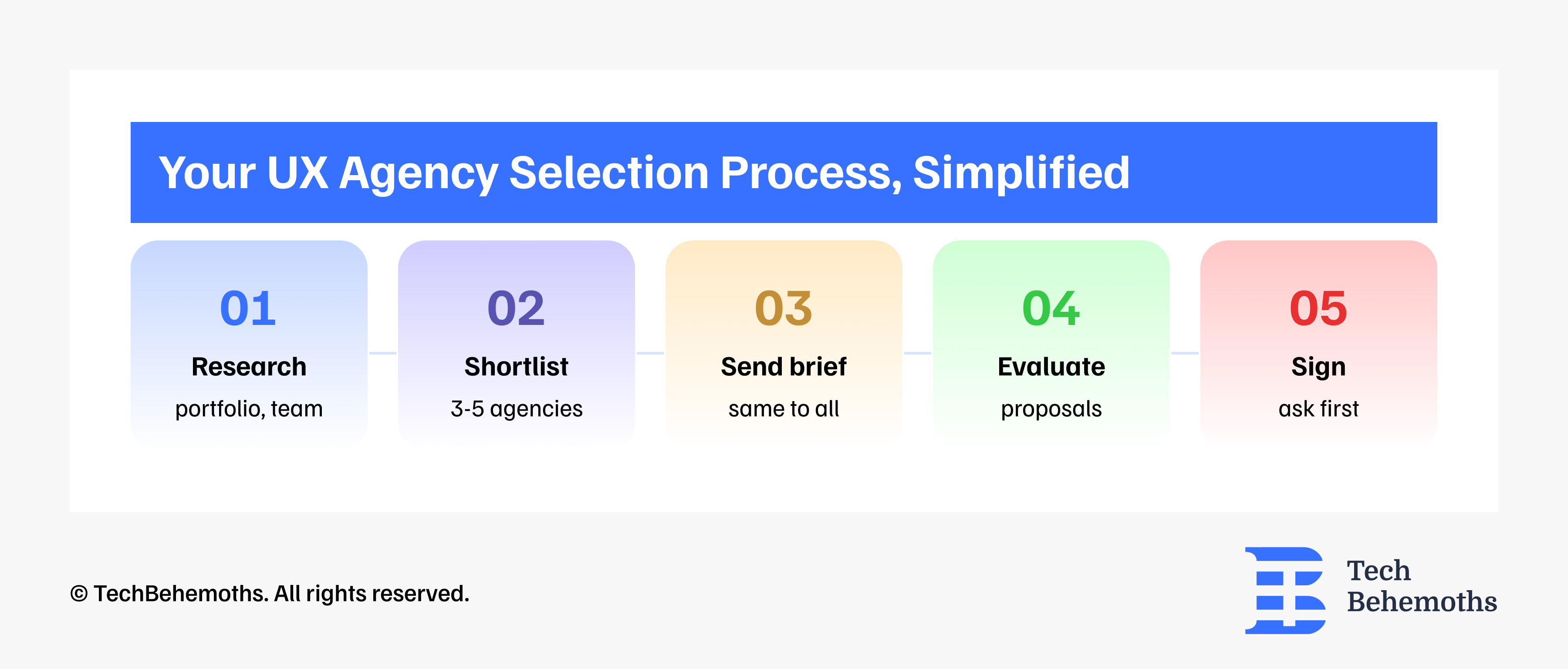
How to do research UX/UI agencies, the right way
Most users go straight to the portfolio, and that's ok, but it's not the whole picture. Here are the criteria that actually matter before you reach out to anyone.
1. Portfolio, look past the aesthetics
Good UX agencies solve different problems differently.
2. Research, visuals are not enough
Any agency can show you Figma files. Ask them to walk you through how they got there. If there's no mention of user interviews, usability testing, or data, the work is decoration, not design.
3. Industry experience is useful, but not mandatory
For fintech, healthcare, or anything with compliance layers, prior domain experience saves valuable time. Sometimes, an agency coming in fresh can be the better bet, having a different perspective
4. Negative client reviews
A profile with an ideal five stars rating is worth questioning.
5. Who's exactly working on your project
The number one complaint in the agency world is the bait-and-switch, a senior partner sells the deal, but junior interns do the work. Before moving forward, ask who's actually doing the work. Thirty minutes of reference calls can save you thousands in wasted fees.
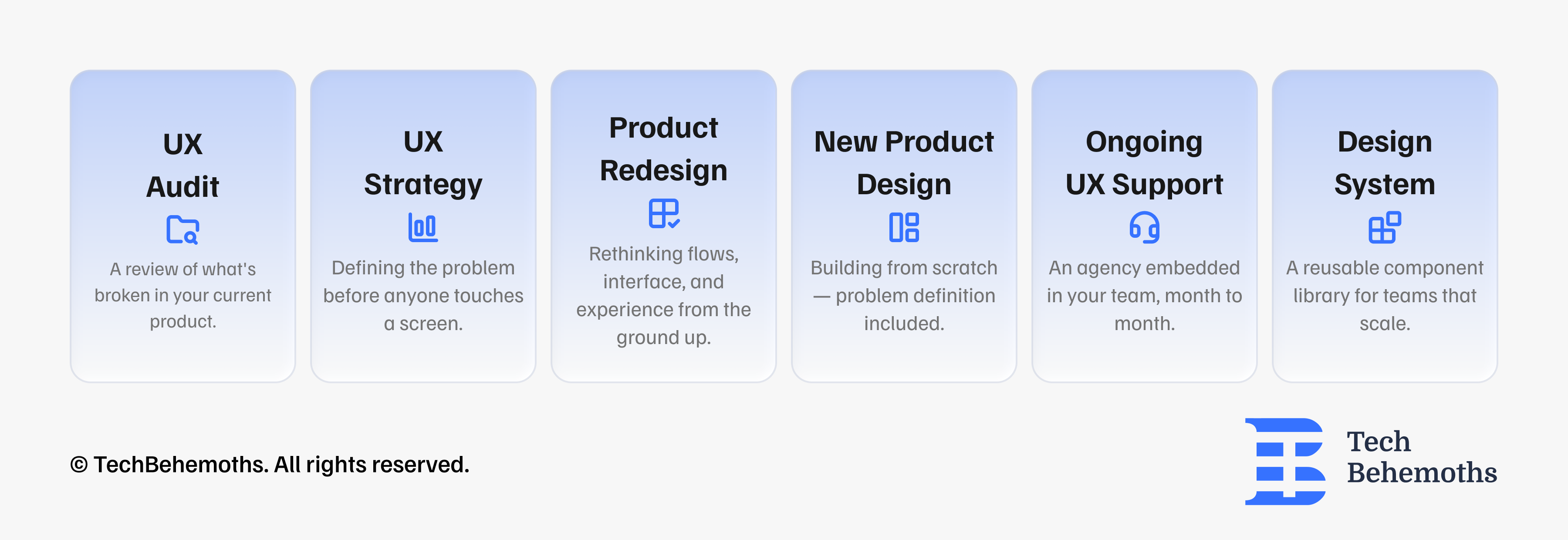
6. Not all UX/UI projects are the same
Before you talk to anyone, get specific about what you're buying. UX covers a wide range of work, and the type of agency you need depends on what the actual problem is.
Here is a set of common UX/UI tasks to keep in mind.
How to shortlist the right agencies?
Many clients speak with 15 - 20 agencies and end up more confused than when they started. A practical approach looks like this:
-
Start with a larger pool of companies
-
Narrow it to around 10 agencies
-
Shortlist 3-5 agencies
-
Send the same brief to everyone
-
Compare proposals and communication styles
-
Choose one partner
A poorly scoped engagement can lead to a bad return/outcome. A bad agency hire costs approximately €115,000 when you calculate wasted fees, the cost of a redo, and months of lost market time.