Why IT Companies Are Becoming Energy Companies (in the AI Era)


Summary
- Big Tech has locked in nearly 10 gigawatts of new nuclear capacity in the past year, enough to power around 7 million homes, just to keep AI data centers running.
- Data centers drove roughly half of the 2% jump in US electricity demand in 2025, a growth rate more than double the previous decade's average.
- Smaller IT companies are tackling the same energy pressure differently, OVHcloud redesigned its cooling to cut electricity use by up to 50%, while Equinix now sources 96% of its energy from renewables.
Running AI at scale takes steel, concrete, and enough electricity that Microsoft, Google, Amazon, and Meta have all ended up signing 20-year nuclear contracts, the kind utilities sign, not software companies. Every new model needs more compute, and that compute lives in data centers packed with thousands of servers that don't really idle. Unlike a normal software service, AI workloads just keep pulling power, and it shows up in the electricity bill fast.
How Much Power AI Actually Needs
US electricity demand grew 2% in 2025, more than double the average annual rate of the previous decade. Data centers were responsible for roughly half that growth. Their consumption went from 58 TWh in 2014 to 176 TWh in 2023, which is nearly triple in under ten years, and the IEA doesn't expect the curve to flatten. It's projecting global electricity demand to keep growing around 3.6% a year through 2030. Global AI infrastructure spending is set to cross $630 billion in 2026. The nuclear contracts below are just the slice of that spending that happens to make headlines.
Why Energy Is Now a Business Priority for IT Companies
Continuous access to large-scale compute now means continuous access to large amounts of electricity. That's flipped energy from a background line item into something companies running AI at scale actually have to plan around at the board level. Reliability, sustainability, and cost all became strategic questions almost overnight.
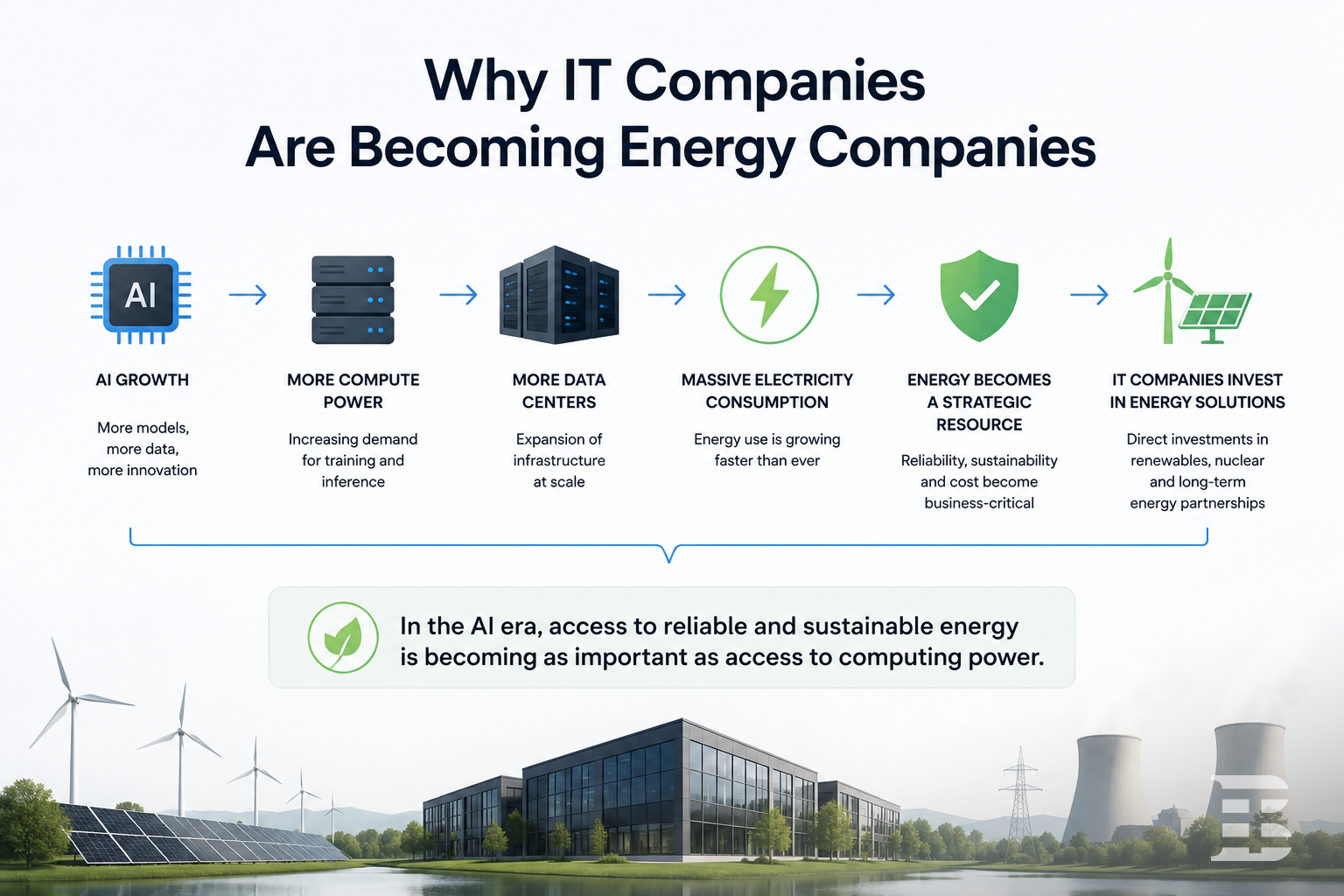
None of this is entirely new. Google and Amazon have been signing renewable power deals since the early 2010s. What's different now isn't the instinct to buy clean power, it's the scale. Those early deals were mostly about image and modest emissions targets. This wave is about keeping the lights on for AI infrastructure, full stop.
Big Tech's Nuclear Contracts
Microsoft, Google, Amazon, and Meta have signed contracts for close to 10 gigawatts of new nuclear capacity in the US over the past year, enough, Forbes estimates, to power around 7 million homes.
Microsoft got there first with a 20-year, 835-megawatt deal to restart the Three Mile Island plant, now renamed the Crane Clean Energy Center. Constellation, which owns it, priced the restart at $1.6 billion, later backed by a $1 billion federal loan from the Department of Energy. Here's something worth flagging: a lot of tech coverage has been calling this a "$16 billion" deal. That number traces back to one early report and has been copy-pasted since without anyone checking it against Constellation's own filings. Microsoft never disclosed what it's actually paying, though Jefferies analysts put it around $110 to $115 per megawatt-hour over the life of the contract.
Google went a different route, the first corporate agreement for a fleet of small modular reactors, up to 500 megawatts from Kairos Power, kicking off with the Hermes 2 plant in Oak Ridge, Tennessee. Amazon expanded its existing deal with Talen Energy to 1,920 megawatts through 2042, tied to the Susquehanna plant in Pennsylvania, and separately put $700 million into X-energy toward up to 12 small reactors. Meta went bigger than all of them combined: up to 6.6 gigawatts spread across four partners (TerraPower, Oklo, Vistra, and Constellation).
|
Company |
Deal |
Capacity |
Value |
|---|---|---|---|
|
Microsoft |
Three Mile Island restart (Constellation) |
835 MW |
~$1.6B restart cost / 20-year PPA |
|
|
Kairos Power SMR fleet |
500 MW |
Order-book model |
|
Amazon |
Talen Energy / Susquehanna |
1,920 MW |
Through 2042 |
|
Amazon |
X-energy SMR investment |
Up to 12 reactors |
$700M |
|
Meta |
TerraPower, Oklo, Vistra, Constellation |
Up to 6.6 GW |
Multiple deals |
These numbers sit inside a much bigger curve. Global data center electricity use is projected to go from roughly 460 terawatt-hours in 2024 to over 1,300 terawatt-hours by 2035. Nuclear runs day and night without interruption, which happens to be exactly what AI infrastructure needs.
The Backlash Nobody Puts in the Press Release
There's a part of this story that doesn't show up in the announcements. Nuclear PPAs let a company draw power from a source that isn't shared with the regional grid, and that matters a lot right now, because sharing the grid has gotten politically expensive. PJM alone passed $4.3 billion in transmission costs and $7.3 billion in higher generation costs onto ratepayers in 2024.
Residential electricity prices climbed roughly 13% nationally that same year. By mid-2026, Fortune had the cumulative hit to ratepayers at around $23 billion, and a Gallup poll from March 2026 found 7 in 10 Americans didn't want a new data center anywhere near them.
Lawmakers picked up on this fast. More than 30 states saw legislators introduce over 300 bills related to data centers in 2026 alone, moratoriums, tax incentives, rate protections, all of it. Congress has its own version too, the SHIELD Act, aimed at making large power users foot the bill for grid upgrades instead of households. Microsoft got ahead of it in January 2026, publicly pledging to cover its own electricity costs, cut water use, and skip local tax breaks. Anthropic made a similar promise tied to its own buildout.
But it's genuinely more complicated than "tech companies dumping costs on their neighbors." An E3 analysis from 2026 looked at Virginia, the largest data center market on the planet, and found no historical evidence of costs shifting onto residential customers at all. Individual Amazon facilities have generated an average of $3.4 million in net surplus revenue per site, meaning the utility actually collected more than it cost to serve them. So it really comes down to whether the local grid had spare capacity before the data center showed up. Where it didn't, costs get spread around. Where it did, the data center might genuinely be subsidizing everyone else's bill.
I'd guess most of the "data centers are wrecking your electric bill" coverage doesn't bother making that distinction, because it's a less clean story than picking a villain. What's true either way is that a dedicated nuclear or SMR contract now doubles as a PR shield, whether or not the underlying economics in a given region actually justify the fear.
How Smaller Players are Responding
Smaller and mid-sized IT companies obviously don't have $16 billion balance sheets or a direct line to Constellation. But they're under the same underlying pressure: energy is no longer just a line item, it's starting to shape how infrastructure gets built in the first place.
OVHcloud, a cloud infrastructure provider founded in 1999 in Roubaix, France, rebuilt its cooling from scratch with what it calls a Smart Datacenter, redesigned racks paired with AI-driven monitoring. The company says it's cutting water use by up to 30% and cooling electricity by up to 50%, using direct-to-chip water blocks and a closed-loop circuit across the whole facility. Cooling usually eats 30 to 40% of a data center's total energy, so a cut that size actually moves the needle. The first rollout is at OVHcloud's Roubaix site (60 racks, 2,000 servers, one coolant distribution unit), with more planned globally.
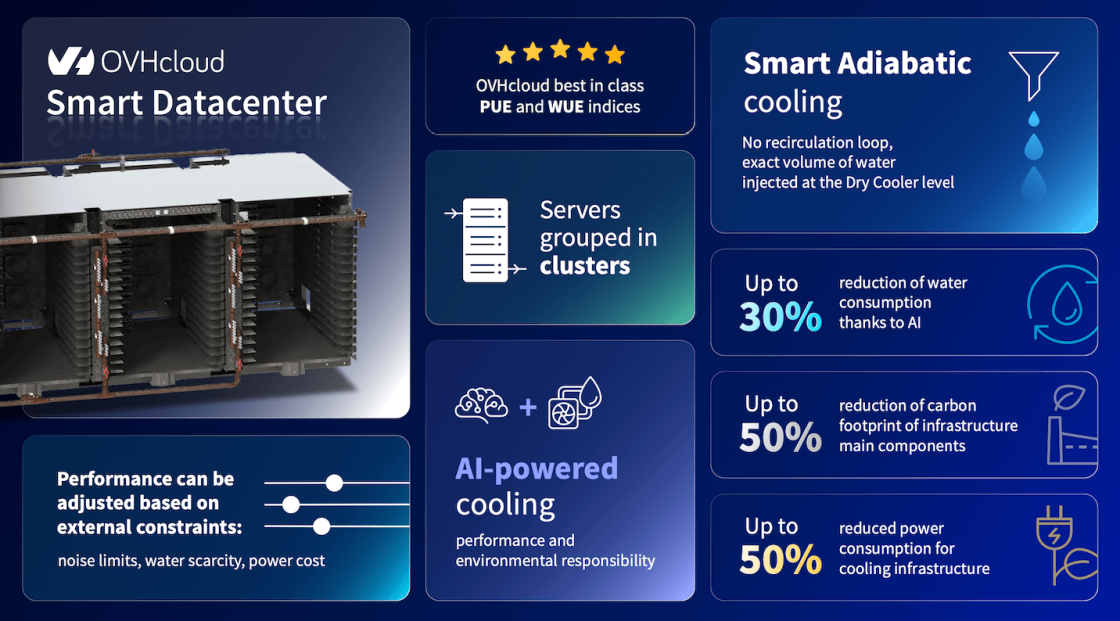
Image source: OVHcloud Blog
Equinix, a data center and colocation provider founded in 1998 in Redwood City, California, sources 96% of its energy from renewables across retail data centers as of 2025, aiming for 100% by 2030. It's also gone further upstream than most, committing up to $700 million over a possible 10-year partnership with Hanley Energy in Ireland to help manufacture the power equipment its next-gen data centers will need. It's also testing hydrogen fuel cells at its Dublin site as a zero-emissions swap for diesel backup generators.
Image source: Equinix Editor, DA11 in Dallas
A. Power Equipment Manufacturing
Dundalk, Ireland
Equinix is investing up to $700M with Hanley Energy to manufacture power equipment for its next-generation data centers.
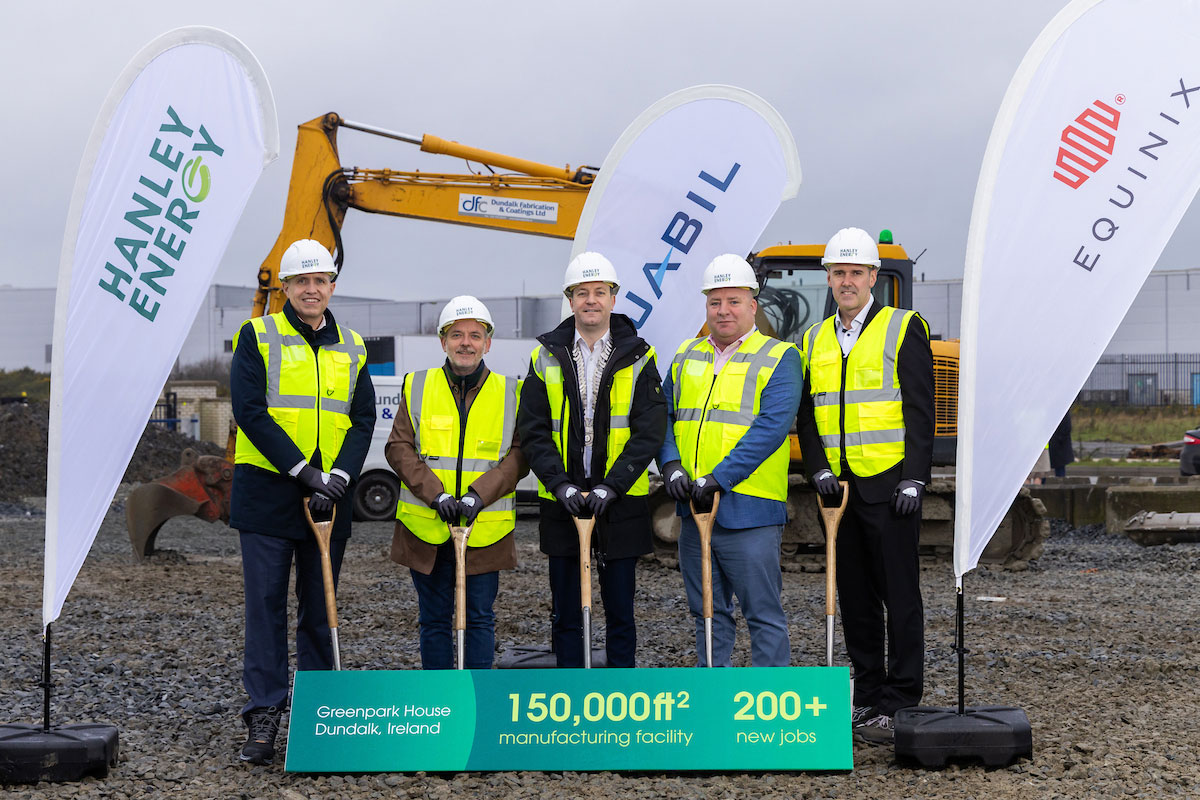
Equinix and Hanley Energy's Dundalk project, announced in February 2026.
Image source: Hanley Energy
“Partnering with Equinix on this transformative project highlights the strength of Irish engineering and innovation. Our advanced testing facilities and expertise will ensure that the equipment produced here meets the highest global standards, supporting data centers worldwide.”
- John O’Driscoll, CEO, Hanley Energy
B. Hydrogen Backup Power
Dublin, Ireland
Equinix is testing hydrogen fuel cells as a cleaner alternative to diesel backup generators.
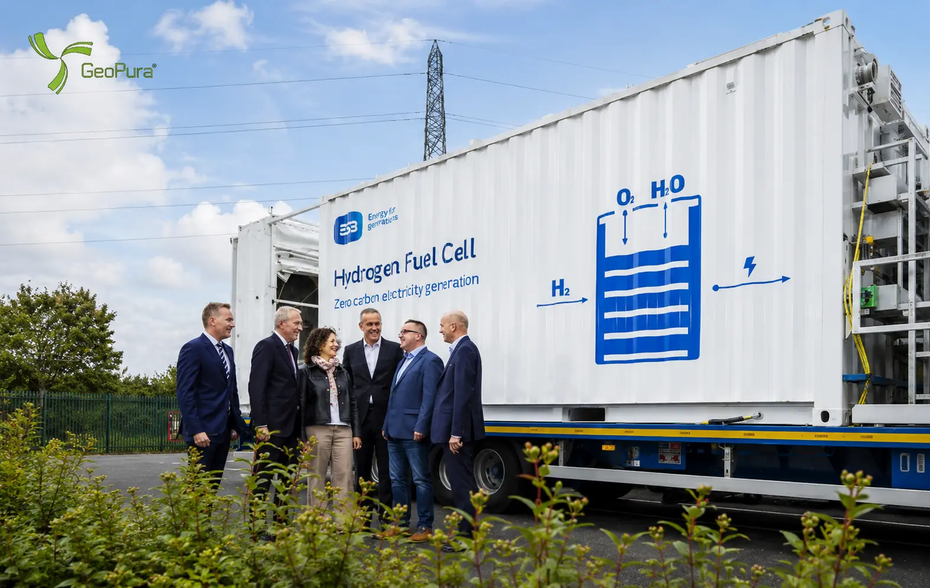
Image Source: GeoPura
Mistral AI, founded April 2023 in Paris, went the opposite direction entirely. Instead of a data center operator bolting AI on top, it's an AI lab that had no real choice but to become a data center operator. In March 2026 it raised $830 million in debt to build a facility outside Paris running 13,800 Nvidia GB300 GPUs, pulling about 44 megawatts, roughly 1.5 times what a normal data center draws. They're aiming for 200 MW across Europe by end of 2027, and even where they're building says something: Bruyères-le-Châtel sits on France's low-carbon nuclear grid, and there's a Swedish site planned specifically because the cold climate cuts cooling costs.
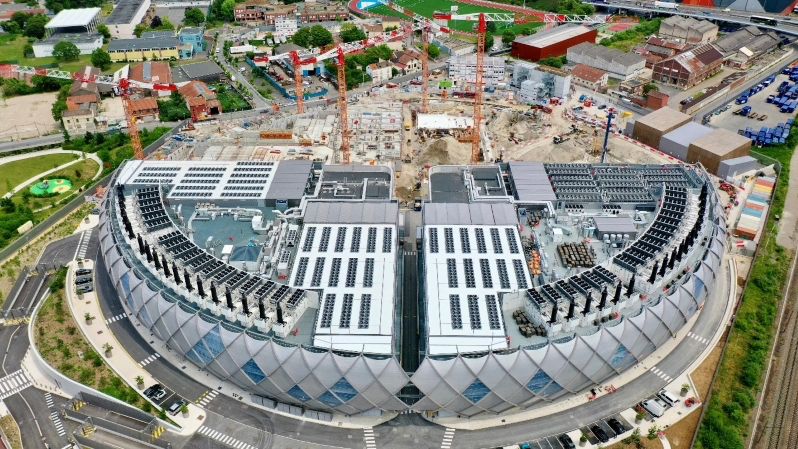
Image Source: Construction Review Online, March 2026
CEO Arthur Mensch tied the raise to something bigger than raw compute: governments, enterprises, and research institutions wanting to build their own AI environments instead of renting someone else's.

What Comes Next
Meta, Amazon, and Google all have more reactor orders somewhere in regulatory review right now, and it wouldn't be surprising to see at least two more hyperscaler nuclear announcements before the year's out. On the political side, expect more states to try their own version of Maine's moratorium bill, even if most don't pass, and more "we'll cover our own costs" pledges from AI companies trying to get ahead of the backlash instead of reacting to it after the fact.
Final Word
There's no single playbook here, and that's kind of the point. OVHcloud spent its money on engineering, Equinix spent its on supply chain, Mistral didn't really choose, it got forced into becoming an infrastructure company by its own growth curve. If you're running a mid-sized IT company looking for "the move" to copy, there isn't one. There's a set of pressures (rising power costs, a grid under political fire, a queue that keeps getting longer) and each company is answering them with whatever lever it actually has.
What stands out is that none of these companies are treating this as optional anymore. Microsoft is publicly pledging to eat its own electricity costs. Meta signed with four different reactor developers instead of betting on one. That's not the behavior of companies hedging against a minor inconvenience, it's the behavior of companies that looked at the grid and decided they couldn't wait for it. The deals explain what they're doing about that. The next piece gets into why the grid got this slow in the first place, and it's not really about AI at all, it's about steel.
Related Questions & Answers
Why are tech companies signing nuclear power deals instead of just buying more renewable energy?
How much nuclear capacity have Microsoft, Google, Amazon, and Meta signed so far?
Are data centers actually raising electricity bills for regular households?
What are smaller IT companies doing about rising energy costs, since they can't sign multi-billion-dollar nuclear deals?
Is there a link between AI's energy demand and new state or federal legislation?
I tend to create digital content that captures, inspires, and generates impact. I resonate with the idea that less is more. My approach combines strategy, creativity, and analysis to build authentic and relevant messages. Beyond the digital space, nature is my sanctuary - a place of inspiration and balance. Exploring landscapes, I find clarity in nature's simple beauty.
Discover more TechBehemoths Insights
Learn practical tips and insights about IT Companies, how to find the right company for your projects.
Read the latest news about Market Trends and fresh Interviews.