10x Programmers - Do They Exist?


Summary
The 10x programmer concept describes developers who are believed to be significantly more productive than their peers. Although research has shown that developer performance can vary greatly, this concept often reduces productivity to visible outputs such as coding speed, ticket completion, or lines of code.
True high-value developers are defined by making well-reasoned decisions that reduce future costs, improve software quality, and create long-term business value. Rather than relying on individuals, successful companies build environments where experience is shared, knowledge is documented, and developers continuously learn from one another.
The software industry has long used the term 10x programmers to describe an engineer who is believed to produce work equivalent to several average developers. The “10x programmer” is a controversial term used in the IT industry. While there are developers who outperform their colleagues, the idea is highly debated due to its toxicity and a misunderstanding of modern Software Development.
This term comes from a 1968 study that discovered wide variations in programmer productivity. This idea gained popularity in Silicon Valley and is frequently used in hiring, marketing, and discussions about developer productivity. Titles like rock star, ninja, guru, and wizard reinforce the belief that top software is created by exceptionally talented programmers.
Many studies suggest that large differences in programmer effectiveness do exist, but the popular image of a 10x programmer is often oversimplified and misunderstood. This article examines how high-performing developers differ from the popular stereotype.
Where Did This Term Come From?
The term 10x programmer comes from a 1968 study by Harold Sackman, W.J. Erikson, and E.E. Grant. They analyzed professionals working on an IBM mainframe and discovered a 10-fold and even a 20-fold difference in productivity between the best and worst programmers. The original study was small, testing only 27 programmers and measuring isolated work rather than collaboration. They studied programmers with an average experience of 7 years and found the following ratios:
- The initial coding time between the best and worst programmers was about 20:1
- The debugging time was approximately 25:1
- The program size was 5:1
- The program execution speed was about 10:1
The researchers found that programmers with similar levels of experience could differ in productivity by a factor of ten or more. Although that study has been criticised, it laid the foundation for other similar studies that reached similar conclusions. The associated nicknames, like rock star, ninja, or guru, are used by companies that look for top programmers. Even the Netflix CEO uses this "rockstar” approach and paid substantially more to one exceptional developer instead of hiring ten average ones.
Although the study demonstrated that productivity differences existed, it did not suggest that Software projects should rely only on one developer. Later research demonstrated that productivity is also influenced by development tools, management practices, project organization, and the working environment.
What Does 10x Programmer Actually Mean?
A 10x programmer, also known as a 10x developer, is a term used in the Software sector. It is used to describe a very talented engineer who is 10 times more productive than an average colleague. But this term is not applicable at present, because this domain often measures the wrong things when deciding who is exceptional.
A developer is named the 10x programmer based on some easy-to-measure metrics:
- Faster code writing
- Increased number of produced codes
- Closes more tickets
- Pushes new updates
These parameters don’t necessarily correlate with engineering and business value. Several 10x developers can create a massive amount of code that later becomes expensive to maintain or has many bugs. Compared to developers who may write less code but can prevent problems before they exist.
Speed is also a characteristic that should not be fundamental to describe the productivity of a programmer. A strong engineer challenges assumptions like “does this code work?”, or “can it be shipped?” They usually take into account things like supportability, failure scenarios, adaptability, operational costs, and knowledge transfer costs. Real productivity is not measured by the amount and the speed of production but by the ability to reduce future pain and chaos.
Other differences between the myth and the reality of the 10x programmer belief are described in the following table:
| Myth | Reality |
|---|---|
| 10x programmers know everything | A great developer always learns something new and isn’t afraid to ask questions |
| They always have the right answer immediately | They spend time understanding the problem before proposing a solution |
| Writing complex code makes one a 10x programmer | Writing simpler, readable code creates more long-term value |
| No need for feedback | The best engineers look for feedback to improve their work |
| Productivity for a 10x programmer means staying busy all day | Productivity means delivering meaningful value, even if it is less code |
| 10x developers compete with their teams | Great programmers grow together with their colleagues |
The Stereotype: The "Lone Genius"
Labeling someone as a 1ox developer can inflate their ego while creating unrealistic expectations about individual performance. This term suggests that the 10x programmer can resolve impossible problems rapidly or work tirelessly. These assumptions create a myth of a lone genius that can meet impossible requirements without help from his colleagues. And even companies prioritize a talented individual too much rather than teamwork.
Teamwork suffers when an engineer is recognized as a 10x developer. They often try to do all the work alone, ignoring the help from other team members. This results in a downgrading of team unity and productivity. It is also hard for other developers to contribute due to the fact that the codebase is now linked to only one person's way of thinking. It is additionally very likely for the 10x programmers to leave because the team doesn’t have the required knowledge.
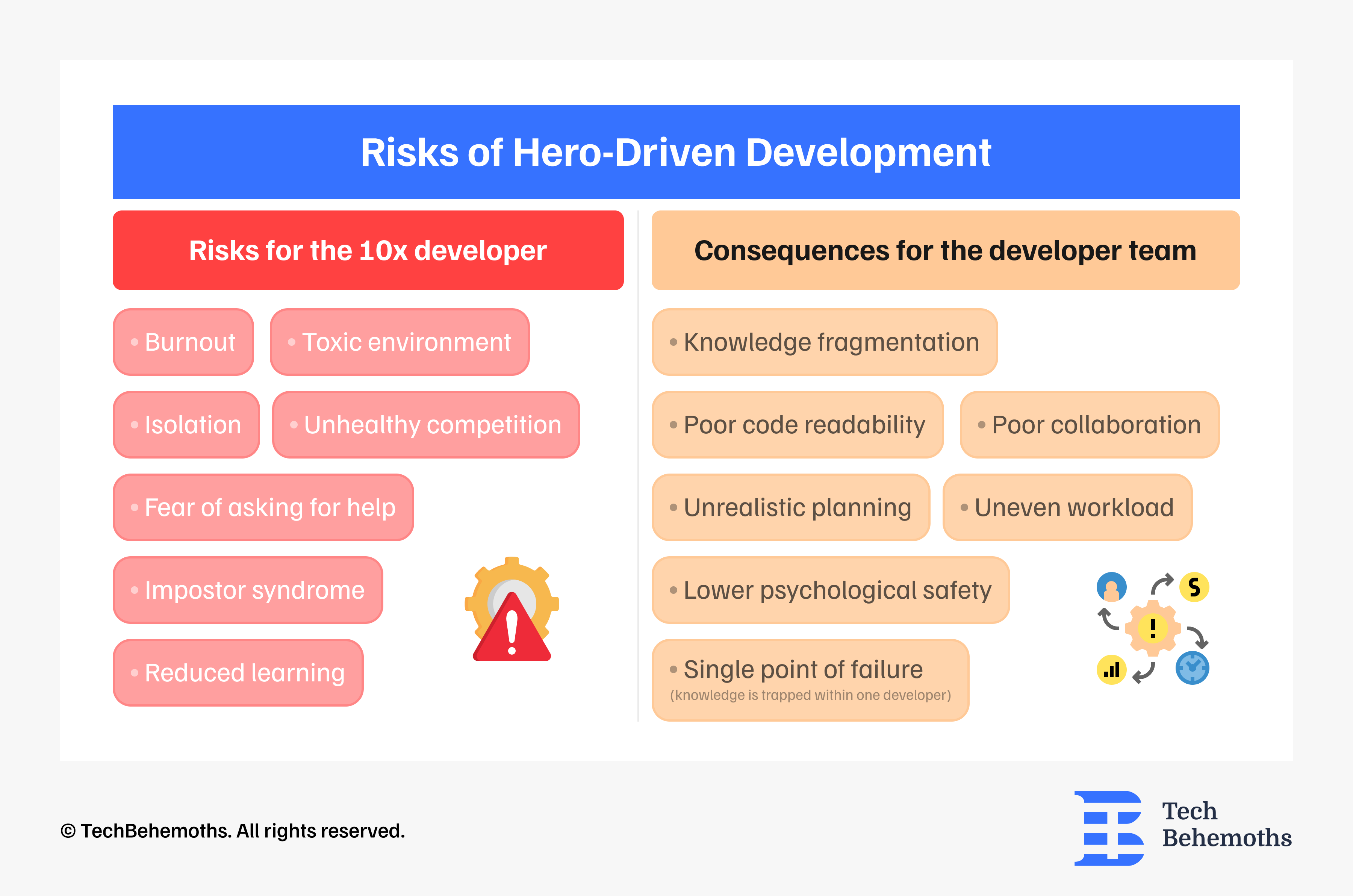
Soft skills are also at risk of being excluded by 10x programmers due to them focusing mainly on the tech stack. However, top developers communicate technical concepts clearly, mentor junior colleagues, provide constructive feedback, and align technical decisions with business objectives. These abilities increase the impact of the technical knowledge and make complex projects easier to execute.
Conclusion: Teams Beat Superheroes
Top developers are distinguished not by how much code they write but by the lasting value they create. They learn from mistakes, share knowledge, mentor others, and make decisions that optimize both the software and engineering process.
Tech firms prioritizing team development rather than individual recognition have better chances of overall success, employee retention, better reviews, increased productivity, and future sustainability. The company’s prosperity lies in shared experience rather than reliance on a single expert.
Related Questions & Answers
How Can Companies Create a Healthier Working Environment for Developers?
Is Competition Between Employees Beneficial or Harmful in the Workplace
How Can Organisations Prevent Employees From Becoming Overdependent on One Expert?
How Can Companies Encourage Knowledge Sharing Between Employees?
What Are the Advantages and Disadvantages of Having Highly Specialised Employees?
I am an enthusiastic Biomedical Engineering Researcher and love learning about various domains. One of the biggest treasures that we, people, have is knowledge because it's hard to achieve and it depends only on human will. And it can be shared with others, that's why I like to find something new and share it with the world.
Discover more TechBehemoths Insights
Learn practical tips and insights about IT Companies, how to find the right company for your projects.
Read the latest news about Market Trends and fresh Interviews.