The Importance of Empathy in Tech Businesses


Summary
- Adding empathy to a business’s work culture transforms a workplace by integrating security and deep trust.
- Over 70% of clients avoid enterprises that don’t show empathy with 43% of them choosing over firms that deliver it.
- Ai changes the perspective of empathy in several ways, and studies show that it can both enhance and reduce it depending on the context.
- More than 70% of people tend to believe that AI cannot create real human bonds.
- 92% value direct human interactions rather than non-stop availability.
In a time when companies feel disconnected from their customers, empathy doesn’t seem like a crucial ability, especially for tech businesses where logic is the basis of their philosophy. However, empathy changed its value from a simple soft skill to a fundamental value that can help increase the business’s proficiency and competitive advantage.
This article explains how empathy impacts tech firms, including Leadership, Product Design, and AI.
Why Is Empathy Important In a Tech Company?
For a tech business science and reliance on data are in the first place. Because of this, multiple firms rely heavily on dashboards, analytics, and reports. Data can show patterns in user behaviour, or employee performance, but is limited in capturing human motivations and frustrations.
When companies prioritize data over empathy, they risk falling into the trap of Goodhart's Law, when a measure becomes a target, it ceases to be a good measure. By choosing only quantitative metrics, such as daily active users or employee performance, companies often build products that technically succeed but fail to deliver genuine value to the user. Additionally, when empathy is missing, firms often face additional operational costs, such as misaligned products, lower employee morale, and reduced innovation capability, which leads to weakened competitiveness.
Research shows that empathy in tech teams helps reinforce trust and collaboration, which are key factors for innovation and team performance. Without these bonds, even advanced teams can struggle with decision-making and alignment.
What Are The Benefits of Empathy In a Business’s Work Culture?
When empathy is part of daily interactions and decision-making, it influences both collaboration and external outcomes. The following are key benefits of fostering empathy within a tech organization:
- Encourage communication and group collaboration: Empathy improves communication by helping employees listen more carefully and understand intent, not just words. This reduces misunderstandings and creates smoother teamwork across departments, leading to better coordination and fewer conflicts.
- Increased employee retention: In a company that values empathy, employees feel heard, seen, and more appreciated, leading to increased motivation to perform better at work. Empathy contributes to a supportive atmosphere where people feel safe to express concerns, express themselves with new ideas, and admit their mistakes.
- Optimized customer experience: Empathy in a tech firm doesn’t include only its employees but also its clients. Professionals who value compassion are more responsive to customers’ demands and feedback. It also helps the company to be more competitive and have a better reputation compared to other companies.
While its efficiency cannot be measured in numbers, it has a long-time effect reflected in more resilient business performance.
What Are The Areas Where Empathy Is The Most Critical?
Whereas business leaders should not choose between empathy and innovation, they must find a balance and a way to combine both into their firm’s philosophy. These soft skills are crucial for supporting many areas in a tech firm, such as Product Development, Client Support, and many others. Fields that require empathy are the following:
Leadership
According to the Center for Creative Leadership, empathetic leadership positively influences job performance, especially among mid-level managers and higher-level managers. This study was conducted across 38 countries, and over 6,700 managers found that leaders rated as more empathetic by their employees were also rated as higher-performing by supervisors.
There are four ways of showing more empathy at work:
-
Look out for signs of overwork in other employees: Empathetic leaders can recognize signs of burnout before it becomes a bigger issue. This can be done by checking with team members to understand how they keep up with their workload.
-
Show genuine interest in people’s needs and dreams: Managers should also pay attention to the team members' unique needs and goals and how to find the best work assignment, taking in mind this information about every employee.
-
Support team members facing personal challenges: Team members are individuals who face personal problems while having to keep up their professional careers. The reason why leaders should understand and support them is to create a culture of communication and transparency that fosters psychological safety at work. This will help employees feel safe to share.
-
Respond with compassion when employees experience personal loss: Managers can use empathy as a tool to create real bonds between themselves and their subordinates. Everybody has been through personal loss, and even if not everybody can relate, it is best to help the person who needs it to know they are supported.
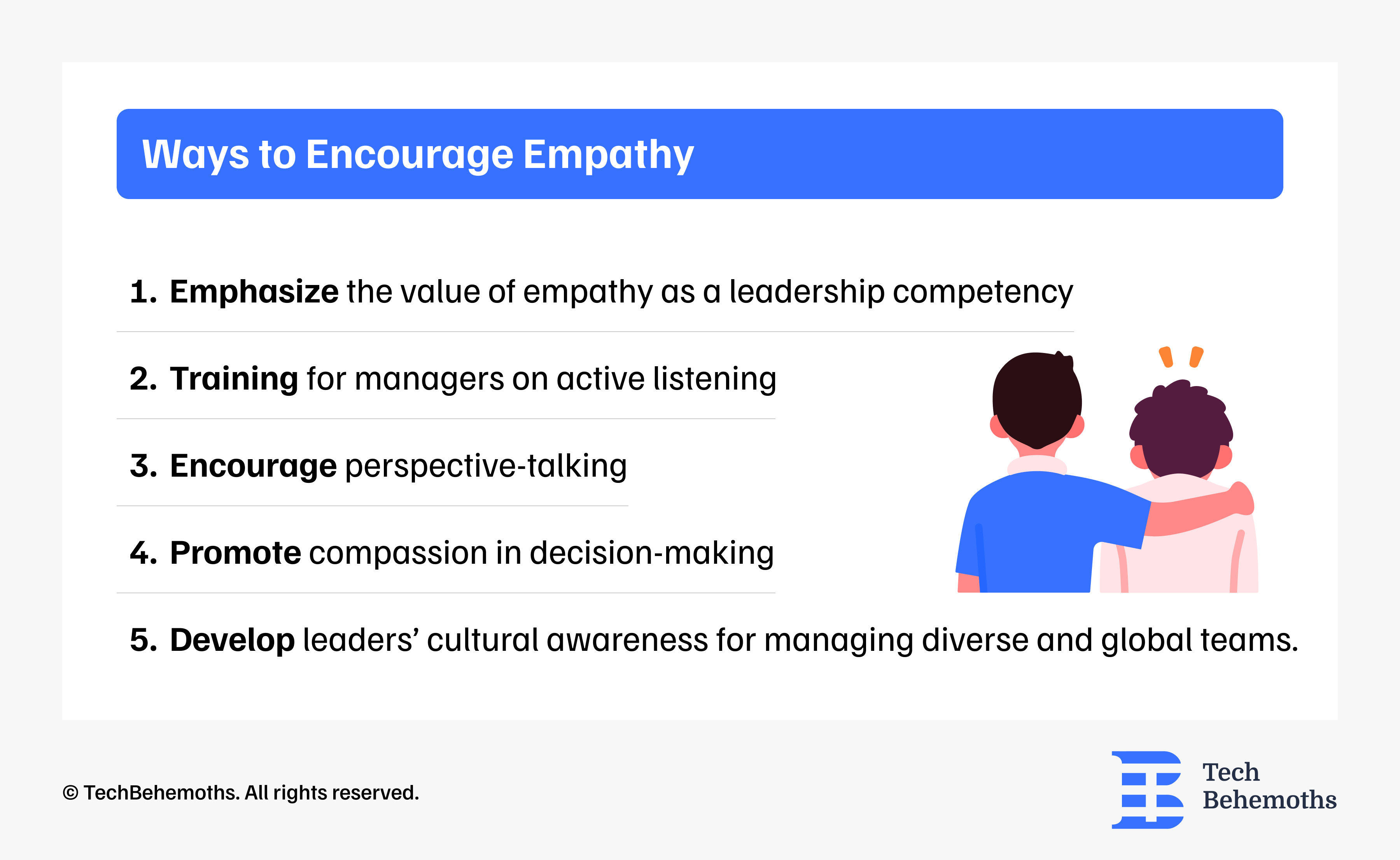
Empathy is a trait that can be learned and developed through training and practice. It shapes how managers respond to people, influencing the quality of day-to-day interactions within the team.
Building Products People Actually Want
“People Ignore Design That Ignores People”
- Frank Chimero
In Product Design, empathy helps teams move beyond assumptions and create solutions that solve real problems. It helps people to transform even the most unpleasant moments into something delightful or useful for their customers.
The first step in creating a product is empathizing, to understand the clients that Products Designers create for. This involves emerging into the customer’s environment to understand their issues and needs engaged in their daily lives. It will provide them with the background circumstances of people for whom this product is created, but also another perspective.
Empathy helps Product Designers to put aside their presumptions and gather real insights that will help create a successful product that will be used. Other advantages of adding compassion into Product Building are the following:
- Improves usability: Products created with their customers' needs in mind are more intuitive and enjoyable to use, helping reduce frustration.
- Encourages continuous optimization: Gathering feedback through a product's lifecycle and modifying it based on the client’s preferences is a way to make products more favorable for their established and new clients.
- Enhances accessibility and inclusivity: Empathy helps create products for people with different abilities, backgrounds, and levels of tech experience, leading to more inclusive products that are easier to use and more widely adopted.
By gathering customers' feedback and demands and continuing to improve, organizations create solutions that are more useful, accessible, and competitive in the market.
Sales and Business Development
According to Zurich Insurance Group, over 70% of clients avoid enterprises that don’t show empathy with 43% of them choosing over firms that deliver it. Without empathy, sales conversations remain at a surface level, but with it, sellers can uncover real pain points, understand business context, and identify hidden needs.
Sales conversations without empathy can feel more like an interrogation, causing buyers to become defensive and closed off. Compassion keeps conversations collaborative, open, and problem-solving, instead of being confrontational, guarded, or stressful. This leads to the discovery of real pain points and business priorities. By understanding customers’ situations, salespeople can tailor their sales process to be more relevant, reduce friction in decision-making, and often shorten the overall sales process.
Ultimately, empathy leads to better sales outcomes because it optimizes the solution’s quality and reinforces the strength of the built relationship.
Empathy vs Sympathy
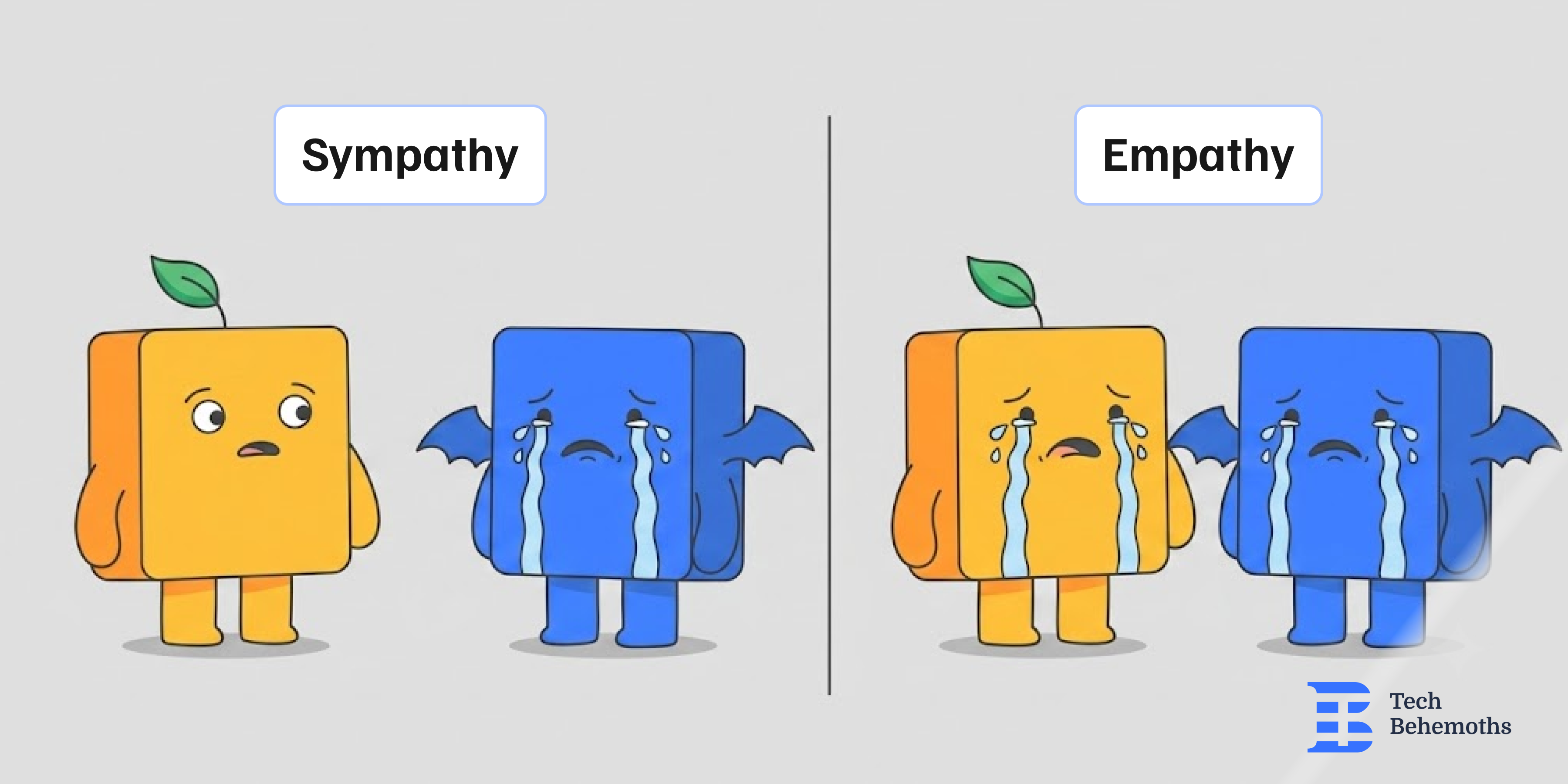
Empathy and sympathy both involve having concerning feelings for somebody, but empathy adds a sharing in the person’s suffering. The key difference between these two is the level of involvement:
- Empathy - the skill to show concern for others even if you don’t have to go through the same situation as they do.
- Sympathy - the projection of pity onto another person with a sense of detachment and superiority.
Sympathy in a tech business can not only cause frustration but also negatively affect multiple processes in a business, from designing a product to customer support and sales processes.
| Empathy | Sympathy |
|---|---|
| Feeling with someone | Acknowledge their feelings but stay emotionally separate |
| Fosters connection | Creates separations |
| Give compassion and understanding | Feeling of pity for another |
| Comes from the heart | Comes from ego |
| “I understand why this workflow is frustrating, and let’s find out what’s causing it.” | “I’m sorry you’re having a frustrating experience.” |
This difference is crucial in multiple business areas, such as customer support. The empathetic approach acknowledges the customer’s bad experience and moves toward finding the solution, leading to stronger customer satisfaction and loyalty. This method of finding the solution instead of showing pity for someone’s situation further leads to improving products, services, and client’s experiences with your tech company.
Ultimately, empathy contributes to better business outcomes because it transforms understanding into a meaningful action. Sympathy expresses care and concern, but empathy makes it possible for organizations to offer services that genuinely address the user’s needs. For tech firms, empathy is a business strategy ensuring success.
How AI Influences Empathy?
Ai changes the perspective of empathy in several ways, and studies show that it can both enhance and reduce it depending on the context. More than 70% of people tend to believe that AI cannot create real human bonds, and 92% value direct human interactions rather than non-stop availability.
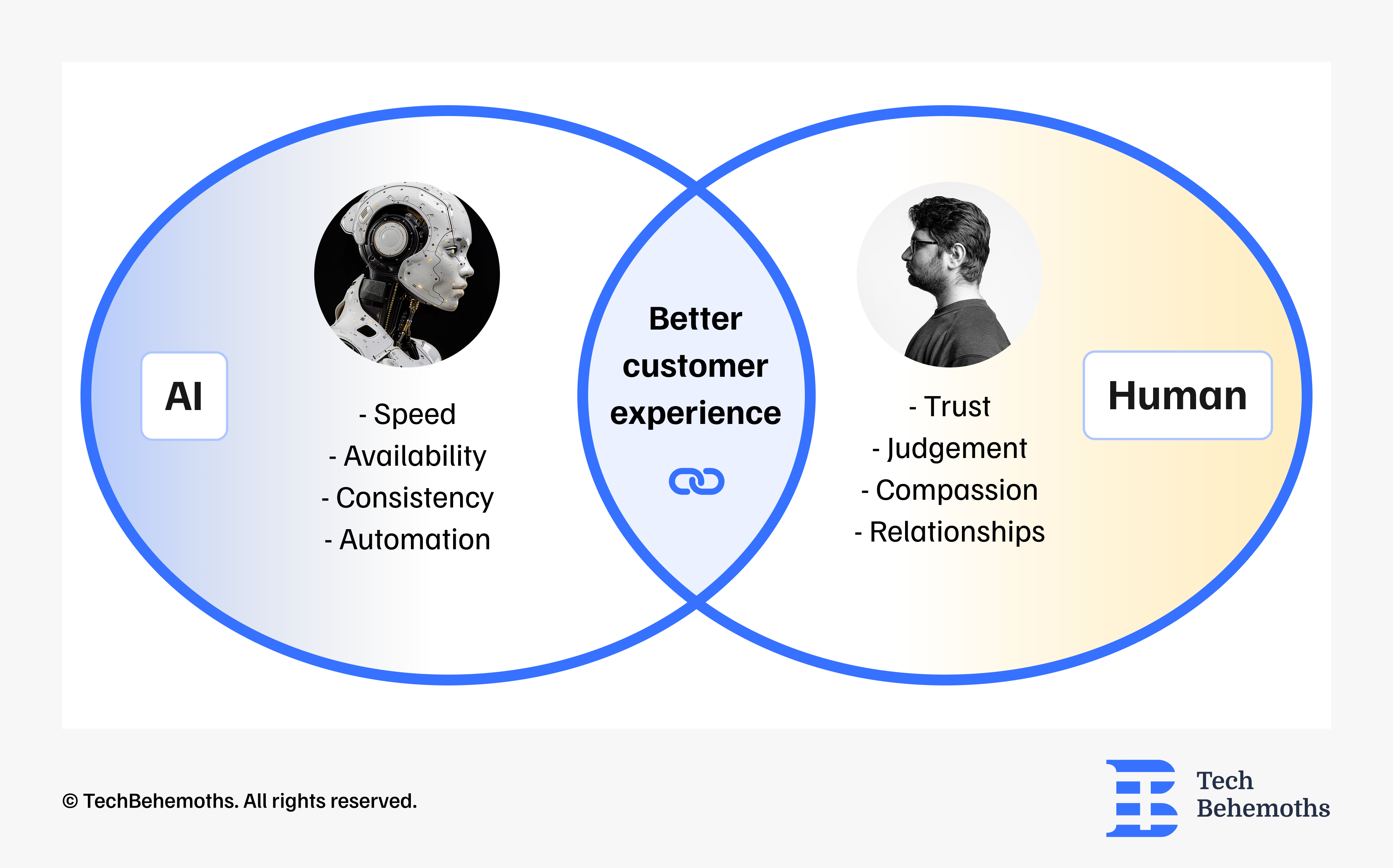
According to ScienceDirect, modern AI systems such as chatbots and virtual assistance can detect emotions via text, for example, frustration, sadness, or anxiety. Using "artificial empathy" they respond with language that feels supportive. This increases user satisfaction because people feel heard, even if the system does not actually feel emotions, it gives the illusion of somebody that will listen to everything and at any time of need.
Other studies find out that people perceive AI chatbots as more empathetic than humans, because they remain consistently calm, polite, and emotionally balanced. These AI systems can appear more empathetic because they don’t feel fatigue or impatience as every human being does. However, this perception changes when people find out that they are speaking with AI. Many people start judging the responses and think about them as less empathetic due to distrust towards AI.
On one hand, AI can reduce repetitive work, for example in Customer Support, allowing employees to focus on other tasks. On the other hand, replacing human interaction with AI in emotional tasks can reduce the opportunity of real bonding. Still, AI can be an ideal option for people who tend to avoid human interaction or simply don’t have people whom they can share their experiences with. It can be useful in AI chat on a business’ site to understand the customer’s problem and redirect it to the Support Workers for them to offer help and find a solution.
Final Thoughts
In tech companies, empathy strengthens both internal culture and customer experience. Many business leaders rely solely on dashboards, analytics, AI, and reports, and while these tools provide information, they don’t offer understanding, crucial for creating products that people will need, love, buy again and recommend to other people.
Overall, empathy not only helps to create a healthy work environment within the company, it expands its influence across the enterprise towards its customers leading to a strong and respectuous company brand.
Related Questions & Answers
How Might Remote and Hybrid Work Environments Reshape How Empathy is Expressed in Organizations?
Could Future Product Design Eventually Become Fully Emotion-driven Rather Than Feature-driven?
Where Should Companies Draw the Line Between Empathetic Design and Manipulation of User Emotions?
Why Do People Sometimes Prefer Systems Like AI That Simulate Empathy Over Real Human Interaction?
What Prevents Leaders From Practicing Empathy Consistently, Even When They Value It in Theory?
I am an enthusiastic Biomedical Engineering Researcher and love learning about various domains. One of the biggest treasures that we, people, have is knowledge because it's hard to achieve and it depends only on human will. And it can be shared with others, that's why I like to find something new and share it with the world.
Discover more TechBehemoths Insights
Learn practical tips and insights about IT Companies, how to find the right company for your projects.
Read the latest news about Market Trends and fresh Interviews.