What SaaS Founders Are Building to Survive 2026


Summary
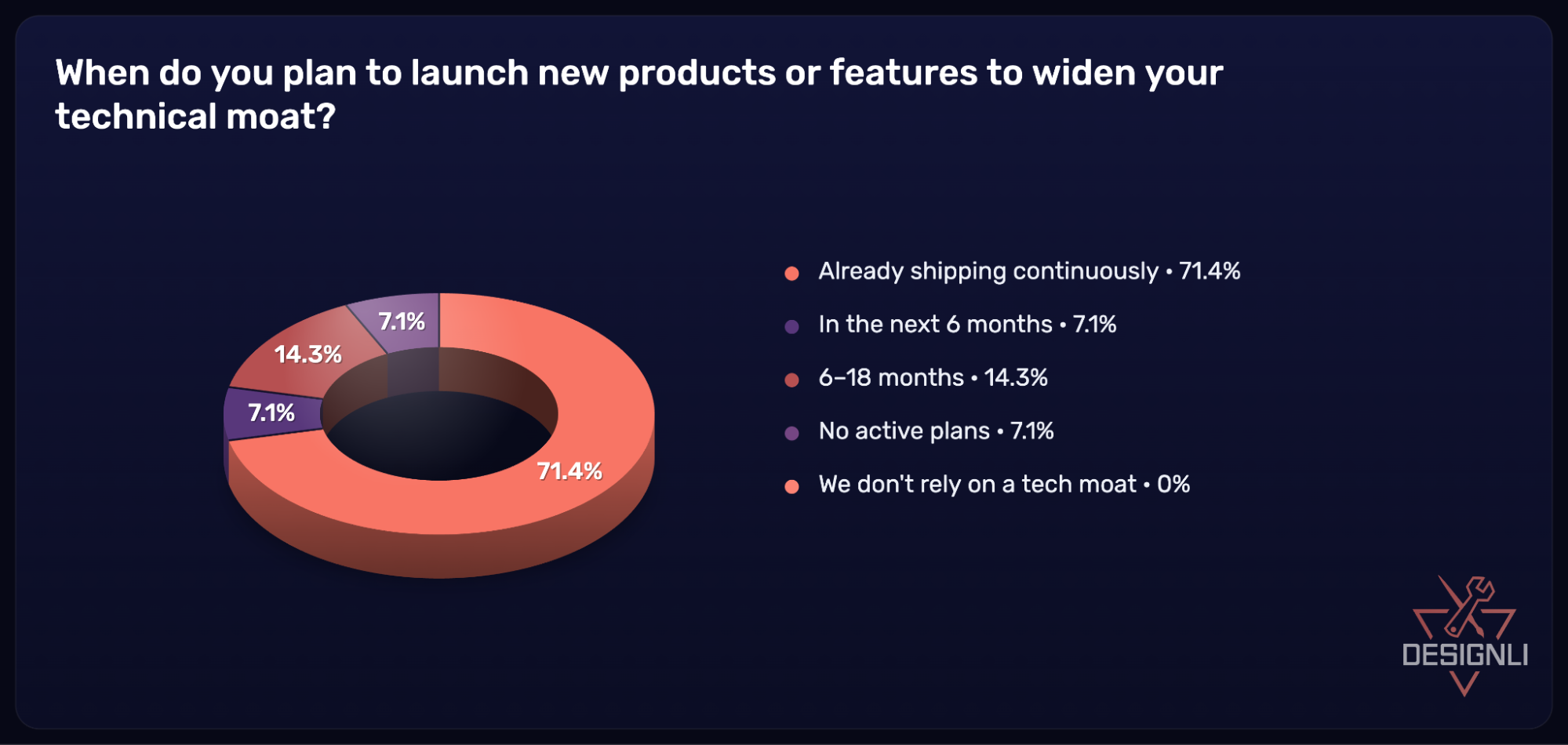
- 71.4% of founders continuously release new features, but none believe their product is fully protected from competitors.
- While many rely on AI as their differentiator, 21.4% say their biggest advantage is not technical, and 14% still lack a clear distribution strategy.
- The findings suggest that founders are more likely to succeed by strengthening one defensible advantage rather than trying to build every type of moat at the same time.
Founders today are experiencing one of the most challenging moments regarding product development due to high market expectations and the moat they select and trust to lead as their market advantage.
Founders Can’t Defend Everything
As a founder, you will have to deal with the development of a precise roadmap, ensuring there is a data strategy, a retention plan, and a distribution route that leads directly to your ideal users. This is nothing new, however, as development has now changed and evolved; timelines are no longer the same length, so having the resources and time to execute everything precisely is not easy. That's why prioritization and awareness are necessary skills to develop, and a good stage to do that is when defining your idea's moat: understand where you have an advantage and where you need to maximize efforts.
Build Towards a Clear Advantage
As mentioned above, awareness is key to taking the next steps in your roadmap; never lean on reactivity as a motivator to decide. If a decision is not designed and validated, chances are you are just aiming towards failure. That’s why executing the technical, data, service, and distribution moats all at once is not just a matter of discipline; you also need resources, and if you do not have access to them, you must strategize before advancing.
In the report, we asked, "When do you plan to launch new products or features to widen your technical moat?" 71.4% of respondents are already shipping continuously with moat-widening as an explicit goal. This shows many founders are just shipping for the sake of it, without defining priorities and leaning on reactivity, which won't compound as a technical moat.
Speed Is a Tactic, Not a Strategy
To further emphasize more the importance of planning, we can analyze the last insight, 71.4% shipping continuously, and add a new one coming from the question, “How defensible is your core technology if a well-funded competitor copied your product today?” On a scale from 1 to 5, no founder rated their own defensibility with a 5/5. This reveals founders do rely on velocity when building, treating it as an overall plan, which can feel like progress in the short term. But those same founders do not fully trust that their products can’t be fully copied by a competitor. Speed buys time, but it won’t save you from the inevitable if your competitors are actually building an outstanding and unique technical moat to defend themselves from others.
Identify Your Strengths Early On
When we asked, "What is your primary technical differentiator?" a significant percent answered with AI or machine learning models; however, the answer that surprised us was the 21.4% who said their edge isn't technical at all. Given that the majority of survey respondents were in the tech industry, it was unexpected. This is where we acknowledge some founders can and will thrive through their relationships, domain expertise and judgment, and skills that can compete with and potentially outgrow any feature or AI integration.
Founders who understand that betting on a moat they can maximize from the beginning, one so strong that no competitor can buy their way into, is rare, should take on that opportunity without doubt.
The Moat Where Everyone Has Doubts
Distribution moats have the majority of founders out there doubting themselves, trying to understand what channel or what strategy will crack the code and generate leads and customers fast. When asked, "What is the single distribution bet you're making in 2026 that most founders in your space aren't?" answers varied among creating content for AI search optimization, community-led growth, API/MCP channels, and rapid-response content. About 14% of respondents aren't placing a single, differentiated distribution bet; either their efforts are spread across standard channels, or they simply haven't approached strategy at this level yet.
This shows that given the lack of clarity on which distribution channel to fully lean on (AI, TikTok, and shifting user behavior all playing a role), there is no proven playbook to copy from, which means your best bet is to fully understand your target audience and build upon it.
The Best Defense Comes After Churn
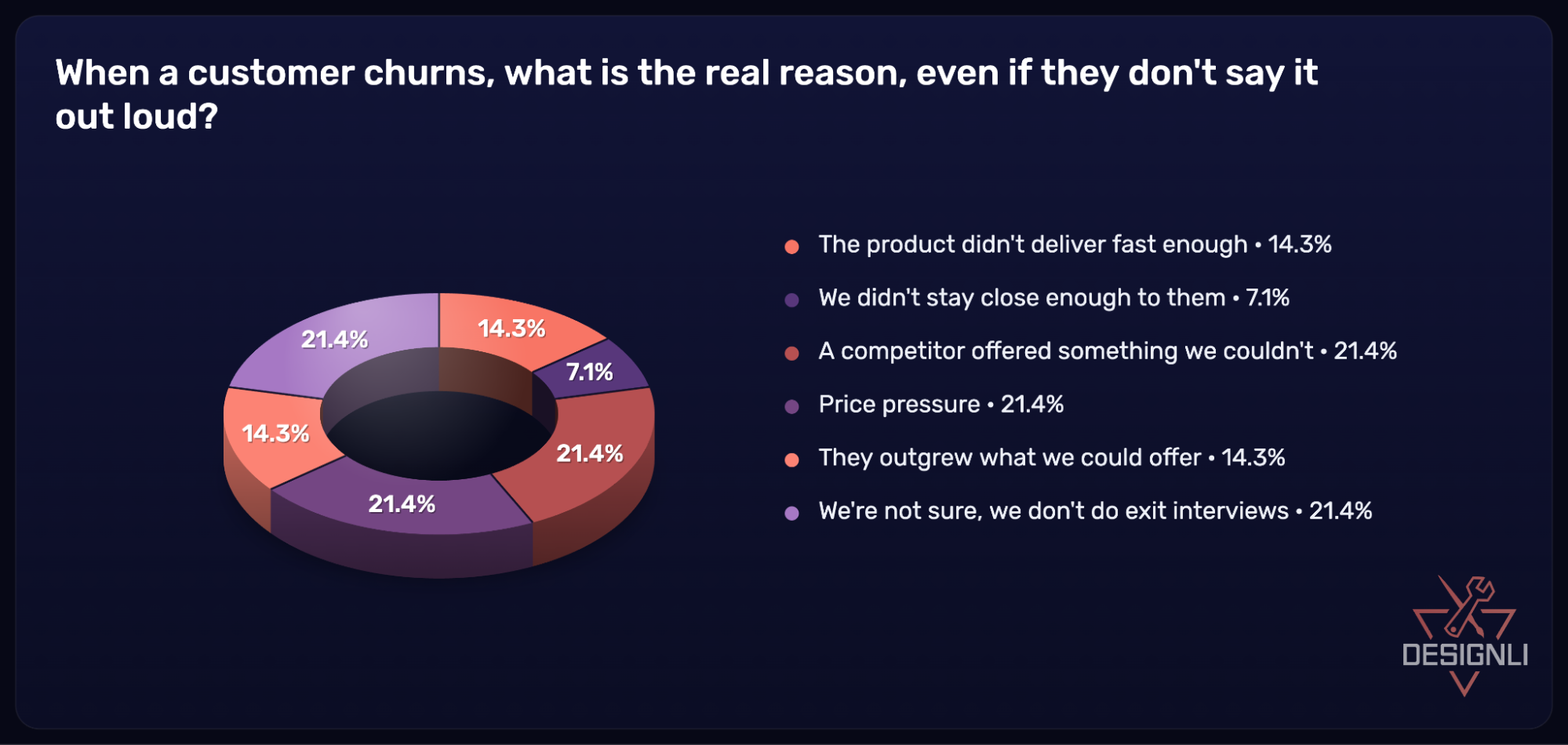
When a client parts ways with your product, you must do everything in your control to understand their reasons. It's fine if they leave, but having no knowledge of it hurts you more than you imagine. We asked, “When a customer churns, what is the real reason, even if they don't say it out loud?" Common answers include a competitor offering something the customer couldn't get from the current product, price pressure, or the customer outgrowing the product.
We were shocked to discover that 21.4% of respondents said they don't conduct exit interviews at all and genuinely don't know why customers leave.
This is one of the most controversial decisions a founder can make. We all know there is a churn percentage to accept, and even in those moments you can gain knowledge of how to improve. Feedback loops are the only reliable way to identify patterns, common mistakes, and a clear reason to question your next steps and, if necessary, even your moat itself.
Case Study: Mailchimp
Mailchimp started as a web design firm offering common marketing services back in 2001, and due to a client's request, they got into email. In 2006 they went all in on Mailchimp, getting real significant traction in 2009 when they adopted a freemium model, offering users the ability to send up to 3,000 emails so they’d fall in love with it and, most importantly, normalize its use in their routines. From that point onward, Mailchimp grew to become one of the most profitable bootstrapped companies in history.
As a lesson to all the founders out there, Mailchimp understood their moat was in the scope they decided to focus on and, therefore, in how their distribution and retention strategy worked. With a competitor like Constant Contact in the market, it made no sense to compete directly with them, so Mailchimp's approach was to help small businesses grow, serving them and helping them strategize for the long run, capturing a huge chunk of clients, and creating a benefit cycle that made everyone grow. In 2021, Mailchimp was sold to Intuit for $12 billion, in one of the largest deals in Intuit's history.
Pick the Moat You Can Defend
With 2026 being one of the years with the greatest capacity to build and develop products, make sure you are also building a moat you can maximize and defend completely. Far from building a technical, data, service, and distribution moat at the same time, you must understand how they work and which one provides the most benefit for your context. Do not build, create, or decide based on reactiveness; now more than ever is the time to validate and iterate before going all in. Your main focus should be on constantly building a moat that, no matter what your competitor does, they can't copy or buy their way into.
Related Questions & Answers
Can a founder realistically build a technical, data, service, and distribution moat all at once?
Does shipping fast enough to stay ahead of competitors count as a moat?
Why does it matter if a founder doesn't know why customers churn?
Keith Shields is the CEO and Co-founder of Designli, a leading software and web development company. Keith is passionate about creating impactful digital experiences for non-technical founders. He co-founded Applits, a startup recognized as the "Coolest College Startup of 2014" by Inc.com, and has since led hundreds of successful projects at Designli. As a serial entrepreneur, Keith is committed to helping non-technical founders launch transformative digital products through Designli’s proprietary SolutionLab process.
Discover more TechBehemoths Insights
Learn practical tips and insights about IT Companies, how to find the right company for your projects.
Read the latest news about Market Trends and fresh Interviews.