AI in the Software Development Lifecycle: Where Humans Stay in Control


Summary
Four in five developers use AI, but fewer than one in three trust its output.
AI makes development faster, but it can also scale mistakes. This article explains where AI saves time and where human judgment must remain in control.
Four in five developers now use AI tools regularly. Fewer than a third trust what it produces to be accurate. Sounds like a contradiction, but it’s just a natural consequence of the increase in coding speed and volume caused by AI. Moreover, this skepticism is good software development practice that has carried on in the age of AI-assisted everything.
Every stage of the software development lifecycle (SDLC) has long been steered by practices that separated good from sloppy engineering: clear specs, intellectual ownership, small increments, real review, deliberate testing. AI hasn't replaced any of that – nor should it. But it’s made the gap between teams that follow those practices and teams that don't even bigger.
So, to the important question: how does one make the call on when and how to use AI?
Where a Fast Answer is Good Enough
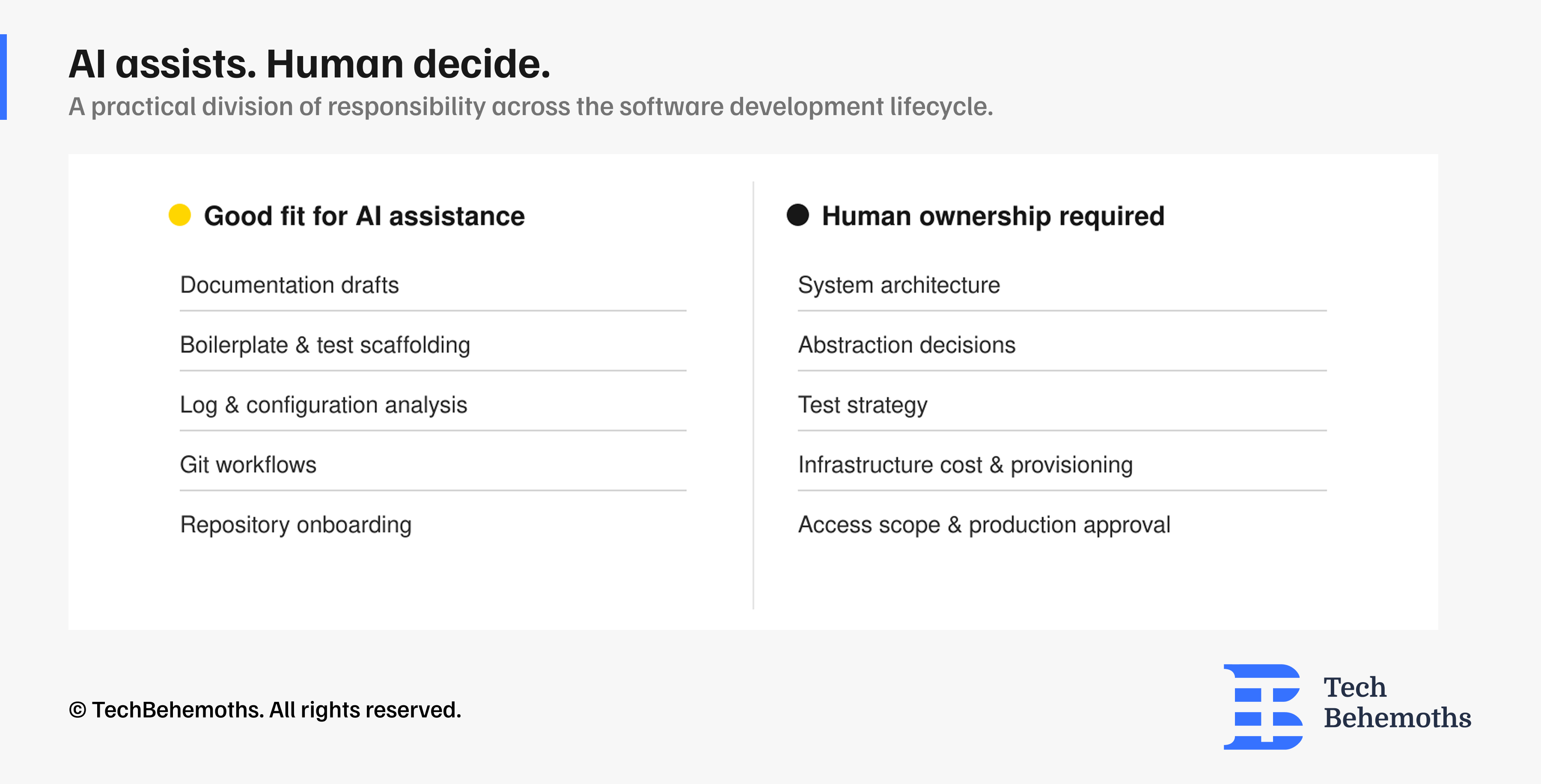
AI's speed (and reliability) delivers most clearly on the mechanical aspects of the job - documentation, boilerplate, test scaffolding. On complex work, like system design or untangling an unfamiliar codebase, the gains are much smaller (more on that later).
Reference and API documentation is another good fit - mechanical, pattern-following text generation, close to what these models do best. Several DevOps-adjacent tasks belong in this category too:
-
Debugging. Feeding logs to AI to find a likely cause is faster and arguably better than a human dredging through them. Sifting through large amounts of structured text is a natural task for an LLM that either points to the bug or it doesn't, and you'll know within minutes. It also works as a stand-in for rubber-duck debugging when no colleague is around. The real caution here isn't trust; it's exposure: check logs for plain text credentials before pasting them anywhere.
-
Configuration review. AI is decent at spotting configuration gaps - a security misconfiguration in a Kubernetes Helm chart, an overly broad IAM policy. This is detection, not action: it flags candidates for a human to confirm.
-
Git. Resolving merge conflicts, explaining rarely-used or cryptic git commands, and scanning remote branches to flag work that might overlap with your own - all low-stakes, easily verified, easily discarded if wrong.
-
Onboarding. Asking AI what a repository does, or to explain an unfamiliar concept used in its Readme’s, beats hopping between five docs and three repos. Zoning in on the important parts and providing a succinct summary can save a lot of time, while a wrong or incomplete answer here is easily falsifiable once you begin working on the codebase.
Where Someone Has to Own the Call
Arguably, there are parts of the SDLC that shouldn’t be fully delegated to AI due to the technology’s (current) limitations. In order to steer the process in the right direction, you’ll have to rely on good old human judgement. Here are some of the best practices our team has implemented to maintain high software quality:
-
Push for critique, not validation, at the planning stage. Ask the model to interview you and find gaps in an idea, rather than describing it and taking the response at face value. Don’t let it default to agreeing with you.
-
Diagram before generating code on anything nontrivial. A wrong diagram surfaces a misunderstanding in minutes; the same misunderstanding baked into thousands of lines of generated code is expensive to catch.
-
Keep abstraction decisions with a human. Whether to hard-code a one-off or build a reusable component depends on where the product is headed – that’s information the model doesn't have and a decision it shouldn’t be making for you.
-
Review in small, staged increments, and keep code structurally consistent. That lets a change be sanity-checked by its shape, not read line by line - the same discipline good teams already used before AI, just under more pressure to skip it now that generation is fast (don’t skip it).
-
Treat test level and test volume as design decisions. What's worth a unit test versus an end-to-end test is a judgment call, and AI-generated test suites need the same scrutiny as AI-generated code - brittle, hard-coded tests that need rewriting on every change quietly erode the time saved.
-
Review anything that provisions or spends before it runs. AI can bootstrap a multi-environment Terraform proof of concept, or a local Docker Compose setup, in minutes. The catch is that "minutes" cuts both ways - an un-reviewed apply can spin up an expensive instance as easily as a cheap one.
-
Treat access scope as a standing rule, not a case-by-case judgment. Any AI given access to a cloud account, remote server, or Kubernetes cluster should default to read-only. It limits what a wrong call can break or cost, even if it doesn't by itself solve the separate risk of sensitive data leaving your environment. IBM's 2025 Cost of a Data Breach Report found that heavy unsanctioned AI use added as much as $670,000 to the average breach cost, and 97% of AI-related breaches happened at organizations with no AI access controls in place at all.
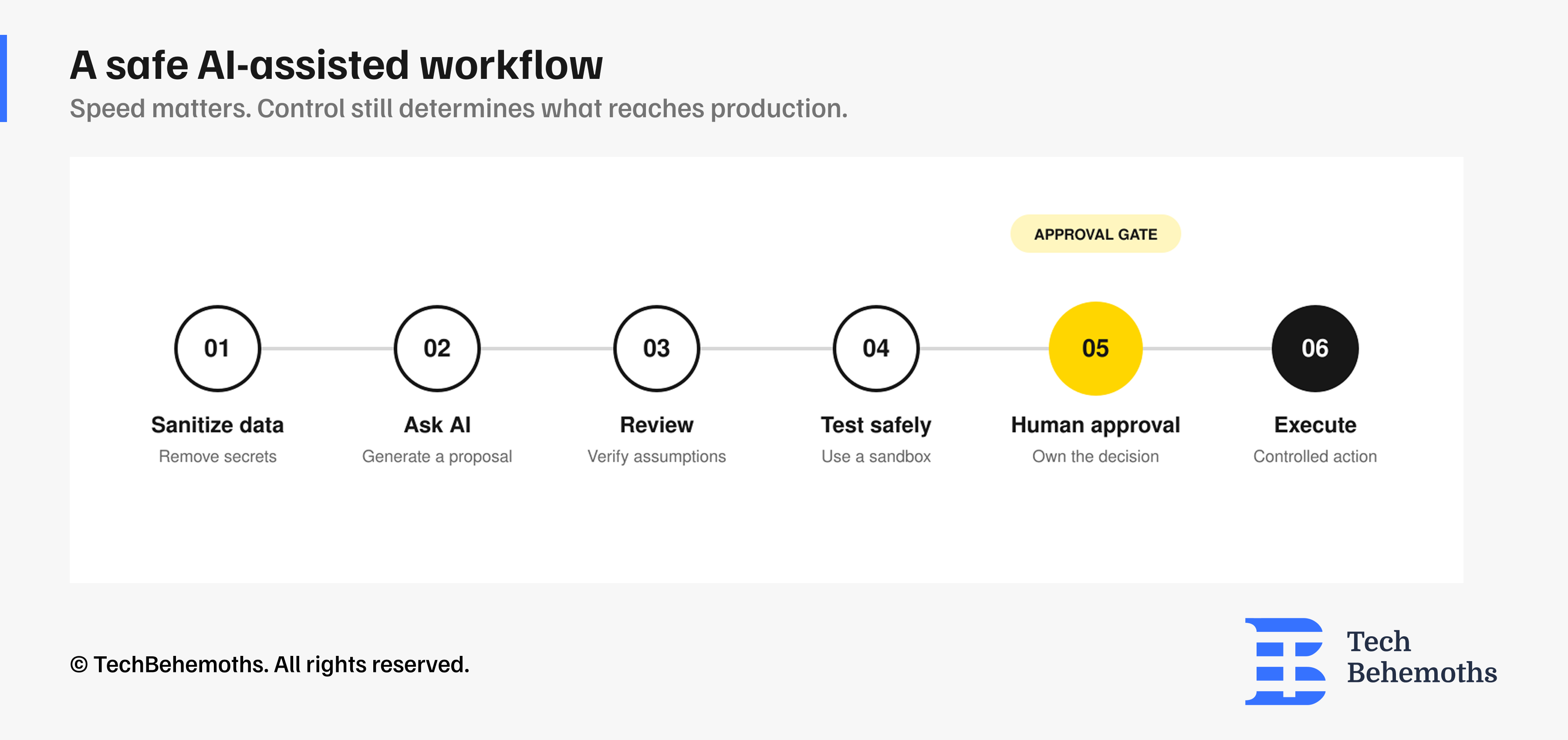
It’s worth exploring how to formalize this judgment into a repeatable process instead of leaving it to individual habit. That distinction could be made by substituting generic AI tools with a custom AI agent built around one team's actual workflow and data security policies.
Documentation: same split, smaller footprint
The same logic holds at smaller scale. Code-adjacent comments and API references are a strong AI fit - mechanical, structured, low-risk to get slightly wrong. Anything user-facing or architecture-level still needs a person with a broad view of the product to guide and review it; that kind of vision isn't something a model can originate on its own.
Summing It Up
The software development lifecycle has stages that were always mechanical - where speed is a clean win- and stages that were always about judgment - where someone still has to own the outcome before it ships. None of that is a new discipline - it's the same engineering practice that predates AI, running at higher speed, with a lot less slack for skipping it.
Would you trust AI-generated code without reviewing it?
Petko is a machine learning engineer at Proxiad SEE who has experience in modelling perception data, building document processing pipelines, and developing full-stack software systems. Before diving into machine learning and getting an MSc in Artificial Intelligence, Petko graduated from medical school. He strives to use technology to solve societal issues and advance scientific research.
Discover more TechBehemoths Insights
Learn practical tips and insights about IT Companies, how to find the right company for your projects.
Read the latest news about Market Trends and fresh Interviews.