5 Tips for Identifying a Great Tech Company Portfolio


Summary
To win over the competitive market, a company portfolio must not only represent a list of past projects but also serve as a strategy and a commercial tool. It helps create trust and market value, differentiate the organization from competitors, and record its growth and expertise. When clients evaluate a tech firm’s portfolio, they should look for a clear alignment of its mission, specific tech specializations, and clear case studies that address its problem-solving skills and demonstrate its dedication to future management.
A professional portfolio is a collection of a company’s work, projects, products, and achievements. Every firm should recognize that a portfolio can strengthen its reputation and build trust with future clients. Whether it is a collection of client testimonials, finished projects, or the technologies a company works with, it offers evidence of its expertise and capabilities.
Beyond representing past work, a company portfolio is a way to communicate a firm’s potential. It gives clients access to details that may not always be remembered during conversations and helps them distinguish between promises and proven results. But what should you look for in a portfolio when looking for a next partner for your project? The answer is in this article.
Why Is a Company Portfolio Needed?
"A good portfolio is more than a long list of good stocks and bonds. It is a balanced whole..."
- Harry Markowitz
The average B2B buying group now includes up to 10 decision-makers, according to Gartner research. If a portfolio includes strong projects, it can give the firm an advantage over other candidates. It also presents clear evidence of profitability before the buying group makes a choice. There are several reasons why a business portfolio will bring profits for tech firms, including:
- It turns promises into proof: A firm can say it has experience, a skilled workforce, and the ability to handle complex tasks. But statements alone can’t provide clients with reason to believe. A portfolio offers concrete evidence for those claims. Completed projects, client testimonials, and the results allow future customers to see what the company has actually accomplished. A portfolio is a material representation instead of saying “our company can do it.” It also makes it easier for clients to evaluate an organization’s abilities before making a decision.
- It builds credibility: Choosing a particular company involves a level of risk, especially when a client is working with it for the first time. A portfolio allows others to see its work and strengths, helping clients to see how the firm will fit in their vision or project. It becomes more than a collection of finished tasks, but a credibility tool that helps clients feel more confident about future collaboration with the chosen company.
- A portfolio helps a company stay competitive: Firms often offer similar services and propose matching points. To be ahead of the competition, an organization that says it is experienced, innovative, or customer-focused may not be enough to differentiate it from any other firm. A portfolio provides context and allows a company to demonstrate its particular approach, the types of problems it has encountered, and the uncommon solutions it has developed. A curated portfolio can communicate a firm’s unique strengths and make it easier for potential clients to understand why they should work with this firm rather than another.
- It tells the story of the company’s growth: A company portfolio can serve as a record of an organization’s professional journey. Analyzing old projects can show how the organization has expanded its expertise, adopted new technologies, taken on more challenging tasks, or tried new styles and approaches. It means not only the perfect outcomes, but also the issues that arise in adaptability and the ability to find better solutions no matter the situation. A strong portfolio tells more than the story of what a company has worked on, but it tells how it has evolved.
- It helps turn potential clients into actual clients: A company portfolio has a commercial purpose. It can help a potential customer to consider a future collaboration. It contains all the required information for a customer to evaluate a tech firm. A portfolio can also make the company easier to remember and easier to recommend. Instead of relying on conversations, the company has resources that customers can revisit and share. The portfolio is a continuation of the meeting and conversation.
What to Look For in a Portfolio?
A strong portfolio should communicate the company’s value quickly and give potential clients evidence of what the organization can do. It should not only contain a collection of successful projects, but a transparent story about the organization, its experience, its problems, the conclusion it draws, and the results. Clients looking for a tech company as a future partner should take into consideration the following elements of a portfolio:
1. Company’s mission. A portfolio should communicate the philosophy and values behind the enterprise. The mission provides context for every project and offers understanding of what this firm stands for and what kind of partner it aims to be. A strong portfolio should make it transparent without turning it into a lengthy statement.
2. Firm’s specialization. Be it UI/UX Design, Web Development, Software, or AI, it must be noted in the portfolio what the main focus industry is. The portfolio should make it clear in what domain its priority lies. It can demonstrate its expertise with particular industries or case studies.
3. Strongest skills. It is useful for the firm to mention what strong skills it possesses, for example, it may be programming languages, frameworks, platforms, design tools, cloud technologies, or AI solutions. A strong portfolio links these skills with real projects that highlight the mentioned abilities.
4. Key projects. These cases should define the organization’s growth, diversity, and skillfulness. In this way, clients can observe the challenges faced by the enterprise, analyzing its problem-solving skills. The portfolio should also include not only the project and the challenges that arose, but also the tools and technologies leveraged, the main conclusions, and ideas for future projects on how to optimize the work process. A good case study can also show what the firm learned from the project. Challenges, changes in direction, and lessons learned can demonstrate adaptability and critical thinking rather than weakness. In some cases, companies can mention what could be improved in the future, making the portfolio feel more authentic and demonstrating commitment to continuous improvement.
5. Portfolio format. Tech companies can have portfolios in several formats, such as brochures, PDFs, websites, and slide decks (usually for client meetings). The format must match the portfolio’s purpose and audience. An online portfolio is useful for independent clients, while PDFs or presentations can be more convenient for sales meetings and client presentations. Regardless of the format, a portfolio should be easy to navigate and scan. Potential clients should not have to search through pages to find specific information. A clear structure, strong visuals, and succinct information make a remarkable difference between a simple portfolio and one with business potential.
Eventually, a top company portfolio is not trying to show everything. It contains selected information that most effectively communicates the firm’s expertise, reliability, and perspective for partnership.
Red Flags In a Tech Firm’s Portfolio
A portfolio can make a great first impression, but for potential clients is important to recognize warning signs. Several factors can indicate that a portfolio is not representing the capability or the quality of a company’s work.
- Outdated technologies or design choices: The technology choices in a portfolio can give clients a clue about the future sustainability of their project. Dependable companies use both the newest technologies and reliable platforms. Clients should ask themselves if the technologies used by the potential partner are meeting their requirements. Because if not, outdated trends may not reflect a firm’s current capabilities, which is important when choosing a long-term partner.
- Inconsistencies in quality: If some projects have better quality than others, for example, several sites run smoother than others from the same portfolio, it can raise questions about the quality consistency. The differences in quality can indicate that the company leveraged the work of other firms or professionals, which puts at risk the success of the client’s project.
- Vague case studies (fake testimonials or unclear agency role): An exaggerated project can include fake testimonials, generic descriptions, or unclear agency involvement. This leads to challenges for possible clients to determine what the company’s actual work is.
- Untrue results: A strong portfolio is supported by results that demonstrate the company’s involvement in its projects. Clients can look for studies that describe specific outcomes. Numbers such as the rate of improvement or how the statistics change before and after launch and measurable metrics give more trust than simple praise.
- Lack of variety: A portfolio that has several versatile projects is more impressive than one with similar projects. Clients should look for the size, complexity, and industries of the company’s projects. This diversity not only highlights the firm’s experience but also its adaptability. This value is important for the future sustainability of the project.
- Poor project management: Clients should search in a company’s portfolio for a clear structure of work processes. This can include the working phases or deadlines. A portfolio can also include multiple demo versions across the path of working on a project, and described workflows, to emphasize the process and not only the results. If a project can’t deliver these factors, it can indicate that the company is not well organized, responsive, and transparent in the work processes.
- Dead links or broken demos: A company’s portfolio should also communicate the firm’s attention to future maintenance. Broken links, unavailable sites, and non-functional prototypes can undermine a strong presentation. A live project should be tested rather than judged from the screenshots.
A single red flag doesn’t mean that the firm is unreliable. Discontinued products or projects that are no longer maintained can be explained by several limitations. Despite that, multiple red flags together can encourage potential clients to ask questions, request transparency, and verify the organization’s claims before deciding on a future partnership.
How can TechBehemoths Help You Find the Best Portfolio?
When it comes to choosing a partner for a future project, it is crucial to choose the right candidate. But the process can become very tiresome, resource-consuming, and risky. To avoid such challenges, TechBehemoths is a platform with over 60,000 tech firms across more than 140 countries worldwide, offering 510+ services in Web Applications, Software Development, Design, Business Services, and Advertising.
There are several factors to consider when analyzing the candidates, such as location, price, time zone differences, and others. To prevent evaluating every detail for the possible firms, TechBehemoths has a solution. On this platform, clients can leverage the filter option, which includes 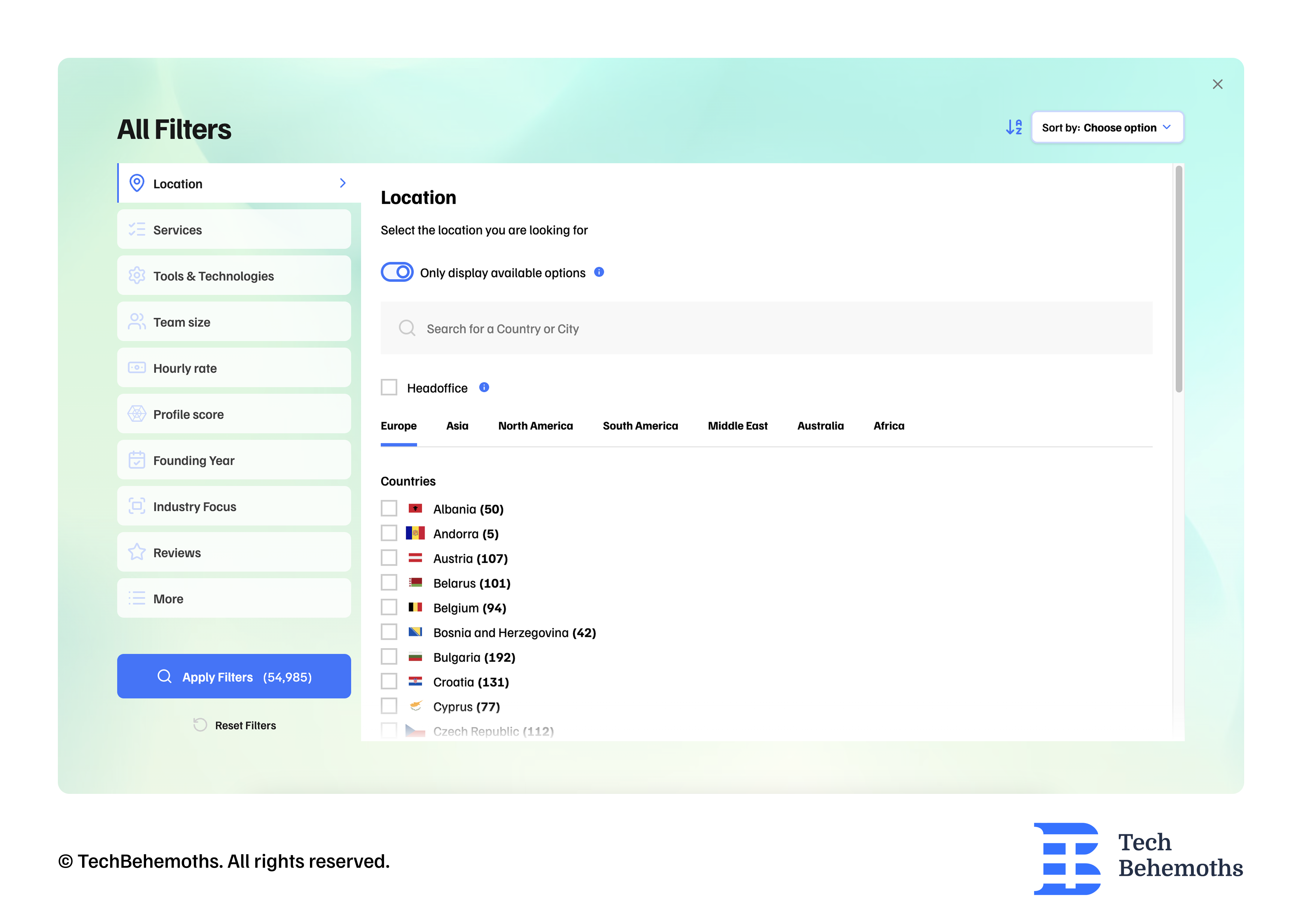
Using this filter, it is easier to narrow down the results based on your requirements and reduce the list of companies. There is also the possibility to submit your project, and the TechBehemoths team will select and send you the best matching companies in about an hour. It is free, with no need to hire, and 100% risk-free.
Conclusion
A company’s portfolio serves as a strategic asset that converts a firm’s promises into evidence that creates trust with its future partners. By highlighting the fundamental industries, the tech stack, key projects, and organizational growth, a curated portfolio enables clients to evaluate tech companies as potential partners and make informed and low-risk decisions. To ease the process of choosing the right partner, TechBehemoths is offering its list of tech companies that provide multiple services, leveraging its filter option.
Related Questions & Answers
How Often Should a Tech Company Update Its Portfolio?
How Many Projects Should a Tech Company Include in Its Portfolio?
What Makes a Tech Company Case Study Convincing?
How Can Clients Verify the Claims Made in a Tech Company's Portfolio?
How Can a Client Compare Portfolios From Different Tech Companies?
I am an enthusiastic Biomedical Engineering Researcher and love learning about various domains. One of the biggest treasures that we, people, have is knowledge because it's hard to achieve and it depends only on human will. And it can be shared with others, that's why I like to find something new and share it with the world.
Discover more TechBehemoths Insights
Learn practical tips and insights about IT Companies, how to find the right company for your projects.
Read the latest news about Market Trends and fresh Interviews.