How to Choose a UX Design Agency. 6 Red Flags You Should Know First.


Summary
A bad UX agency hire costs around €115,000 in wasted fees, rework, and lost market time. 88% of users will leave after a poor experience and most will never come back. Portfolio and pitch quality are the easiest things to fake.
This guide covers six red flags worth knowing before you shortlist anyone, and what good UX work actually looks like from start to finish.
Choosing a UX agency is not a design decision. It is a business decision with consequences that show up months after the contract is signed — in retention numbers, in developer costs, in products that look finished but do not actually work for the people using them. The problem is that the selection process rarely reflects that. Most companies evaluate agencies on portfolios and presentations, which are precisely the things easiest to polish and hardest to verify.
What separates a good hire from an expensive mistake is usually visible before you sign anything. You just have to know where to look.
How to Research UX Agencies the Right Way
Most people go straight to the portfolio, and that's fine, but it's not the whole picture. Here are the criteria that actually matter before you reach out to anyone.
Portfolio, but look past the aesthetics
Scroll through their case studies. If you can cover the client names and still tell it's the same agency on every project, that's the problem. Good UX agencies solve different problems differently.
Research, not just visuals
Any agency can show you Figma files. Ask them to walk you through how they got there. If there's no mention of user interviews, usability testing, or data, the work is decoration, not design. Developers already spend 50% of their time reworking projects because of avoidable errors, and fixing those errors after development can cost up to 100 times more than catching them in the design phase. An agency that skips research isn't saving you time. It's deferring the bill.
Industry experience, useful, not mandatory
For fintech, healthcare, or anything with compliance layers, prior domain experience saves real time. Everywhere else, an agency coming in fresh can be the better bet, no assumptions about how things are done in your sector.
Client reviews, especially the uncomfortable ones
A profile with nothing but five stars is worth questioning. The more useful signal is how an agency talks about a project that hit friction. Did they own it? Did they fix it?
Who's on your project, not who's in the room
The number one complaint in the agency world is the bait-and-switch, a senior partner sells the deal, but junior interns do the work. Before anything gets signed, ask who's actually doing the work. Not "our UX team", but concrete names. Thirty minutes of reference calls can save you €50,000 in wasted fees.
6 red flags worth knowing before you shortlist anyone
1. They show you mockups before asking a single question about your users.
Research comes first. Visual output this early means they're skipping the part that matters. When CrowdStrike updated its security dashboard in 2024 without properly thinking through user needs, IT admins were overwhelmed with relentless, cryptic alerts every few minutes — and ended up missing critical incidents, leading to a 12% rise in unresolved cases. The problem wasn't the feature. It was the missing research behind it.
2. Their portfolio is all visual design — no testing, no research, no outcomes.
If there's no process behind the pretty visuals, there's no UX. 88% of users won't return to a site after a bad experience, which confirms that a product that looks good but frustrates people costs you retention.
3. They can't explain their process without using the word "holistic".
If it sounds like buzzwords, it probably is, that's why you should ask them to describe a specific project from brief to handoff and listen for how concrete they get.
4. No mention of who handles dev handoff or what format the files come in.
This is where most projects fall apart. Disorganized Figma files handed to developers cost more to fix than the design itself.
5. They discourage you from talking to former clients.
References should be easy to provide. If there's resistance, that tells you something. A "perfect" portfolio means nothing if the agency missed deadlines, ignored feedback, or required constant micromanagement.
6. They're selling you seniors and will deliver juniors.
During the sales process, clients are introduced to senior strategists and directors. But once the contract is signed, those people vanish, and the account gets handed off to someone with a year or two of experience, sometimes less. Ask to meet the actual team working on your project before you sign anything.
Not all UX projects are the same
Before you talk to anyone, get specific about what you're buying. UX covers a wide range of work, and the type of agency you need depends on what the actual problem is.
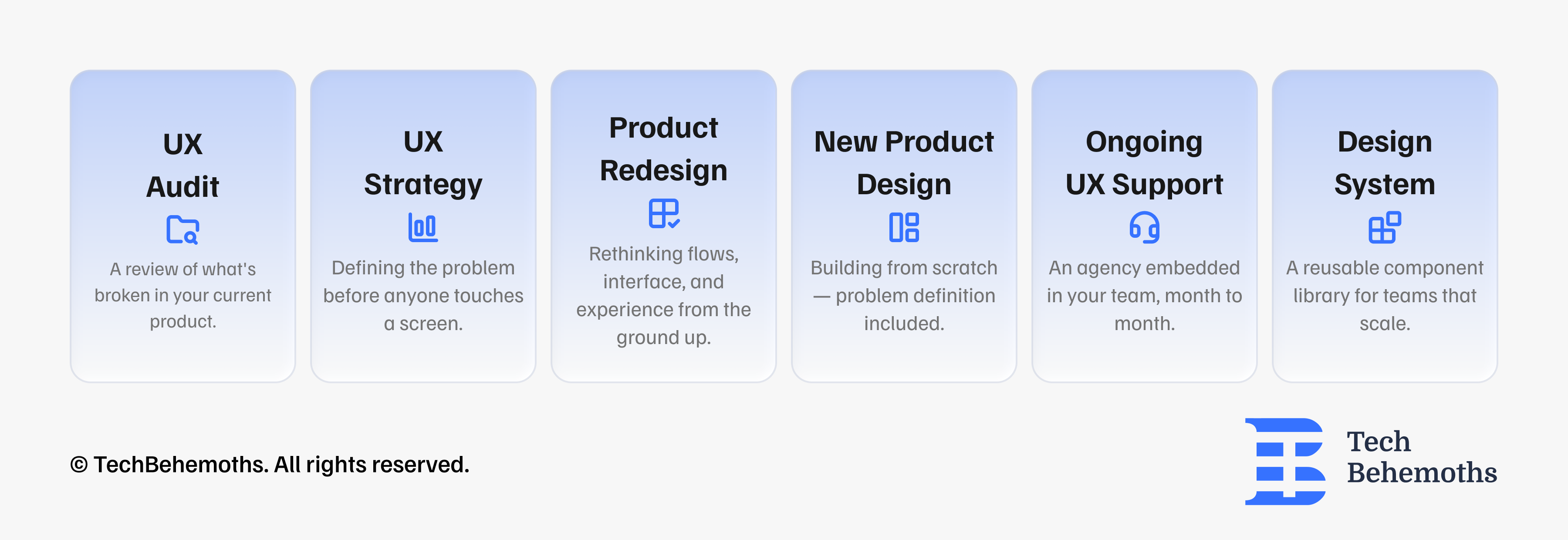
UX AUDIT. An independent review of what's broken in your current product. Usually a one-off engagement with a clear deliverable.
PRODUCT REDSIGN. Rethinking an existing product from flows to interface. Involves research, wireframing, testing, and handoff to dev.
NEW PRODUCT DESIGN. Building from scratch. You need an agency that can define the problem, not just execute on a brief someone else wrote.
ONGOING UX SUPPORT. A retainer model where the agency embeds into your team. Works best when you already have a product and ship regularly.
UX STRATEGY/ DISCOVERTY SPRINT. A focused research engagement before any design starts. Usually 2-4 weeks. The goal is to define the real problem, map the user, and set the direction, without touching the interface. Most useful when you're not yet sure what needs to be built.
DESIGN SYSTEM. A reusable component library with documented patterns, built for teams that manage multiple products or ship features regularly. Not a one-off project, it's infrastructure.
How to find and compare UX agencies in practice
Finding agencies isn't difficult. Finding the right one is.
Instead of spending weeks browsing Google results, start with a platform that lets you compare providers by specialization, location, reviews, pricing, and company size.
TechBehemoths currently features over 20.000 UX/UI design agencies and UX strategy firms, making it easier to narrow down the market before you contact anyone.
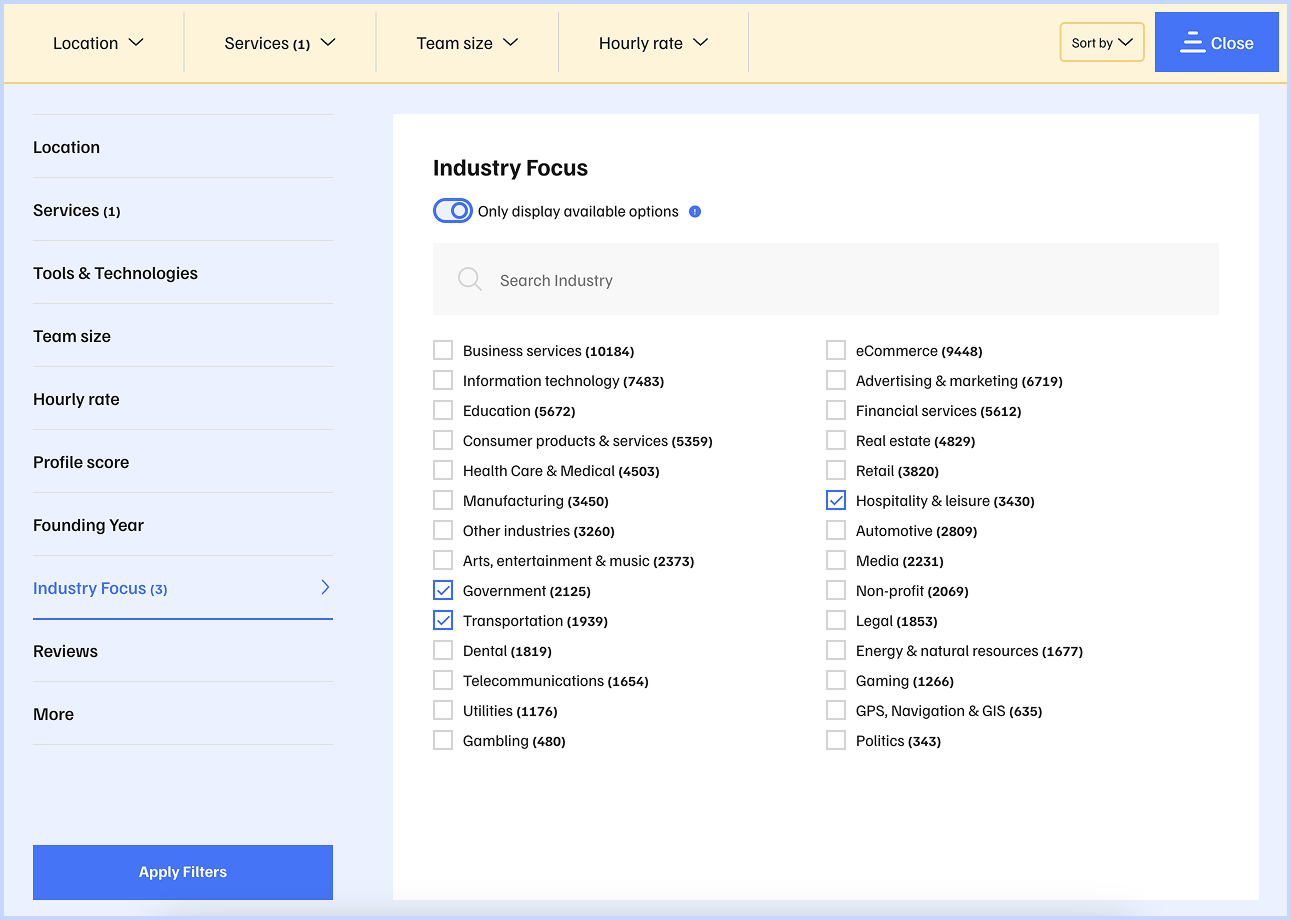
Step 1. Use filters to narrow your search
Focus on: country or region, company size, hourly rates, industry expertise, services offered, client reviews, minimum project size.
Step 2. Build an initial list
Start with 10-15 candidates. Review portfolios, ratings, years in business, industries served, pricing, and minimum project sizes.
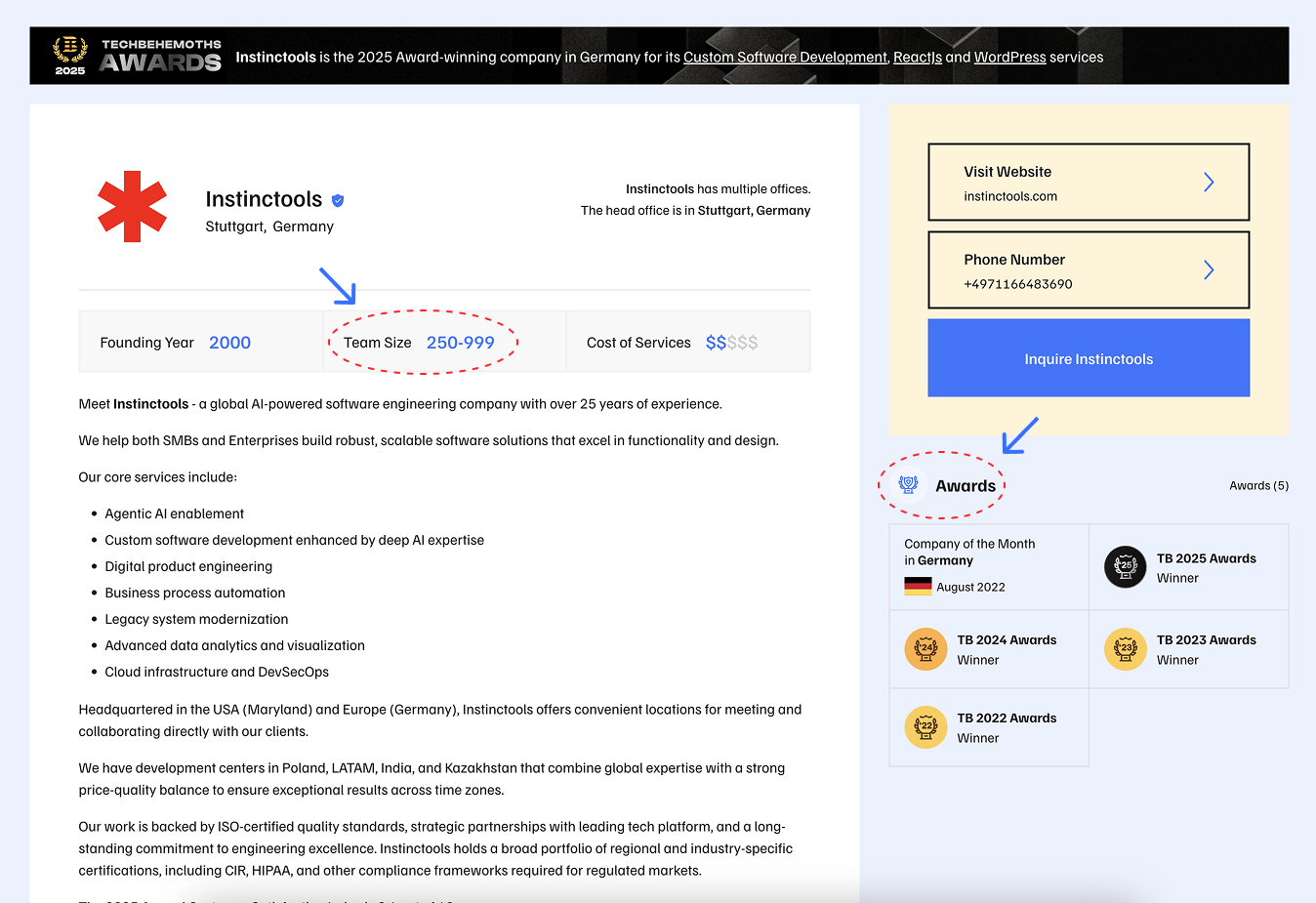
Step 3. Visit individual profiles
Good company profiles should tell you: services offered, previous clients, team size, hourly rates, project minimums, locations, reviews and ratings.
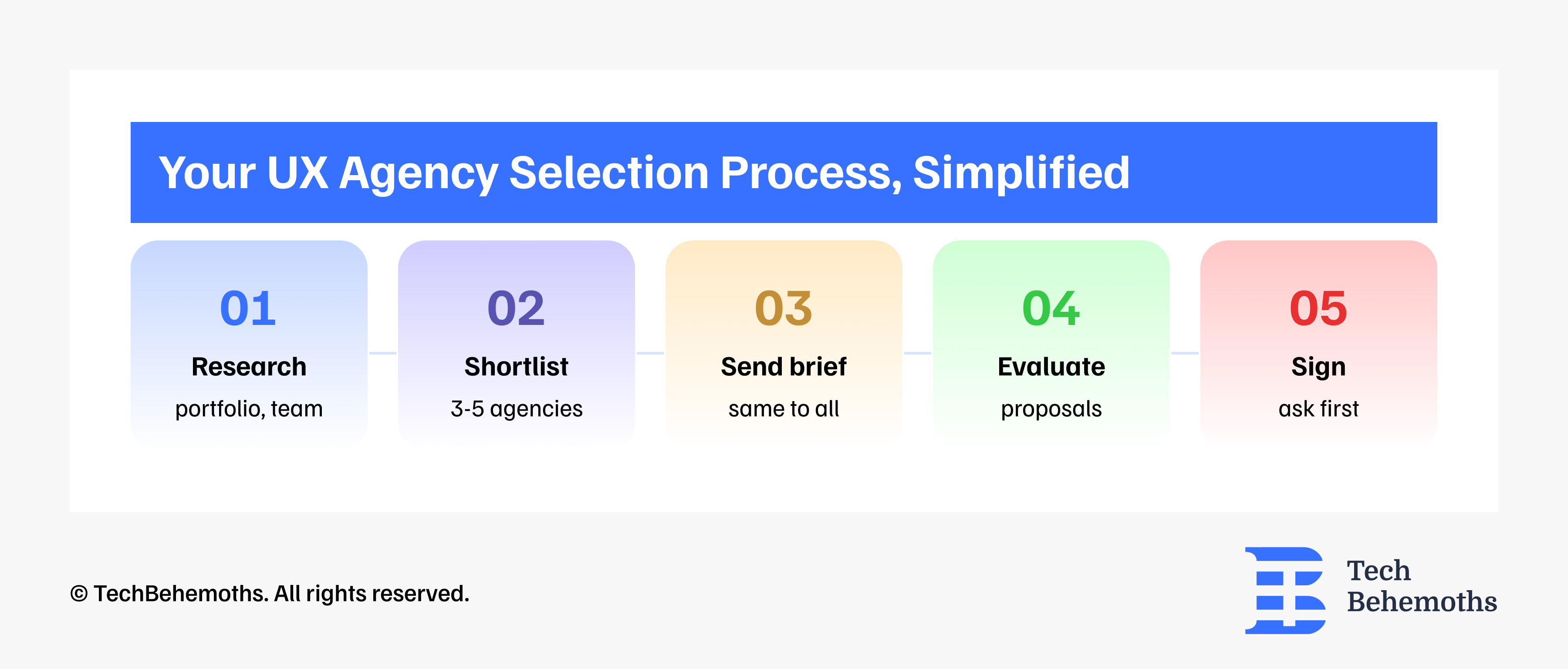
Step 4. Shortlist 3-5 agencies
More options don't lead to better decisions. Reduce your list to a maximum of five agencies and contact all of them with the exact same brief. Include: product context, target users, key problems, expected timeline, budget range, and any technical constraints. Using the same brief for everyone is the only way to compare apples to apples.
Once responses come in, prepare a list of questions tailored to your goals. Before that, align internally, discuss expectations with your team and define the methodology you're comfortable with.
This is the most important stage in the process. Your final decision depends on it, because specific questions reveal far more than generic sales calls and help reduce inconvenient surprises later.
Many companies speak with 15 or 20 agencies and end up more confused than when they started. A practical approach looks like this:
▪️ Start with a larger pool
▪️ Narrow it to around 10 candidates
▪️ Shortlist 3-5 agencies
▪️ Send the same brief to everyone
▪️ Compare proposals and communication styles
▪️ Choose one partner
Evaluation checklist
8 criteria, in order of importance:
-
Have they worked on products similar to yours? Not necessarily the same industry — UX complexity matters, not the domain.
-
Do they explain design decisions, rather than present them as final? A good agency can say, "I chose this navigation structure because..."
-
Who actually works on your project? Ask to know the exact team and meet them before you sign.
-
Do they do research with real users? If they don't test with users, it's not UX — it's UI.
-
Do they understand business metrics, not just design? If they don't know what CAC, LTV, or churn rate mean, beautiful design won't move the needle.
-
Can you talk to a previous client? Not a testimonial, but a 15-minute conversation with someone who worked with them in the last 12 months.
-
Do they deliver organized files and design systems? Or do you get a chaotic Figma your dev team can't use?
-
How do they handle negative feedback? Test in the call: raise a legitimate objection and see if they defend the design or listen.
What a solid UX process looks like
A good agency should be able to explain this before you sign anything. If they can't, the process probably doesn't exist.
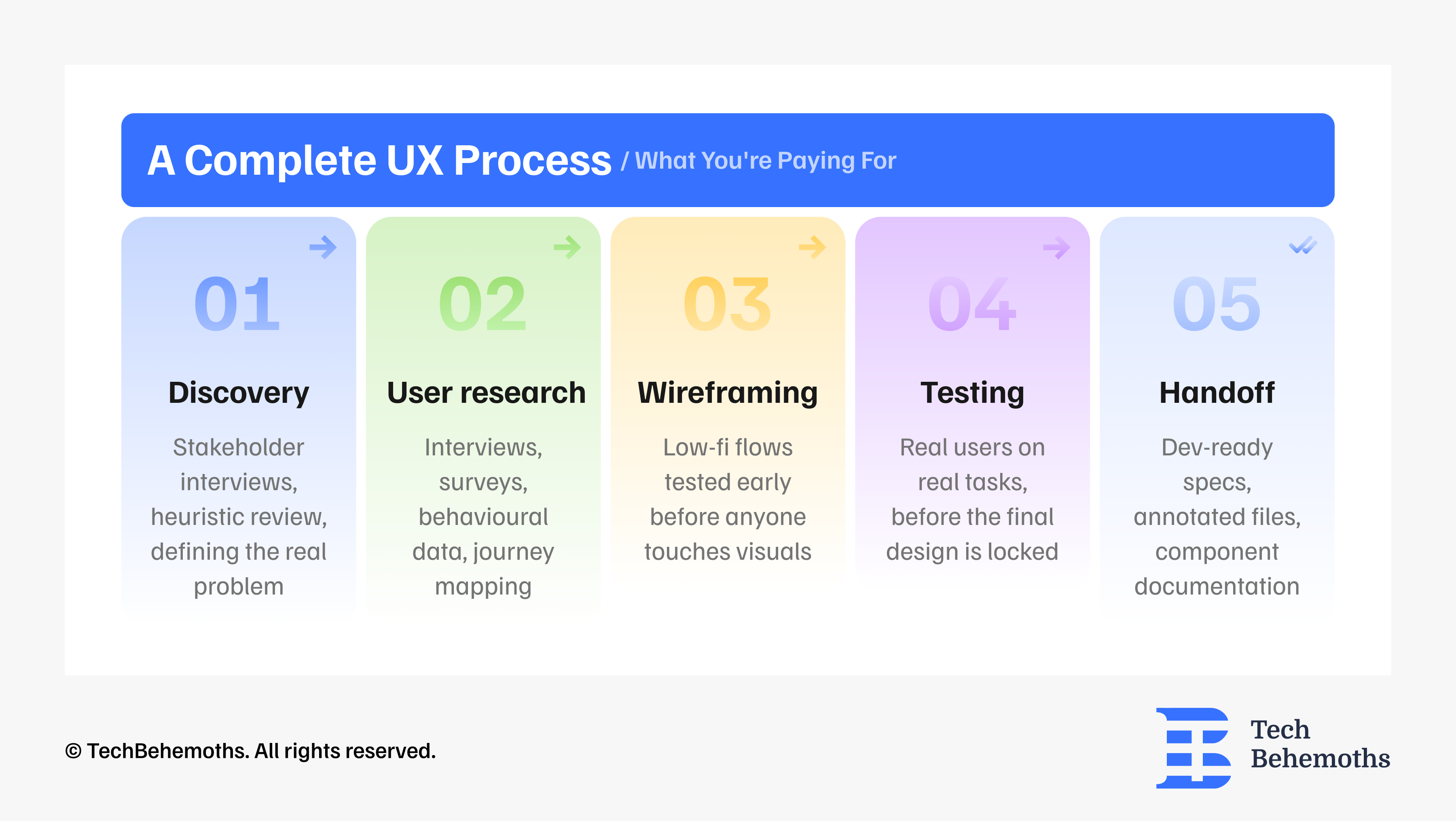
Not every project requires all five stages. But an agency that goes straight from brief to final design, with no steps in between, is cutting corners at your expense.
Types of deliverables and what they mean
Make sure you know what you're getting before the project starts, not after.
UX audit report — A documented review of usability issues, usually with severity ratings and recommendations.
Wireframes — Low or mid-fidelity screens showing structure and flow. Not the final visual design.
Interactive prototype — A clickable version of the design for testing with real users before development starts.
UI design files — Final visual designs in Figma or equivalent, ready for handoff. Should include a component library.
User research report — Findings from interviews or usability sessions, with insights that inform design decisions.
Design system — A reusable component library with documented patterns. Usually a longer-term deliverable, not a one-off project.
Turn Requirements Into Real Deliverables
Partner with UX/UI design agencies offering full-service work — from UX audits and wireframes to interactive prototypes and complete design systems.
Before you sign anything
Ask who specifically is on your project, not the team, but the person. Some agencies deliver only web files and call it done, so check what you're actually getting. Same with IP - get it in the contract, not in an email. And the question most clients skip: what usually goes wrong on projects like this? An agency that answers that honestly is one worth trusting.
Ask these before the first invoice:
-
Who exactly is working on our project, and can we meet them before we sign?
-
What do we actually get at the end, and in what formats?
-
What happens if we hate the first direction?
-
How many revision rounds are included, and what counts as a revision?
-
What's not in the quote?
-
When do we see the first concepts?
-
Who owns the files once we pay?
Budget: what to expect in 2026
UX costs vary widely depending on scope, team seniority, and geography. Every $1 invested in UX returns roughly $100, which makes it one of the better-performing line items in a product budget, but only if the work is done properly.
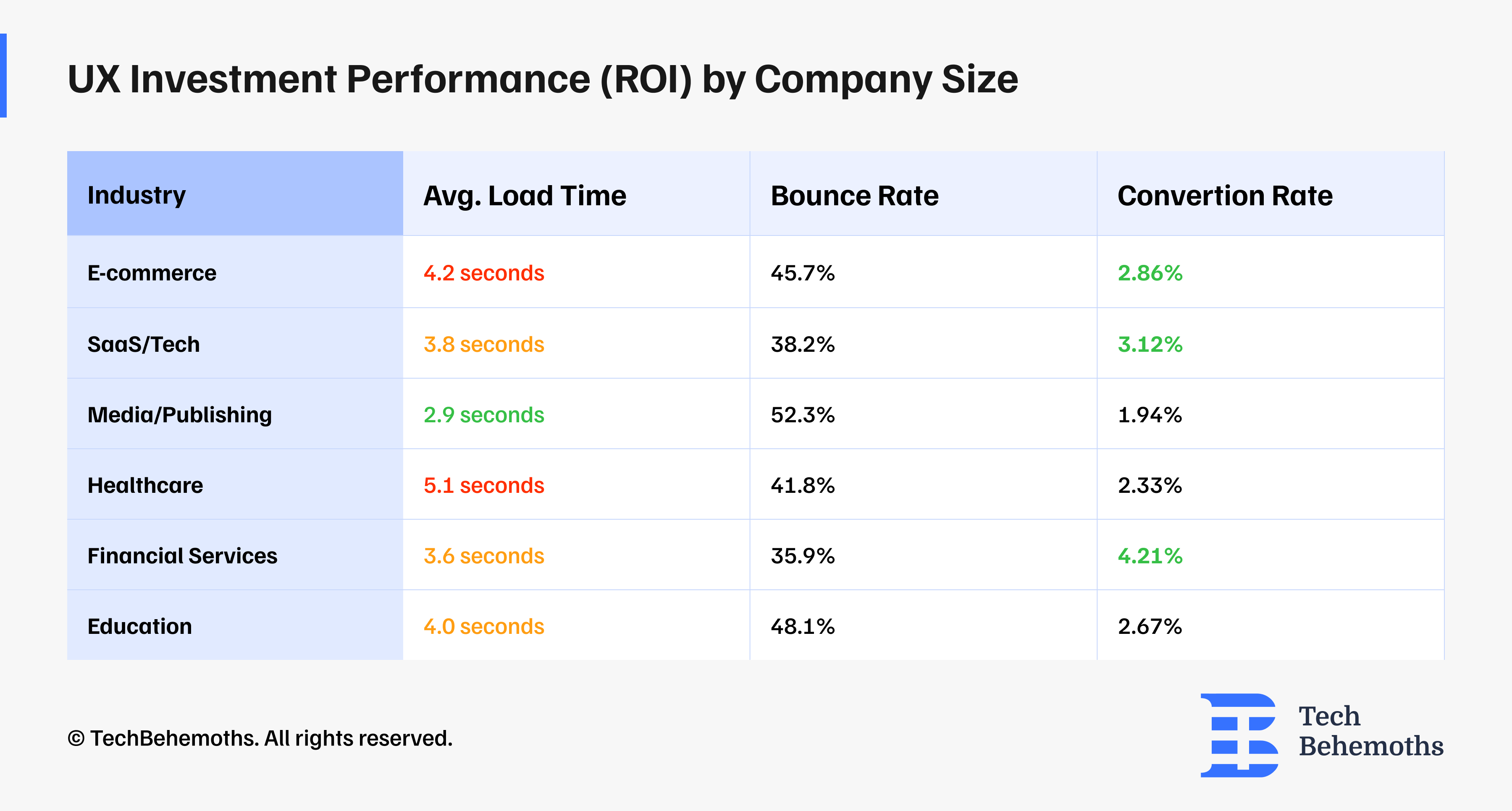
A poorly scoped engagement doesn't get you that return. A bad agency hire costs approximately €115,000 when you factor in wasted fees, the cost of a redo, and six months of lost market time.
|
Scope |
Who it's for |
Rough range |
|---|---|---|
|
UX audit |
Existing product with usability issues |
€3,000 – €10,000 |
|
Product redesign |
Full flow rethink with research and testing |
€15,000 – €60,000 |
|
New product design |
Discovery through dev-ready handoff |
€30,000 – €120,000+ |
|
Design system |
Scaling teams, multiple products |
€20,000 – €80,000+ |
|
Ongoing retainer |
Embedded UX support, monthly |
€5,000 – €20,000/month |
One final thought
Most people who hire the wrong UX agency knew something felt off. The pitch moved too fast, the portfolio was too polished for every single project, the senior partner had a smooth answer for every concern you raised. But the deadline was close, the budget was approved, and asking more questions felt like being difficult.
That's usually where it goes wrong, not in the research, not in the contract, but in that moment when the pressure to decide overrides the instinct to slow down.
The €115,000 average cost of a bad hire isn't an edge case. It's what happens when that instinct gets ignored.
Related Questions & Answers
How do I know if the agency showing me mockups has actually done user research?
What happens if the agency delivers Figma files my dev team can't use?
Can I change my mind about the direction after the project starts?
Should I hire an agency that hasn't worked in my industry before?
Who owns the design files once the project is done?
I tend to create digital content that captures, inspires, and generates impact. I resonate with the idea that less is more. My approach combines strategy, creativity, and analysis to build authentic and relevant messages. Beyond the digital space, nature is my sanctuary - a place of inspiration and balance. Exploring landscapes, I find clarity in nature's simple beauty.
Discover more TechBehemoths Insights
Learn practical tips and insights about IT Companies, how to find the right company for your projects.
Read the latest news about Market Trends and fresh Interviews.