Top 5 Cross-Platform Mobile App Frameworks for Android & iOS in 2026


Summary
A practical breakdown of the five cross-platform frameworks that real products are built on in 2026, and how to figure out which one is the right call for you.
Choosing the right cross-platform mobile app framework is not a casual decision that you as a founder should hand off to your developer. It shapes your hiring pool, your product roadmap for the years to come, and, most importantly, your budget. This article breaks down the five frameworks that are actually running production apps in 2026 and what makes them ideal or not for your product idea.
What are the 5 Frameworks Running Production Apps in 2026?
All of these frameworks have one thing in common: as cross-platform, their codebase can be engineered to ship on both iOS and Android flawlessly, fully proven in production.
React Native
This is the safest and most common option for most startups, where the real advantage is the JavaScript talent pool, not exactly the technology. Overall, React developers are easier to find, faster to onboard, and less expensive to recruit. As a plus, React is backed by Meta, which creates a variety of solid tutorials and libraries for developers to move forward at any time.
Flutter
The go-to option when UI quality needs to be a clear differentiator; overall it's the strongest cross-platform solution available today, ensuring positive, consistent experiences across iOS and Android. It is Google-backed and owns its own rendering engine.
Kotlin Multiplatform
Among the new options available, Kotlin is the fastest-growing serious one. It focuses on sharing business logic while allowing native UIs, so everyone can manage, process, and store things. As a main benefit, it reduces platform divergence, which attracts many engineering organizations.
.NET MAUI
Must be the first choice for organizations that have already invested in the Microsoft ecosystem. Enterprises with large .NET teams will definitely accelerate their mobile delivery, adding it as their framework.
Ionic + Capacitor
Even though it is usually overlooked, as a working ecosystem, it is a solid path from web development engineering to mobile apps. Mainly it helps you excel at creating MVPs and internal tools.
These five frameworks cover the majority of mobile products built today. They all work efficiently; if not, they wouldn't even be mentioned. For them to work efficiently for you, it's important to analyze your product context in the long term to match accordingly.
|
Framework |
Core Advantage |
Best Used For |
|---|---|---|
|
React Native |
Massive JavaScript talent pool; easy and cost-effective to recruit and onboard developers. |
Functional Utility: SaaS tools, fintech, marketplaces. |
|
Flutter |
Custom rendering engine that matches designer mockups identically on every screen. |
UI-First Products: Fitness apps, consumer brands. |
|
Kotlin Multiplatform |
Shares core business logic while keeping native UIs entirely untouched. |
Performance Efficiency: Existing mobile teams maximizing output. |
|
.NET MAUI |
Seamless integration for systems natively running on Microsoft architecture. |
Enterprise Tech: Large companies already utilizing .NET. |
|
Ionic + Capacitor |
Fast, direct bridge to deploy existing web code into a mobile wrapper. |
Speed-to-Market: MVPs, internal tools, and content apps. |
Why are Cross-platforms Thriving at Performance?
Yes, cross-platform apps used to feel slower and potentially have lower quality than a native app, but today that is no longer the reality. The JavaScript bridge problem is no longer an issue to worry about; no more middleman, no more lag, thanks to the evolution of these frameworks.
-
React Native’s new architecture: With the introduction of Fabric, TurboModules, and JSI, quality has increased significantly. Basically, enhancing user experience to a whole new level, faster startup, smoother animations, and overall better scrolling.
-
Flutter engine optimizations: With Flutter now owning its entire rendering pipeline, it has way more control, meaning fewer surprises and a consistent output.
But today, realistically speaking, the shift has come from a change of perspective about development and architecture, not entirely from framework potential. Teams now can analyze an app separately and decide from there what's worth sharing and what should be built natively for each platform.
By 2026, the discussion is no longer about whether cross-platform frameworks are good enough. They are. The real question is whether your framework choice supports your hiring strategy, product roadmap, and business goals. Technology rarely becomes the bottleneck; misaligned decisions do.
Emerson Reyna, Senior Product Owner at Designli
What Framework Should You Choose for Your App?
This is not set in stone; it’s just a very calculated suggestion for builders.
-
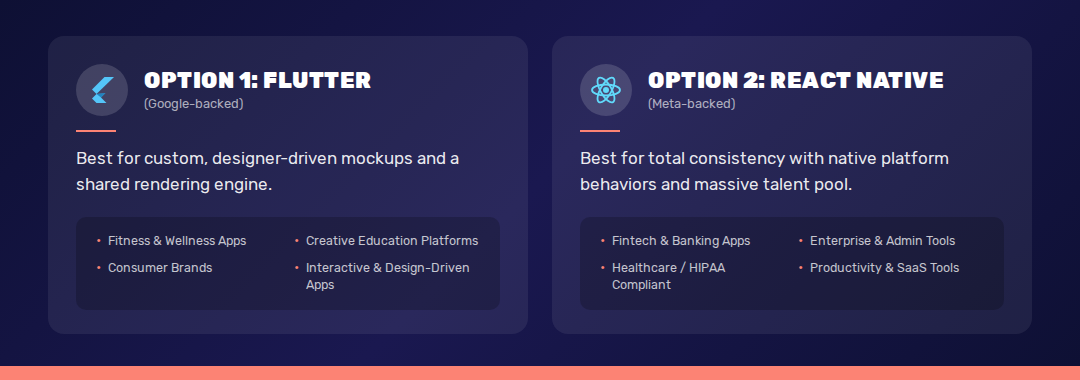
If your product experience is the main focus of your idea, meaning consumer apps, fitness platforms, education products, and similar things, choose Flutter. This decision will guarantee the exact UI all around the product, and if your designers feel more comfortable with it, it is a no-brainer.
-
However, if your product is centered around users expecting total consistency, like for fintech, healthcare, productivity, and enterprise applications, choose React Native. Users expect familiarity; an iPhone user wants it to work and behave as an iPhone app, and the same goes for Android users.
In our experience at Designli, the teams that struggle most with this decision are the ones optimizing for the technology instead of the product context, and that's usually where timelines slip. Getting it right requires understanding your industry, your growth trajectory, and increasingly, how your framework holds up as AI capabilities become a baseline expectation in mobile products.
From a Cost Perspective, What Should You Choose?
As this article is focused on non-technical founders and founders in the early stages of their startups, advice will be around these scenarios.
For React Native, an advantage is a massive JavaScript talent pool; it's easier for recruiting as well as contractor availability and even scaling. Since most companies already have React web developers, hiring risk is lower.
→ Limited funding, the need to hire quickly, and uncertain roadmap = React Native
As a framework, Flutter's advantage is being highly productive for developers, having a consistent development experience, and having a strong code quality culture; however, it does have a smaller talent pool and a higher dependence on specialized Flutter engineers.
→ Stable funding, need for strong founding engineers and a product heavily dependent on UI differentiation = Flutter
*Regarding Kotlin, MAUI, and Ionic, there is really no decision to make; given their specific context, they are the ideal choice directly.
Case Study: Shopify & React Native
In 2020, Shopify decided to trust React Native as its main framework to build apps. At one point they were building both with React Native and Native they identified that native doesn't mean speed, nor is React Native the slower option. What they did say is the evolution of React Native as a world-class framework is evident.
Some of the reasons Shopify found React Native better suited for them were hot reloading, which is more effective for their large code bases; with Native it took longer and broke developers' flow. TypeScript has become a universal success with developers transitioning between React web and React Native, facilitating the transition between web and mobile. At the end of the day, this decision depends on many factors; for Shopify it was a shift that made sense and was successful over time.
The Best Choice Adapts to Your Team
We've discussed the top five frameworks for cross-platform mobile development available in 2026. The best way to decide which one to choose is to understand how your team is built, what its strengths are, your product’s UX requirements, and what will be the best bet for flawless development in the long run. If you ever get the urge to rebuild towards full Native, remember this must be a very calculated decision, because you are looking at least 12 months, if not more, of new development.
Be clear if that extra percent of performance improvement is worth the time and resources. If your current cross-platform framework is working well, keep it that way; if you get evidence to evolve, go for it.
Related Questions & Answers
Are cross-platform apps good enough for a funded startup, or do serious products need native development?
Can I switch cross-platform frameworks later if I pick the wrong one?
How do I know if my app needs Flutter's pixel-perfect UI or React Native's native components?
Keith Shields is the CEO and Co-founder of Designli, a leading software and web development company. Keith is passionate about creating impactful digital experiences for non-technical founders. He co-founded Applits, a startup recognized as the "Coolest College Startup of 2014" by Inc.com, and has since led hundreds of successful projects at Designli. As a serial entrepreneur, Keith is committed to helping non-technical founders launch transformative digital products through Designli’s proprietary SolutionLab process.
Discover more TechBehemoths Insights
Learn practical tips and insights about IT Companies, how to find the right company for your projects.
Read the latest news about Market Trends and fresh Interviews.