There are 44 Companies in Iraq
that provide UX/UI Design Services!
Despite political instability and security concerns, the IT services market in this country is growing, driven by rising demand for digital transformation and technology adoption across sectors such as oil, gas, finance, and telecommunications. Iraq is continuously optimizing its tech sector through government digital initiatives, increased internet and smartphone penetration, and investment in digital infrastructure like fiber backhaul and data centers.
Discover Top IT Companies in Iraq specialized in UX/UI Design including Usability Testing, User Research, UX Strategy and more.
Have you ever noticed how some websites and apps just feel easier to use than others? - That's because of the UX/UI design - basically, the people who make sure everything looks good and is easy to navigate. UX/UI design services are closely connected, but they are not the same.
UI (user interface) design concentrates on visual elements. It is all about how things look and work on a product, like colors, fonts, and buttons. UX (user experience) refers to the overall experience a person has with a product – how easy it is to use the product, how it makes the user feel, and whether it is possible to easily get what is needed from it.
Handpicked companies • No obligation to hire • 100% risk-free
Featured Companies in Iraq
This month, the following UX/UI Design companies managed to provide an outstanding service and support. It's worth taking a look.

IT service provider company formed by a dynamic professional team with rich experience in providing customized and customer-centric solutions.

Suncode co is an IT solutions and consultancy company based in Erbil, providing high quality web development, designing and IT services.
VOXO Design is a creative studio based in Erbil, specializing in motion graphics, 3D design, branding, and social media content.
Explore Top UX/UI Design Companies in Iraq
Enzziro — your full-stack tech partner for AI solutions, mobile apps, websites, and custom software built to scale.
We design and develop high-performance web, mobile, and AI-powered software that helps businesses automate, scale, and transform digitally worldwide.
H9 Cloud is a software development company delivering innovative digital solutions that help businesses across Iraq grow, automate, and scale.
Services:
Ronex Enterprises builds custom software, cloud infrastructure, digital products, and brand experiences for modern businesses.

https://mydano.ir/
Data analytics partner helping Iraqi businesses turn scattered data into clearer decisions and stronger profit.

For information technology ( Development - Consultancy - Socialmedia )
White Label Solutions is a top-tier software development company specializing in custom web development, mobile app development.
MoonWhale® is a creative tech studio building websites, apps, and AI-powered systems that help individuals and companies work faster and smarter.

We are a creative studio, committed to creating meaningful solutions built around the fundamentals of design and technology.

There is always a solution with solway
Becorp is a strategic communication and branding agency blending local insight and global expertise to craft impactful solutions for the Iraqi market.
Software, Call Center and Marketing Solutions
Driving Smart Innovation Your Digital Future, Simplified We craft innovative solutions and digital experiences to power your business growth.
Cutting-edge mobile app development with AI innovation to craft digital solutions that enhance lives.
Your Partner in the IT and tech Space In Iraq
Safe Data provides Safe Products: * ERP * Educational Compound * Store * Rest * Clinic * HR Services: * Website * Web & Mobile App * Cloud * UX/Ui

Transforming ideas into digital solutions
Alphabet is a leading software house company in Iraq, that provides multiple solutions that will fit your needs, with unlimited customization ability
Services:

Business Line is a SAP Gold Partner in Iraq, specializing in ERP solutions and digital transformation for businesses.
We are a UK based Software consultancy expanding our services in the Kurdistan Region of Iraq.
- 1
- 2
Filter UX/UI Design Companies in Iraq by Cities
Find the right tech company near you or from a specific city. Some of the best companies might be located in smaller cities.
Find more UX/UI Design companies around the world
TechBehemoths is the world's most advanced and user-friendly platform to match IT Companies with real clients without hustle.
The IT Industry in Iraq: General Profile and Insights
Despite the political instability and security concerns, the IT services market in this country is growing, powered by increasing demand for digital transition and technology adoption in sectors like oil, gas, finance, and telecommunications.
The IT services market in Iraq is expected to reach $975.2 million in 2025, and the dominating sector is IT Outsourcing, underlining the high demand for these services from this country. The average spend per employee in this sector is expected to reach $76.79.
Iraq is continuously optimizing its tech sector through government digital initiatives, increased internet and smartphone penetration, and investment in digital infrastructure like fiber backhaul and data centers. Against challenges like power instability and a shortage of skilled labour, the market is expanding with rising demand for cloud, IT services, and security solutions.
Why Should You Work With an Iraq-based Company?
In Iraq’s tech sector is a rising focus on digital technologies, including Cybersecurity, AI, and robotics. Doing business in Iraq or collaborating with a tech company from this region could bring multiple benefits for your project.
The growing number of people adopting digital services and e-commerce will lead to the development of data centers and smart cities initiatives. This can cause increased demand for outsourcing services in fields like e-commerce, Data Management, and infrastructure development.
Iraq’s workforce is one of its greatest assets, with 60% of its population under the age of 25. This growing tech force is eager to embrace new opportunities, as young people are more adaptable to new technologies and possess the digital literacy required for many tech roles like IT support, Software Development, and Data Entry. Also, the country's English proficiency is very high, making communication and collaboration easier.
The ICT market in Iraq is growing quickly, so it provides individuals to be part of or contribute to this development that is at an early stage. Other factors that influence this improvement include the rising smartphone and internet adoption, increasing demand for cloud services, digital payment systems, and growth in e-commerce and digital services. These combined make Iraqi companies a good choice for partnerships and innovation development.
What You Should Be Aware of When Working With Iraq-based Tech Companies?
Despite the growth of the IT sector and its many benefits, working with tech firms in Iraq may be complicated for several reasons. The weak internet connection and power outages make the work process harder, as they are widespread across many parts of the country. Iraq’s geographical elements (deserts, remote zones, and mountains) complicate laying fiber-optic cables and maintaining a stable digital framework. These factors make remote collaboration and reliable communication very challenging.
Skills gaps are also a factor to look for when working with a tech company from Iraq. There is a shortage in some specialized ICT areas, for example, Software Engineering, Cybersecurity, and cloud computing. Other difficulties include political instability, security risks, cultural challenges, and possible financial limitations. To avoid these issues, it is important to check the company’s infrastructure, reliability, assess the team’s skills, and clarify legal terms.
Are Iraqi IT Companies Reliable?
The tech scene in Iraq is described as focused on development and optimization despite its political instability and location complications. The reliability of the Iraqi tech firms depends on the company itself, as it is different for each of them.
Taking into consideration the tech market's growth in Iraq in recent years, which is caused by the regional firms, it is important to note their dedication to further drive improvement. Collaborating with a tech company in Iraq can offer the possibility to take part in this progress and develop innovations.
How is Iraq’s IT Sector Related to Neighboring Countries?
The tech industry in Iraq is connected and influenced by its neighbouring countries, such as Iran and Turkey. In 2025, this country and Iran expressed interest in expanding cooperation in fields like AI, Cybersecurity, digital government services, and communication networks. The two countries signed a memorandum of understanding (MoU) for ICT cooperation. They can benefit from shared expertise, knowledge transfer, and cross-border partnerships. The same year, the national telecom authorities signed a contract with a Turkish telecom company to integrate Iraq and Turk Telecom with a joint telecommunication network.
What is UX/UI Design and what are its benefits for your projects?
Have you ever noticed how some websites and apps just feel easier to use than others? That's because of the UX/UI design - basically, the people who make sure everything looks good and is easy to navigate.
UX/UI design services are closely connected, but they are not the same. They are actually about different parts of the design and to be effective they must work together.
-
UI (user interface) design concentrates on visual elements. It is all about how things look and work on a product, like colors, fonts, and buttons.
-
UX (user experience) refers to the overall experience a person has with a product - how easy it is to use the product, how it makes the user feel, and whether it is possible to easily get what is needed from it.
According to research conducted by Forrester, a well-designed user interface (UI) can increase a website's conversion rate by 200%, whereas a better user experience (UX) design could raise it by up to 400%.
In this connection, the importance of UX/UI Design cannot be overstated. Nowadays users have high expectations for the products they use, if a product is not easy to use or enjoyable, users will quickly abandon it.
UX/UI design can help:
-
Enhance user satisfaction
-
Reduce bounce rates
-
Lead to higher customer retention and revenue
UX Design has also an important role in Inclusive Government Design, which makes government services accessible and user-friendly for diverse and marginalized communities.
But how do choose the right UX/UI Company?
-
Review the company's portfolio and make sure they have experience in your industry
-
Look for companies that understand your target audience to meet their needs.
-
Inquire about their design process: research, wireframing, prototyping, and testing.
-
Choose a company that maintains transparent and open communication and keeps you involved throughout the design process.
-
Read client reviews to check their reputation and client satisfaction.
-
A good design company should be up-to-date with the latest design trends and technologies.
Taking into consideration all these tips you will manage to select the right UX/UI Design Company that will help to achieve your goals.
There are over 13,800 UX/UI Design companies on TechBehemoths platform. Check their profiles, their strong portfolios, and previous clients' reviews before you make a decision. With the help of smart filters, you can easily find suitable partners to deliver exceptional digital experiences. Alternatively, you can submit your project, and the system will find the best match on your behalf.
UI/UX design in the AI era
As AI tools evolve and become more capable of prototyping and designing layouts, the human/emotional aspect will become even more important. AI can't experience and tell and illustrate personal stories, while UI/UX designers can. This human/personal touch will become a valuable part of UI/UX work.
You can interact with the web in multiple ways: using text, voice, images, videos, VR, etc. All these require user interfaces adapted to different needs and scenarios. Professional design agencies should be able to deliver interfaces and UX for multiple interaction modes and devices like smartphones, VR headsets, smart glasses, etc.
The importance of UI/UX for your leads/sales
Lots of websites lose their visitors without a single click. Poor UX design is almost always the reason, and most business owners don't even know where the problem is.
On average, websites convert only 2–3% of visitors. This means the majority of visitors land on a site, browse for a few seconds, and leave without taking any action. Business owners express this as one of their most common frustrations.
How to solve this problem?
The answer is simple: make it easy for visitors to take desired actions on your website, such as viewing a product page or service, completing a purchase, or downloading a resource.
Your website should communicate effectively, guide users, and convince them to take a specific action.
Why your website doesn't convert
There might be multiple reasons, but here are the most common ones + some tips on how to improve your UX to convert visits into leads/conversions.
1. The first seconds count
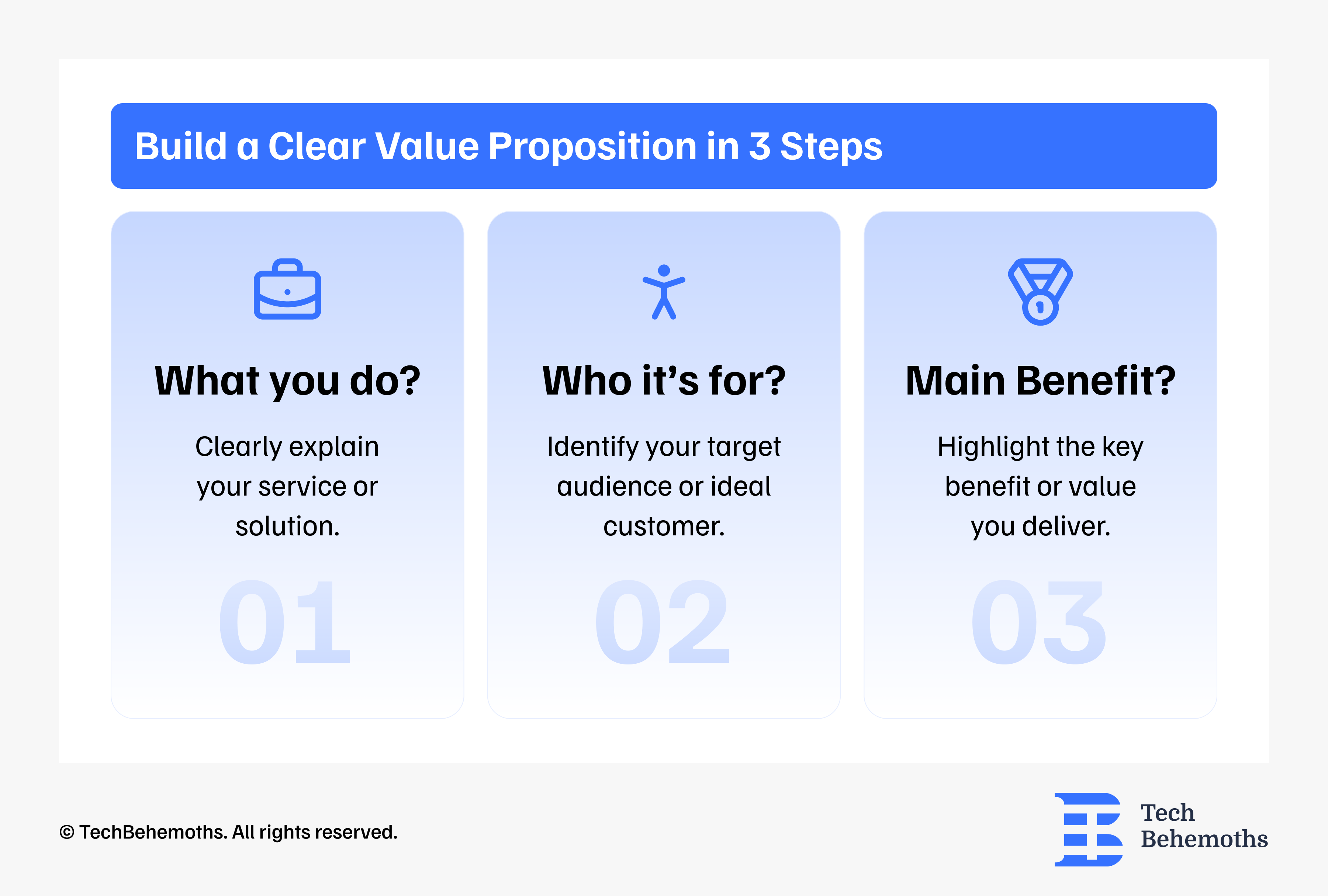
How to fix? Start with a clear value proposition that shows the benefits and answers these three questions right away.
2. No call to actions (CTAs)
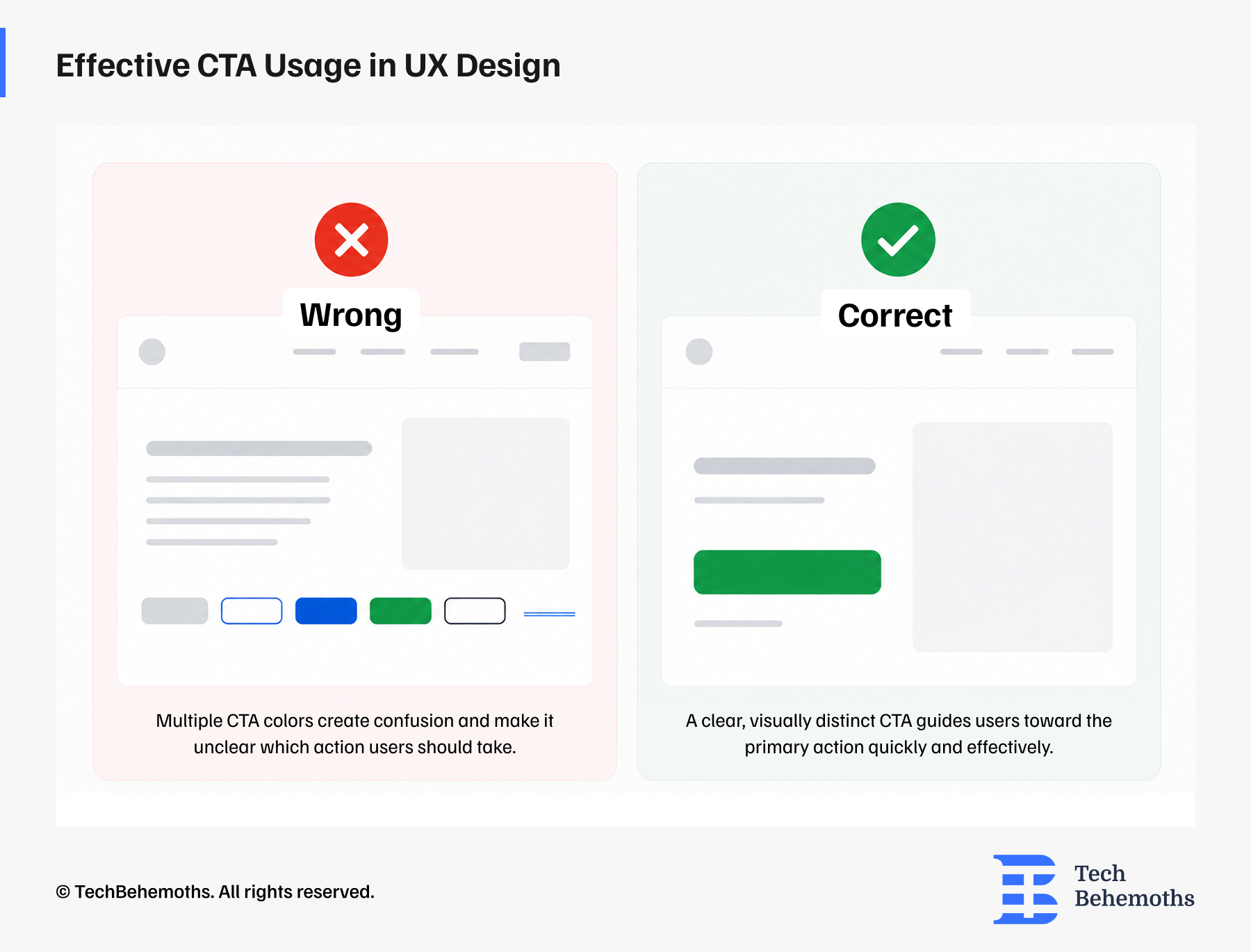
How to fix? Your service/product and other important pages should have one primary CTA, and it should be: specific, prominent, smooth/short. Example: Get a free quote.
3. Poor mobile UI/UX
How to fix? Focus on mobile-first UX design, which means designing the mobile experience first and then adapting it for the desktop experience.
4. No social proof
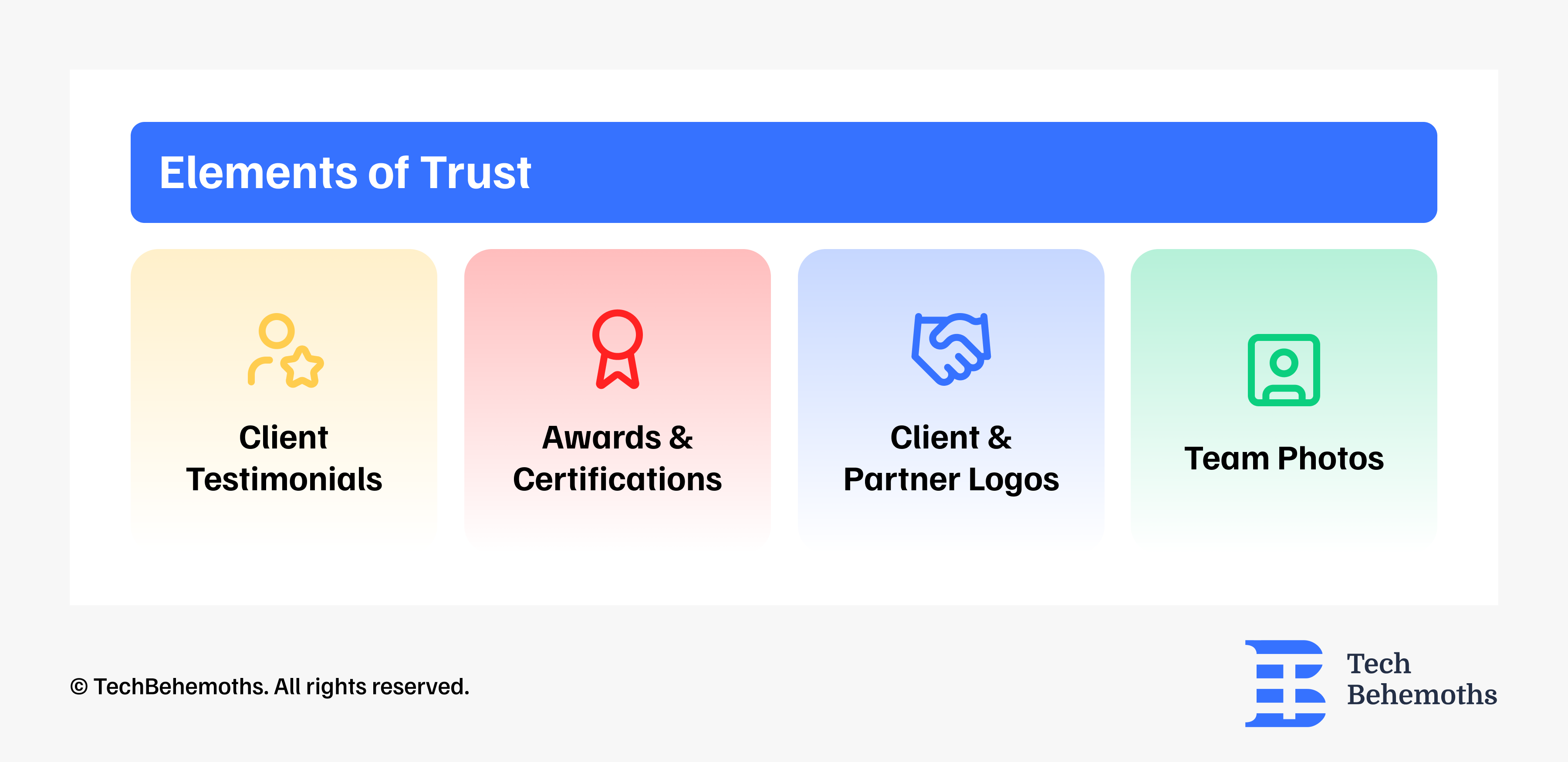
How to fix? Place trust signals throughout the conversion path: client testimonials, reviews, awards, certifications, team photos, etc.
5. Complex navigation/structure
How to fix? Simplify your navigation and content structure by limiting menu items, using plain language, making contact options visible and accessible from everywhere, using proper visual hierarchy.
6. Slow loading time
How to fix? Optimize your web pages for speed, especially for mobile devices. Use modern image formats like webp, compress images, use reliable/fast hosting, minify JavaScript/CSS, don't usee too many 3rd party services.
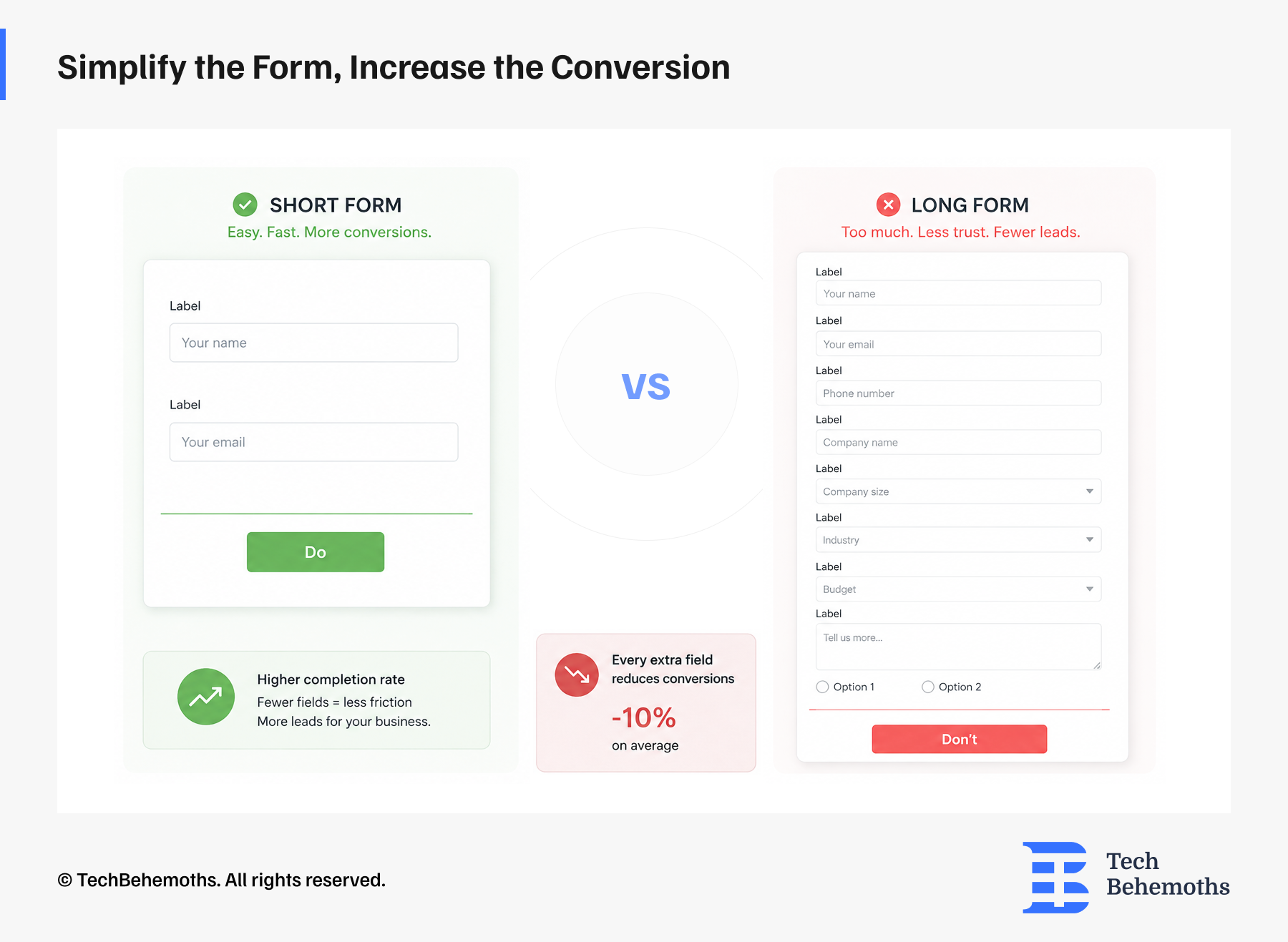
7. Too long forms
How to fix? Use the minimum required number of input fields: name, email, and one open field. Don;t overwhelm users withh too many questions and options.
How to choose the right UX/UI agency?
Choosing a UX/UI agency is a business decision with consequences that show up months after the contract is signed. Most companies evaluate agencies based solely on portfolios and presentations, which are the things easiest to polish and hardest to verify.
What separates a good hire from an expensive mistake is usually visible before you sign anything. You just have to know where to look.
How to do research UX/UI agencies, the right way
Most users go straight to the portfolio, and that's ok, but it's not the whole picture. Here are the criteria that actually matter before you reach out to anyone.
1. Portfolio, look past the aesthetics
Good UX agencies solve different problems differently.
2. Research, visuals are not enough
Any agency can show you Figma files. Ask them to walk you through how they got there. If there's no mention of user interviews, usability testing, or data, the work is decoration, not design.
3. Industry experience is useful, but not mandatory
For fintech, healthcare, or anything with compliance layers, prior domain experience saves valuable time. Sometimes, an agency coming in fresh can be the better bet, having a different perspective
4. Negative client reviews
A profile with an ideal five stars rating is worth questioning.
5. Who's exactly working on your project
The number one complaint in the agency world is the bait-and-switch, a senior partner sells the deal, but junior interns do the work. Before moving forward, ask who's actually doing the work. Thirty minutes of reference calls can save you thousands in wasted fees.
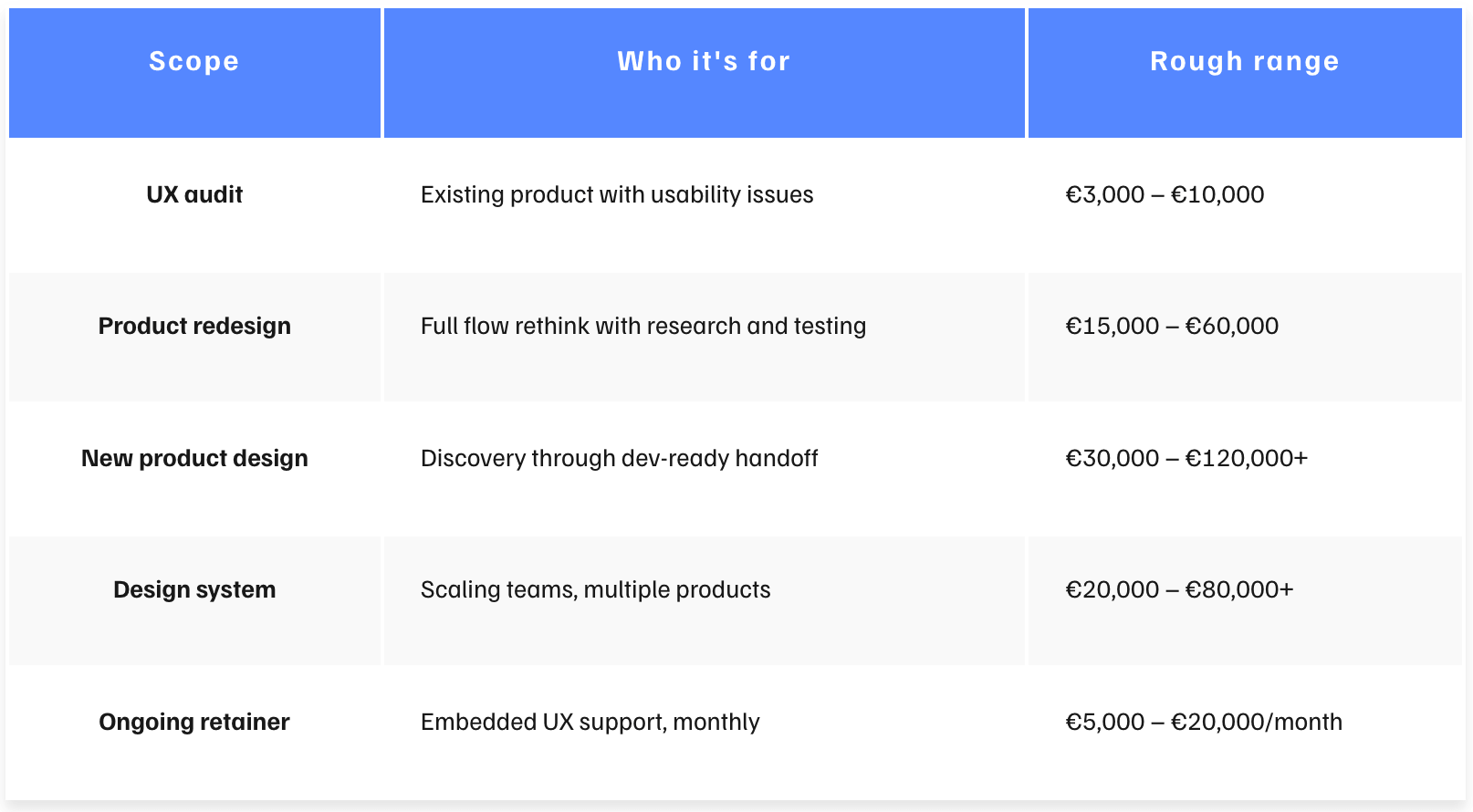
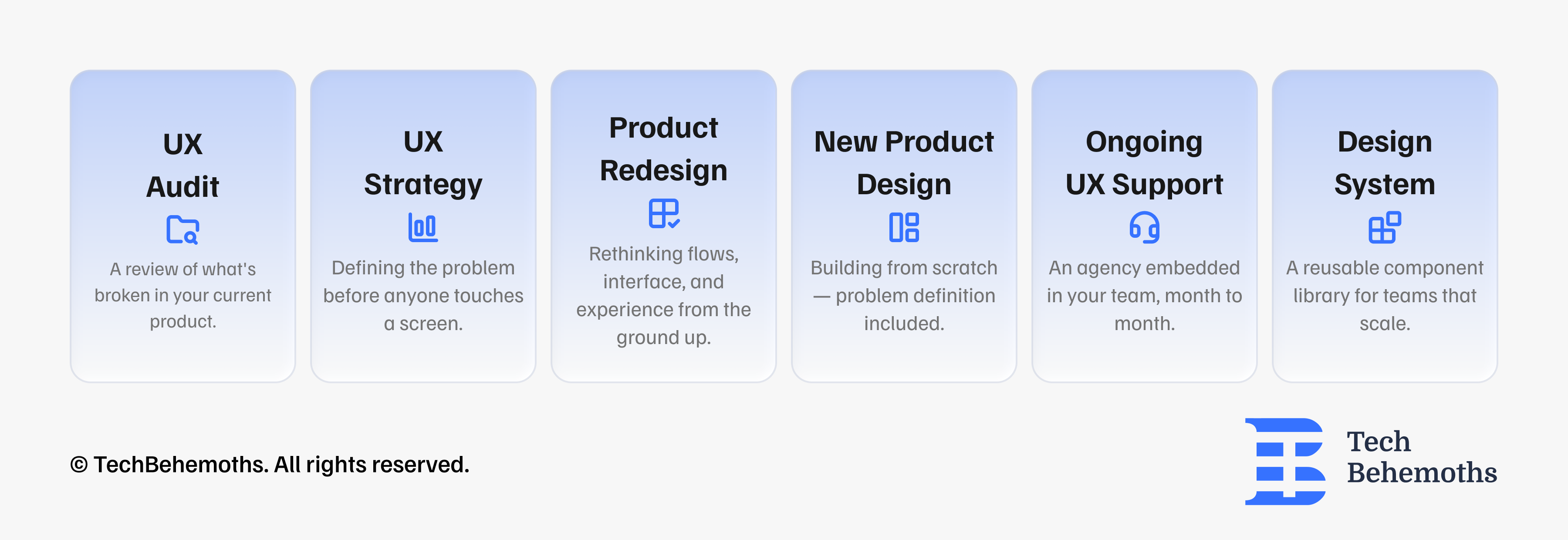
6. Not all UX/UI projects are the same
Before you talk to anyone, get specific about what you're buying. UX covers a wide range of work, and the type of agency you need depends on what the actual problem is.
Here is a set of common UX/UI tasks to keep in mind.
How to shortlist the right agencies?
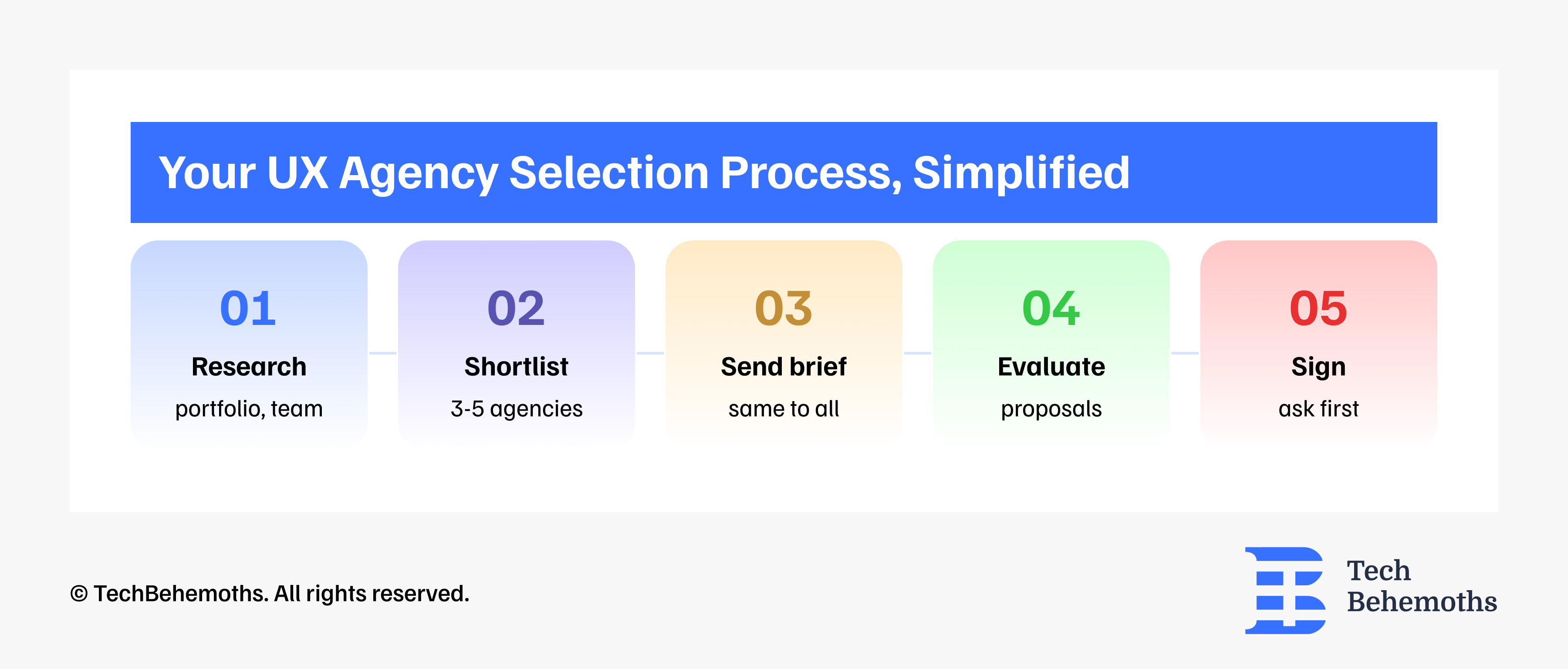
Many clients speak with 15 - 20 agencies and end up more confused than when they started. A practical approach looks like this:
-
Start with a larger pool of companies
-
Narrow it to around 10 agencies
-
Shortlist 3-5 agencies
-
Send the same brief to everyone
-
Compare proposals and communication styles
-
Choose one partner
A poorly scoped engagement can lead to a bad return/outcome. A bad agency hire costs approximately €115,000 when you calculate wasted fees, the cost of a redo, and months of lost market time.