There are 62 Companies in Bulgaria
that provide UX/UI Design Services!
Bulgaria has long been recognized for having a strong tech industry and, during the past few years, has become one of the top software development hubs. Its geographical proximity to Western Europe and cultural similarities with the US and Western European countries, the availability of technically diverse, highly-skilled, and multi-lingual talent, the affordable labor cost, and favorable taxation are among the main advantages of the country.
Discover Top IT Companies in Bulgaria specialized in UX/UI Design including Usability Testing, User Research, UX Strategy and more.
Have you ever noticed how some websites and apps just feel easier to use than others? - That's because of the UX/UI design - basically, the people who make sure everything looks good and is easy to navigate. UX/UI design services are closely connected, but they are not the same.
UI (user interface) design concentrates on visual elements. It is all about how things look and work on a product, like colors, fonts, and buttons. UX (user experience) refers to the overall experience a person has with a product – how easy it is to use the product, how it makes the user feel, and whether it is possible to easily get what is needed from it.
Handpicked companies • No obligation to hire • 100% risk-free
Featured Companies in Bulgaria
This month, the following UX/UI Design companies managed to provide an outstanding service and support. It's worth taking a look.

AI-augmented software engineering company delivering scalable solutions and dedicated teams worldwide.
Custom software, app and web development company. ✉ - [email protected]🌎

Presitely is an award-winning full-service digital marketing agency providing holistic solutions to businesses worldwide since 2014.
Explore Top UX/UI Design Companies in Bulgaria

Webolie Ltd delivers innovative web-based solutions, expert consulting, and online marketing services to help businesses thrive in the digital age.

Everything is possible for those who believe! Your full-service marketing and communication agency in Europe!
Experts in Web Development in Plovdiv, Bulgaria / EU. Website design and web development studio. Company and business websites.

The Collaboratory. A place where initiative meets inquisitiveness.

iZi Media Group helps businesses grow in the Balkans through web development, digital marketing, call center services, and market expansion consulting

BeLinked is a Sofia-based digital marketing agency specializing in web design, PPC, social media, SEO, GEO and e-commerce growth.
Services:
Boutique digital marketing agency helping businesses grow through high-converting websites, SEO, Google Ads, and Meta Ads.

Digital Products & Platforms, R&D Embedded Engineering, Automotive Software
Software R&D partner from Europe
goodmorning is a Web3 development studio providing scalable decentralized products for startups, enterprises, and Web3-native organizations worldwide.

Accedia is an AI and custom software company delivering engineering, data and technology consulting from concept to production since 2012.

If you’re looking for a cheap offshore production shop, that’s not us. If a long-term partnership with a highly-efficient, easy-to-work-with global le...

Helping our clients reach their full potential through quality software and long-term partnership

Boutique web studio in Sofia building fast custom-coded websites and headless online stores for ambitious small and medium businesses.

A Registered ServiceNow Partner and a product and software development company focused on delivering great service with customer-centric approach

Web Solutions for Positive Impact

Grumspot is a Shopify Plus agency, based in Sofia, Bulgaria. We specializee in custom builds and Shopify app development.

We design high-performance digital identities for small businesses that demand more than just a website.
Public Cloud Group (PCG) Verified Company
Blagoevgrad, Bulgaria Head office in: Germany
We're your trusted partner backed by certified expertise. We empower European businesses in developing and growing their cloud strategy.

I’m a web designer located in Bulgaria, Europe. Since the past 15 years I’ve worked on a variety of projects for small, medium and large companies.

Infopulse, part of Tietoevry, is an international vendor of end-to-end digital services and solutions since 1991.
Filter UX/UI Design Companies in Bulgaria by Cities
Find the right tech company near you or from a specific city. Some of the best companies might be located in smaller cities.
Find more UX/UI Design companies around the world
TechBehemoths is the world's most advanced and user-friendly platform to match IT Companies with real clients without hustle.
The ICT Industry in Bulgaria: General Profile
Bulgaria has long been recognized for having a strong tech industry, and during the past few years has become one of the top software development hubs. Its geographical proximity to Western Europe and cultural similarities with the US and Western European countries, the availability of technically diverse, highly-skilled, and multi-lingual talent, the affordable labor cost, and favorable taxation are among the main advantages of the country.
With heavy traditions in IT and mathematics that could be traced back to the communist times, Bulgarians have strong technical knowledge and are one of the best-performing developers in Europe, as stated in the European Innovative Scoreboard 2025. They rank 26th in the overall chart and occupy top positions in major technologies such as Design Applications (#3) and Trademark applications (#3).
Why Should You Work With a Bulgarian IT Company?
Among the multi-national organizations that have already discovered the advantages of the country and built their operational and development centers in Bulgaria are companies like HP, SAP, Microsoft, VMware, and others. Currently, the IT sector in Bulgaria consists of more than 65,000 full-time employees (excluding freelancing professionals) according to the National Social Security Institute (NSSI).
Another reason for choosing a Bulgarian IT company compared to other countries in Europe is because one of the best price/quality ratios on the market. Bulgaria is known for its competitive labor costs compared to other EU countries, which translates into more affordable rates for IT services such as software development. The local IT companies have access to a talented pool of professionals with strong technical skills, problem-solving abilities, and proficiency in English. Also, they have a reputation for being adaptable and versatile, allowing them to work effectively on a wide range of projects and technologies.
As a result of the well-functioning education system and the rising popularity of privet educational organizations, this number is continuously increasing, making Bulgaria’s system very well suited to match the IT business needs.
At the same time, what makes Bulgaria attractive from an ICT perspective is the skilled workforce, EU membership, competitive labor costs, low corporate taxes, and a growing startup ecosystem.
What to Pay Attention to When Working With a Bulgarian IT Company?
Even though Bulgaria has a developing IT infrastructure, there are several indicators that make potential clients give second thoughts when working with Bulgarian IT companies. Among them are high piracy rates, a lack of cybersecurity infrastructure, and lower-than-average service quality compared to Western European countries.
At the same time, the other two main topics you should be aware of are talent retention and choosing the right vendor.
Talent retention can be a challenge for the Bulgarian IT industry, with skilled professionals sometimes attracted to opportunities in other European countries. To mitigate this risk, ensure that the local IT company you work with has a strong team and a track record of maintaining a stable workforce. Many local IT companies are offering their services. It is crucial to perform thorough research and due diligence when selecting a vendor, considering factors such as experience, expertise, client testimonials, and portfolio of work.
How Reliable Are Bulgarian IT Companies
The country has built a reputation as an attractive IT destination for developing software, establishing near-shore centers, and outsourcing business processes. With its strategic location and the steady growth of its economic and demographic indicators, the country has turned into a preferred development destination.
How the Bulgarian IT Industry Relates to the Neighboring Countries
Having Romania and Greece as the main regional competitors, Bulgaria’s IT industry is positioned somewhere between those two countries in international rankings. While Romania probably has more capacities in developing web and software solutions for the foreign market due to a long-term investment in IT education and a different business model, Bulgaria ranks better than Greece in some IT branches, such as BPO and Java programming.
Also, the IT industry in Bulgaria has experienced significant growth over the past decade. An interesting fact is that the industry has exceeded the Country’s GDP Levels from 25 years ago. Compared to neighboring countries such as Romania, Serbia, and North Macedonia, the Bulgarian IT industry performs competitively. Bulgaria's competitive labor costs, skilled workforce, and supportive business environment make it an attractive alternative for clients and investors seeking opportunities in the region.
The Bulgarian Business Environment From an ICT Perspective
Deyan Denchev, the founder of Bulgarian Lexis Solutions, appreciates the national business environment as being dynamic and rapidly growing, especially since the country joined the European Union in 2007. On this basis, Bulgaria is becoming a regional hub for technology startups and outsourcing services. The local ICT industry is driven by a strong pool of software developers, engineers, and digital professionals, and the country is home to a growing number of technology parks and incubators that nurture startups and innovative companies.
At the same time, the business climate for opening a new IT company as a local entrepreneur in Bulgaria is generally favorable. There are multiple local investment companies like LaunchHub, Eleven, and Sofia Angels Ventures, which you can easily reach directly or through the local acceleration programs and network events.
SAP, SiteGround & Others Dominate the Bulgarian ICT Stage
At the same time, several prominent IT companies are operating in Bulgaria, both local and international, that have made a significant impact on the country's IT landscape, like:
- Telerik (Acquired by Progress in 2014) - a leading provider of application development tools and services for web, mobile, and desktop platforms.
- VMWare - a global leader in virtualization and cloud infrastructure solutions - SAP - a market leader in enterprise application software.
- SiteGround - a leading web-hosting company with its headquarters in Bulgaria.
The Bulgarian Government Programs Supporting the ICT Development
Governmental institutions in Bulgaria encourage the development of the IT sector through a variety of policies, initiatives, and support measures, like investment in infrastructure. The Bulgarian government invests in digital infrastructure development to improve internet connectivity and create a more conducive environment for IT businesses. This includes initiatives to expand broadband access, enhance data center capacities, and promote the development of smart city solutions.
Also, the creation of Tech Park Sofia and INSAIT - Institute for Computer Science, Artificial Intelligence, and Technology are two great examples of governmental support of the IT sector. Another way of encouraging the IT sector is through access to EU funds and the creation of a more business-friendly regulatory environment for IT companies.
Sofia & Plovdiv - The Leading Tech Bulgarian Urbs
The two best cities in Bulgaria for establishing an IT business are Sofia and Plovdiv. Both cities have unique advantages that make them attractive locations for IT companies and entrepreneurs. As the capital and largest city of Bulgaria, Sofia is the country's primary economic and business hub. It offers several advantages for IT businesses, like a skilled workforce, a startup ecosystem, international presence, and connectivity. Plovdiv, the second-largest city in Bulgaria, is also emerging as an attractive destination for IT businesses due to: - Educational institutions like Plovdiv University and the Technical University, - Technology parks like Plovdiv Tech Park, - Lower operating costs - Compared to Sofia, Plovdiv generally offers lower costs for office spaces and living expenses.
The Bulgarian IT Talent Pool - Skilled and Attractive
According to Deyan Dunchev, the local talent pool in Bulgaria is characterized by well-educated and highly skilled individuals, particularly in the fields of computer science, engineering, and information technology. Bulgarian universities and educational institutions offer strong programs in STEM (Science, Technology, Engineering, and Mathematics) disciplines, which contribute to the development of a qualified workforce in the IT sector. The IT industry is seen as an attractive career choice for many young professionals due to the high demand, competitive salaries, career growth, and global and entrepreneurship opportunities.
What is UX/UI Design and what are its benefits for your projects?
Have you ever noticed how some websites and apps just feel easier to use than others? That's because of the UX/UI design - basically, the people who make sure everything looks good and is easy to navigate.
UX/UI design services are closely connected, but they are not the same. They are actually about different parts of the design and to be effective they must work together.
-
UI (user interface) design concentrates on visual elements. It is all about how things look and work on a product, like colors, fonts, and buttons.
-
UX (user experience) refers to the overall experience a person has with a product - how easy it is to use the product, how it makes the user feel, and whether it is possible to easily get what is needed from it.
According to research conducted by Forrester, a well-designed user interface (UI) can increase a website's conversion rate by 200%, whereas a better user experience (UX) design could raise it by up to 400%.
In this connection, the importance of UX/UI Design cannot be overstated. Nowadays users have high expectations for the products they use, if a product is not easy to use or enjoyable, users will quickly abandon it.
UX/UI design can help:
-
Enhance user satisfaction
-
Reduce bounce rates
-
Lead to higher customer retention and revenue
UX Design has also an important role in Inclusive Government Design, which makes government services accessible and user-friendly for diverse and marginalized communities.
But how do choose the right UX/UI Company?
-
Review the company's portfolio and make sure they have experience in your industry
-
Look for companies that understand your target audience to meet their needs.
-
Inquire about their design process: research, wireframing, prototyping, and testing.
-
Choose a company that maintains transparent and open communication and keeps you involved throughout the design process.
-
Read client reviews to check their reputation and client satisfaction.
-
A good design company should be up-to-date with the latest design trends and technologies.
Taking into consideration all these tips you will manage to select the right UX/UI Design Company that will help to achieve your goals.
There are over 13,800 UX/UI Design companies on TechBehemoths platform. Check their profiles, their strong portfolios, and previous clients' reviews before you make a decision. With the help of smart filters, you can easily find suitable partners to deliver exceptional digital experiences. Alternatively, you can submit your project, and the system will find the best match on your behalf.
UI/UX design in the AI era
As AI tools evolve and become more capable of prototyping and designing layouts, the human/emotional aspect will become even more important. AI can't experience and tell and illustrate personal stories, while UI/UX designers can. This human/personal touch will become a valuable part of UI/UX work.
You can interact with the web in multiple ways: using text, voice, images, videos, VR, etc. All these require user interfaces adapted to different needs and scenarios. Professional design agencies should be able to deliver interfaces and UX for multiple interaction modes and devices like smartphones, VR headsets, smart glasses, etc.
The importance of UI/UX for your leads/sales
Lots of websites lose their visitors without a single click. Poor UX design is almost always the reason, and most business owners don't even know where the problem is.
On average, websites convert only 2–3% of visitors. This means the majority of visitors land on a site, browse for a few seconds, and leave without taking any action. Business owners express this as one of their most common frustrations.
How to solve this problem?
The answer is simple: make it easy for visitors to take desired actions on your website, such as viewing a product page or service, completing a purchase, or downloading a resource.
Your website should communicate effectively, guide users, and convince them to take a specific action.
Why your website doesn't convert
There might be multiple reasons, but here are the most common ones + some tips on how to improve your UX to convert visits into leads/conversions.
1. The first seconds count
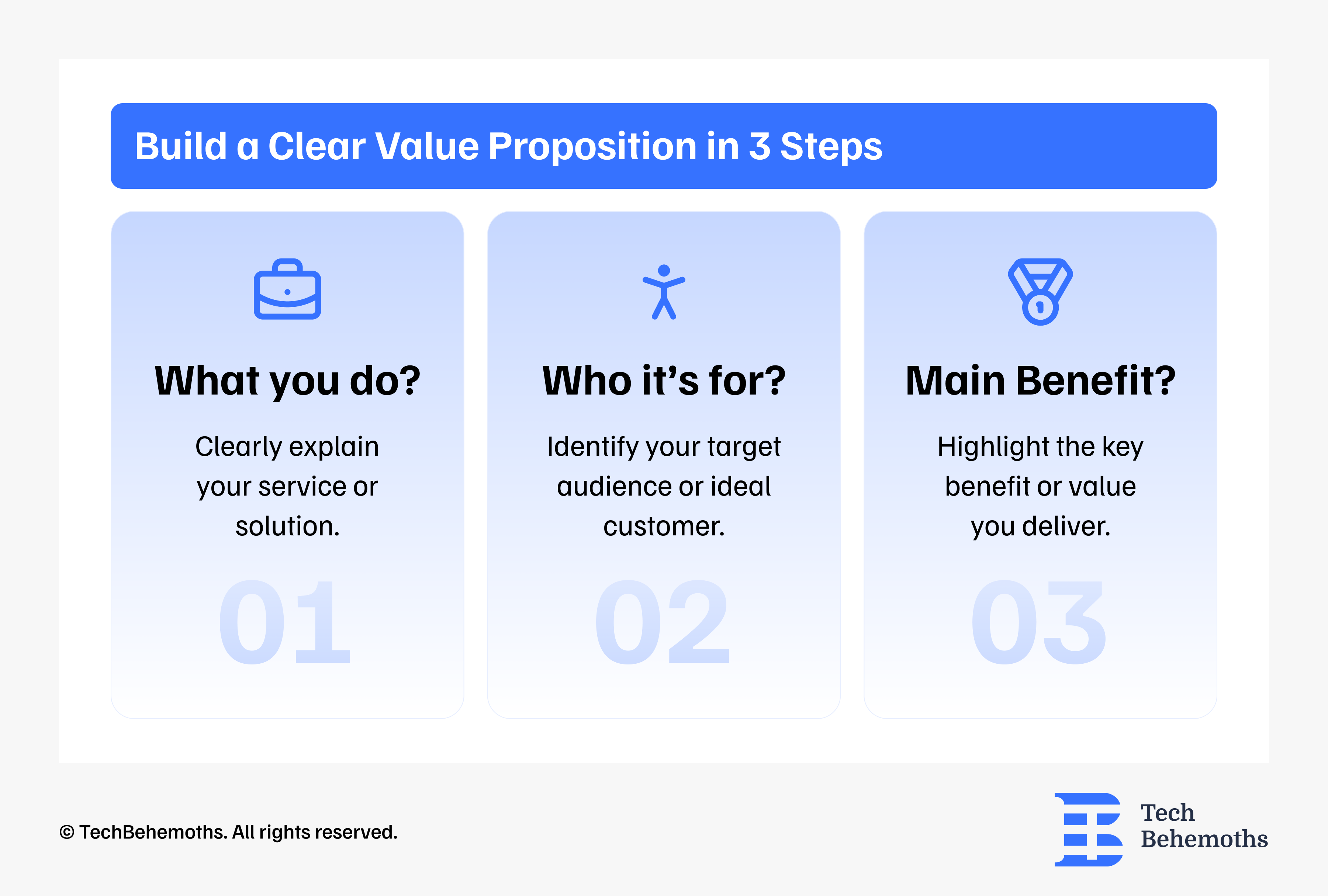
How to fix? Start with a clear value proposition that shows the benefits and answers these three questions right away.
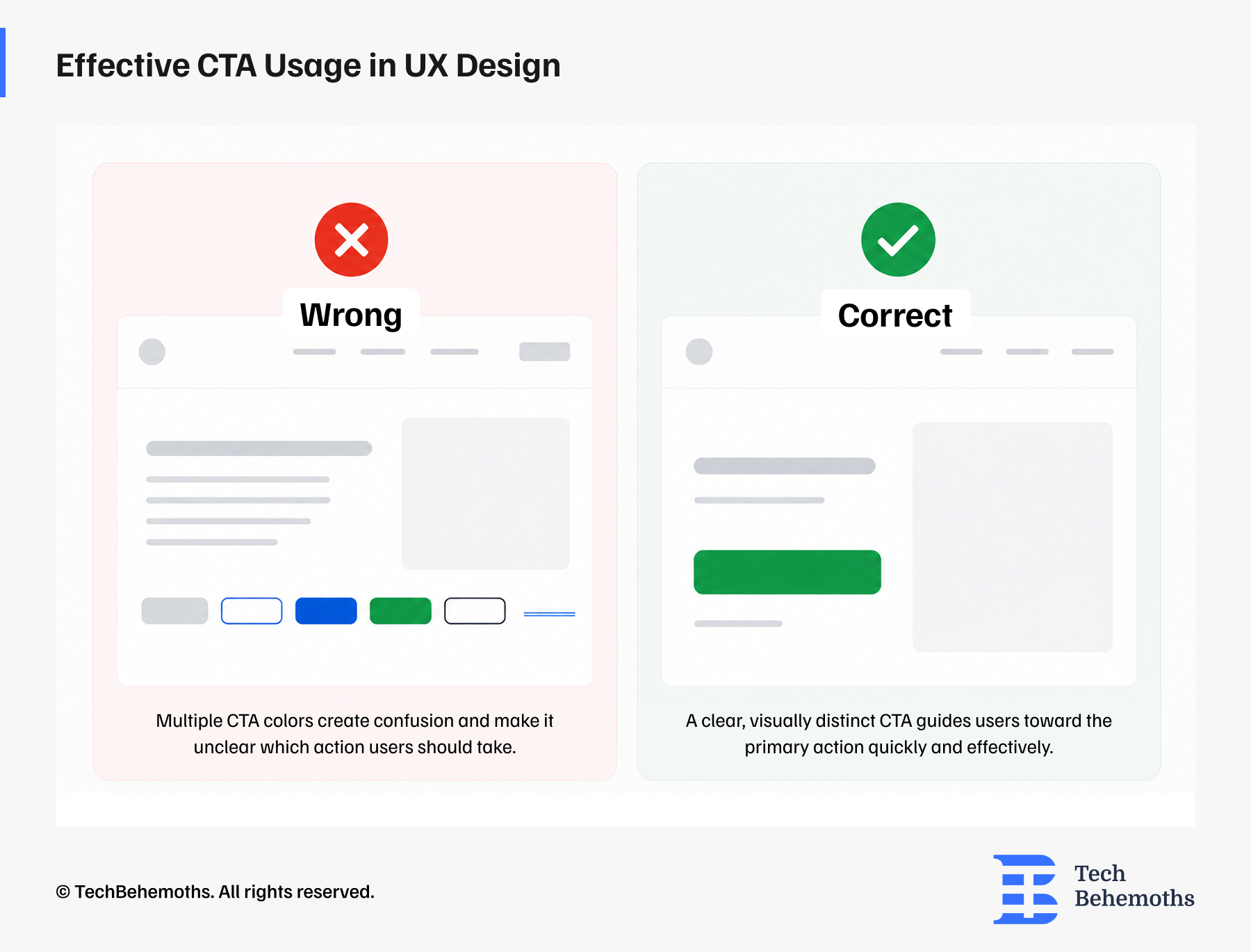
2. No call to actions (CTAs)
How to fix? Your service/product and other important pages should have one primary CTA, and it should be: specific, prominent, smooth/short. Example: Get a free quote.
3. Poor mobile UI/UX
How to fix? Focus on mobile-first UX design, which means designing the mobile experience first and then adapting it for the desktop experience.
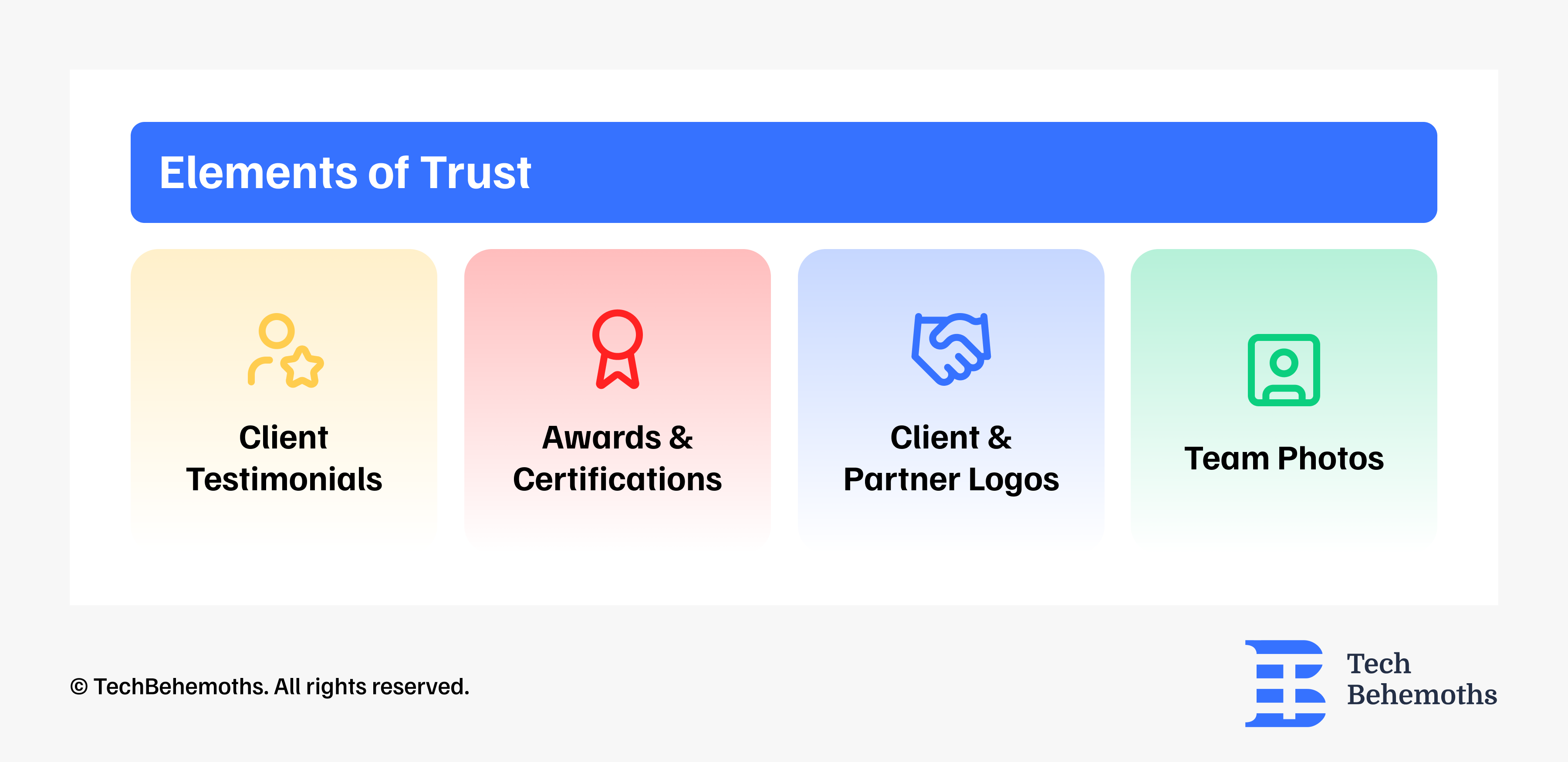
4. No social proof
How to fix? Place trust signals throughout the conversion path: client testimonials, reviews, awards, certifications, team photos, etc.
5. Complex navigation/structure
How to fix? Simplify your navigation and content structure by limiting menu items, using plain language, making contact options visible and accessible from everywhere, using proper visual hierarchy.
6. Slow loading time
How to fix? Optimize your web pages for speed, especially for mobile devices. Use modern image formats like webp, compress images, use reliable/fast hosting, minify JavaScript/CSS, don't usee too many 3rd party services.
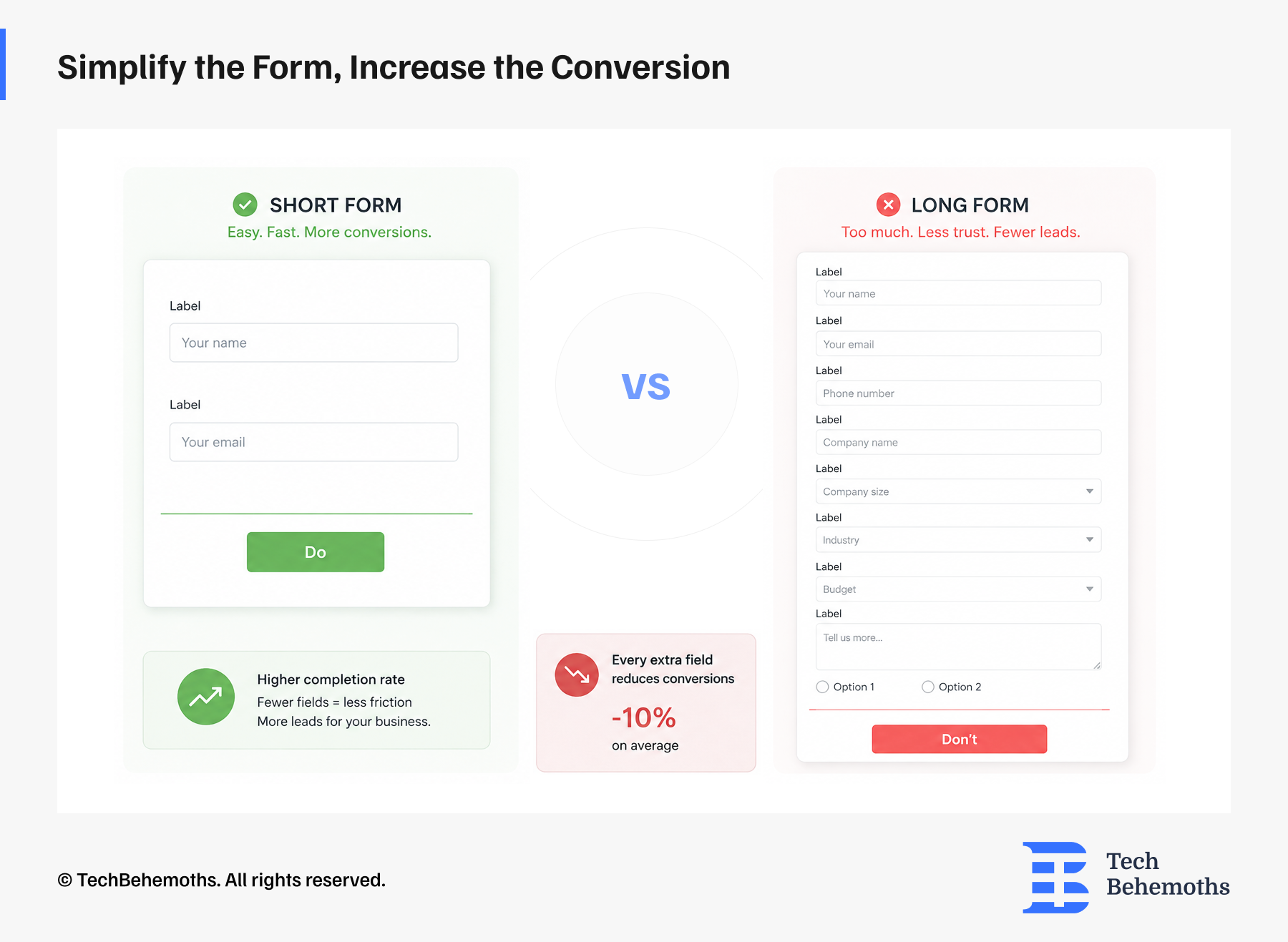
7. Too long forms
How to fix? Use the minimum required number of input fields: name, email, and one open field. Don;t overwhelm users withh too many questions and options.
How to choose the right UX/UI agency?
Choosing a UX/UI agency is a business decision with consequences that show up months after the contract is signed. Most companies evaluate agencies based solely on portfolios and presentations, which are the things easiest to polish and hardest to verify.
What separates a good hire from an expensive mistake is usually visible before you sign anything. You just have to know where to look.
How to do research UX/UI agencies, the right way
Most users go straight to the portfolio, and that's ok, but it's not the whole picture. Here are the criteria that actually matter before you reach out to anyone.
1. Portfolio, look past the aesthetics
Good UX agencies solve different problems differently.
2. Research, visuals are not enough
Any agency can show you Figma files. Ask them to walk you through how they got there. If there's no mention of user interviews, usability testing, or data, the work is decoration, not design.
3. Industry experience is useful, but not mandatory
For fintech, healthcare, or anything with compliance layers, prior domain experience saves valuable time. Sometimes, an agency coming in fresh can be the better bet, having a different perspective
4. Negative client reviews
A profile with an ideal five stars rating is worth questioning.
5. Who's exactly working on your project
The number one complaint in the agency world is the bait-and-switch, a senior partner sells the deal, but junior interns do the work. Before moving forward, ask who's actually doing the work. Thirty minutes of reference calls can save you thousands in wasted fees.
6. Not all UX/UI projects are the same
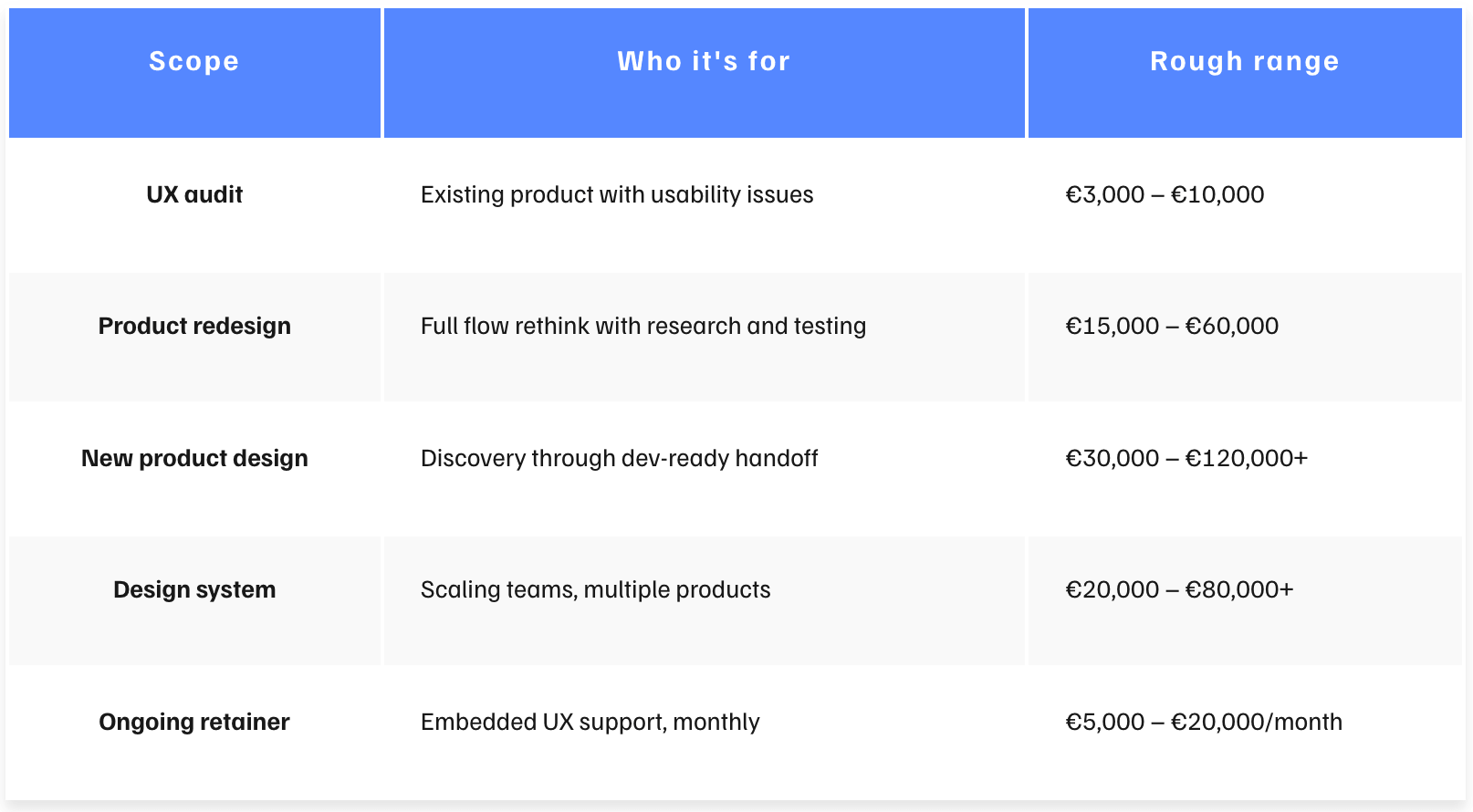
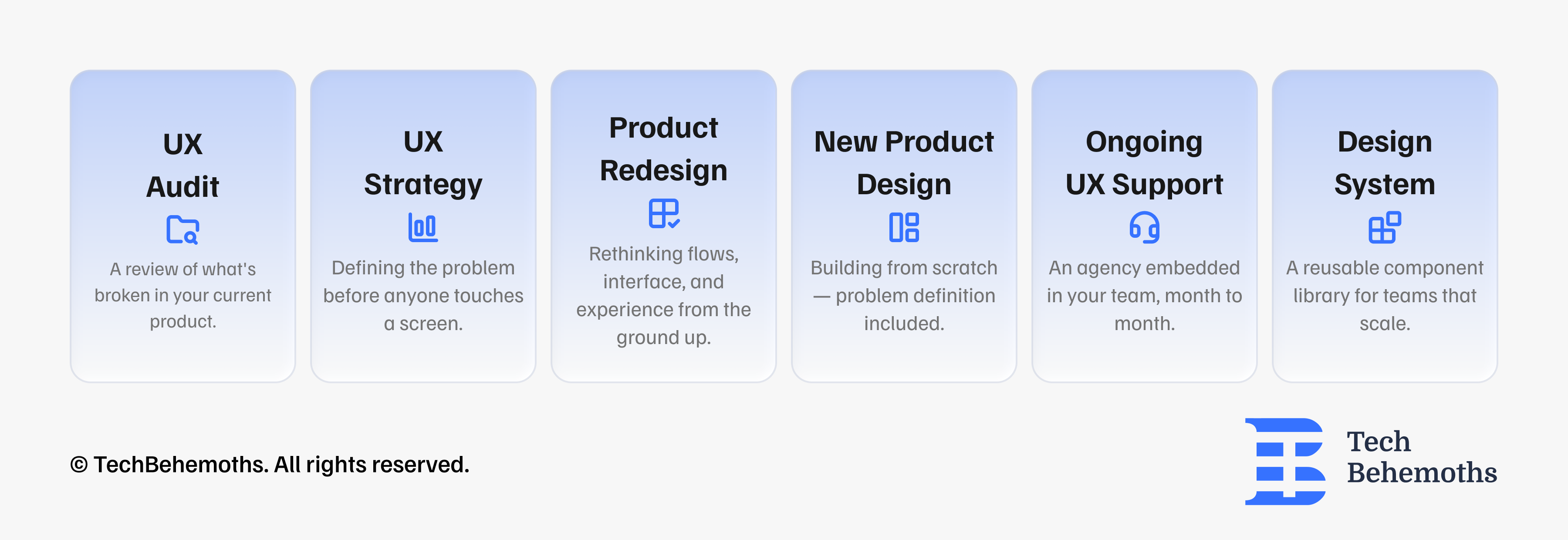
Before you talk to anyone, get specific about what you're buying. UX covers a wide range of work, and the type of agency you need depends on what the actual problem is.
Here is a set of common UX/UI tasks to keep in mind.
How to shortlist the right agencies?
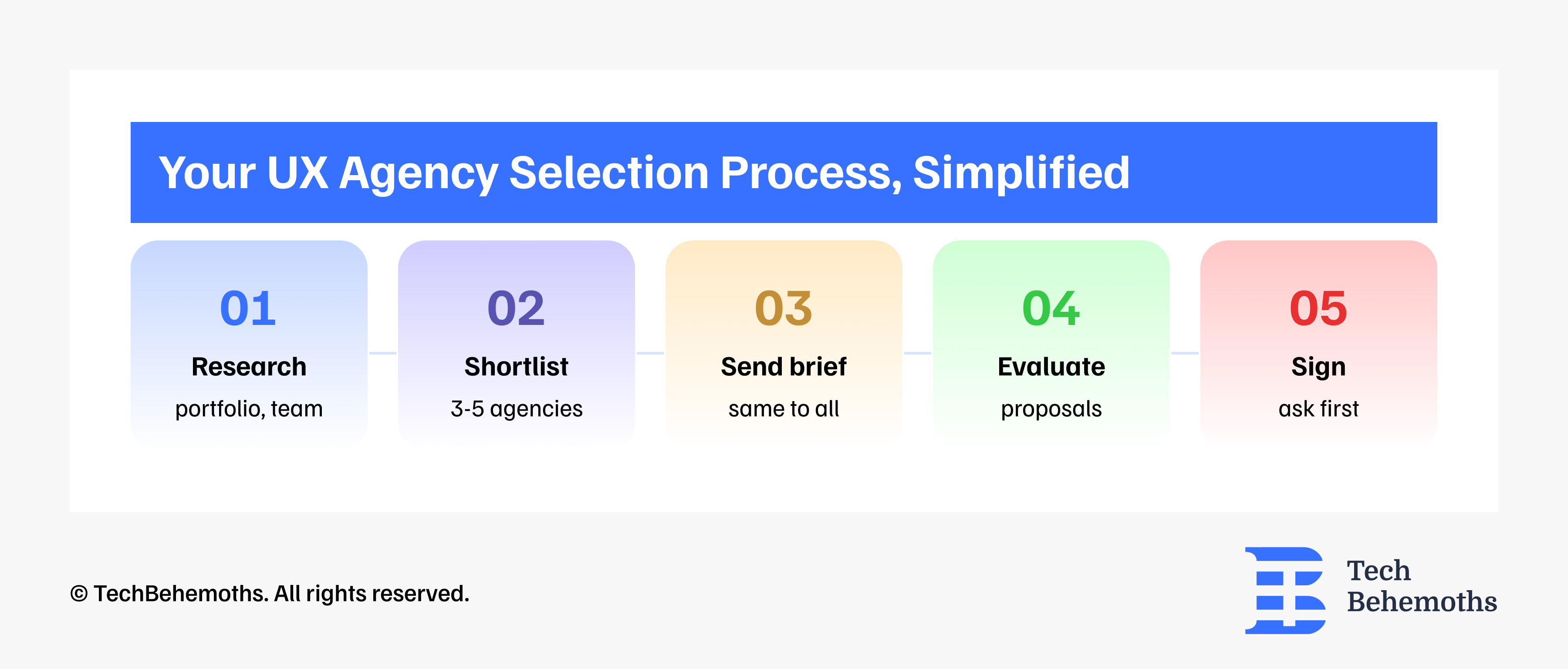
Many clients speak with 15 - 20 agencies and end up more confused than when they started. A practical approach looks like this:
-
Start with a larger pool of companies
-
Narrow it to around 10 agencies
-
Shortlist 3-5 agencies
-
Send the same brief to everyone
-
Compare proposals and communication styles
-
Choose one partner
A poorly scoped engagement can lead to a bad return/outcome. A bad agency hire costs approximately €115,000 when you calculate wasted fees, the cost of a redo, and months of lost market time.