
There are 16 Companies in Vietnam
that provide Recruiting Services!
As Vietnam moves from low-tech manufacturing to a service-oriented economy. The country’s information technology (IT) market is increasingly gaining traction, giving competition to IT firms in China and India. This has partly been encouraged by the growth of Vietnam as a regional market for domestic enterprises and global technology vendors.
Discover Top IT Companies in Vietnam specialized in Recruiting and other related services. Find the best IT service providers for your projects.
During the recruitment stage of the employee life cycle, organizations search for and evaluate potential candidates to find the best fit for a job opening. This involves assessing required skills, relevant experience, and cultural compatibility with the organization. Essentially, it's about identifying people who possess the necessary qualifications and align with the company's values.
Recruitment is currently going through many changes. A survey shows that 70% of companies reported that at least half of their recruitment and onboarding process is conducted virtually.
Handpicked companies • No obligation to hire • 100% risk-free
Featured Companies in Vietnam
This month, the following Recruiting companies managed to provide an outstanding service and support. It's worth taking a look.

I-Talent is the rising Recruitment Agency in Vietnam providing ESS service, Payroll Calculation & Business Set-up Service in various industries.
BTS Digital Solutions Verified Company
Ho Chi Minh City, Vietnam Head office in: Vietnam
BTS Solutions help businesses elevate their value through custom software development, App development, Blockchain, NFT and consultancy services.

ManNet, a vibrant LTS Group subsidiary specializing in talent acquisition, IT staff augmentation, headhunting and body shopping services.
Explore Top Recruiting Companies in Vietnam
BHSoft - Engineering complex systems organizations can trust and scale with.
End-to-end HR Solutions for the IT sector. Headhunting | Staff Augmentation | BOT | Payroll ( EOR ) | HR Outsourcing.

Ho Chi Minh City, Vietnam Head office in: Netherlands
Sunbytes | Trusted Tech & HR Solutions for Business Growth

Premier Software Solution Provider for Businesses

Verified Remote Talent. Cost-Effective. Hassle-free Outstaffing.
Services:

Scaling Your Tech, Seamlessly

The Vietnam Group and our global partners, strategically collaborate with our clients to deliver exceptional results. The talented and adaptable peopl...
Services:
1BITLAB are a cutting-edge technology company from Vietnam, delivering software solutions with agility, top-notch quality, and cost efficiency.

Talent JDI is a leading recruitment firm that helps link top IT talents in Vietnam to growing startups and businesses.
VietSoftware International (VSII) now has 150+ engineers and becomes one of the leading software outsourcing companies in Vietnam.
Twendee is a global full-cycle software development company with experience seniors and a focus on the Web3 and Blockchain fields.
Empowering Innovation, Enabling Success

JT1, an agency with IT recruitment experts, specializes in IT/Software Engineer recruitment and offshoring projects across Vietnam and South East Asia
Filter Recruiting Companies in Vietnam by Cities
Find the right tech company near you or from a specific city. Some of the best companies might be located in smaller cities.
Find more Recruiting companies around the world
TechBehemoths is the world's most advanced and user-friendly platform to match IT Companies with real clients without hustle.
The ICT Industry in Vietnam: Market Overview and Trends
As Vietnam moves from low-tech manufacturing to a service-oriented economy, the country’s information technology (IT) market is increasingly gaining traction, giving competition to IT firms in China and India. This has partly been encouraged by the growth of Vietnam as a regional market for domestic enterprises and global technology vendors.
Why You Should Work With Vietnamese IT Companies
Local software producers mostly provide their products to the government and small and medium-sized enterprises, while larger Vietnamese companies generally look to multinationals for software. As internet infrastructure starts to improve, more demand for areas such as software as a service (or, on-demand software) and other cloud-computing services should pick up.
What You Should Pay Attention to When Working With Vietnamese IT Companies
The underdeveloped IT sector and infrastructure, as well as a relatively low level of education in IT, make Vietnamese companies less attractive to foreign customers. Additionally, IT companies and web agencies from Vietnam face systemic problems with cybersecurity, piracy rate, and efficient communication, among others.
Cybersecurity is a particular vulnerability for Vietnam, and one of the most notable cases happened in 2016, when an alleged Chinese hacker group, 137CN, carried out some cyberattacks on Vietnam’s airports as well as the official website of the national flag carrier Vietnam Airlines, in which the airline’s customer database was stolen and made public on the internet.
In 2019, there were a total of 31,500 security incidents in the country, according to the Vietnam Computer Emergency Response Team. In the first half of 2020 alone, the number of incidents was 4.4 times higher compared with a year earlier. In 2025, the cyberattacks continued with 179 more attacks, mostly attributed to the group Anonymus VNLBN.
How Reliable Are Vietnam-based IT Companies
Under the strongly growing digital economy, major opportunities are opening for investors, especially those who want to provide products and services based on new technologies. Combining this and the cheap market price, investors rely on Vietnamese IT companies to provide the needed digital services.
But the situation is different in the regional market, where potential clients have a wide range of countries and companies to choose from for their web or software projects.
Why Outsource Software/Web Development to Vietnam?
Vietnam is an appealing destination for outsourcing software and web development due to the various perks it provides. It has a fast-growing tech sector with more than 1.2 million workers in over 74,000 IT companies. It is cost-effective to outsource web and software development in Vietnam, with hourly prices of $20-$45, compared to the US costs $65-$130. The country’s rich talent pool has over 560,000 new employees in 2024-2025, and between 50,000-60,000 students who choose to learn computer science or other IT domains. Additional benefits include a stable government and a favorable investment ecosystem.
How Does the Vietnamese IT Industry Relate to the Neighboring Countries
IT Outsourcing services generate around $777.36 million by 2025, Statista reports. However, Vietnam is still a boutique market when it comes to outsourcing and lags behind its regional peers, such as India and the Philippines, which earned $12.41 billion and almost $800 million, respectively, from providing IT services the same year.
What is Recruiting and what are its benefits for your projects?
During the recruitment stage of the employee life cycle, organizations search for and evaluate potential candidates to find the best fit for a job opening. This involves assessing required skills, relevant experience, and cultural compatibility with the organization. Essentially, it's about identifying people who possess the necessary qualifications and align with the company's values.
Recruitment is currently going through many changes. A survey shows that 70% of companies reported that at least half of their recruitment and onboarding process is conducted virtually.
Recruiting typically follows this process:
-
Job analysis - Conducted to document the necessary knowledge, skills, abilities, and other characteristics required or desired for the position. This information is then included in a person specification.
-
Sourcing - Attracting or identifying candidates.
-
Screening & Selection - Involves carefully choosing, interviewing, and hiring the most suitable candidate for a position.
Let's explore the benefits of implementing a strategic recruitment process:
-
Hiring the right fit: The key to finding the ideal candidates lies in dedicating time and effort to a well-organized recruitment process. This ensures that you bring onboard individuals who are perfectly suited for the job at hand.
-
Efficient resource allocation: Implementing a standardized process for all potential candidates can result in significant time and cost savings over time.
-
Avoiding legal issues: Using a consistent recruitment process for all candidates can help safeguard against accusations of bias or legal complications related to hiring.
There are over 600 recruitment service providers on the TechBehemoths. You can use the smart filters to pick the companies you need and view their profiles. Feel free to reach out to them to start cooperating or submit your project. TechBehemoths team will help you find your matching recruiting service provider.
Hirig talent in 2026: challenges and how to adapt
According to World Economic Forum reports, by 2030, it is estimated that 170 million jobs will be created globally due to structural transformations of the labor market.
This represents approximately 14% of all existing jobs, and the main factors determining this change are:
-
Digitalization
-
Automation
-
Green transition
A major factor that is worth mentoning is the current trend in implementing AI and automating processes in companies, that can lead to layoffs, but at the same time can create new hiring opportunities in the long term.
How can businesses adapt and hire efficiently?
Here are some key strategies to consider:
-
Prioritize AI and specialized job roles - prioritize strategic and AI-focused roles over administrative and support ones
-
Implement AI-driven hiring - use AI to automate technical and/or administrative HR tasks.
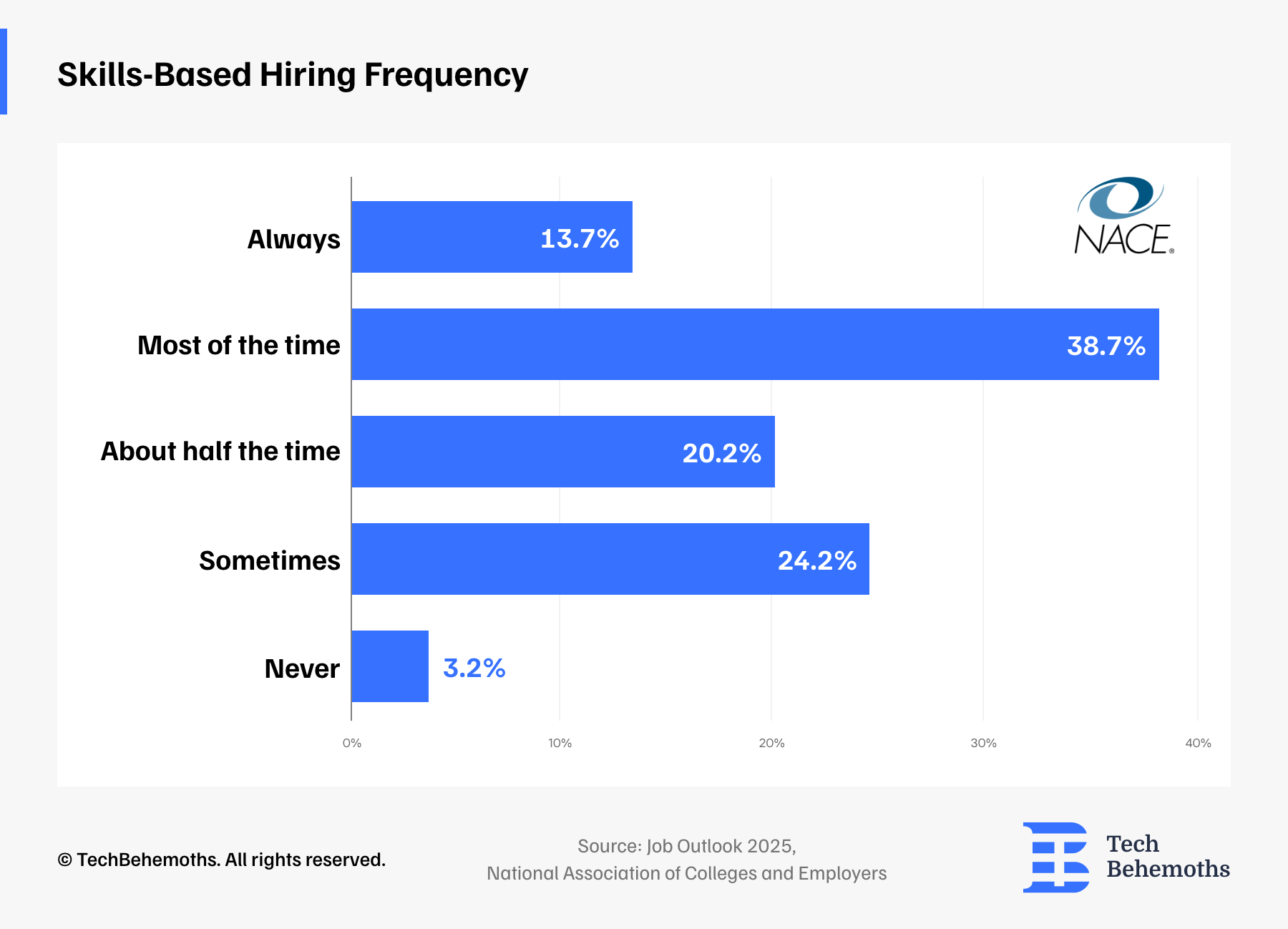
- Adopt skills-based hiring - don't solely rely on traditional CVs. Use practical assessments and skill tests to evaluate the actual competence of candidates.
-
Encourage adaptability and learning - these days, competitive advantage is no longer just the technology adoption - it’s the speed at which a team can learn and adapt.
-
Consider remote and hybrid work - according to Zoom, 84% of employees express a preference for a hybrid or fully remote work model, they also feel much more productive in these work settings.
- Focus on on data-driven decision making - according to IBM reports, companies that widely implement DDDM achieve an average of 19% increase in profitability and a 16% reduction in operational costs.
Common mistakes to avoid when hiring tech talent/providers
Try to avoid these common mistakes that may put at risk your project’s success. Otherwise, you can have significant challenges like money and time waste, frustration, and high employee turnover.
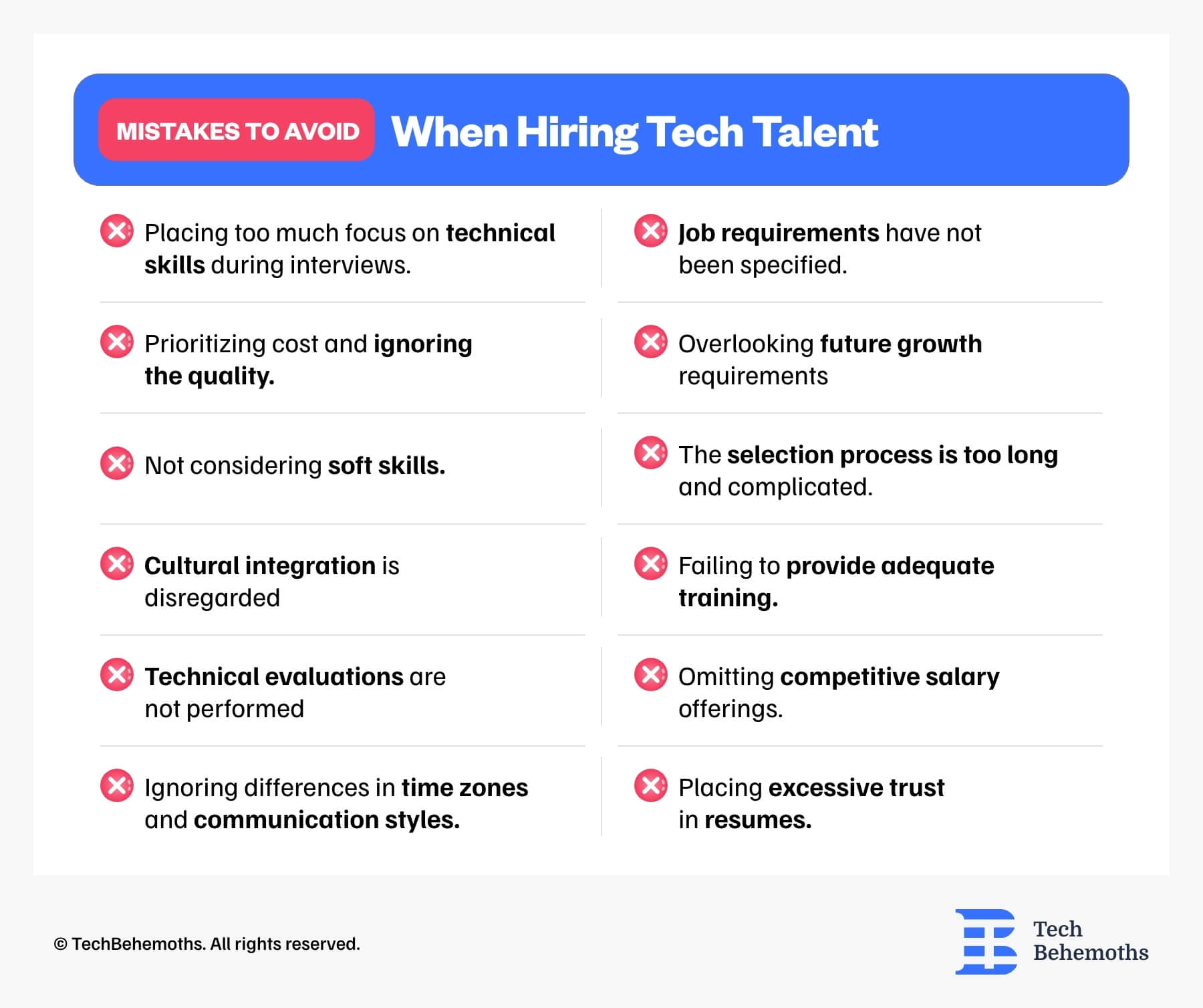
1. Trusting the CV too much
How to avoid? Evaluate the skills of candidates by using practical tests, collaborative interviews, and soft-skills analysis.
2. Too much focus on tech skills
How to avoid? Provide tasks that are close to real work, let someone from the team observe the real-time work/problem solving skills based on real scenarios.
3. Not including exact job requirements
How to avoid? Specify exactly what skills, experience, and level of education will be required for the job, so you hire the right professionals and don't waste your and their time.
4. Choosing cost over quality
How to avoid? Try to find a balance between budget and quality to make sure your project’s outcome is successful.
5. Ignoring soft skills
How to avoid? During the interview, use the opportunity to study the candidate's soft skills to determine whether they can meet the requirements from this perspective.
6. Selection process is too long
How to avoid? Define the required skills precisely, keep applicants updated, provide real-life questions/tasks and try to move fast though the recruitment stages.
7. Ignoring the cultural aspect
How to avoid? Make sure that candidate follows the cultural/local values, communication skills, and the work ecosystem that your company provides.
8. Remuneration is too low
How to avoid? Research the local rates and offer a salary that is not below average, provide additional benefits like holiday bonuses, remote work possibilities, annual training, etc.
9. Ignoring time zone differences
How to avoid? Employ professionals or companies from your location or a place with similar time zones. Don't go too far, as a 6-8 hour difference can be disruptive for your team.
10. Not providing training
How to avoid? Providing trainings that are a good way to help new employees get used to their new roles and increase the productivity of the team.