
There are 18 Companies in Nepal
that provide Recruiting Services!
The IT sector in Nepal is an emerging area of the country. It is one of the priorities for the Nepalese government. This country specializes in web and mobile apps development, they have a lot of new startups, but also big companies like Verisk, Leapfrog, or Brain Digit IT Solutions, and of course, many of the companies in Nepal are providing services for other companies in Europe, America, and other countries in Asia.
Discover Top IT Companies in Nepal specialized in Recruiting and other related services. Find the best IT service providers for your projects.
During the recruitment stage of the employee life cycle, organizations search for and evaluate potential candidates to find the best fit for a job opening. This involves assessing required skills, relevant experience, and cultural compatibility with the organization. Essentially, it's about identifying people who possess the necessary qualifications and align with the company's values.
Recruitment is currently going through many changes. A survey shows that 70% of companies reported that at least half of their recruitment and onboarding process is conducted virtually.
Handpicked companies • No obligation to hire • 100% risk-free
Featured Companies in Nepal
This month, the following Recruiting companies managed to provide an outstanding service and support. It's worth taking a look.

Green Tick Nepal provides business management consulting services tailored to enhance business performance, risk management, compliance, HR, etc.

Global Recruit Experts is a leading manpower agency based in Nepal, specializing in connecting skilled professionals with global opportunities.

We love the challenge of delivering truly IT services that function perfectly and we constantly strive to provide quality service to our customers.
Explore Top Recruiting Companies in Nepal

Startups Realm is the Nepal leading #1 startup-focused IT company, founded with the intention of supporting and connecting great startup ideas.

BIN delivers complete, high-quality BPO services from Nepal, empowering businesses worldwide with cost-effective and skilled outsourcing solutions.

Digital Consulting Ventures helps companies expand into Nepal by providing market entry advisory, outsourced talent, & end-to-end compliance support.

𝐓𝐡𝐢𝐧𝐤𝐯𝐢𝐯𝐞 𝐂𝐨𝐧𝐬𝐮𝐥𝐭𝐢𝐧𝐠 𝐏𝐯𝐭. 𝐋𝐭𝐝. is a leading HR and business consulting firm based in Kathmandu, Nepal.

Your Reliable Partner for Payroll Management, logistic management, staff Outsourcing, Housekeeping & BPO Services in Nepal.

Sofixs delivers scalable IT solutions in web, software, and digital transformation for startups and global businesses.

Software Company providing IT related services to small, mid and corporate businesses. Located in heart of Pokhara City, Nepal.

Kantipur Management Private Limited (KMPL) is an ISO certified company. We specialize in Business Process Outsourcing and Talent Sourcing services.
Simplifying the Recruitment
Services:

A leading BPO and IT Outsourcing Company provides outsourcing and technology services enabling organizations to move forward innovating and growing.


EOR Nepal, Leading Employer of Record EOR, Remote Staffing, Payroll Management, IT Staffing and Global Recruitment Partner in Nepal

Frontline Consult Pvt. Ltd. is an ISO-certified HR and Business Consulting company in Nepal.

Creative IT Agency based in Kathmandu Nepal. Services: Creative Graphic, Digital Marketing, Website Development, Event Management, Outdoor (All).

AJEETS is the best Recruitment Agency providing staffing solution for the Middle East, Far East, Europe, North America.
Filter Recruiting Companies in Nepal by Cities
Find the right tech company near you or from a specific city. Some of the best companies might be located in smaller cities.
Find more Recruiting companies around the world
TechBehemoths is the world's most advanced and user-friendly platform to match IT Companies with real clients without hustle.
The IT Industry in Nepal: Companies, Data & Insights
The IT sector in Nepal is an emerging area of the country. It is one of the priorities for the Nepalese government. This country specializes in web and mobile apps development, they have a lot of new startups, but also big companies like Verisk, Leapfrog, or Brain Digit IT Solutions, and of course, many of the companies in Nepal are providing services for other companies in Europe, America, and other countries in Asia. Also, the government of this country identified the high demand for IT students and professionals from other developed countries, and they started offering different opportunities for being able to become an IT professional. In order to achieve these requirements, many institutions, universities, and colleges are providing various courses and degrees, for example, BCA, CSIT, or BSc.
Right now, a big challenge for the industry is the high competition that is going on in the sector, which is growing very fast, especially because right now, a company can hire employees from every part of the world, and that makes the level required to keep growing.
The IT industry in Nepal has more potential, but due to the lack of laws in relation to IT topics, it’s a bit stalled in some sectors like e-commerce, online transactions, and cyber law.
Why Should Somebody Work With Nepalese Companies?
Some of the best advantages that this country has are the following, low cost, affordable workers, and high profitability, and this is because, there’s a minimum wage of NPR 19,550 a month, and that’s $138.81, which stands out when looking for outsourcing services or products to another country for being a really strong point when choosing which country you should work with.
Another strong point of Nepal is the accessible bureaucracy and its higher education in IT topics such as mobile app development, data science, or web development, as the most important ones. The number of people interested in IT in this country is growing year after year because of the popularity and the job opportunities that can be found in this sector, in Nepal, and outside of Nepal. Some of the best universities and institutions to learn this discipline are Nepal Engineering College, Kathmandu University, and Himalaya Engineering College. Each year, approximately 5000 students graduate from Nepalese universities in the IT sector.
Business Process Outsourcing (BPO) in Nepal is very popular, and they are providing these services all over the world, but especially in European countries like Germany, the Netherlands, and France. And of course, the ICT Policy from 2015 has a special and separate section focused on the delivery and good use of ICT. Some of the political sectors that are involved in the law creation in relation to the ICT BPO are the Ministry of Information and Communication, the Ministry of Science, Technology, and Environment, the Nepal Telecommunication Authority, and the Department of Information Technology of the government.
What Should Somebody Be Aware of When Working With IT Companies From Nepal?
Nepal is well-known for being a low-cost destination for Outsourcing projects, and this country has some interesting data about professionals graduating each year in IT topics in the universities of Nepal, but there’s not a majority of professionals that went through this educational background and that can also lead to finding a lot of non-professional workers in Nepal, due to the difficulties to be able to study properly or the difficulties for almost the 25% of the population that are living with 50 cents of Euro a day. This can cause many people who are not well prepared to try to find their career in this sector, which looks highly successful and profitable, but without the basics that support the knowledge required to develop and outsource software, services, or apps.
Also, it is important to say that Nepal, being outside of the European Union, doesn’t have to comply with the laws and agreements that are currently being used in the countries that are part of the EU. This is important because the quality standards may not always be similar between the country of origin and destination during the Outsourcing process. Also, there are cultural aspects such as the possibility of finding companies and workers with a low level of English, which can be dangerous for the relationship between the two parties in terms of the goals and the way to achieve them.
There are also some aspects in relation to the laws and agreements that are currently being used in Nepal that can be dangerous, and this is the lack of laws in some aspects, such as e-commerce, e-transactions, or cybercrime laws.
The poverty levels in this country are an important factor to take into account, and this can lead to companies trying to sell the BPO services but not being able to achieve the expected standards of quality required by some countries in the most developed countries. This doesn’t mean that Nepal is a country of low-quality BPO companies, but it’s more possible to find them than in other places due to some of its socio-economic problems.
The last thing that is important to talk about is the stability of the country. Nepal is a country that is affected by some natural disasters more often than is desirable. In fact, it is a very vulnerable country when talking about natural disasters such as earthquakes, floods, landslides, and Avalanches due to its high mountains and altitude. This, in addition to the socio-economic situation, is two very important things to take into account when working with Nepalese companies, because the instability can be more frequent than it is desirable.
How Reliable Are IT Companies From Nepal?
Continuing with the previous point, there are Nepalese companies that are very reliable, but also others that cannot be so reliable due to some specific situations and characteristics of this country, such as poverty. Nepal is one of the poorest and least developed countries in some aspects, so you can find services offered that don’t correspond to the quality required due to the difficult situation of some people.
Also, there’s an important trend in the IT sector in Nepal, which is about cybercrimes and a lack of system security. It's popular to have one ethical hacker in a company because it’s popular to hack public and private websites, and companies need to avoid this, which is a problem for Nepal’s IT industry.
Also, the lack of awareness of cybercrimes in business firms and brands is a big concern nowadays. And this is related to the lack of cybercrime laws, which can also affect Nepalese companies’ reliability.
As in past articles about the IT industry reliability in other countries, you should always work with companies of proven quality and experience to avoid scams as much as possible. There’s always a risk when outsourcing services to another country, but with Nepal, this risk is more notorious than with other European countries due to the difficult situations that we talked about in this section.
How is the IT Industry in Nepal in Relation to the Neighboring Regions/Countries?
Nepal is over India and under China, which are two powerful countries in terms of the IT/ICT industry, especially China, which has a widely established ICT market in its country, as they are the home country of brands like Huawei, Xiaomi, or Honor. China, is the second-largest ICT market and in the year 2025 the sector’s production outperformed the country’s GDP with technologies like Big Data, IoT, or AI (Artificial Intelligence), their project is to reach 8.1$ trillion dollars representing 55% of China’s GDP, and this is also because in this country they have their own phone brands, social media apps and networks, and of course one of the biggest competition centers for making the best hardware and software for their products.
On the other hand, India is a well-known and number 1 BPO destination country, with a very strong industry, well-educated professionals, and low costs for companies. Also, living costs in India, rents, and profitability really stand out for their price-quality when compared to Nepal, and this is one reason why many Nepalese qualified workers choose to go and develop their career in this country. Both are very powerful competitors.
Conclusion
Nepal can be a good outsourcing destination for some companies that put the low prices first and the quality or the stability in second place, even when you can find very well-prepared professionals and companies. Some aspects of the law and agreements related to cybersecurity and cybercrimes are also a big weak point. The strong points are low costs, high profitability, and a good number of graduate students in IT-related fields every year. Taking these aspects into account, we can conclude that Nepal can be a good Outsourcing destination for its production prices, but it’s not very good in other aspects, such as law, protection for the company that wants to outsource its services. This can be beneficial for companies looking to reduce their costs to the maximum.
What is Recruiting and what are its benefits for your projects?
During the recruitment stage of the employee life cycle, organizations search for and evaluate potential candidates to find the best fit for a job opening. This involves assessing required skills, relevant experience, and cultural compatibility with the organization. Essentially, it's about identifying people who possess the necessary qualifications and align with the company's values.
Recruitment is currently going through many changes. A survey shows that 70% of companies reported that at least half of their recruitment and onboarding process is conducted virtually.
Recruiting typically follows this process:
-
Job analysis - Conducted to document the necessary knowledge, skills, abilities, and other characteristics required or desired for the position. This information is then included in a person specification.
-
Sourcing - Attracting or identifying candidates.
-
Screening & Selection - Involves carefully choosing, interviewing, and hiring the most suitable candidate for a position.
Let's explore the benefits of implementing a strategic recruitment process:
-
Hiring the right fit: The key to finding the ideal candidates lies in dedicating time and effort to a well-organized recruitment process. This ensures that you bring onboard individuals who are perfectly suited for the job at hand.
-
Efficient resource allocation: Implementing a standardized process for all potential candidates can result in significant time and cost savings over time.
-
Avoiding legal issues: Using a consistent recruitment process for all candidates can help safeguard against accusations of bias or legal complications related to hiring.
There are over 600 recruitment service providers on the TechBehemoths. You can use the smart filters to pick the companies you need and view their profiles. Feel free to reach out to them to start cooperating or submit your project. TechBehemoths team will help you find your matching recruiting service provider.
Hirig talent in 2026: challenges and how to adapt
According to World Economic Forum reports, by 2030, it is estimated that 170 million jobs will be created globally due to structural transformations of the labor market.
This represents approximately 14% of all existing jobs, and the main factors determining this change are:
-
Digitalization
-
Automation
-
Green transition
A major factor that is worth mentoning is the current trend in implementing AI and automating processes in companies, that can lead to layoffs, but at the same time can create new hiring opportunities in the long term.
How can businesses adapt and hire efficiently?
Here are some key strategies to consider:
-
Prioritize AI and specialized job roles - prioritize strategic and AI-focused roles over administrative and support ones
-
Implement AI-driven hiring - use AI to automate technical and/or administrative HR tasks.
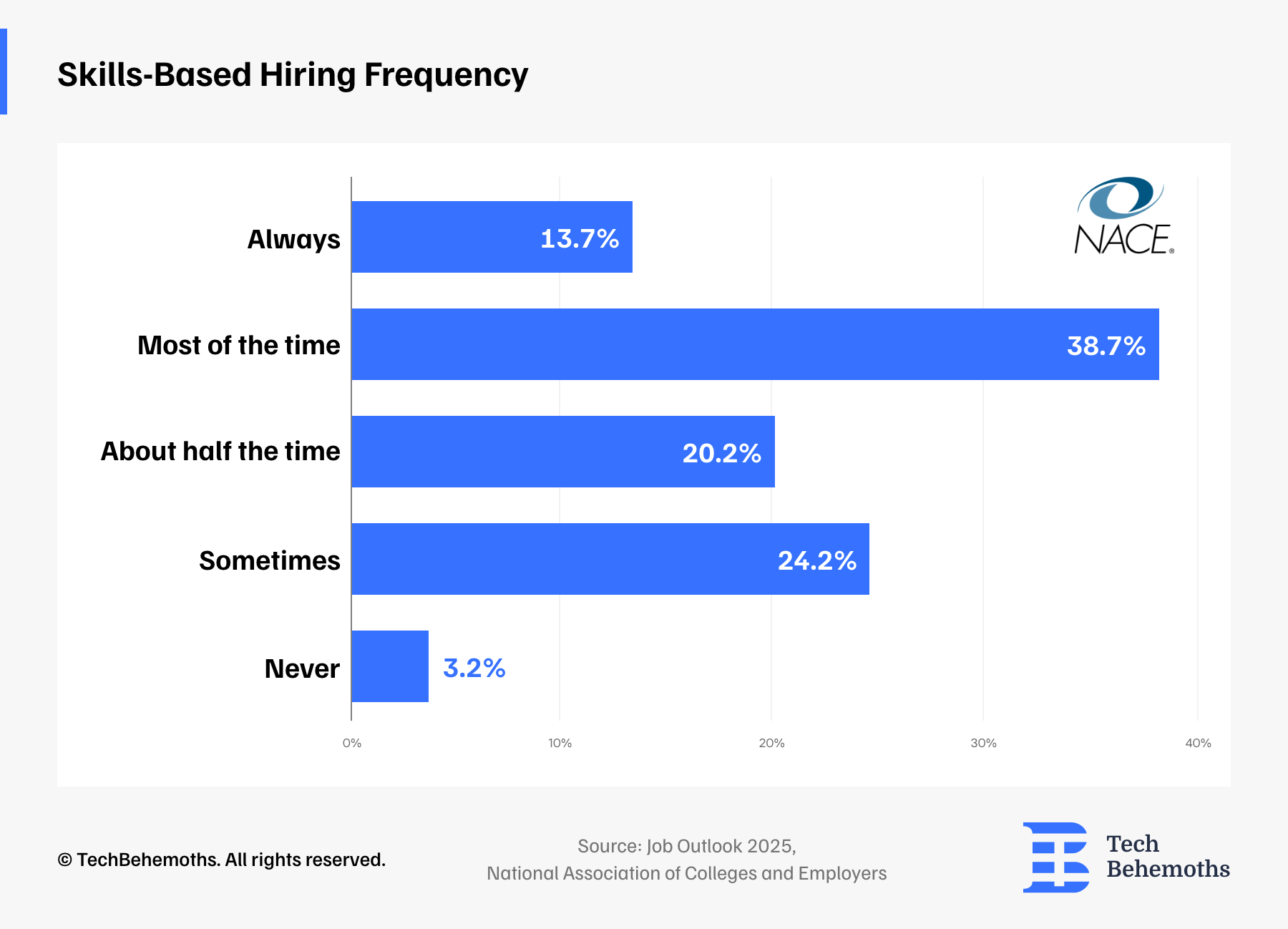
- Adopt skills-based hiring - don't solely rely on traditional CVs. Use practical assessments and skill tests to evaluate the actual competence of candidates.
-
Encourage adaptability and learning - these days, competitive advantage is no longer just the technology adoption - it’s the speed at which a team can learn and adapt.
-
Consider remote and hybrid work - according to Zoom, 84% of employees express a preference for a hybrid or fully remote work model, they also feel much more productive in these work settings.
- Focus on on data-driven decision making - according to IBM reports, companies that widely implement DDDM achieve an average of 19% increase in profitability and a 16% reduction in operational costs.
Common mistakes to avoid when hiring tech talent/providers
Try to avoid these common mistakes that may put at risk your project’s success. Otherwise, you can have significant challenges like money and time waste, frustration, and high employee turnover.
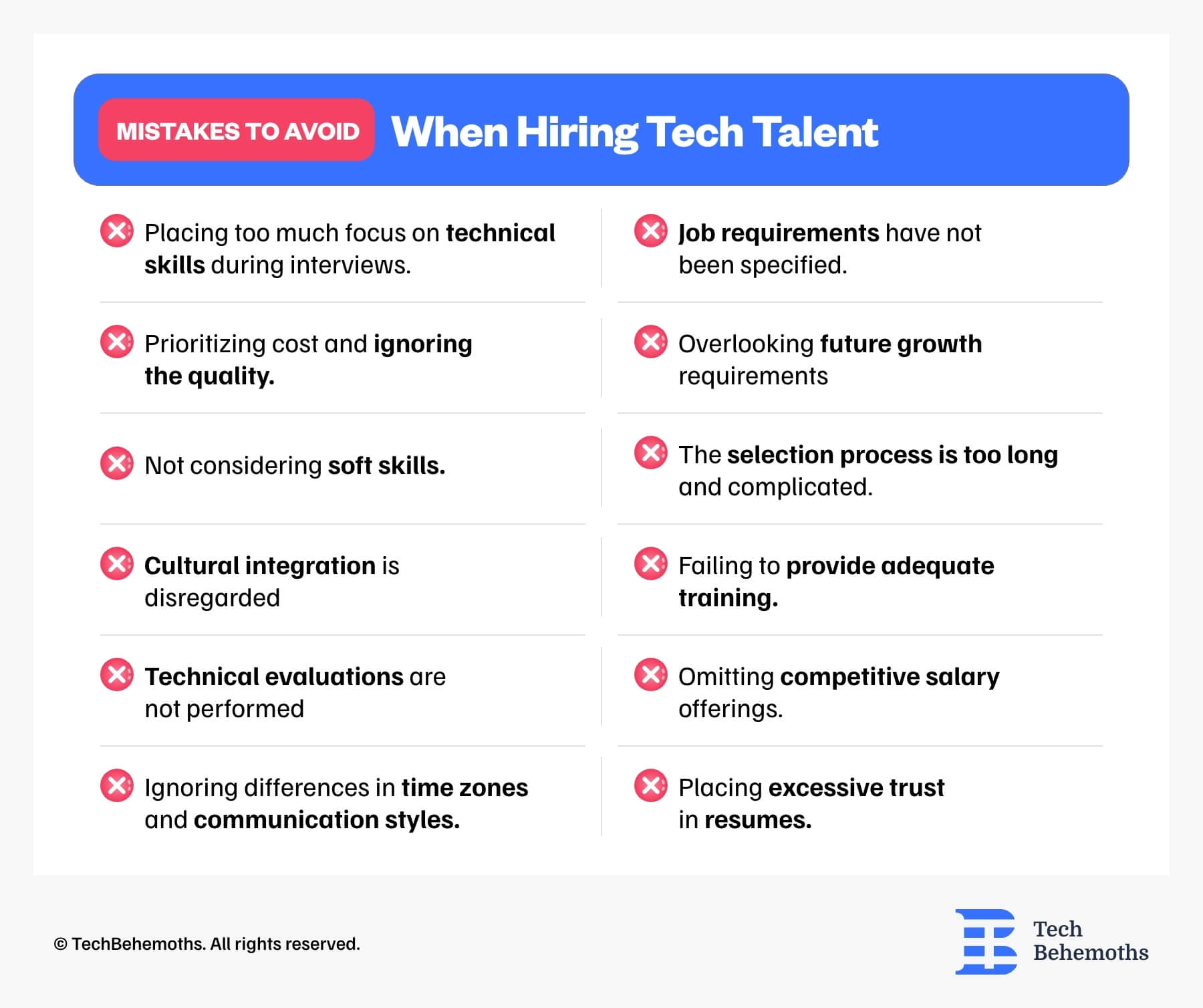
1. Trusting the CV too much
How to avoid? Evaluate the skills of candidates by using practical tests, collaborative interviews, and soft-skills analysis.
2. Too much focus on tech skills
How to avoid? Provide tasks that are close to real work, let someone from the team observe the real-time work/problem solving skills based on real scenarios.
3. Not including exact job requirements
How to avoid? Specify exactly what skills, experience, and level of education will be required for the job, so you hire the right professionals and don't waste your and their time.
4. Choosing cost over quality
How to avoid? Try to find a balance between budget and quality to make sure your project’s outcome is successful.
5. Ignoring soft skills
How to avoid? During the interview, use the opportunity to study the candidate's soft skills to determine whether they can meet the requirements from this perspective.
6. Selection process is too long
How to avoid? Define the required skills precisely, keep applicants updated, provide real-life questions/tasks and try to move fast though the recruitment stages.
7. Ignoring the cultural aspect
How to avoid? Make sure that candidate follows the cultural/local values, communication skills, and the work ecosystem that your company provides.
8. Remuneration is too low
How to avoid? Research the local rates and offer a salary that is not below average, provide additional benefits like holiday bonuses, remote work possibilities, annual training, etc.
9. Ignoring time zone differences
How to avoid? Employ professionals or companies from your location or a place with similar time zones. Don't go too far, as a 6-8 hour difference can be disruptive for your team.
10. Not providing training
How to avoid? Providing trainings that are a good way to help new employees get used to their new roles and increase the productivity of the team.