
There are 5 Companies in Sri Lanka
that provide Recruiting Services!
Sri Lanka is and has been for some years always been considered in the top 50 countries to outsource services, which is also related to the IT industry being one of the most important industries in the country. The history of the industry in Sri Lanka started in 1976 with the creation of the Computer Society of Sri Lanka, but the Business Process Outsourcing (BPO) industry started around the year 2000, and its development has been increasing since then to become one of the top destinations for foreign countries to outsource their services.
Discover Top IT Companies in Sri Lanka specialized in Recruiting and other related services. Find the best IT service providers for your projects.
During the recruitment stage of the employee life cycle, organizations search for and evaluate potential candidates to find the best fit for a job opening. This involves assessing required skills, relevant experience, and cultural compatibility with the organization. Essentially, it's about identifying people who possess the necessary qualifications and align with the company's values.
Recruitment is currently going through many changes. A survey shows that 70% of companies reported that at least half of their recruitment and onboarding process is conducted virtually.
Handpicked companies • No obligation to hire • 100% risk-free
Explore Top Recruiting Companies in Sri Lanka

Lapnos is an international development firm that works with governments and public institutions across South Asia and Africa.

We are specialized in Accountancy, Taxation, Financial Consulting, and Back Office Support for clients in Sri Lanka and around the globe.

Alp Consulting is a leading Indian HR &staffing firm, offering tailored recruitment, payroll, and outsourcing solutions to global clients Since 1996

Ventureskey is a forward-thinking business solutions provider

Leading HR services provider to International entities operating in Sri Lanka. Leader in EOR services and provider of remote/virtual IT professionals.
Filter Recruiting Companies in Sri Lanka by Cities
Find the right tech company near you or from a specific city. Some of the best companies might be located in smaller cities.
Find more Recruiting companies around the world
TechBehemoths is the world's most advanced and user-friendly platform to match IT Companies with real clients without hustle.
The IT Industry in Sri Lanka: Companies, Insights & Data
Sri Lanka has consistently been considered one of the top 50 countries for outsourcing services. This status is also related to the country's IT industry being one of its most important sectors. The history of the industry in Sri Lanka started in 1976 with the creation of the Computer Society of Sri Lanka, but the Business Process Outsourcing (BPO) industry started around the year 2000, and its development has been increasing since then to become one of the top destinations for foreign countries to outsource their services.
The country is a development center for many big companies from all over the world, such as J.P. Morgan & Co., Qatar Airways, Microsoft, and Google, and other companies from countries like Japan, Sweden, Norway, North America, Australia, and the UK. It is estimated that the profit of outsourcing services to Sri Lanka can cost 70% of the price it would cost in the same country as the companies.
The next projection of the future for the country is to reach 5 USD billion in exports by 2022 and create 200.000 jobs. Related to this data, the country also achieved a target of 1 USD billion in the year 2016. In the first 7 months of 2025, the total exports are worth $10 billion. The ICT sector reached approximately $1.7 billion, and by 2030, is expected to reach $5 billion.
With the fast growth of the IT industry, the government took action to boost the possibility to be able to learn IT-related technologies in the country and improve IT education in the country. Sri Lanka also ended the Indo-Sri Lankan “Comprehensive Economic Partnership Agreement” because it was causing unemployment for Sri Lankan professionals.
Why Should You Work With Sri Lankan Companies?
Some of the reasons for working with IT companies from Sri Lanka are the low costs of outsourcing the services there, and also the good education of the country’s professionals. It is estimated that the costs can be 30% lower. Also, the minimum wage in Sri Lanka is €89.37, and we will talk in-depth about this in the following section.
The education in the IT sector is rich in knowledge because the IT industry is one of the most important ones in the country. You can find highly educated graduates, and also, there’s one more aspect to talk about, and it is the law.
The law about foreign business and commercial law follows the principles of British commercial law and has an independent judiciary. Sri Lanka has also signed some international treaties about intellectual property rights, electronic transactions, and computer crimes, and it is one of the most rigorous in this region. In addition to this, the country has signed a Free Trade Agreement with Singapore (SLS FTA) that eliminates 80% of all tariff lines through staging periods of up to 15 years, and this has come into force since 1st of May 2018.
Their English level is better in relation to other neighboring regions, especially in the city zones, and they are friendly by nature, which makes doing business so much easier.
What to Know When Working With IT Companies From Sri Lanka?
When thinking about working with IT companies from Sri Lanka, you have to be aware of the geopolitical situation of the country and its past, as well as the current situation of the sector. First of all, when talking about minimum wage in Sri Lanka being $89.37 a month (the equivalent of 27.000 rupees, the official coin of the country), you can think about why there’s only a 30% difference between outsourcing the projects to this country with such a big difference in salaries, and the answer is lies in the difference in purchasing power and payment gap between employees and employers that earn a huge profit from these operations. This means that you can have workers of a certain quality, but not always comparable to more developed countries, with better salaries and work conditions.
Also, you need to be aware of the country past and present history, and this includes a very recent civil war that lasted 26 years (from 1983 to 2009), a sometimes unstable security situation in relation to the terrorist attacks suffered from moderate frequency, the last one was on April 2019 and talking about this last attack, Sri Lanka is also a very conservative and religious country, especially for women (Buddhism is part of life in 70% of the people).
Instability, the wage gap between the richest and the poorest, and common scams, not only for tourists but also for business, are things to be aware of when doing business with IT companies from Sri Lanka.
How Reliable Are IT Companies From Sri Lanka?
To answer this question, we will have a look at some studies and other parameters to be able to measure the reliability of Sri Lankan IT companies. We have to refer to a 2008 study by the University of Moratuwa in Sri Lanka, which we will take with a grain of salt for the few objective references that can be found on this subject, and the source of the information. We will also take into account other aspects in relation to the other questions we answered above.
There’s a case study called “Reliability of effort estimates in offshore software companies in Sri Lanka” that can be found in the Digital Library of the University of Moratuwa. The goal is to find out the reasons affecting the reliability of projects in Sri Lanka's offshore IT organizations and recommendations made as a result of this research study.
This case study concludes that the credibility and reliability of IT companies in this sector are subordinated to subjective beliefs of concrete experiences of prejudice, although, from the data we know, not all unreliability is due to this, as Sri Lanka is a country where common scams are certainly frequent. This can apply to the IT industry, but not with the same magnitude.
To conclude this section, we will say that the reliability of IT companies is certainly compromised by the fear of fraud, but as in every region or country, there are always good companies and bad companies. It is advisable to find companies with proven reliability to avoid fraud, and that work with the international standards of quality.
How Does the IT Industry in Sri Lanka Relate to the Neighboring Regions/Countries?
To start developing this section, we will analyze one important and basic aspect of outsourcing projects to this type of country that is still developing. Internet access could potentially curtail the industry’s growth. Although local telecoms operator Mobitel has developed the implementation of 4.5G LTE technology. The average connection speed is 23.77 Mbps in the country, in relation to other countries: Indonesia (28-30), India (136.53), Malaysia (168.94), and Vietnam (163).
Another aspect that can influence the industry development is the high rental prices in Colombo’s commercial property sector, which is the most populated city in the country, although it is not the capital of Sri Lanka. When outsourcing services, one of the most important things is cost reduction, so this is an important aspect to talk about. This aspect in the neighboring countries is less problematic because their development of the industry is more advanced at this time.
Sri Lanka is surrounded by one of the giants of outsourcing services, which is India, a very powerful country that remains untouchable in position number 39 in accordance with the 2024 Global Innovation Index, where Sri Lanka remains in number 89.
Conclusion
The conclusions of this short analysis on Sri Lanka IT industry are as follows, Sri Lanka is one of the top 20 best Business Process Outsource destinations, and the biggest industry activity is outsourcing services, you have to be aware of the unstable situation and the specific characteristics of this country such as internet connection, reliability of the industry, IT level of education of the graduates in this country and of course prices, for this it is recommended to work with companies that have proven reliability to be sure that any frauds will occur, and take advantages of lower costs of outsourcing services to this country.
What is Recruiting and what are its benefits for your projects?
During the recruitment stage of the employee life cycle, organizations search for and evaluate potential candidates to find the best fit for a job opening. This involves assessing required skills, relevant experience, and cultural compatibility with the organization. Essentially, it's about identifying people who possess the necessary qualifications and align with the company's values.
Recruitment is currently going through many changes. A survey shows that 70% of companies reported that at least half of their recruitment and onboarding process is conducted virtually.
Recruiting typically follows this process:
-
Job analysis - Conducted to document the necessary knowledge, skills, abilities, and other characteristics required or desired for the position. This information is then included in a person specification.
-
Sourcing - Attracting or identifying candidates.
-
Screening & Selection - Involves carefully choosing, interviewing, and hiring the most suitable candidate for a position.
Let's explore the benefits of implementing a strategic recruitment process:
-
Hiring the right fit: The key to finding the ideal candidates lies in dedicating time and effort to a well-organized recruitment process. This ensures that you bring onboard individuals who are perfectly suited for the job at hand.
-
Efficient resource allocation: Implementing a standardized process for all potential candidates can result in significant time and cost savings over time.
-
Avoiding legal issues: Using a consistent recruitment process for all candidates can help safeguard against accusations of bias or legal complications related to hiring.
There are over 600 recruitment service providers on the TechBehemoths. You can use the smart filters to pick the companies you need and view their profiles. Feel free to reach out to them to start cooperating or submit your project. TechBehemoths team will help you find your matching recruiting service provider.
Hirig talent in 2026: challenges and how to adapt
According to World Economic Forum reports, by 2030, it is estimated that 170 million jobs will be created globally due to structural transformations of the labor market.
This represents approximately 14% of all existing jobs, and the main factors determining this change are:
-
Digitalization
-
Automation
-
Green transition
A major factor that is worth mentoning is the current trend in implementing AI and automating processes in companies, that can lead to layoffs, but at the same time can create new hiring opportunities in the long term.
How can businesses adapt and hire efficiently?
Here are some key strategies to consider:
-
Prioritize AI and specialized job roles - prioritize strategic and AI-focused roles over administrative and support ones
-
Implement AI-driven hiring - use AI to automate technical and/or administrative HR tasks.
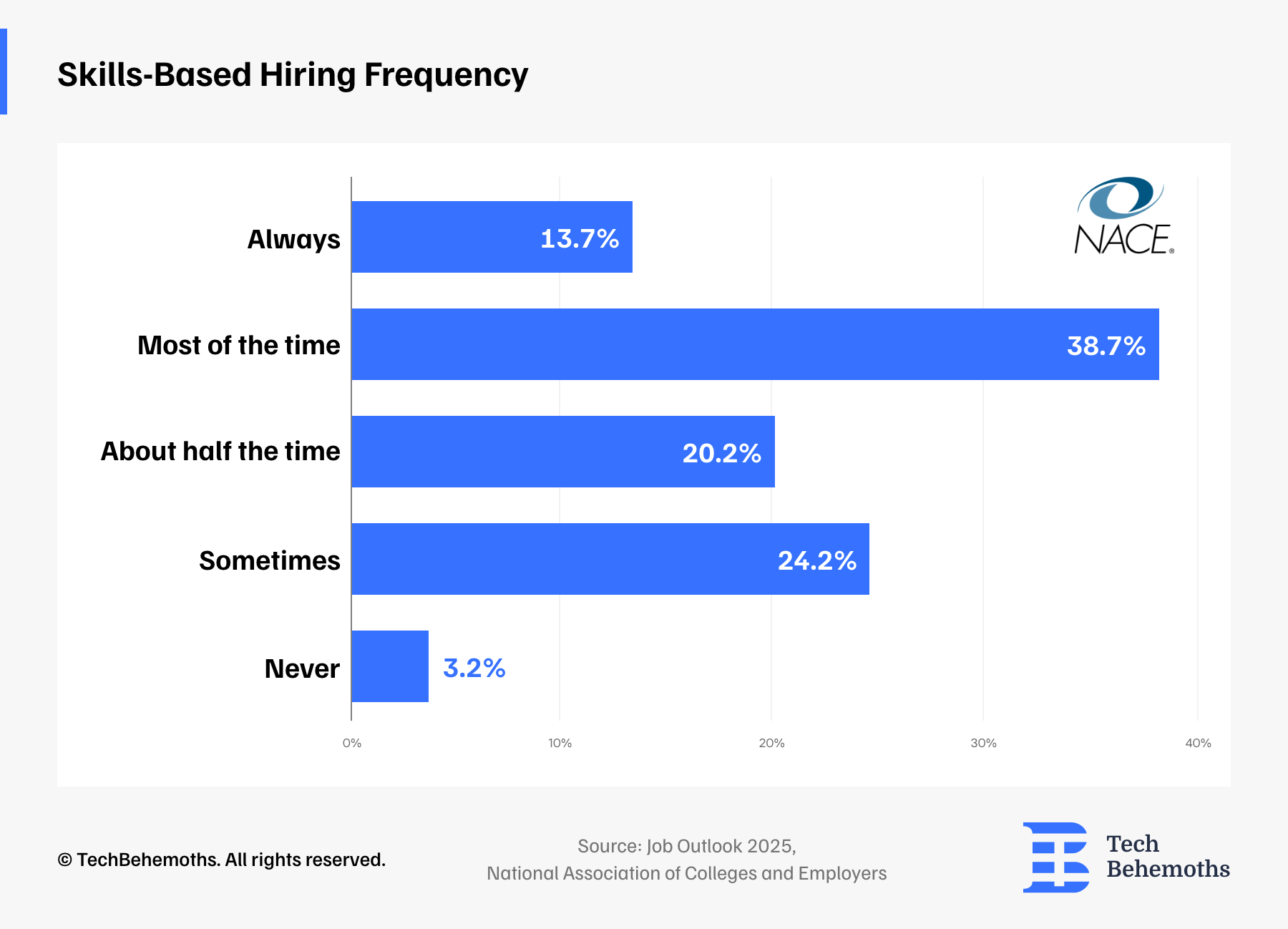
- Adopt skills-based hiring - don't solely rely on traditional CVs. Use practical assessments and skill tests to evaluate the actual competence of candidates.
-
Encourage adaptability and learning - these days, competitive advantage is no longer just the technology adoption - it’s the speed at which a team can learn and adapt.
-
Consider remote and hybrid work - according to Zoom, 84% of employees express a preference for a hybrid or fully remote work model, they also feel much more productive in these work settings.
- Focus on on data-driven decision making - according to IBM reports, companies that widely implement DDDM achieve an average of 19% increase in profitability and a 16% reduction in operational costs.
Common mistakes to avoid when hiring tech talent/providers
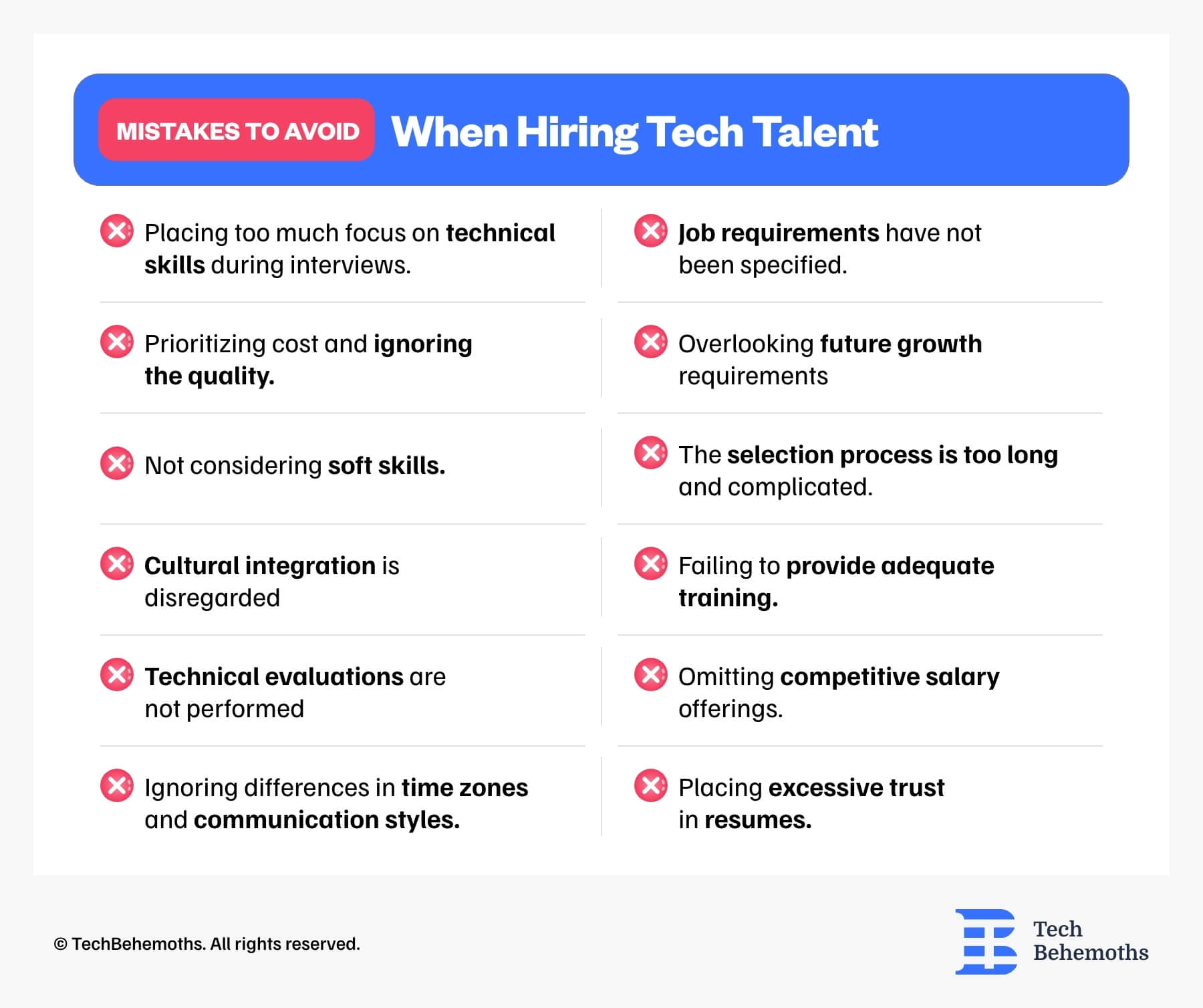
Try to avoid these common mistakes that may put at risk your project’s success. Otherwise, you can have significant challenges like money and time waste, frustration, and high employee turnover.
1. Trusting the CV too much
How to avoid? Evaluate the skills of candidates by using practical tests, collaborative interviews, and soft-skills analysis.
2. Too much focus on tech skills
How to avoid? Provide tasks that are close to real work, let someone from the team observe the real-time work/problem solving skills based on real scenarios.
3. Not including exact job requirements
How to avoid? Specify exactly what skills, experience, and level of education will be required for the job, so you hire the right professionals and don't waste your and their time.
4. Choosing cost over quality
How to avoid? Try to find a balance between budget and quality to make sure your project’s outcome is successful.
5. Ignoring soft skills
How to avoid? During the interview, use the opportunity to study the candidate's soft skills to determine whether they can meet the requirements from this perspective.
6. Selection process is too long
How to avoid? Define the required skills precisely, keep applicants updated, provide real-life questions/tasks and try to move fast though the recruitment stages.
7. Ignoring the cultural aspect
How to avoid? Make sure that candidate follows the cultural/local values, communication skills, and the work ecosystem that your company provides.
8. Remuneration is too low
How to avoid? Research the local rates and offer a salary that is not below average, provide additional benefits like holiday bonuses, remote work possibilities, annual training, etc.
9. Ignoring time zone differences
How to avoid? Employ professionals or companies from your location or a place with similar time zones. Don't go too far, as a 6-8 hour difference can be disruptive for your team.
10. Not providing training
How to avoid? Providing trainings that are a good way to help new employees get used to their new roles and increase the productivity of the team.