TechBehemoths Web Development Expert Insights 2026


Summary
What makes a website successful long after launch?
Two web development experts share practical insights on website performance, user experience, choosing the right development partner, and avoiding costly mistakes.
Choosing a web development partner is about far more than creating a visually appealing website. A successful website needs to deliver fast performance, support business growth, and provide an intuitive user experience.
To better understand what separates high-performing websites from average ones, we spoke with two experienced industry leaders. They share their perspectives on the most common mistakes businesses make, what to look for when hiring a web development company, and where to invest first when a complete redesign isn't an option.
Meet the Experts
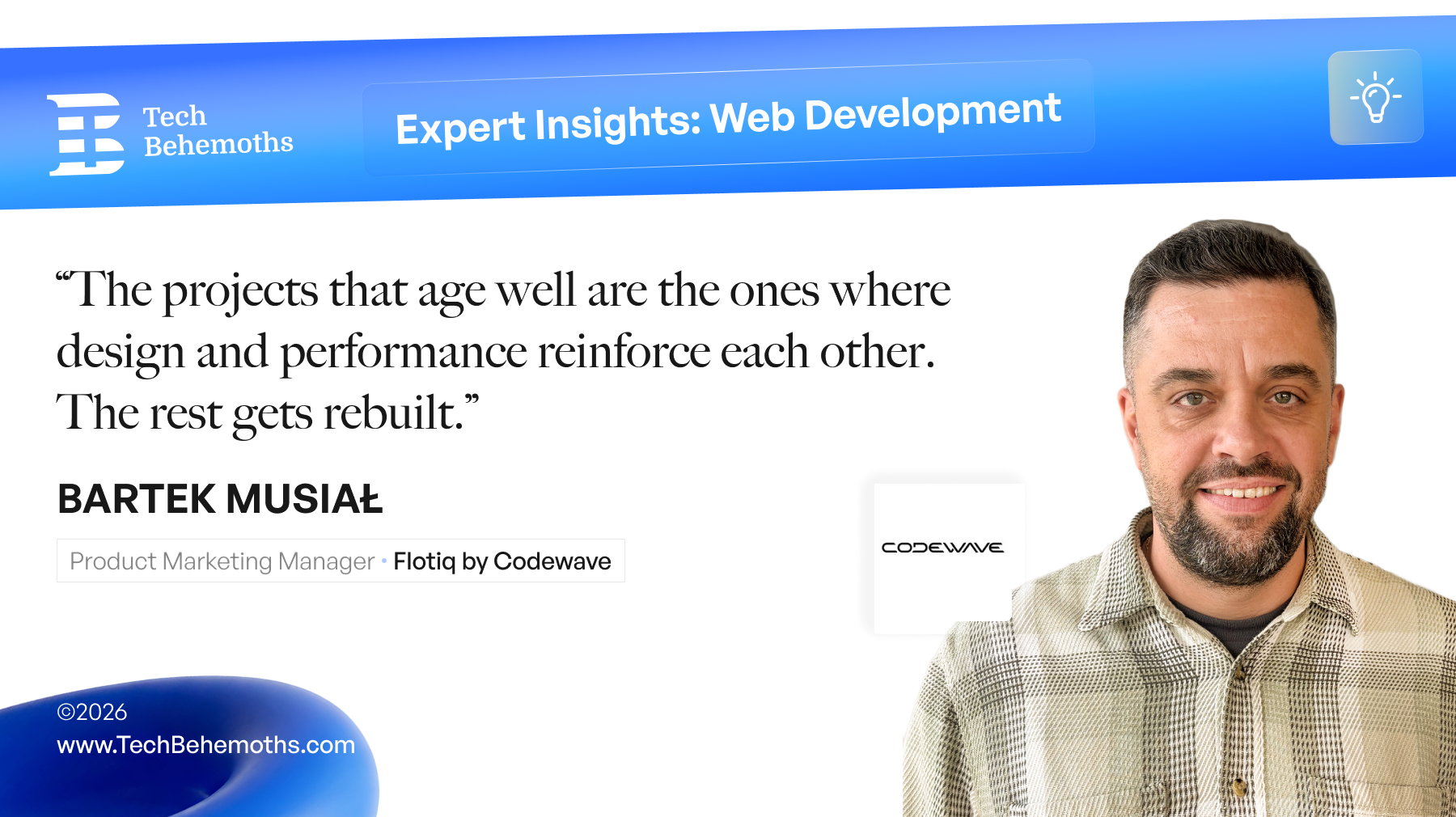
Bartek Musiał is the Product Marketing Manager at Flotiq by Codewave, a Poland-based technology and software development company specializing in secure, scalable digital solutions for regulated industries. With 15+ years of experience in software, SaaS, and B2B growth, Bartek helps connect product strategy with market positioning, focusing on enterprise web platforms, high-performing digital products, and long-term business value.
Thomas Kwon is the Founder & CEO of Idea Maker, a California-based boutique software development agency specializing in custom web, mobile, and AI solutions. With more than a decade of experience in software development and digital innovation, Thomas helps businesses build scalable digital products, streamline operations through AI, and develop technology solutions that drive long-term business growth.
Let's start with the first question.
What separates a website that looks good from a website that performs well?
Bartek Musiał, Codewave
A website that looks good is a design problem. A website that performs is an engineering problem. The visible part shows up in the first week: typography, imagery, how the homepage feels. The invisible part shows up later: how fast pages render on a 4G connection, whether search returns results in under 200 milliseconds, what happens to your checkout when traffic doubles overnight, and, more recently, whether the platform can absorb the AI features users now expect without breaking the rest of the stack. Working with our clients, we treat both sides as one problem, not two. The projects that age well are the ones where design and performance reinforce each other. The rest gets rebuilt.
Thomas Kwon, Idea Maker
A high-performing website will have two things: 1) Easy and intuitive navigation and 2) a clear storyline. The user experience of a website is very important. People need to find the information about your company, service or product quickly as they evaluate many options. If they can’t find what they’re looking for they will move onto another site. This is especially important on large and complex sites. The second most important feature of a high-performing site is a clear storyline or message. Every site is telling a story about the company, what service or product they offer, what problem they solve and why they’re better than the competition. This thread has to be easily followed across your site as well on individual pages.
What is the most expensive mistake businesses make when building a new website?
Bartek Musiał, Codewave
The most expensive mistake is treating a website like a one-off project rather than a system your business will live with for three to five years. Companies often optimize for the cheapest, quickest go-live and then pay for it twice. First with a costly rebuild months later, when performance drops and integrations start to fail. The hidden costs aren't in the invoice. They're in two years of lost momentum, integrations that have to be re-architected, the team that burned out keeping a broken system alive, and customer trust that took a hit during the migration window. Cheap launches don't save money. They defer it—with interest. We see this pattern in many rebuild projects we take on.
Thomas Kwon, Idea Maker
The most expensive mistake is focusing on a flashy look without putting time into substance. It is important to put time into converting your traffic into customers. By following the ideas presented earlier, such as an intuitive interface and a clear storyline, businesses can convert viewers into customers. But if they aren’t focusing on conversions, they’ll lose potential customers.
What questions should a company ask before hiring a web development partner?
Bartek Musiał, Codewave
Three questions tell you everything you need to know about a potential partner.
First: Who takes care of this website in three years—you or your partner? If they can't answer with conviction, they're a project shop, not a long-term partner.
Second: Show me a client you've actually worked with for more than five years. Long relationships only exist when both sides keep delivering value over time. That's the most honest signal of capability you'll find.
Third: What happens at 2 a.m. when the website breaks right after launch? Listen carefully to that answer. It tells you who they are when nobody's watching.
The first two questions filter out project shops. The third filters out everyone else.
Thomas Kwon, Idea Maker

Evaluating a development company is a difficult process as many clients are non-technical. But evaluating them is the same as evaluating any other business.
I recommend the following questions:
1. How long has this company been in business? A company that has been around for a while has proven procedures and deliverables.
2. What is their reputation? How are their reviews? You’d want to check their reviews to ensure they have satisfied customers. To make sure you’re checking thoroughly, ask for references from past and current clients.
3. Do they have ongoing clients? A company that has clients that come back repeatedly for more work, maintenance or other services shows that they provide quality service that is reliable.
4. Do they have a clear process? A good company would be able to explain its process clearly so the customer can follow along with the development.
What should companies prioritize if they cannot afford a complete redesign?
Bartek Musiał, Codewave
If you can't afford a complete redesign, stop trying to find one. You probably don't need one anyway. Fix the foundations instead. Audit performance, security, and the integrations that actually drive your business, and prioritize those. A faster, more reliable platform outperforms a prettier one every time, especially when you're measuring conversion, retention, or operational efficiency. Refactoring is incremental, less disruptive, and typically pays back within six months—sometimes faster. Redesigns are vanity projects with multi-year payback. And those same foundations are what allow you to implement AI later without rebuilding from scratch. The companies that come out of constrained periods stronger are the ones that know how to improve what they already have.
Thomas Kwon, Idea Maker
Companies that cannot afford a complete redesign can first evaluate their traffic and focus on high-traffic pages. Many times, this is the homepage and the About page. Besides this, they could do some small but important fixes on their current site. Update outdated photos, modernize structure or fonts, and simply tidy up the site. These changes are inexpensive but make a big difference.
Both Experts Agreed That:
A good-looking website isn't enough.
A website should help users find what they need quickly while supporting real business goals.
User experience has a direct impact on results.
Clear navigation, intuitive structure, and a smooth experience make it easier to convert visitors into customers.
Long-term thinking matters.
A website should be built and maintained as a long-term business asset, not just launched and forgotten.
Choosing the right development partner is critical.
Businesses should look beyond attractive portfolios and evaluate experience, reliability, processes, and long-term support.
Not every improvement requires a full redesign.
Focusing on performance, usability, and the pages that matter most can deliver meaningful results without rebuilding the entire website.
Thank you to Bartek Musiał (Flotiq by Codewave) and Thomas Kwon (Idea Maker) for sharing your expertise and contributing to TechBehemoths Web Development Expert Insights 2026.
Looking for a Web Development Company?
Check our list of top Web Development companies
Did you enjoy reading the interview?
I absolutely love embracing new opportunities and connecting with people. Every project is a chance to analyze, create, and work until I am satisfied with the results. Bringing creativity into every aspect of my work offers a fresh perspective on turning ideas into reality. Paying attention to the details is key because it's the little things that truly make all the difference.
Discover more TechBehemoths Insights
Learn practical tips and insights about IT Companies, how to find the right company for your projects.
Read the latest news about Market Trends and fresh Interviews.