Soft Skills or Tech Skills? What to Look for When Hiring Web Developers


Summary
-
As of 2026, about 250,000 new websites appear daily, and there are over 5.4 billion internet users.
-
The sector of Web Development is estimated at 87.75 billion in 2026, and is expected to grow to over 134 billion by 2031.
-
HTML is the most widely used block of the Web, and defines the meaning and structure of Web content.
-
The most popular frameworks used by Web Developers in 2025 are Node.js, followed by React, jQuery, and Next.js.
-
A Web Developer fills the gap between design and functionality, making user experiences more lively.
As of 2026, about 250,000 new websites appear daily, making the online presence a necessity for businesses. More than 5.4 billion people are internet users, reinforcing the need for Web Developers, that create and maintain web pages. This industry demonstrates high competitiveness, fueled by mobile-first consumer behaviour, AI-driven automation, and the demand for fast-performing digital products.
According to Mordor Intelligence, the sector of Web Development is projected to reach 87.75 billion in 2026, and is expected to grow to over 134 billion by 2031. Even though many companies are trying to reduce costs, they can’t avoid investing in digital tools due to the need to optimize online platforms, cloud-based systems, and new features like AI.
To keep up with the need to improve a company’s online presence, it must look for the best Web Developers. But how to choose the right one? This article describes the required skills to look for when hiring Web Developers.
What to Look for in a Web Developer’s Tech Stack?
A Web Developer is a programmer who creates, builds, and maintains websites and Web applications, ensuring they are functional, user-friendly, and visually appealing. These professionals should demonstrate a stack of technical skills that will ensure the needed functions of this job. Employers who consider hiring a Web Developer must consider the following most fundamental tech abilities.
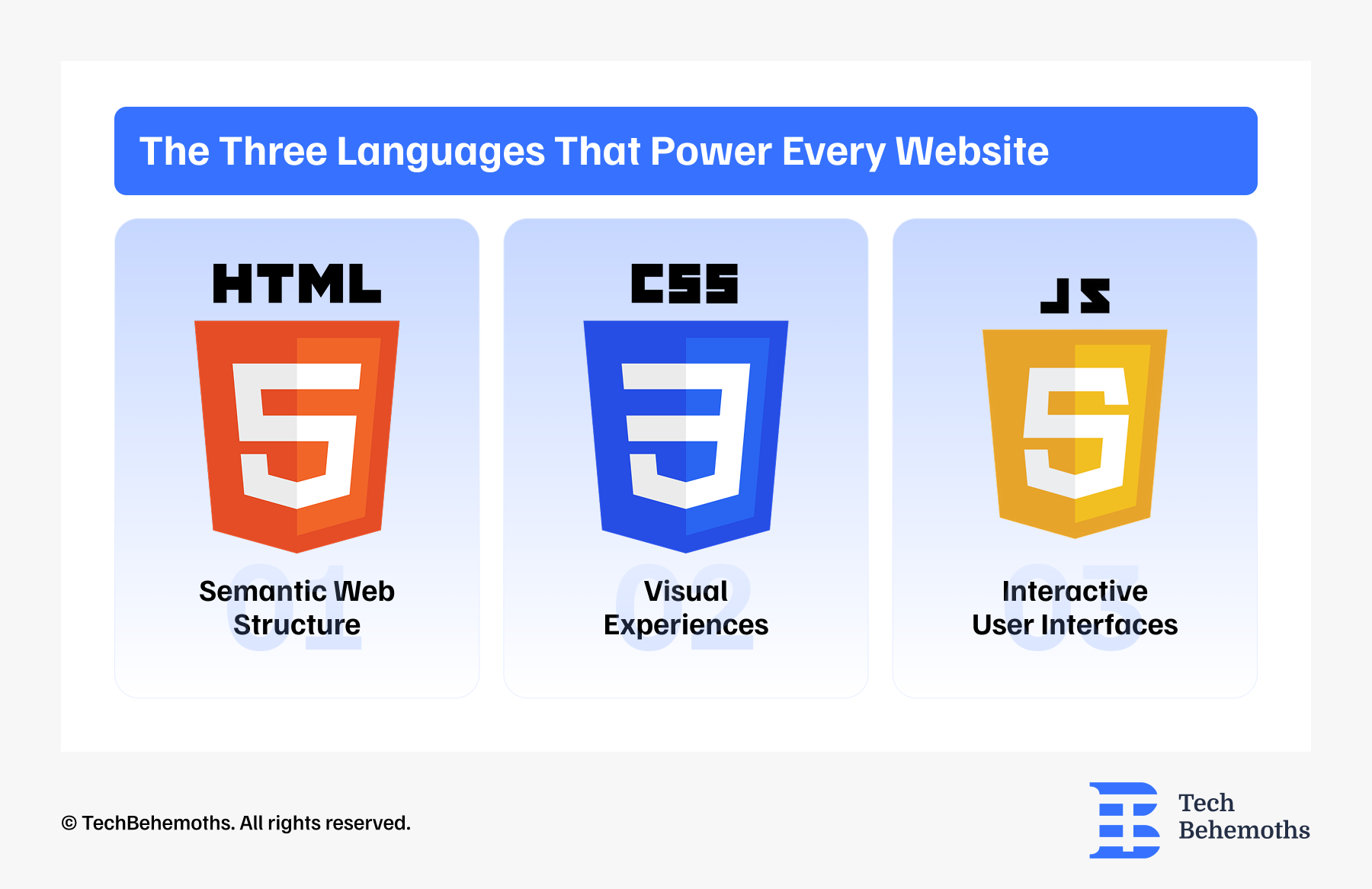
The Three Languages That Power Every Website: HTML, CSS, JavaScript.
HTML (HyperText Markup Language) is the most used block of the Web, and is used to structure and give meaning to the content on a website. A solid understanding of HTML foundation is essential for Web Developers, as they should understand semantic elements such as < article >, < section >, and < nav > to build clear and well-structured pages that are easy for browsers and assistive technologies to understand. Candidates should prioritize accessibility, proper heading structure, and clean, organized markup.
JavaScript is a coding language for building interactive webpages, and Developers leverage it for various functions. Data validation, runtime styling, and UI buttons are examples of functions done with this programming code. Main JavaScript skills for a Web Developer should include:
- ES6+ features
- Asynchronous JavaScript
- DOM manipulation and events
Bring Interactivity to Your Website
Partner with JavaScript development companies to build dynamic user experiences, interactive features, and modern web applications.
The candidates should also be able to create interactive user experiences, work with APIs, and manage application state effectively. Knowing the concepts like closures, promises, and modern JavaScript features can help distinguish Developers from others.
CSS (Cascading Style Sheets) allows Web Developers to create good-looking websites. Using CSS can offer the possibility to control exactly how HTML elements look in a browser. It can be used for several purposes, like text styling, including color and size, creating layouts such as multiple-column layouts, or special effects like animation. Besides basic styling, candidates should have knowledge of modern CSS features, including Grid, Flexbox, and custom properties. Additional skills include animation techniques, responsive design principles, and CSS preprocessing to create visually appealing interfaces that work across all browsers and devices.
Knowledge of Popular Frameworks
Web Developers need to learn popular frameworks to accelerate development speed, ensure code maintainability, and improve security through pre-built components and standardized structures. Frameworks optimize productivity, allowing Developers to focus on unique business logic rather than repetitive tasks. Benefits of using frameworks in Web Development include:
- Efficient development
- Scalability
- Strong security practices
- Maintainable code
- Improved performance
According to Statista, the most popular frameworks used by Web Developers in 2025 are Node.js at the top of the list, followed by React. Other popular frameworks used in this field include Next.js and Angular
Node.js
Node.js is a free, open-source JavaScript runtime available on Windows, macOS, Linux, and other platforms. It allows Web Developers to run this programming language outside the browser, making server-side development possible with JavaScript. This framework was built for creating scalable and efficient Web applications. For Web Developers, it is a great framework, because it is suitable for:
- Real-time apps
- APIs and microservice architectures
- Data streaming and processing systems
- Command-line applications and utilities
- Server-side Web applications
Node.js leverages non-blocking or asynchronous programming, meaning that it can keep working while waiting for tasks like reading files or talking to a database.
React
React lets Web Developers build user interfaces out of individual pieces called components. This framework is a component-based JavaScript library for building dynamic user interfaces. It is very popular for fast and scalable single-page applications (SPAs). Some of its key benefits for Web Development include:
- Increased flexibility and compatibility
- High performance reinforced by Virtual DOM
- An extensive set of tools
- Vast community and market-defining resources
React is one of the most widely used JavaScript libraries thanks to its large set of characteristics that support fast, production-ready development.
Next.js
This React-based framework makes it easier to create fast and interactive applications. It extends its capabilities by adding features like server-side rendering and static site generation. Next.js is a flexible framework used for creating interactive user interfaces. It stands out by simplifying complex development tasks through a complete set of built-in tools and features. A major feature of Next.js is server-side rendering, which enhances both performance and search engine optimization. As a result, applications load more quickly and tend to perform better in search engine rankings. Web Developers that use Next.js can offer better performance, improved SEO, simplified React development, and automatic routing.
Angular
Angular is a TypeScript-based Web framework developed by Google for building scalable and high-performance Web applications. It uses a component-based architecture that allows Developers to build applications from reusable, modular pieces, making code easier to maintain and scale. It also includes built-in tools for routing, forms, state management, and HTTP communication, along with the Angular CLI that simplifies development and project setup. It is widely used for building large, complex, and enterprise-level Web applications.
Find Developers by Framework Expertise
Looking for a specific technology stack? Explore companies specializing in Node.js, React, Next.js, and Angular development.
UX & UI
A Web Developer fills the gap between design and functionality, making user experiences more lively. That’s why another important skill for such professionals is the UI (User Interface) and UX (User Experience) design.
- UI focuses on the visual design of a product, including elements such as colors, typography, buttons, layouts, and overall visual consistency.
- UX focuses on the user experience, prioritizing usability, accessibility, responsiveness, and how easily and effectively users can interact with the product.
Also, a Developer can have a good UX without a good UI, but it is not possible to have a good UI and a bad UX. Due to the competitive landscape, knowing only coding isn’t enough, making UI/UX a benefit to every Developer.
Server-Side Web Development
The back end of the webpage or apps includes every detail that users don’t see. The code makes the front end work properly. The back end includes the databases that collect and link data captured in an app. Back-end development depends on programming languages like Python, Java, and PHP. Developers need to be skilled at connecting their server-side systems to the Web so users can interact with the application seamlessly.
Version Control
Version control systems like GitHub enable Developers to document any changes to the code on either the front end or back end so that they can easily revert to earlier versions in case problems appear. These systems provide multiple features, including branching, merging, and rollback. Thus, Web Developers can manage complex codebases and reinforce stability.
Safety & Data Protection
Companies should focus on ensuring data protection to fortify their systems against cyberattacks by developing a cybersecurity and resilience plan. Web Developers must follow security measures to evaluate risks like data breaches, unauthorized access, and malware. This involves integrating two-factor authentication into the application and maintaining offline backups to restore data in the event of a security breach.
API Development
For Web Developers, knowledge of the application programming interface (API) is crucial, especially for Web applications. API work by allowing software elements to communicate with each other. Other advantages of APIs in Web Development include seamless integration, enhanced functionality, and improved user experiences. Developers need to understand them because it enables them to build efficient, scalable, and dynamic Web applications.
Testing and Troubleshooting
Developers are supposed to demonstrate problem-solving skills and be committed to testing and debugging their apps to ensure optimal functionality, performance, security, and device and browser compatibility. Web Developers are required to implement a testing process to identify bugs in the testing ecosystem before code is pushed to production.
While these technical competencies form the foundation of all Web Developers, they must complement them with a set of essential soft skills that enable Developers to collaborate effectively, solve complex problems, and adapt to the fast-evolving nature of the industry.
Soft Skills That Improve Web Developer Performance
Even though Web Development is a technical field, it demands several soft skills that will optimize professionals' performance and results. Soft skills are personal abilities that help people work effectively with others and complement hard skills. These can be optimized through communication, feedback, and training.
-
Empathy: Outside of real life, compassion should also persist at work. Examples of empathy in tech life include the care a Web Developer puts into their app's user experience, analyzing clients’ feedback, and checking in with their teammates to improve the work environment.
-
Analytical creativity: This domain often experiences bugs, issues, and malfunctions in its work. They need to show a creative way of resolving these difficulties and think outside the box.
-
Communication: Even for more isolated Developers, it is crucial for work efficiency, especially for those on a team. Good communication means the ability to listen and to convey one's goals, needs, and requests. Developers are expected to talk with team members, clients, and higher-ups to optimize the joint project.
-
Adaptability and versatility: There can be moments when the client changes details in the project, or the deadline is moved up. Every Web Developer should be flexible enough to meet these changes.
-
Teamwork: Tech projects are complex and require Developers to collaborate to accomplish their goals. Teamwork within a Web Development firm is a key factor for business success.
-
Task management: Time management represents how an employee administrates its tasks and projects. The organization of a Developer's time could effectively provide him with more room for productivity.
-
Leadership: A leader has a combination of senses, including accountability, ownership, and responsibility, according to their team and work. These skills could be a driving force for the company’s success and innovation.
Soft skills are essential for tech professionals because they enable effective collaboration, bridge the gap between tech and non-technical stakeholders, and drive career advancement in an automated landscape.
The Key to Success is to Look for Both Tech and Soft Skills
Companies that look only at the tech stack are ensuring only half of the project’s success. The table below represents the main differences between tech and soft skills for a better understanding of why employers need to consider both of them.
|
Parameter |
Tech Skills |
Soft Skills |
|---|---|---|
|
Definition |
Job-specific technical abilities |
Personal and interpersonal qualities |
|
Measurable |
Subjective |
|
|
Origin |
University programs, coding courses, and trainings |
Life experience and practice |
|
Demonstrated through qualifications, certifications, portfolios, or technical assessments |
Usually shown through behavior, communication, and workplace interactions. |
|
|
Transferability |
Often transferable across similar roles and industries |
Varies depending on people's environments and situations |
|
Connection to personality |
Primarily technical and not personality-driven |
Closely connected to personality and behavior |
|
Examples |
Programming, Data Analysis, Graphic Design, Project Management, and Financial Analysis |
Communication, teamwork, creativity, adaptability, organization, problem-solving, critical thinking, and time management |
Soft skills help Developers navigate through real-world challenges that cannot be resolved through coding. Tech professionals who can collaborate, communicate clearly, and adapt to change are much more effective in difficult situations than those who are dependent only on tech abilities.
How to Find the Best Web Developer with TechBehemoths?
There are thousands of Web Developers providing the required skills for your project. That’s why it’s important to define your goals and requirements in advance, so you can choose the right service provider for your business.
Choosing a reliable professional to work with can be a difficult task. To make the selection process easier, keep in mind some of the following aspects aside from the tech and soft skills:
- Experience
- Portfolio
- Price
- Location
- Client reviews
Carefully evaluating these factors, you can choose a Web Development company that has the best tech professionals for your needs. There are more than 24600 companies on the TechBehemoths platform that offer a wide variety of Web Development services.
Compare Top Web Development Companies
Browse and compare web development companies based on expertise, tech stack, client reviews, location, and pricing to find the best match for your project.
Explore their detailed profiles and client testimonies, and feel free to get in touch with them. TechBehemoths also has a powerful tech filter that you can use to narrow down the results based on your requirements and shortlist the companies.
Conclusion
Web Developers, while working in a pure tech domain, are still humans and are driven by both logic and emotions. For employers is crucial to consider a combination of these abilities rather than thinking of tech or soft skills.
While the technical part ensures a candidate can build, maintain, and optimize Web applications, soft skills such as communication, adaptability, and problem-solving are equally important for collaboration and long-term success.
The most valuable Web Developers combine their tech stack with the ability to work well with teams, understand business needs, and adapt to evolving technologies. By balancing both skill sets during the hiring process, employers can identify candidates who will contribute not only to project success but also to the overall company’s growth.
Related Questions & Answers
What is the Difference Between Front-end and Back-end Development?
How Can You Evaluate a Web Developer’s Portfolio Effectively?
What is More Important: Experience or Technical Skills?
What Mistakes Should Companies Avoid When Hiring Web Developers?
Will AI Replace Web Developers in the Future?
I am an enthusiastic Biomedical Engineering Researcher and love learning about various domains. One of the biggest treasures that we, people, have is knowledge because it's hard to achieve and it depends only on human will. And it can be shared with others, that's why I like to find something new and share it with the world.
Discover more TechBehemoths Insights
Learn practical tips and insights about IT Companies, how to find the right company for your projects.
Read the latest news about Market Trends and fresh Interviews.