SEO vs AEO: What Works Better in 2026?


Summary
Is traditional SEO enough - or does AEO (Answer Engine Optimization) deliver better results in 2026? The truth is, you need BOTH, and they work best together. But they play very different roles, and understanding those roles is essential for visibility.
Search behavior changed significantly in 2025 as Google began answering more questions directly on the results page and users increasingly relied on AI-powered tools and voice search. People are still searching more than ever, they’re just getting answers in new ways.
In this article, I’ll break down the difference between SEO vs AEO, explain what’s actually driving visibility in 2026, and share a real client example showing how combining both strategies doubled traffic and leads for a local business.
SEO & AEO: Understanding the Basics
SEO and AEO are related but distinct approaches to improving search visibility.
-
SEO helps pages show up in search results.
-
AEO helps content get selected as the answer.
Together, they shape how people discover and trust information in 2026.
Search Engine Optimization
Search Engine Optimization (SEO) is the process of creating and optimizing content to rank prominently in Google’s organic results. Traditionally, SEO is built on three core pillars:
-
On-page SEO: Using relevant keywords
-
Off-page SEO: Earning backlinks and mentions
-
Technical SEO: Improving performance and usability
At its core, SEO is designed to bring users to your website.
Search EVERYWHERE Optimization (The “NEW” SEO)
As search evolves, SEO is increasingly viewed as Search Everywhere Optimization. Search engines and AI systems now assess a brand’s entire online presence including:
-
Website content
-
Brand mentions
-
Social media presence
In late 2025, Google tested showing impressions from YouTube and select social platforms inside Search Console. If these signals are being tracked, they likely contribute to perceived authority.
With the rise of low-quality AI content, trust and brand consistency matter more than ever.
AEO (Answer Engine Optimization)
Answer Engine Optimization (AEO) is the process of structuring content so that search engines, AI models, and voice assistants can extract answers rapidly. It focuses on:
-
Concise definitions
-
Structured Q&A blocks
-
Clear, skimmable formatting
-
40–55 word answer blocks
-
TLDR summaries
-
FAQ sections
AEO is not about longer content - it’s about clearer answers.
This is why AEO heavily influences visibility in:
-
Featured Snippets
-
People Also Ask results
-
AI Overviews
-
Voice search responses
-
LLM-generated summaries and citations
2026 Trends in Search Behavior
More than 60% of Google searches resulted in zero-click outcomes, according to Search Engine Land. Users increasingly get answers directly on the results page through AI Overviews, Featured Snippets, or PAA.
While this may feel like a sudden change, it’s actually the continuation of a trend that began years ago with Rich Snippets and PAA.
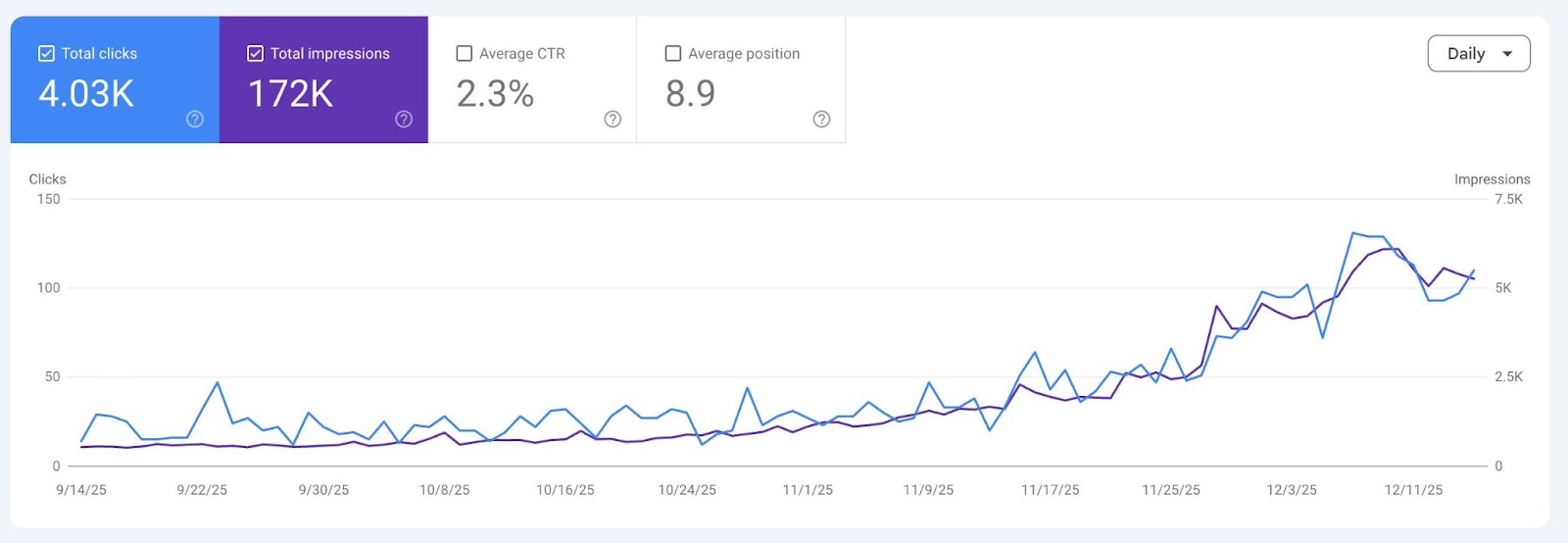
But, search volume remains at an all-time high. Even though informational click-through rates are declining, people are searching more than ever and we’ve continued to grow organic traffic for clients despite this shift.
More Sponsored Results
Many searches now display:
-
4–5 sponsored ads
-
3 sponsored map listings
-
AI Overviews above organic results
This pushes even the #1 organic listing further down the page.
Rapid Adoption of AI Tools
The speed at which people have adopted tools like ChatGPT has been staggering.
Some have labeled this “the death of SEO,” but in practice, it’s been one of the most positive shifts we’ve seen for clients.
Unlike traditional search engines, LLMs don’t sell sponsored answers. Their goal is to surface the best response to a question. This has led to significantly higher trust in AI-generated results, which benefits businesses that consistently publish clear, accurate, and trustworthy content.
Users are now able to:
-
Ask very specific questions
-
Compare providers before visiting a website
-
Make more informed decisions faster
Longer, More Conversational Search Queries
Search queries are becoming more detailed. Traditional SEO focused on 3–4 word phrases. Today, the average LLM query is roughly 23 words, and Google’s AI Overviews are encouraging more conversational searches directly in Google.
This favors businesses that clearly explain services and answer buyer-level questions.
Voice Search Continues to Rise
Voice search now accounts for over one billion searches per month worldwide. Its convenience has led to more searches overall and more opportunities to appear as the direct answer.
Higher Conversion Rates Despite Lower Blog Traffic
While informational blog traffic has declined, conversion rates are rising, particularly from AI-driven traffic.
Users who reach your site are often better informed and closer to a decision.
Businesses that build focused service pages, target the right keywords, and answer buyer-level questions are far more likely to show up in AI-driven results — and convert when it matters most.
SEO vs AEO: Which Works Better in 2026?
SEO and AEO work best together. SEO brings users to your website, while AEO builds trust by answering their questions. Businesses that combine both see stronger visibility, better engagement, and higher conversion rates than those relying on SEO alone.
What Traditional SEO Still Does Best
SEO is about getting people to your website from Google. That hasn’t changed.
Traditional SEO works well for:
-
Ranking pages for keywords people search when they’re ready to buy
-
Driving steady traffic to your site
-
Helping the right pages show up at the right time
Traditional SEO remains the foundation for digital visibility.
Where Traditional SEO Falls Short Today
Even high-ranking pages earn fewer clicks today - especially for purely informational pages that answer simple queries.
Search engines increasingly answer questions directly through:
-
Featured Snippets
-
People Also Ask
-
Google AI Mode
-
LLM-based meta answers
In many cases, users get what they need without visiting a website. To remain visible, content must both rank and clearly answer questions.
How AEO Supplements Traditional SEO
When SEO rankings alone don’t earn the click, AEO helps ensure your content is still chosen as the answer.
By clearly addressing questions on the page, AEO keeps users engaged, builds trust with search engines and AI systems, and supports stronger SEO performance through better engagement signals.
AEO doesn’t replace SEO — it amplifies it.
Case Study: How SEO + AEO Doubled Traffic and Leads for a Local Business
All American Mail Center specializes in wine shipping — a service with detailed regulations and customer questions.
We created SEO-driven content targeting high-intent keywords such as:
-
“wine shipping Napa”
-
“ship wine home from Napa”
-
“wine shipping costs”
We layered in AEO best practices:
-
TLDR summaries
-
FAQ sections
-
PAA-informed subtopics
-
Skimmable answer blocks
Results
2× increase in organic traffic
2× increase in lead submissions
3× increase in inbound calls
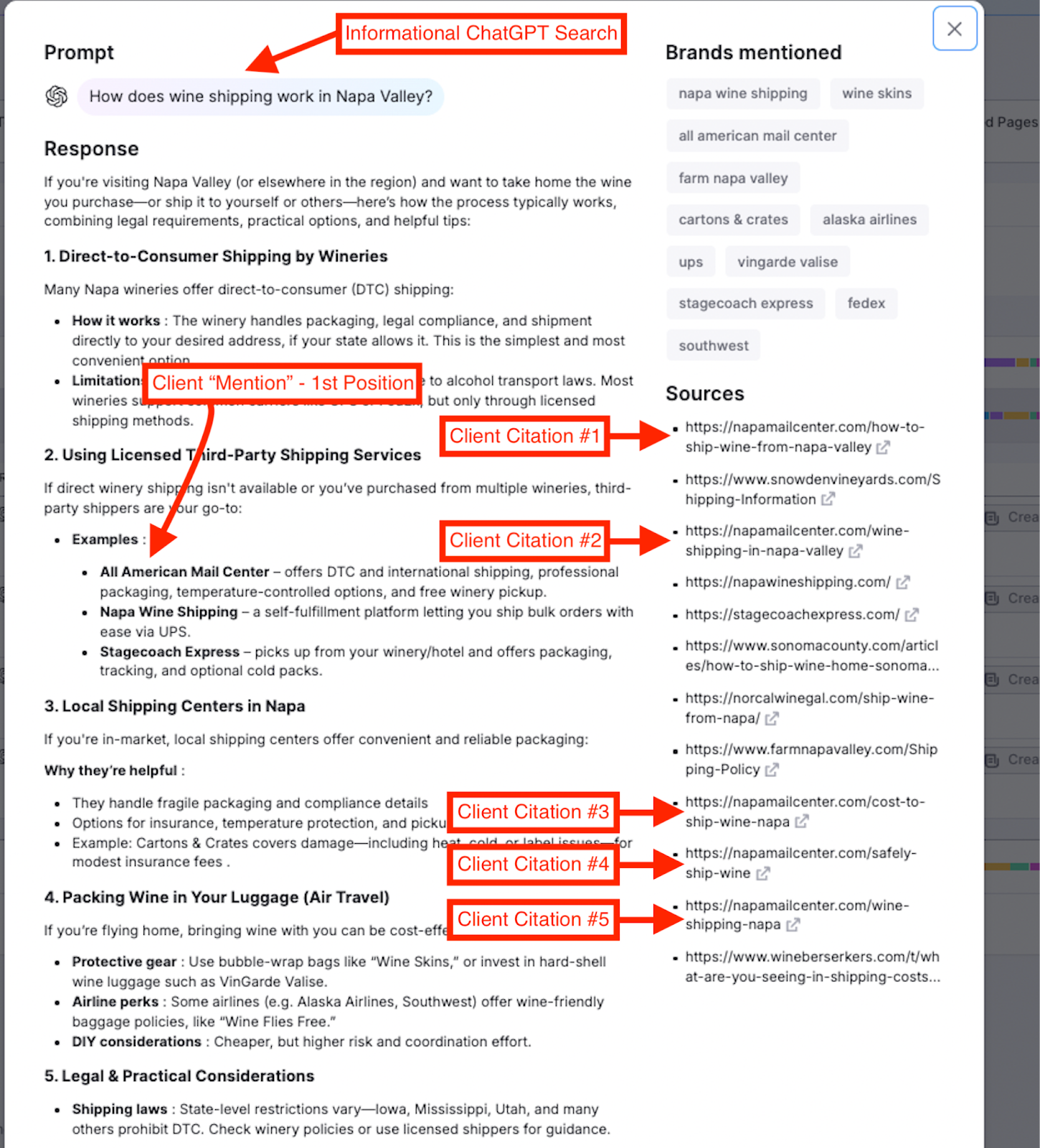
Repeated citations in AI Overviews and ChatGPT
40% rise in branded search
Their content was cited as 5 of 12 sources in a single AI response and ranked first across traditional and AI search results. (see screenshot below)
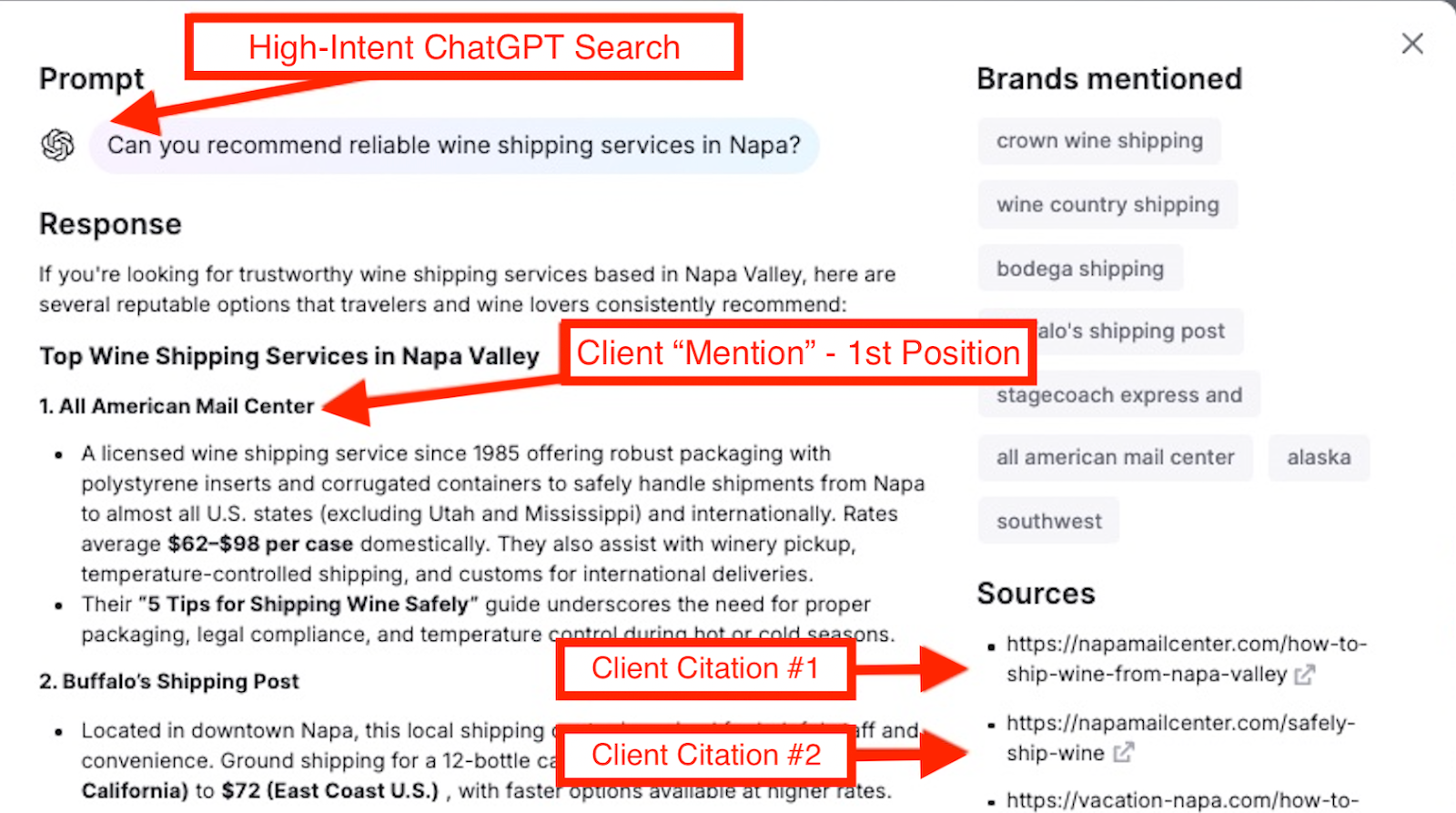
In another high-intent search for reliable wine shipping services in Napa, the business appears first.
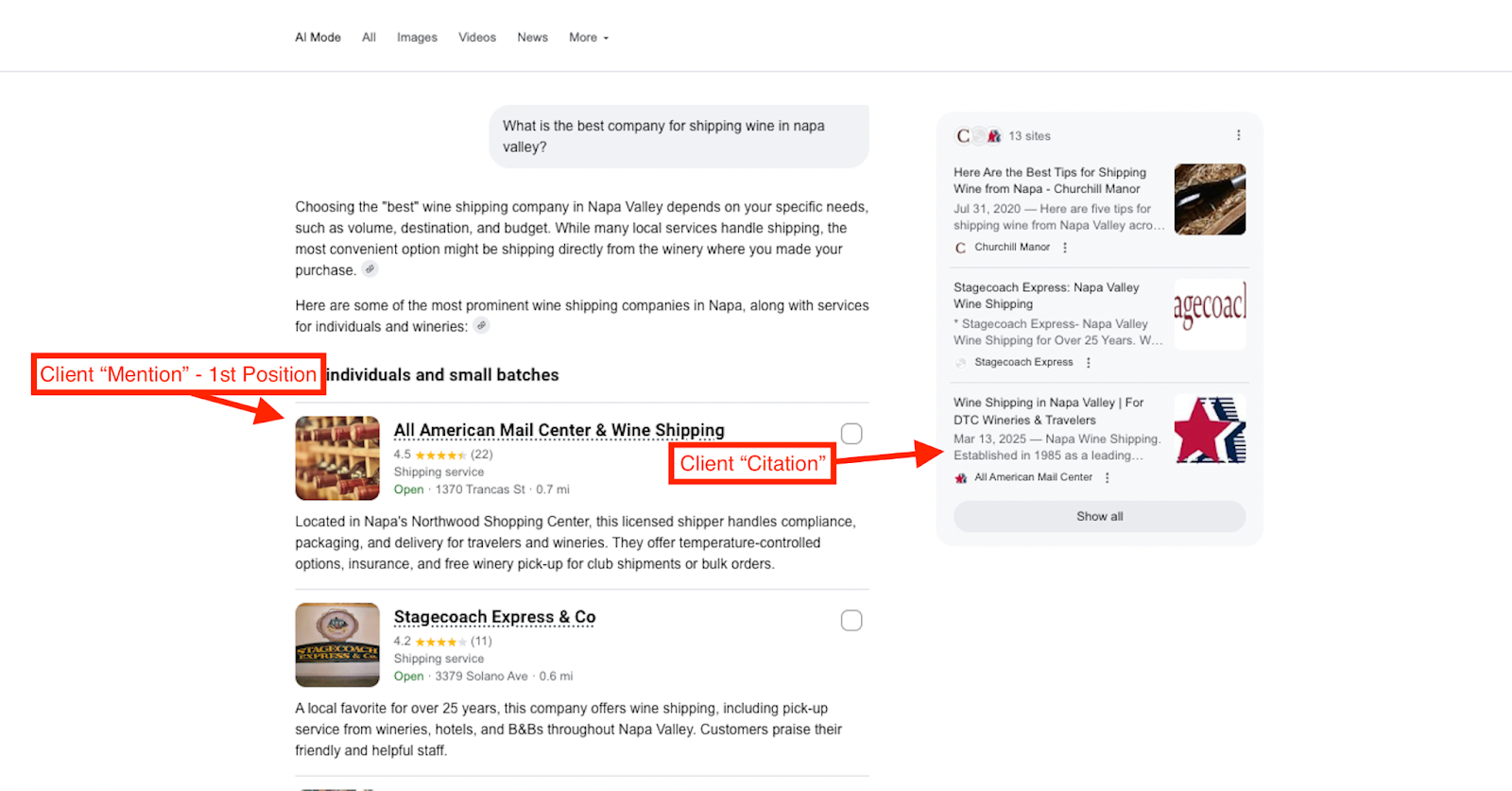
They also hold first-position visibility across Google’s AI Mode, AI Overviews, and the traditional organic search results.
SEO built the foundation — AEO multiplied its impact.
How To Do SEO + AEO: Our Proven Process
We use a simple process that integrates AEO into every piece of content we create. The goal is to rank in search and clearly answer questions — without overcomplicating things or forcing keywords.
Here’s our process from start to finish, using this article as an example:
Part 1: SEO Keyword Research
Choose a primary keyword
Start with one clear keyword that matches the topic (for this article: SEO vs AEO).
Review what’s already ranking
Search the keyword in Google and review the top results to see what topics and questions appear (this surfaced phrases like best answer engine optimization for enhancing AI visibility - targeted later in this article).
Find natural keyword variations
Use closely related phrases so your writing stays natural (e.g., SEO and AEO, AEO vs SEO).
Part 2: AEO Keyword Research
Use People Also Ask (PAA)
Review the questions Google shows and answer them directly on your page (e.g., What is the difference between SEO and AEO - answered in the 2nd section, and in FAQs)

Expand with AnswerThePublic
Use it to uncover additional real-world questions users are asking (e.g. “Seo vs aeo which is better” targeted with “SEO vs AEO: Which Works Better in 2026?” section)
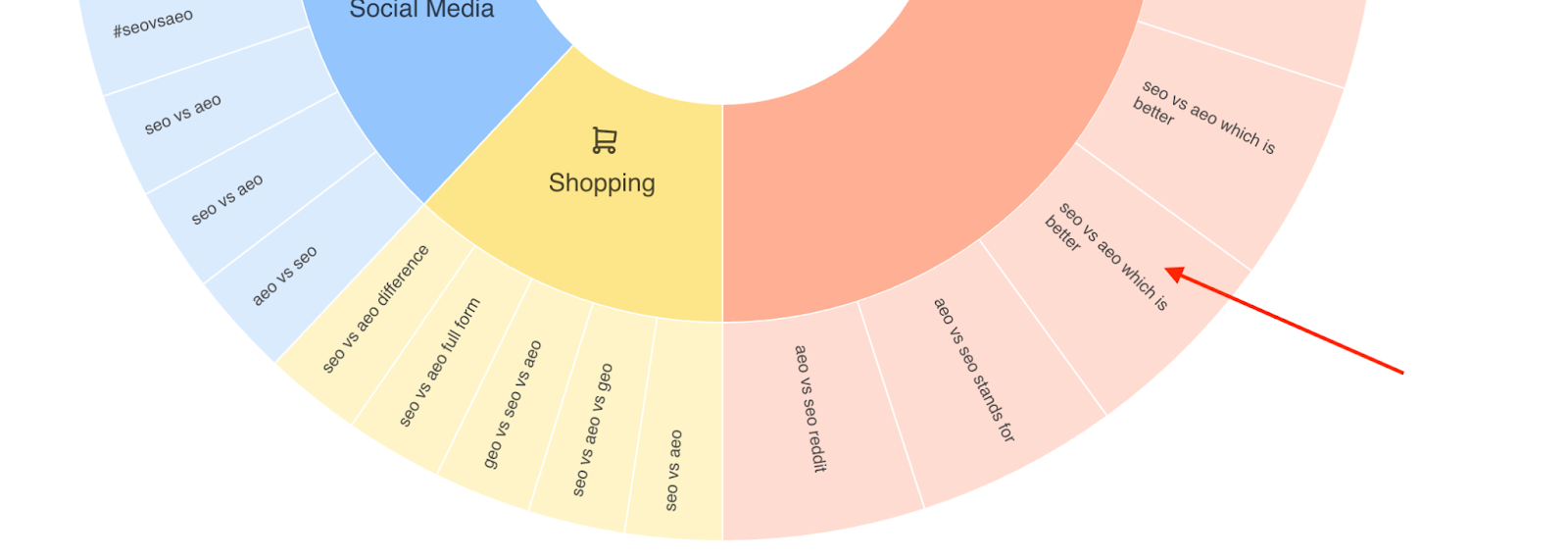
Part 3: Content Structure Optimization
Lead with a clear summary
Add a short TLDR at the top of longer pages (review the bolded text at the top of this article for reference)
Use short answer sections
40–55 word answers perform best for snippets and AI summaries.
Add an FAQ section
Answer 3–7 common questions at the end (we used 6 to end this article).
Conclusion: SEO vs AEO – What Actually Works Better in 2026?
SEO and AEO play different roles - and both are required. SEO builds the foundation. It determines whether your content is eligible to appear in search results at all. AEO amplifies that foundation in the AI ecosystem. It increases the likelihood that your content is selected, featured, and cited in:
-
AI Overviews
-
People Also Ask results
-
voice search
-
ChatGPT / LLM responses
In 2026, visibility isn’t just about ranking - it’s about being chosen as the answer. Businesses that focus on both SEO and AEO are better positioned to show up wherever and however people search.
Related Questions & Answers
Will AEO Replace SEO in the Future?
What Is the Best Answer Engine Optimization Strategy for Enhancing AI Visibility?
How Do SEO and AEO Work Together?
How Do You Measure AEO Results?
Does AEO Matter for Small Businesses?
Matthew Demers is a digital marketing strategist and founder of Diffuse Digital, where he helps e-commerce and local brands grow through data-driven SEO and conversion optimization. His work focuses on one thing: turning visibility into measurable revenue.
Discover more TechBehemoths Insights
Learn practical tips and insights about IT Companies, how to find the right company for your projects.
Read the latest news about Market Trends and fresh Interviews.