4 Questions Your About Us Web Page Must Answer to Build Trust + Examples


Summary
Your About Us page may be losing clients without you realizing it.
It is not simply a place to tell your company story. It is where potential clients look for proof that your business is credible, experienced, and worth contacting. This article explains what an effective About Us page should include, how to replace generic claims with evidence, and how to turn trust into action.
The About Us page is one of the most-visited pages on a company website. Despite this, it is rarely treated as part of the sales process.
Most companies treat their About Us page as a place to tell their story: when the company was founded, what its mission and values are, and perhaps a few photos of the people behind the business.
In reality, people rarely visit an About Us page simply because they are curious about a company's history. More often, they arrive there while deciding whether the business is credible enough to contact, hire, buy from, or trust with a project.
Nielsen Norman Group research supports this, finding that visitors use About Us content to investigate potential vendors and form an opinion about a company before doing business.
About Us is not really about you. It's about giving potential clients enough reasons to trust you.
Why Do Prospects Visit the About Us Page?
By the time someone clicks on "About Us," they've usually already decided your product or service could solve their problem. What they haven't decided yet is whether you are the right choice: a real, credible, capable company, or just a website.
This is especially important in B2B, when buyers need to establish trust in a company early in the process before they feel comfortable contacting a sales representative or sharing business information.
Give potential clients reasons to trust your company. Do not rely on statements that could belong to almost any company.
If you removed your company name and placed a competitor's logo above the text, would the message still make sense? If the answer is yes, you probably haven't communicated much differentiation.
The solution is to replace generic claims with specific evidence.
Compare:
"Founded in 2014."
with:
"Founded in 2014, we've since grown to a team of 50 specialists and delivered more than 300 projects for companies across Europe and North America."
The first is just a date. The second adds context and turns company history into evidence of experience.
Or compare:
"We have extensive industry experience"
with
"For the past 10 years, we've worked primarily with fintech and healthcare companies across Europe and North America."
“Extensive experience” is a claim. Ten years of work in specific industries and markets gives the visitor something concrete to evaluate.
What Should Your About Us Page Prove?
Four Questions Every About Us Page Should Answer
So, what information actually helps build that trust?
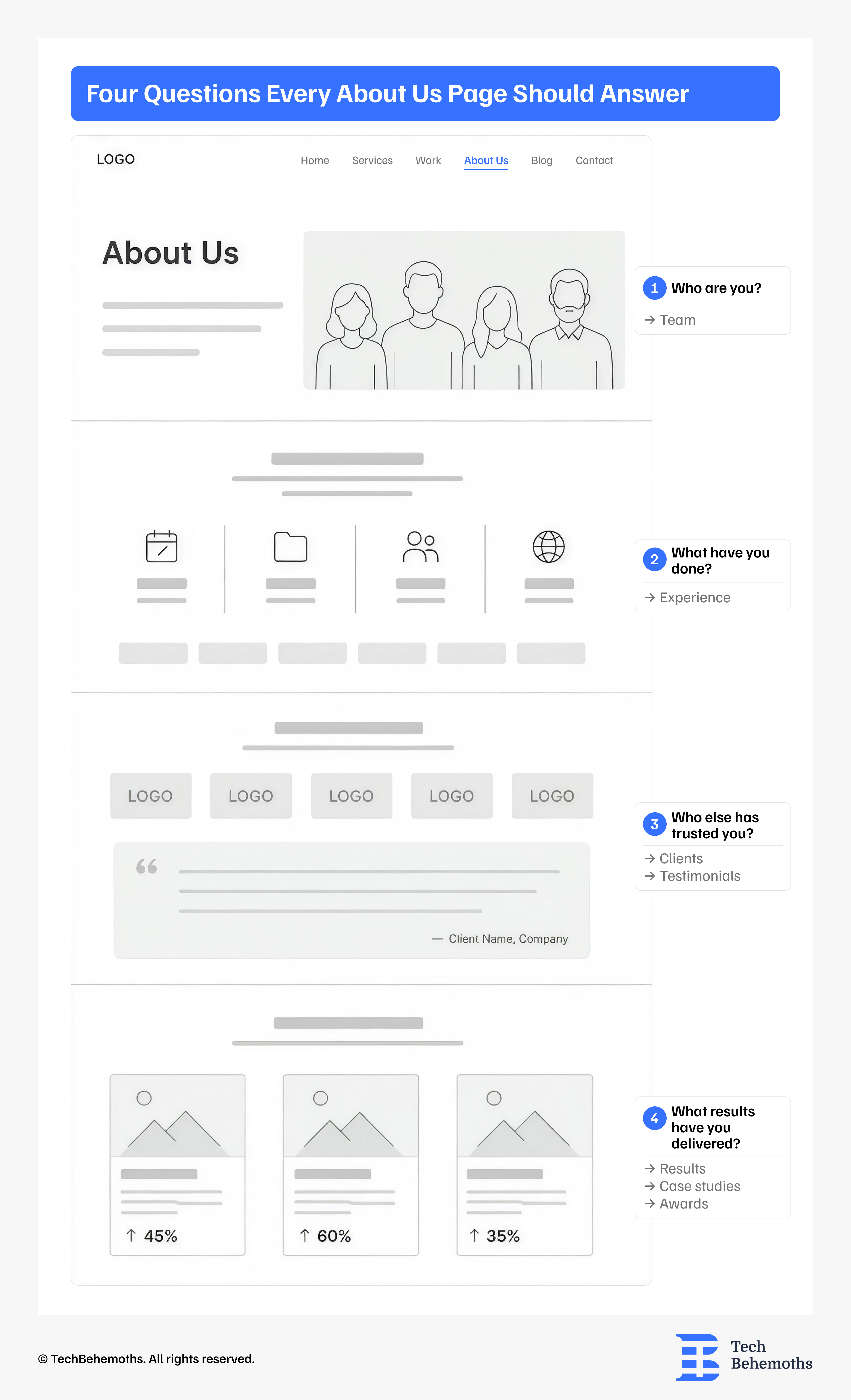
Your About Us page should give potential clients enough information to answer a few basic questions:
-
Who are you?
Show the founders, leadership team, or key people clients may work with, along with their relevant expertise and experience.
-
What have you done?
Show relevant experience: years in business, types of projects delivered, industries served, and areas where your team has developed specific expertise.
-
Who else has trusted you?
Client logos, testimonials, repeat business, and long-term client relationships provide proof that other companies have already taken that step.
-
What results have you delivered?
Case studies, measurable results, successful projects, certifications, awards, or other relevant recognition help turn your claims into evidence.
Once you've answered these questions, the next step is turning that trust into action.
The CTA That Should Come After You've Built Trust
Most About Us pages make the same mistake at the finish line: right after earning a bit of trust, they go silent. No invitation, no next step, just a page that ends.
Someone who has read far enough to reach the bottom of your About Us page has already shown a meaningful level of interest in your company. Don't leave them with a generic "Contact Us" link buried in the footer.
The next step should build naturally on what they have just learned.
Strong options include:
-
A direct invitation to talk to the team they just read about.
Generic: "Contact Us."
Specific: "Talk to Andrei, who has led 40+ projects like yours." -
A link to case studies or results if they need more proof before getting in touch.
"See how we've helped companies like yours." -
A low-commitment next step when they're closer to making a decision.
"Book a consultation", "Get a quote", or "Start a free trial" depending on your business model.
Choose one primary CTA based on the next step you want visitors to take.
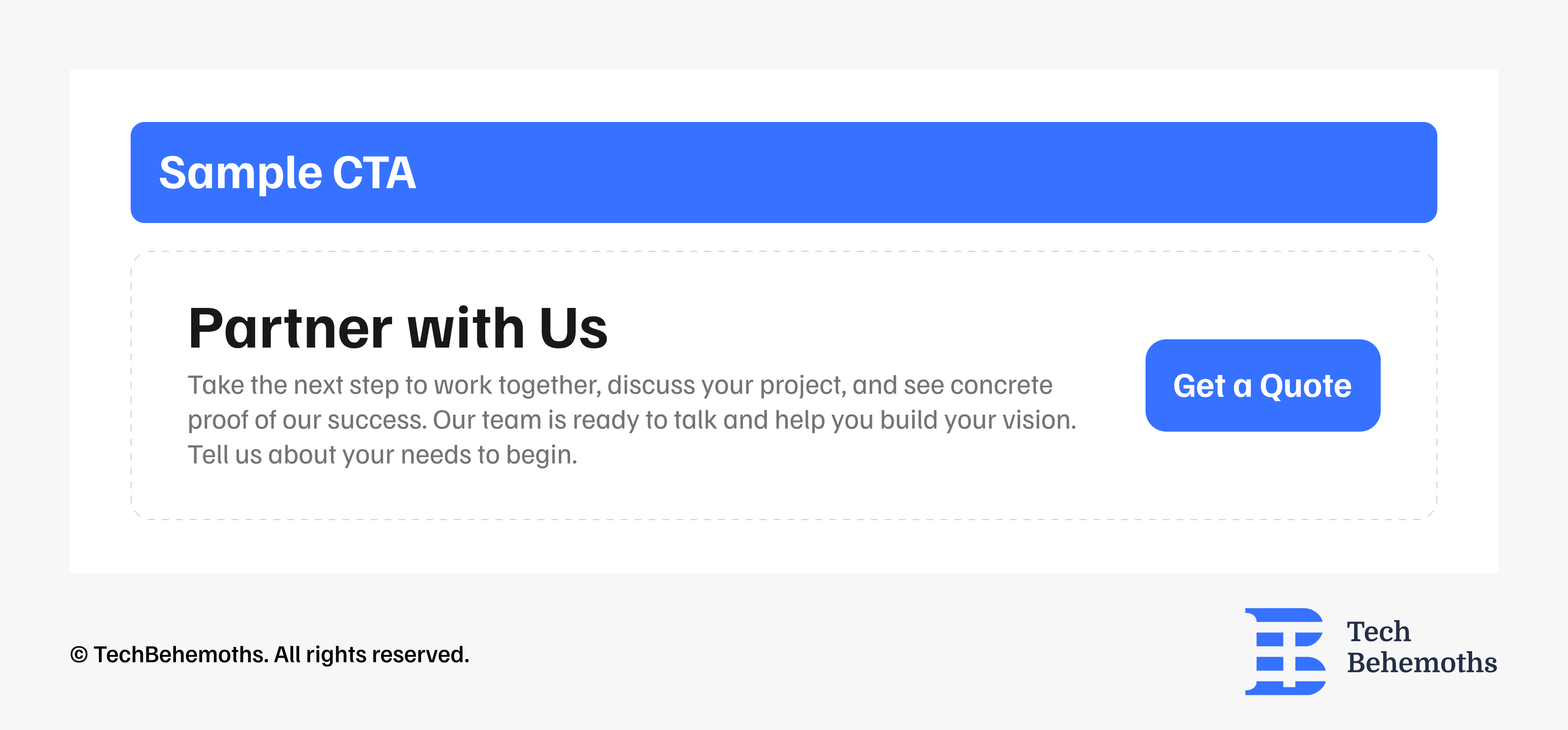
The CTA should match where the visitor is likely to be in the decision process. Someone still evaluating your credibility may want to see your work. Someone who already feels confident about your company may be ready to start a conversation.
You've spent the entire page building trust. The CTA should give that trust somewhere to go next.
Real Companies That Get This Right
Here are a few real About Us pages worth looking at for inspiration:
Buffer
Buffer is a strong example of an About Us page that turns claims into evidence.
Buffer's About Us page is built around people, culture, company history, and transparency.
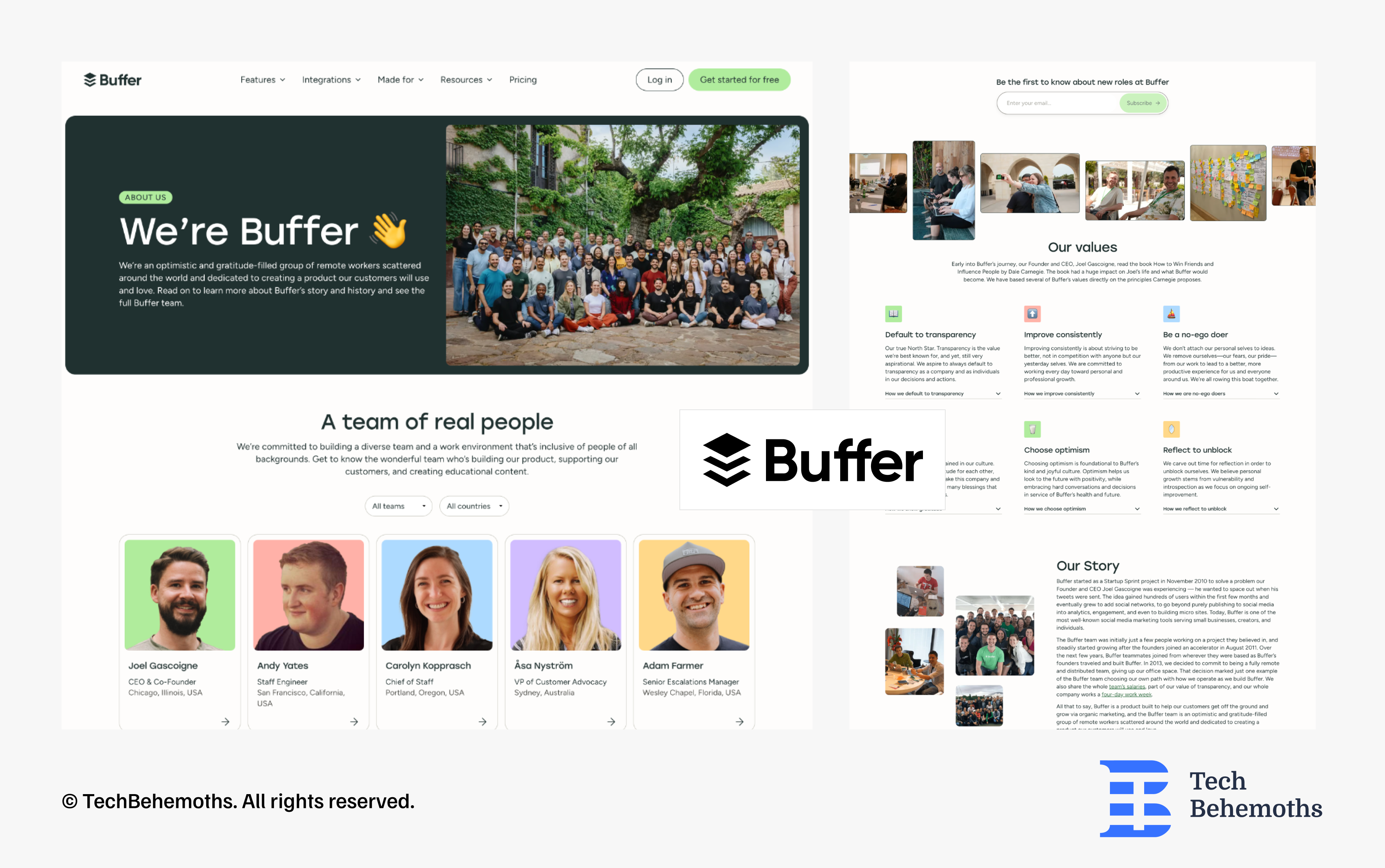
It introduces the real team behind the product, explains how its values translate into actual practices, gives context to the company's story, and supports its claims with public business metrics, such as customer numbers and team size. It even links to its publicly shared team salaries.
Instead of asking visitors to believe that Buffer is transparent, the page gives them evidence to reach that conclusion themselves.
Zapier
Zapier's About page is a good example of replacing broad claims with numbers. It highlights the scale of the platform through metrics such as millions of businesses using Zapier, billions of automated tasks, and adoption among Fortune 1000 companies.
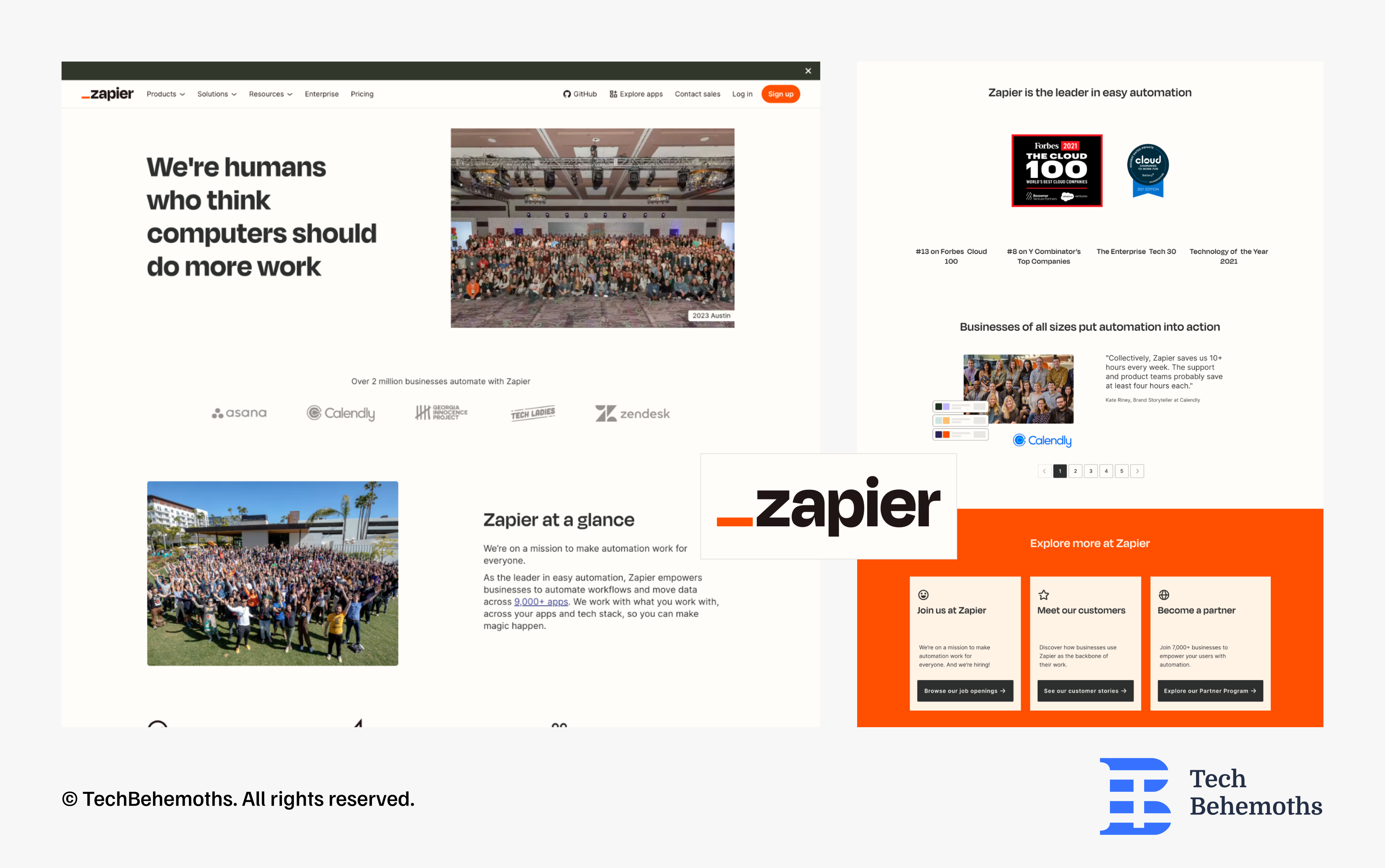
The page also gives visitors a clear picture of the company behind the product, including the size and global distribution of its team, its mission, values, and leadership.
Zapier lets the numbers speak for the company.
Atlassian
Atlassian's About page makes the people and principles behind the company visible. It combines the company's story with the people leading it and the values that shape how it operates. Atlassian defines what those values actually mean in practice.
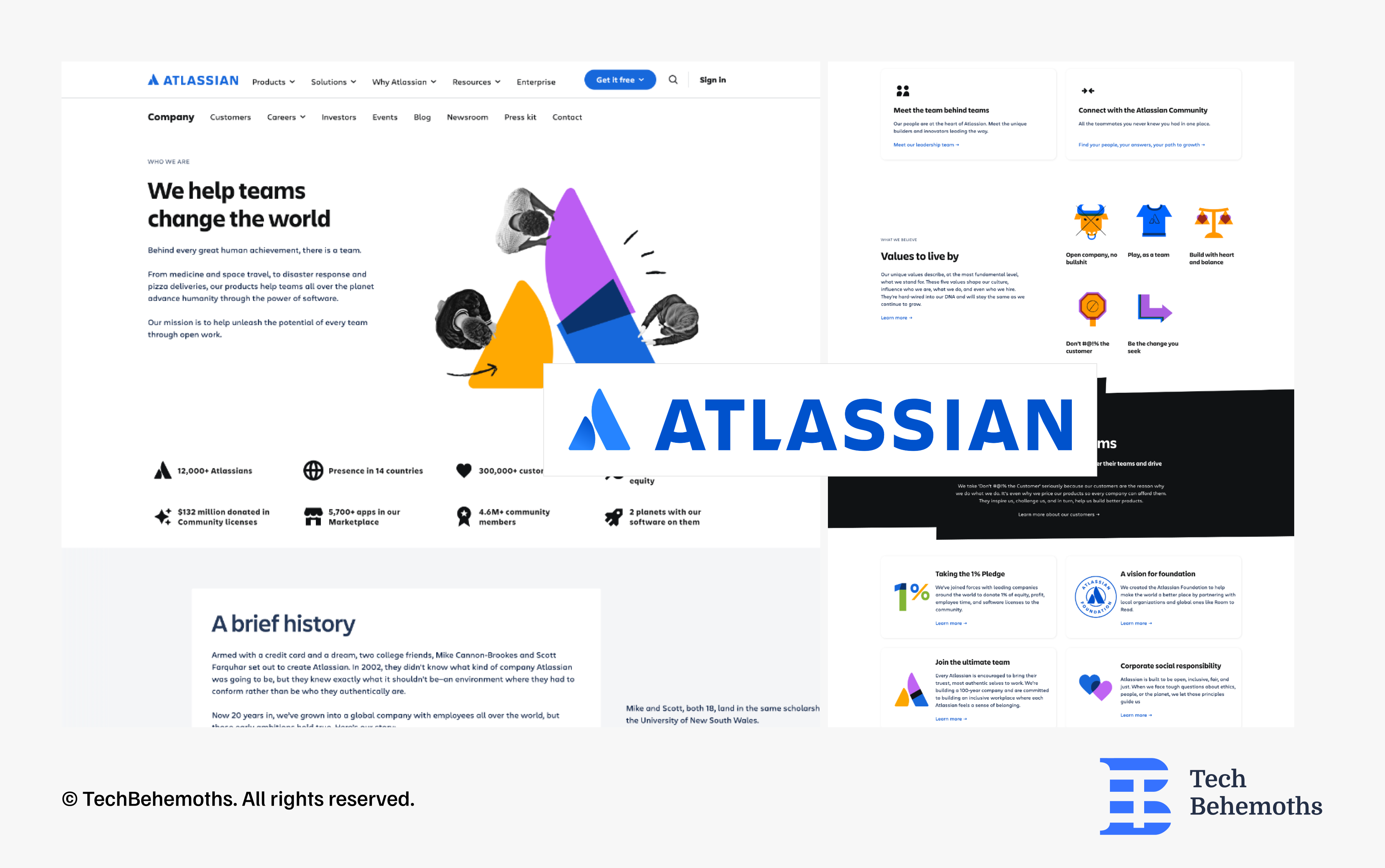
The page highlights details that reveal how the company operates and what it prioritizes: 1% of profit, employee time, and equity donated, and $132 million contributed through its foundation.
Its values follow the same approach. Instead of the usual “innovation, integrity, excellence,” Atlassian uses principles such as “Open company, no bullshit,” “Play, as a team,” and “Don’t #@!% the customer.” They are distinctive enough to actually say something about the company's culture.
The page also connects visitors directly to its leadership team, giving names, roles, and a clearer picture of who is actually behind the products they use.
What Atlassian gets right is personality. Its About page doesn't sound like it could belong to any company. It sounds unmistakably Atlassian.
One pattern across all of these: none of them use stock photos of people.
In one experiment, using a photo of the company founder instead of a generic stock image increased the likelihood of visitors signing up for a free consultation by 35%.
Real team photos consistently outperform stock photography in trust and conversion.
Final Thoughts
Your About Us page does not need to impress visitors with big words or a perfect company story. It needs to help them understand who you are, what you have done, and why they can trust you.
Show the real people behind the business, replace generic claims with evidence, and make the next step clear. Because when someone visits your About Us page, they are not just reading about your company. They may be deciding whether to work with it.
Planning a website redesign?
Related Questions & Answers
How long should an About Us page be?
How often should an About Us page be updated?
Can a new company build trust without years of experience?
Should an About Us page be optimized for SEO?
How can you measure whether your About Us page is working?
I absolutely love embracing new opportunities and connecting with people. Every project is a chance to analyze, create, and work until I am satisfied with the results. Bringing creativity into every aspect of my work offers a fresh perspective on turning ideas into reality. Paying attention to the details is key because it's the little things that truly make all the difference.
Discover more TechBehemoths Insights
Learn practical tips and insights about IT Companies, how to find the right company for your projects.
Read the latest news about Market Trends and fresh Interviews.