How Adidas Makes Money - The Business Model Behind a €24.8B Brand


Summary
In 2025, Adidas posted record revenue of €24.8 billion - without a single Yeezy product in its lineup. This article breaks down exactly how: from an outsourced manufacturing model and a dual distribution strategy, to €3 billion spent annually on brand-building, and a loyalty base of 150 million members.
Product, distribution, brand, and purpose - four systems working simultaneously.
Adidas is not a factory. It doesn't make the shoes you wear, the T-shirts you buy, the bags or the accessories you wear. What it owns is something much more valuable - a brand trusted by billions of people and a business model discreetly designed to turn that trust into one of the most profitable revenue streams in the sportswear industry today.
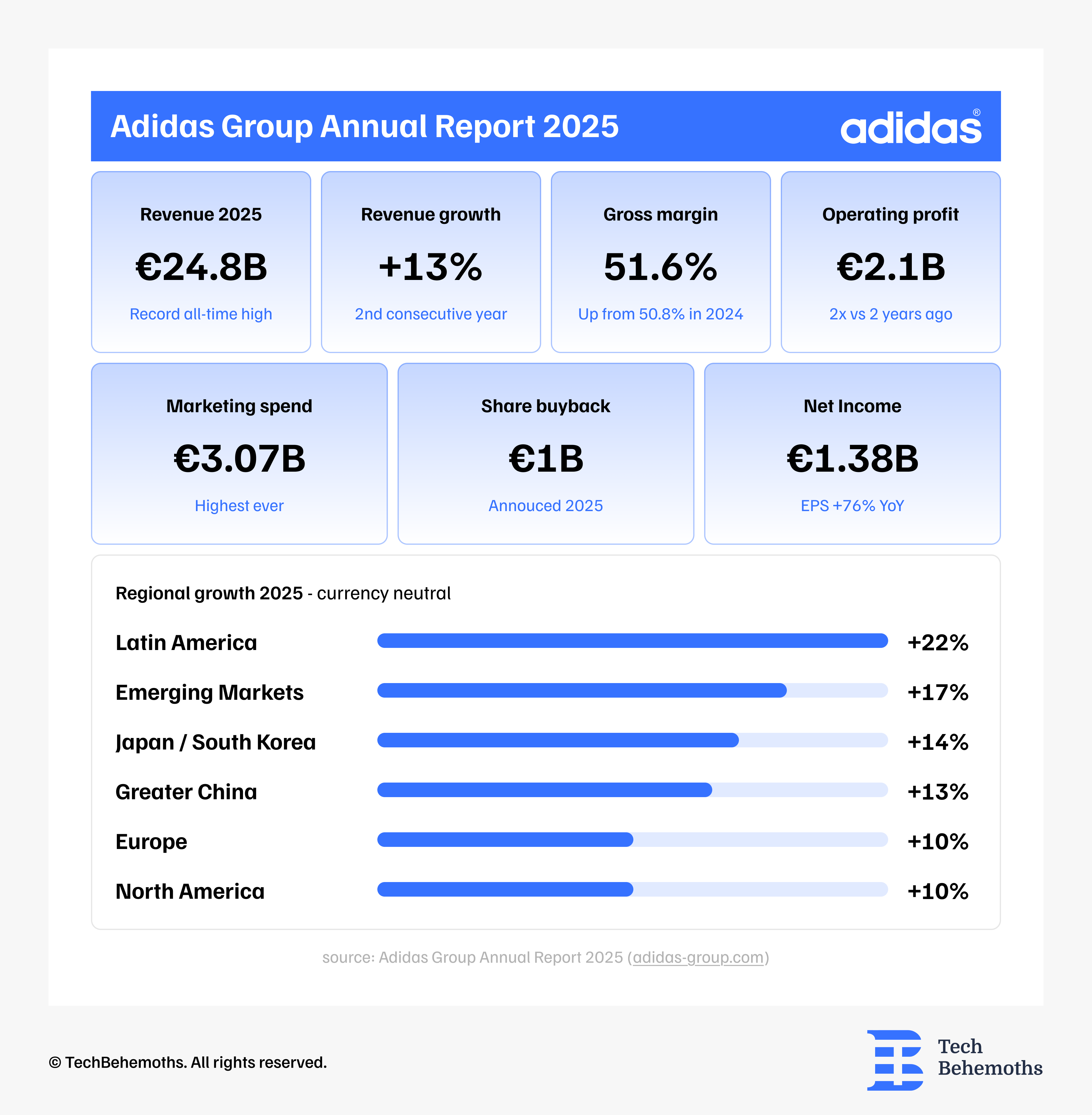
At the end of 2025, Adidas posted the best results in its history. Revenue reached €24.8 billion, with gross margin climbing to 51.6% and operating profit rising to €2.1 billion - a growth which hit 13% for the second consecutive year, also double digits across every market and every channel.
To understand the scale of it: Latin America (+22%), Emerging Markets (+17%), Japan/South Korea (+14%), and Greater China (+13%) led the way, with Europe (+10%) and North America (+10%) close behind, as operating profit more than doubled in two years. And let's be serious, when a company starts buying back its own shares at €1 billion, it's not just confident - it's making a statement.
But this is not what anyone expected from Adidas in 2023.
One Decision. €1.2 Billion in Unsellable Shoes.
Two years earlier, the brand was dealing with the fallout of one of the most damaging partnerships in sportswear history - the abrupt end of its collaboration with Ye, which wiped hundreds of millions in revenue and pushed the company into its first annual loss in over three decades. Analysts were cautious, investors were nervous, and the brand was sitting on billions worth of unsellable inventory.
What happened between then and now is a masterclass in how a business model, when built correctly, can absorb shocks that would destroy most companies.
So how does Adidas actually make its money? Not just which products it sells, but how the entire machine is structured - from design to distribution to the €3 billion it spends every year making sure you want to buy what it makes.
That's what this article breaks down.
How Does Adidas Actually Work?
The first thing to understand about Adidas is that it is not a manufacturer. Almost 100% of its production is outsourced to independent manufacturing partners, the vast majority of which are located in Asia. So Adidas designs the products, sets the specifications, controls the brand, and then hands everything off to a network of factories it doesn’t own.
The majority of manufacturing partnerships with which Adidas has established commercial production relationships are stable and long-lasting (65% over 10 years), with 28% lasting over 20 years, and 35% showshow the network’s capacity to adapt and renew, reducing the risk of rigidity.

Source: Adidas Annual Report 2025
According to the latest available data, Vietnam was the largest source country in 2025, accounting for 27% of total volume, followed by Indonesia at 18% and China at 16%. Overall, 92% of Adidas’ total production volume came from Asia, meaning the Adidas-branded shoes on your feet were almost certainly made in one of these three countries.
This model isn’t specific to Adidas - Nike, Puma, and Under Armour all work in the same way. But what makes it powerful is what it frees up: capital, agility and focus. Instead of running factories, Adidas runs a brand. Instead of managing production lines, it manages relationships with consumers. In this regard, 65% of its independent manufacturing partners have worked with Adidas for at least ten years, and 37% for over 20 years, so we're talking about the efficiency of a factory without the cost of owning one. Impressive, right?

How Adidas Makes Money From Products
Adidas sells three things:
-
Footwear
-
Clothes (Apparel)
-
Accessories
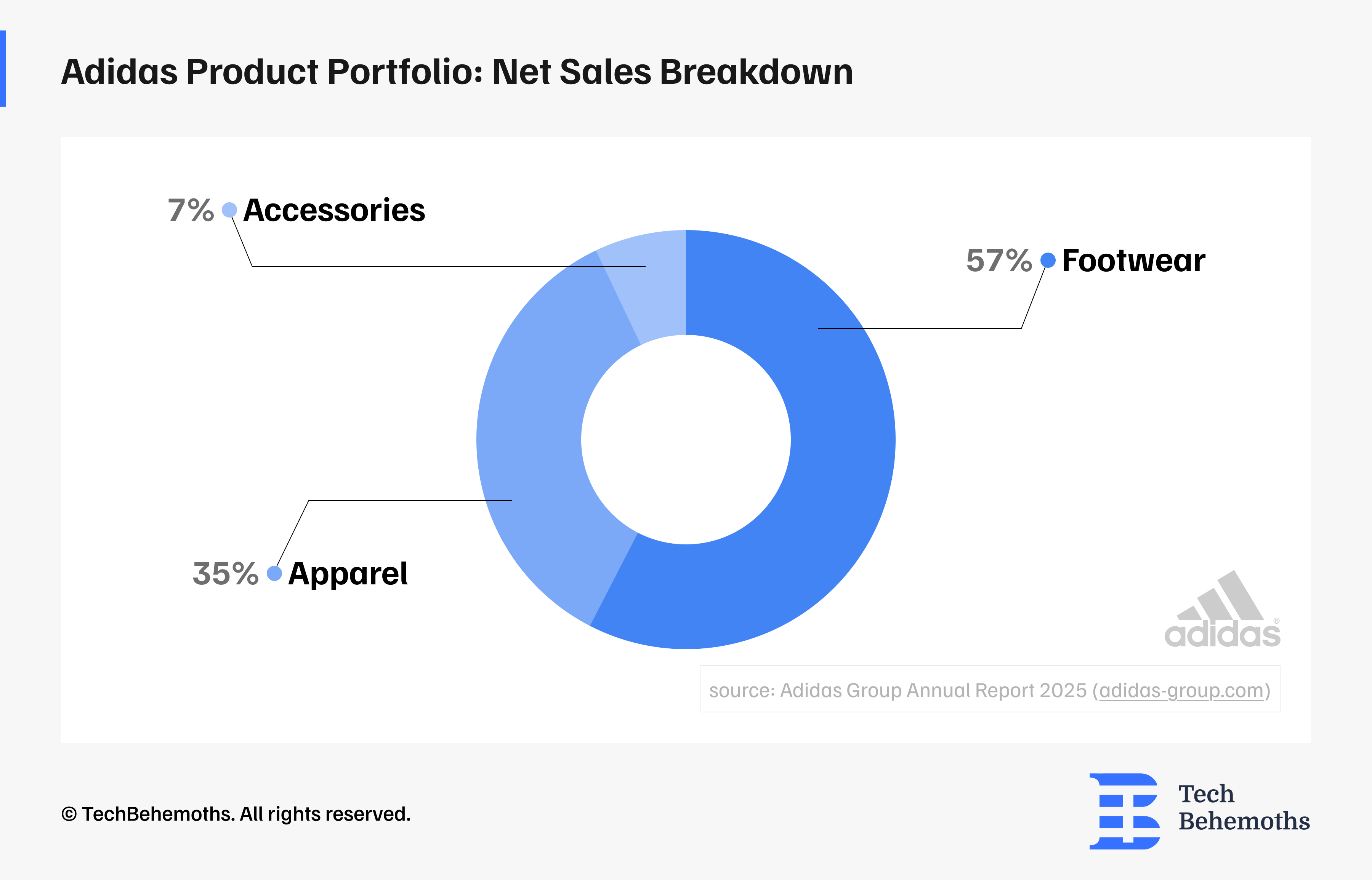
Footwear accounts for 57% of net sales (~€14.1B), apparel for 35% (~€8.7B), and accessories for the remaining 7% (~€1.7B).
Footwear
The largest and most important category of Adidas’ revenue streams is footwear.
According to Statista, the footwear category represents approximately half of Adidas Group's net sales. Footwear net sales are available on Statista for the period 2010-2024, so for 2025, the figure was estimated by applying Adidas' reported growth rate (+12%, currency-neutral) to the 2024 value (€13.98 billion), resulting in approximately €15.66 billion.
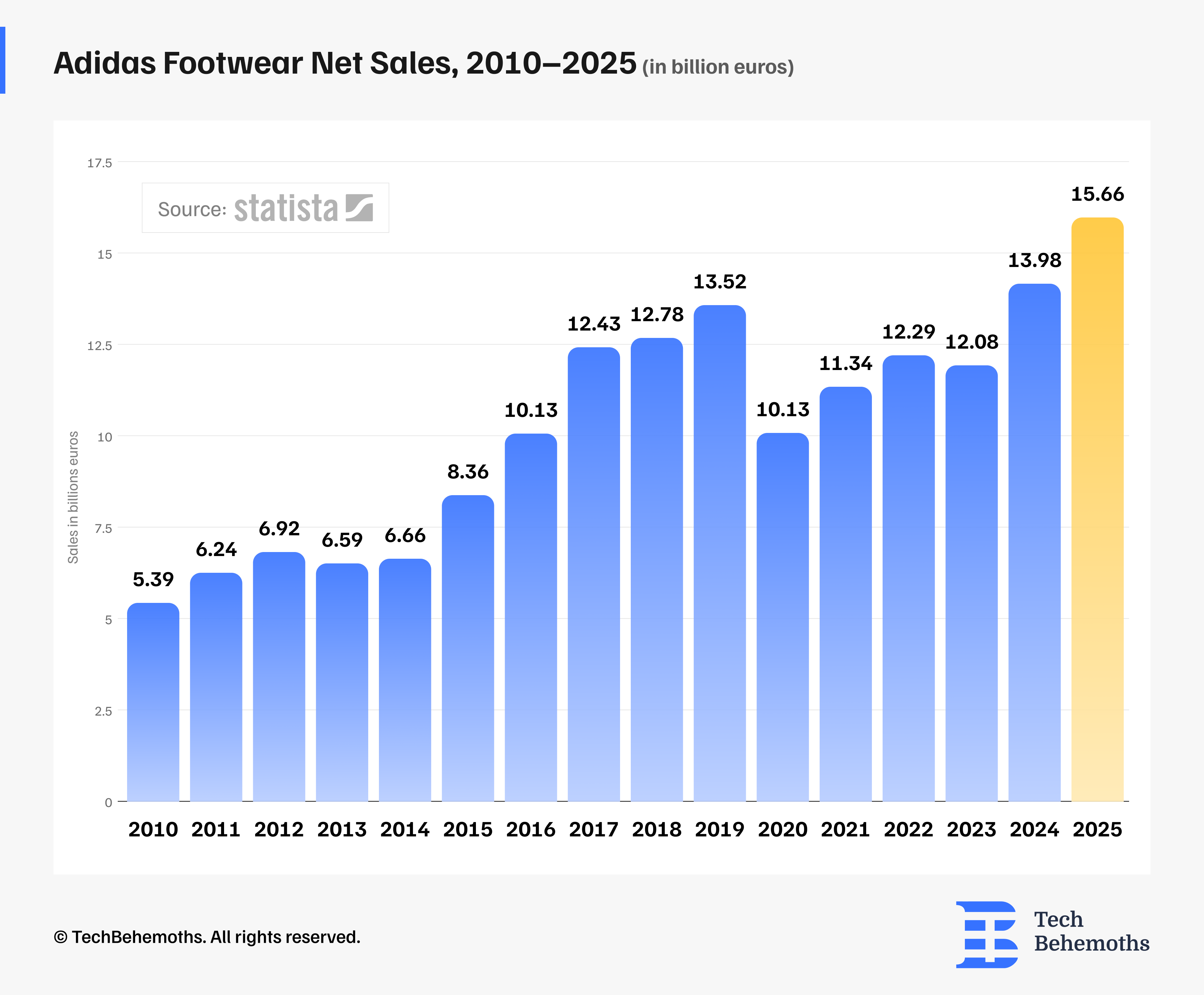
The footwear product category grew 12% in 2025, driven by double-digit growth in the Running, Training, Performance Basketball, and Sportswear segments, with strong growth in the Originals segment also contributing to this.
Samba, Superstar, and Gazelle - shoes that have been around for decades - are somehow more relevant in 2026 than they were in 2010, and this is no coincidence, but a result of strategic brand management.
And then there’s running, a subcategory that deserves its own paragraph, as Running grew 29% in 2025 as Adidas capitalized on the global running boom. The Adizero family has achieved multiple major marathon victories and broken world records. Adidas has proven one thing for sure: when your product wins at that level, you don’t have to promote it, the results speak for themselves and do the work for you.
Also, Football grew by 12%, Training grew by 13%, and Basketball grew by 4%. The only subcategory to see negative growth was Golf, down 3%.
From 2008 to 2025, Adidas' global footwear production experienced steady and accelerated growth until 2019, a stabilization followed by temporary declines during the pandemic, rebounding strongly in 2024 (~364 million pairs) and was estimated to reach nearly 400 million pairs in 2025, reflecting the recovery in demand and the continued expansion of the brand.
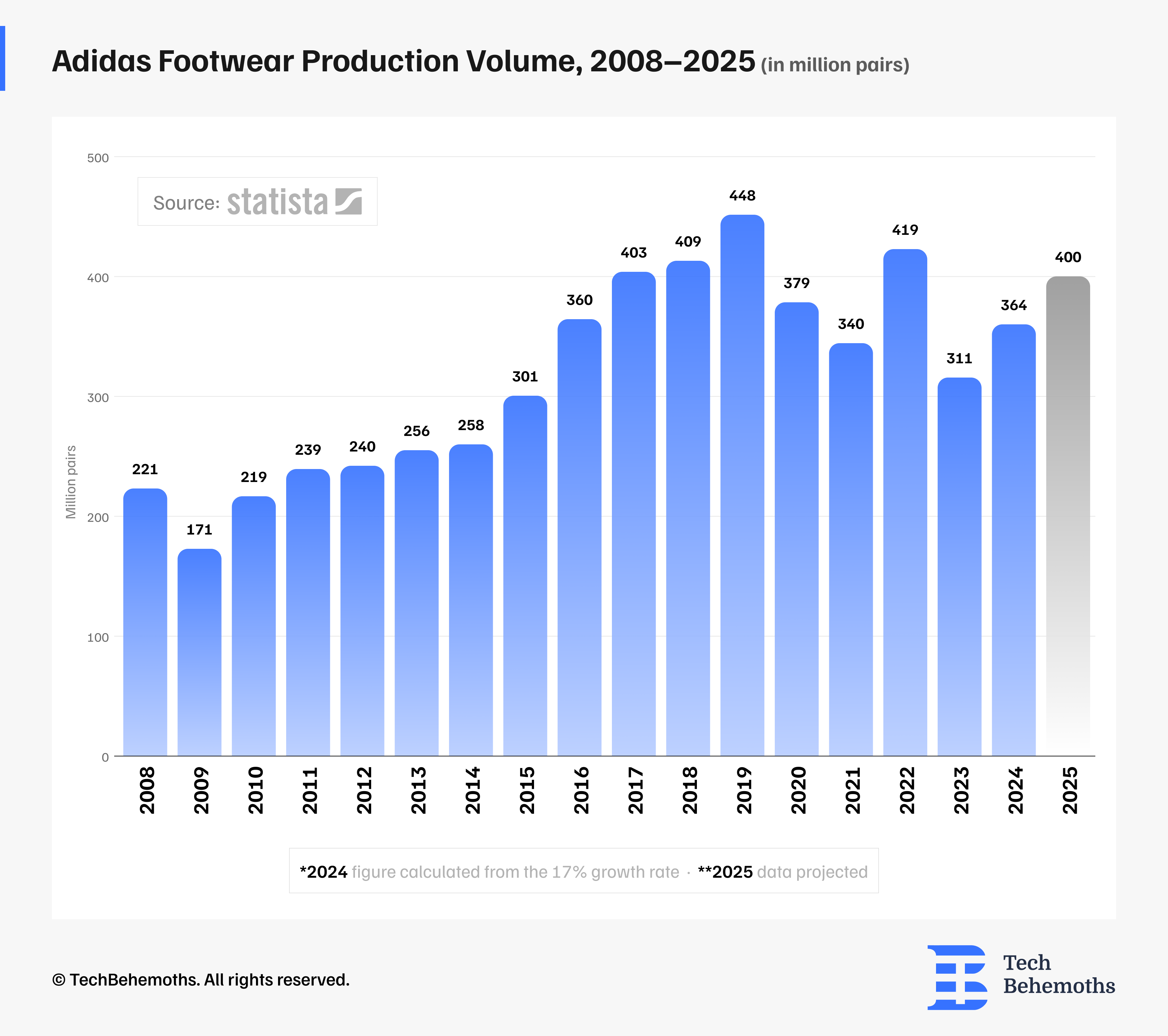
From 2008 to 2025, Adidas' global footwear production experienced steady and accelerated growth until 2019, a stabilization followed by temporary declines during the pandemic, rebounding strongly in 2024 (~364 million pairs) and estimated to reach nearly 400 million pairs in 2025, reflecting the recovery in demand and the continued expansion of the brand.
Apparel
The real surprise of 2025 is that apparel grew by 15%, showing faster growth than footwear - fueled by double-digit increases in the Football, Running, Training, and Originals segments. For a company historically defined by footwear, apparel is becoming the fastest-growing segment.
Accessories
Bags, caps, socks, gear and other accessories accounted for 7% of net sales (aprox. €1.7 billion), growing by 6% in 2025. The smallest category by far, but no less relevant, because accessories do something the other two categories can’t: put the three stripes in places shoes and jackets can’t. A cap, a bag, a water bottle are small products, but with their wide exposure, they inevitably fulfill the role of outdoor advertising.
The image that emerges is of a company that is no longer dependent on any one product, category, or market. This diversification, deliberately built over the past two years, is exactly what made the Yeezy exit possible.
How Adidas Makes Money From Distribution
Once the product is manufactured, Adidas reaches consumers through two distinct channels:
-
Wholesale - selling to retailers (e.g. Foot Locker, Zalando, JD Sports), who in turn sell to consumers. It is the largest channel, accounting for around 60% of net sales, growing by 12% in 2025.

-
Direct-to-Consumer (DTC) - selling directly through your own stores and e-commerce platform, without intermediaries. Growing faster than wholesale, at +14% in 2025, with e-commerce growing by +16% and a member base of 150 million people.
|
Net sales by channel (in € billion) |
2024 |
2025 |
Change |
Change (currency-neutral) |
Brand adidas Change (currency-neutral) |
|---|---|---|---|---|---|
|
Wholesale |
14,833 |
14,172 |
5% |
10% |
12% |
|
Direct-to-Consumer (DTC) |
9,931 |
9,490 |
5% |
9% |
14% |
|
a. Own retail |
— | — |
8% |
12% |
13% |
|
b. E-commerce |
— | — |
1% |
6% |
16% |
The difference matters more than it looks. A sale through a retailer is a transaction where Adidas gets the revenue, but the retailer keeps the customer relationship, the data, and the ability to push competing products on the same shelf. When Adidas sells directly, it keeps all of that. It knows who bought, what they bought, and when. That's why the shift toward DTC isn't just a margin story - it's a data story.
Grow Your Direct-to-Consumer Channel
Partner with e-commerce development companies to own customer relationships and increase order value.
How Adidas Makes Money From Brand
If products are what Adidas sells, and distribution is how it reaches consumers, the brand is the reason consumers choose Adidas in the first place, and the reason they are willing to pay more for it than for a functionally equivalent alternative. The brand is the invisible add-on to every product, the reason why a €120 Samba costs more to manufacture than its retail price and yet sells out.
Adidas invests about 12-14% of its revenue in advertising, sponsorships, and brand partnerships, which totals about €2.8-3.2 billion annually. This figure alone tells you something: for every €10 in revenue, more than €1 goes directly into maintaining the perception that makes those €10 possible, and here it is clear that this is not a classic marketing budget, but infrastructure that we see in practice that really works, and not just occasionally, but for years now.
Sponsorships
Buying credibility on a large scale
The most visible expression of Adidas' investment in brands is its sponsorship portfolio. Partnerships with teams and leagues include FIFA, the UEFA Champions League, Major League Soccer and the national federations of Germany, Spain, Argentina and Japan, while club-level deals include Real Madrid at €120 million per year, Manchester United at €90 million, Bayern Munich at €60 million and Arsenal at £60 million per year. These aren’t just logo placements, every kit deal means Adidas products are in front of hundreds of millions of viewers every weekend, worn by the world’s best players, at the most high-pressure moments in sports. So this isn’t advertising, this is proof that Adidas is more than just a brand.
Adidas x FIFA World Cup 2026 Official kits — 13 qualified federations

The logic of how it works is simple - if the product is good enough for a Champions League final, it’s good enough for you, and that’s what’s being conveyed to consumers with sponsorships that borrow credibility from sports and transfer it to the brand on a large scale, thus generating money.
Collaborations
Relevance as a product
These relationships include athlete endorsements, designer collaborations, and entertainment partnerships, creating rarity, cultural relevance, and premium pricing opportunities.
Results vary, but when they work, they work on a large scale:
The wins:
-
Pharrell Williams (2015 - present) - His 2015 Supercolor collection helped Adidas sell 15 million pairs of Superstars in a single year. The Superstar accounted for $1 of every $10 Adidas made that year. The partnership contributed to Adidas' most profitable year in history, with sales of nearly $14 billion. NAB Business reports that even a decade later, the collaboration is still going strong, with the 2025 Adistar Jellyfish, priced at $300, selling out immediately and reselling at a significantly higher price.

-
Bad Bunny (2021 - present) - The most important strategic collaboration of the current era. After dominating Spotify in 2025, winning the Grammy for Album of the Year, and performing at the Super Bowl halftime show, Bad Bunny became the first Latin artist to have an exclusive Adidas signature silhouette - the BadBo 1.0, which launched in 2026. Each release sells out, and demand for Adidas' Lifestyle offering in 2024 was directly fueled by the Bad Bunny collaboration, which Adidas continues to cite as a key growth factor in its official earnings reports.
-
The partnership goes beyond music: in 2024, Bad Bunny joined forces with Lionel Messi for a co-branded collection built around the Adidas Gazelle and the F50 cleat - two icons from different worlds, united under the same three stripes.

-
Wales Bonner, Edison Chen, Sporty & Rich, Oasis - These collaborations further fueled Originals sales growth throughout 2025, with each of the Adidas group members targeting a specific cultural niche - high fashion, Asian streetwear, vintage aesthetics, British music culture - and most importantly, without cannibalizing each other.
However, there are examples of less profitable collaborations. Ivy Park - the collaboration with Beyoncé, from 2019 to 2023, when sales fell by more than 50% in 2022, reaching an amount of only $ 40 million, compared to an internal target of $ 250 million. Understandable considering that in five of the last six releases, about half of the total merchandise remained unsold. The partnership ended in 2023, and it concludes that cultural capital is not enough and does not automatically translate into sales. Success lies in the fact that the product and the audience must align, and I am not saying that this is easy to do.

Another more complex example is the partnership between Yeezy and Kanye West, which generated annual revenue of $1.7 billion dollars at its peak, demonstrating the massive commercial potential of celebrity collaborations, and at the same time, the risks these relationships pose when they collapse. When it suddenly ended, many predicted it would be a fatal blow for Adidas, but as we have seen so far - it was not. But the full story deserves a separate chapter.
Find the Right Collaboration Partner
Connect with influencer advertising agencies to find collaborations where product and audience truly align - and avoid costly mismatches.
Loyalty Layer
150 million people who have already said yes
Both product and distribution have already established the DTC shift and a base of 150 million members. But it’s worth mentioning what that number means from a brand’s perspective: these are people who haven’t bought Adidas once - they’ve signed up, opted in, and voluntarily handed over their data. Loyalty program members generate an average order value that is 25% higher than non-members.
This premium value is not explained by better products, because members buy the same products as everyone else. The difference is explained by brand attachment: when someone identifies with a brand, price sensitivity decreases and purchase frequency increases.
Brand as a competitive edge
What makes all of this justifiable is that brand value accumulates; it's about effort over years, consistency, and earned loyalty. A competitor can copy a shoe design, match a certain price, open stores in the same cities. What it can't replicate is the 75 years of presence in the sport, the cultural memory that places Adidas at every major tournament, every streetwear moment, every important stage of running. In 2024, excluding Yeezy sales, Adidas' core business grew 13%, meaning the brand, devoid of its most controversial asset, accelerated. This is perhaps the clearest evidence of all of the brand's strength and moneymaking power.
How Adidas Makes Money From Propose
The company funds Safe-Hubs in South African townships, basketball programs for underrepresented communities in the US, runs initiatives against gender-based violence, and has over 25 other social programs globally.
What they are doing is defining who Adidas is to a consumer who doesn’t follow sports, and for that consumer, what the product represents is actually the brand’s values. So Adidas has allocated over 65% of its 2024 marketing budget to digital efforts, targeting Generation Z and Millennials, a demographic for whom brand authenticity and social alignment are becoming key purchasing drivers.
Let’s remember one of the successful initiatives that propelled Adidas to this environmentally responsible audience - the Parley partnership, started in 2017, through which 1 million pairs of shoes were made from recycled ocean plastic that year, gradually increasing to 5 million in 2018 and 11 million in 2019, which contributed to a 12% increase in customer loyalty in 2024.
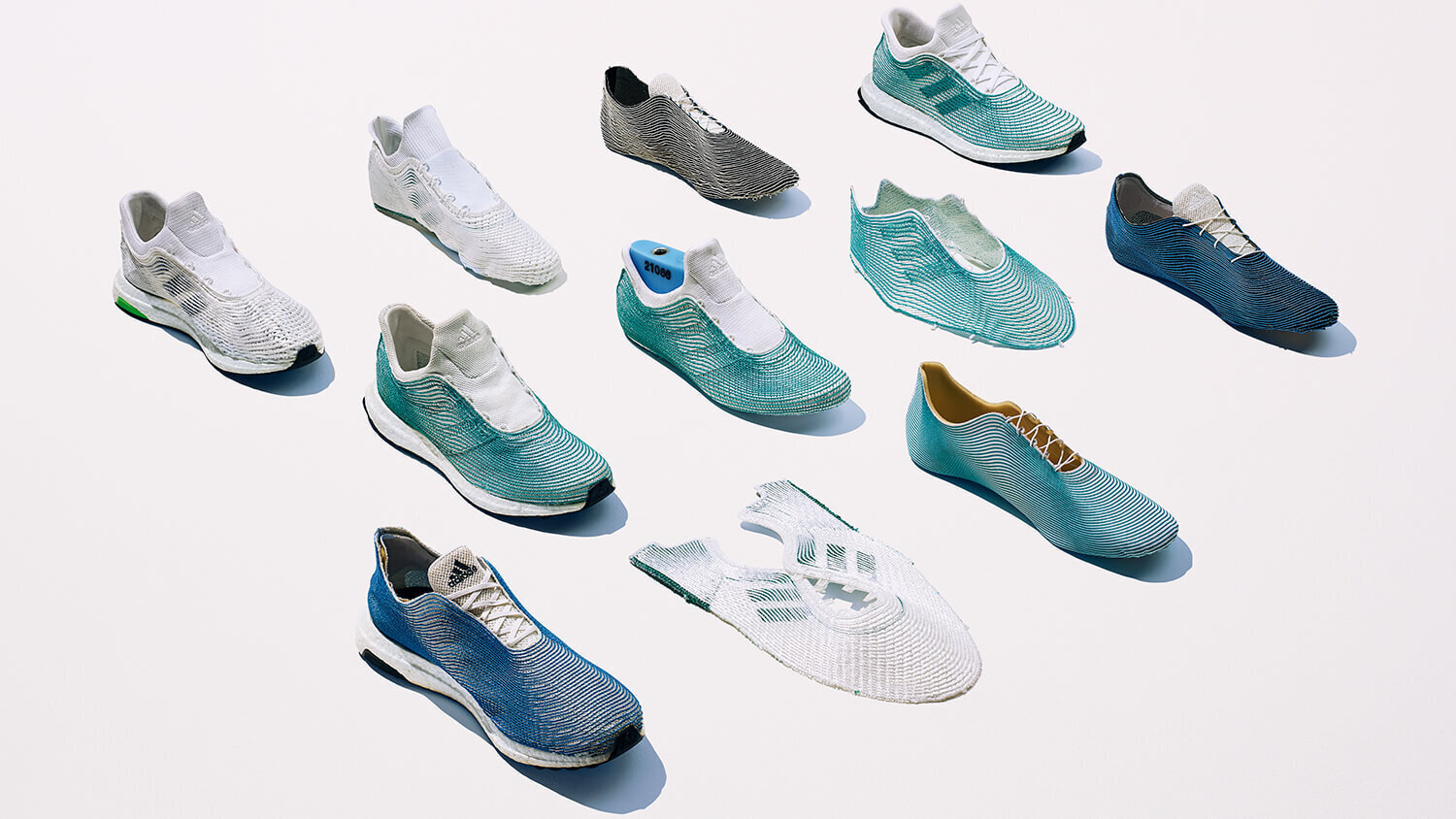
By aligning with consumer values and demonstrating a dignified and conscientious commitment to the environment, Adidas has strengthened customer loyalty and attracted a new generation of green buyers, which continues to matter a lot for a brand with such volume and social impact.
Build a Brand That Earns Loyalty
Work with branding agencies to build consistent identity and turn one-time buyers into long-term customers.
The Yeezy Crisis: What Nearly Broke Adidas
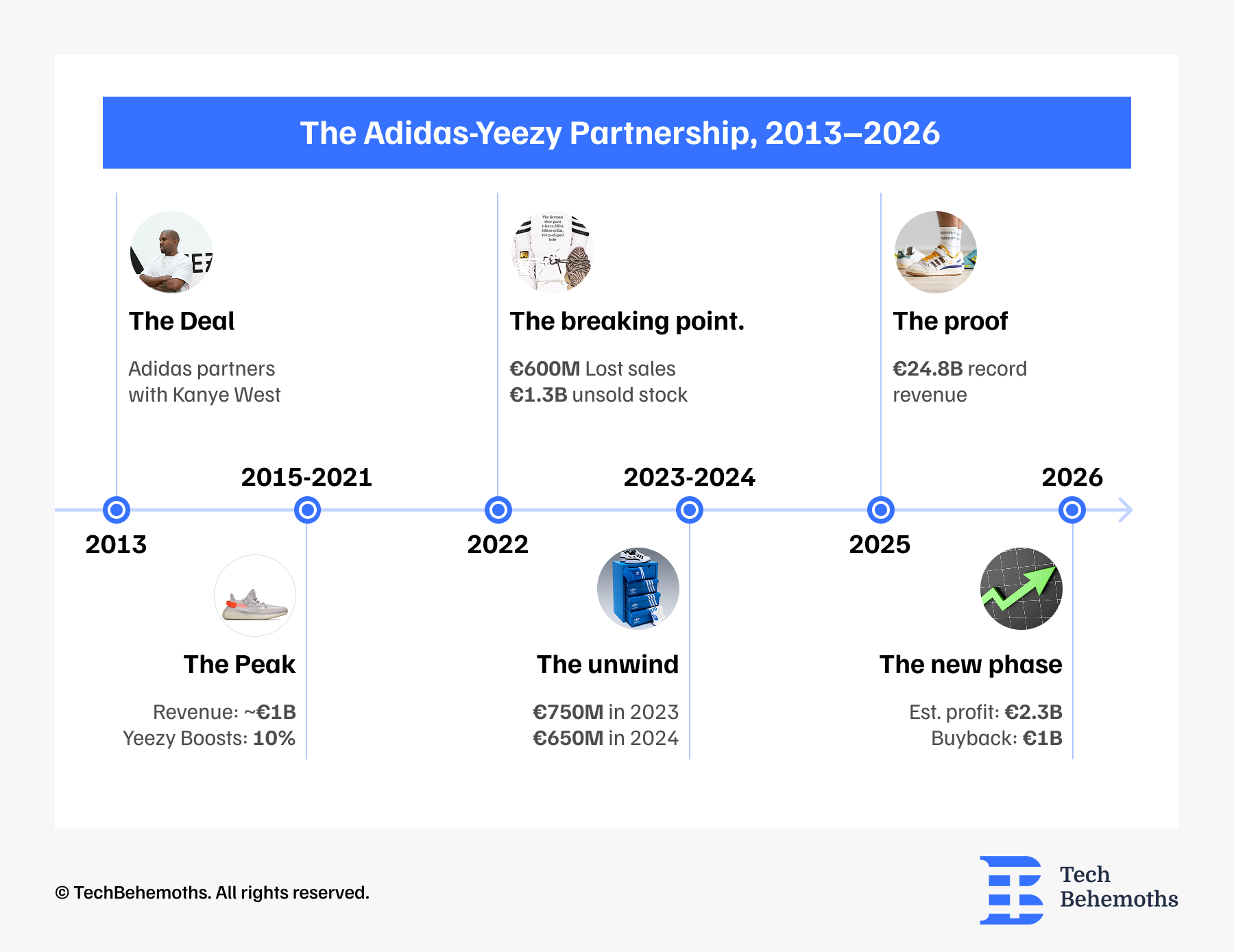
2013 - The deal.
Adidas brings Kanye West in after his split with Nike. West gets creative control and revenue share, and Adidas brings global manufacturing and distribution capabilities. It’s the beginning of an experiment between culture and industry.
2015-2021 - The peak.
The first Yeezy Boosts sell out in minutes. Demand consistently outstrips supply, and the line grows annually.
-
Annual revenue generated at peak: over $1 billion
-
Contribution to Adidas revenue: approximately 10%
By 2021, Yeezy contributed over $1 billion annually to Adidas' revenue, helping drive a 17% rise in North American sales. Each release becomes more than just a product, it becomes a cultural phenomenon and a real growth engine for the brand.
October 2022 - The breaking point.
After West’s controversial statements, Adidas decides to end the collaboration immediately.
-
Yeezy inventory remaining in stock: €1.3 billion
-
First annual loss in nearly 30 years: €513 million
The decision underscores how dependent the brand had become on this partnership.
2023-2024 - The unwind.
Adidas gradually sells off Yeezy inventory, controlling the process and directing a portion of the proceeds to social causes.
-
Revenue generated: €750 million in 2023, €650 million in 2024
-
Inventory is completely liquidated by the end of 2024
The brand begins to rebuild without Yeezy.
2025 - The proof.
Without any Yeezy products, Adidas reaches record revenue: €24.8 billion, and operating profit rises to over €2 billion.
It is proof that the brand can grow on the basis of core products and classic models, without dependence on hype.
2026 - The new phase.
Adidas enters a stage of stability and operational discipline.
-
Estimated profit: €2.3 billion
-
Buyback program: €1 billion
The company focuses on sustainable growth, portfolio optimization, and financial control, not on a single cultural partner.
What’s Next for Adidas
Starting from a base of €24.8 billion in 2025, with an operating profit of around €2.3 billion, Adidas is forecasting “high single-digit revenue growth for 2026”, based on company guidance.
|
Indicator |
2021 |
2022 |
2023 |
2024 |
2025 |
2026 (guidance/estimate) |
|---|---|---|---|---|---|---|
|
Net Sales (€m) |
21 234 |
22 511 |
21 427 |
23 683 |
24 811 |
26 800 (official guidance: +high-single-digit growth, ~€2B increase) |
|
Gross Profit (€m) |
10 765 |
10 644 |
10 184 |
12 026 |
12 804 |
≈13 800 (estimate based on historical gross margin ~51–52%) |
|
Operating Profit (€m) |
1 986 |
669 |
268 |
1 337 |
2 056 |
≈2 300 (official guidance) |
|
Net Income (€m) |
2 116 |
612 |
(75) |
764 |
1 340 |
≈1 900 (estimate based on historical net margin) |
However, while the 2026 figure itself looks impressive, there are still some limitations that challenge Adidas’ current and future revenue. Among the most impactful factors are the recently enacted US tariffs and adverse currency developments, which would impact an estimated €400 million headwind in 2026. When the guidance was released on March 4, 2026, investors were not impressed - shares fell 8.3% intraday to levels not seen since January 2023
FIFA World Cup 2026
This summer’s tournament, the biggest event in four years, will be hosted by the US, Mexico, and Canada - the first with 48 teams and the first to be held in North America on this scale. During the 2022 World Cup, Adidas saw a 19% increase in equipment and accessories sales. FIFA estimates that the 2026 event will reach a global audience of around six billion spectators, making Adidas’ position in the tournament not circumstantial but structural. Adidas is equipping 14 nations at the 2026 tournament, including Mexico, Argentina and Germany, and is the largest kit supplier in the competition.
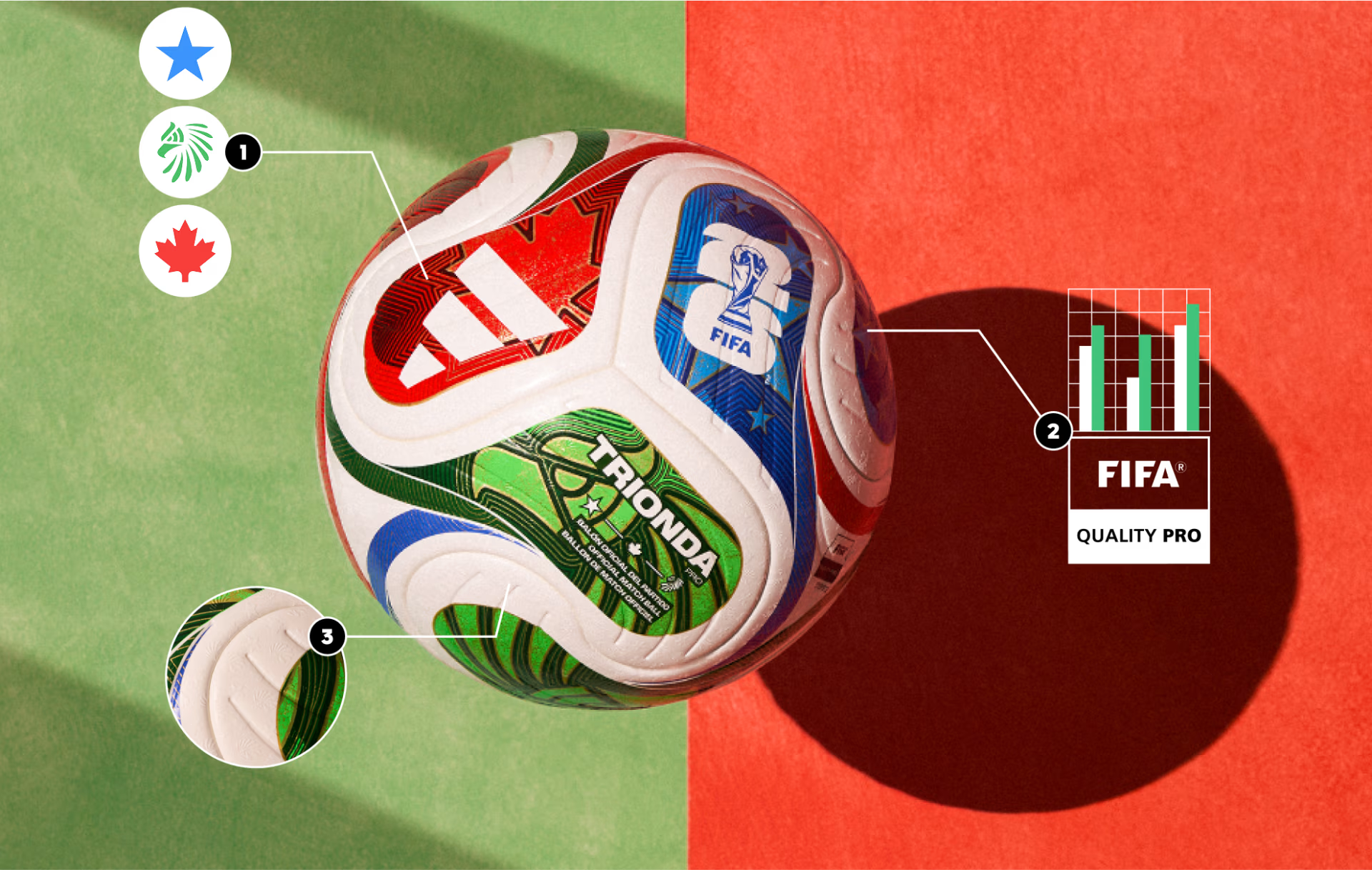
In November 2025, Adidas launched 22 new national team kits simultaneously, the largest collection ever launched in a single day, and the official match ball of the tournament, the Trionda, will also be Adidas.
Did you know? The official match ball of the 2026 FIFA World Cup is called Trionda - a name combining "tri" (three) and "onda" (Spanish for wave), a nod to the three host nations. Its design features three iconic national symbols embossed on the surface: a maple leaf for Canada, a five-pointed star for the USA, and a golden eagle for Mexico, each on its matching national color: red, blue, and green.
CEO Bjørn Gulden was direct in the press release from early 2026:
(...) we continue to prepare for a fantastic FIFA World Cup in the summer. These are great events that I think the world needs. Sports and global sport events bring people from all over the world together. We need that now!
- Bjørn Gulden, CEO, Adidas - Preliminary Q4 2025 Results, January 29, 2026
What's in store for 2028?
Group CEO Bjørn Gulden also reiterated a framework for revenue growth of approximately €2 billion annually in 2027 and 2028, with a focus on operational simplification and a more empowered local model. In the press release in which Adidas presented its multi-year plan for 2027 - 2028, it mentions an estimate of a considerable increase in revenues, moving to a high single-digit pace and reaching an operating margin of over 10% in 2028.
Considering past events, the company that in 2023 reported its first annual loss in 30 years is now aiming for a double-digit operating margin in less than three years, so we are talking about an extremely rapid recovery.
Final thoughts
Yes, Adidas makes money the same way it always has - by selling shoes, clothes, and accessories. But what this article tried to show is that the product is only the surface. Underneath it, there is a system: distribution channels that move volume and protect margins, a brand built through decades of sponsorships and collaborations that justify premium pricing, a purpose layer that builds loyalty among consumers who have more choices than ever, and a financial structure resilient enough to absorb a $1.7 billion partnership collapse and still report record revenues two years later.
The €24.8 billion in 2025 revenue is not just a number, it is the result of every decision examined in this article working simultaneously. The Samba and the Champions League final, the Parley shoe and the Bad Bunny drop, the wholesale shelf and the DTC app, none of it works in isolation. The real business model of Adidas is the compounding of all of it - Product, Distribution, Brand, and Purpose - into something that is harder to replicate than any single shoe design ever could be.
Related Questions & Answers
Is Adidas a manufacturer?
How much revenue does Adidas make?
How did Adidas recover from the Yeezy collapse?
What is Adidas' direct-to-consumer strategy?
How much does Adidas spend on marketing?
What is Adidas' biggest product category?
I tend to create digital content that captures, inspires, and generates impact. I resonate with the idea that less is more. My approach combines strategy, creativity, and analysis to build authentic and relevant messages. Beyond the digital space, nature is my sanctuary - a place of inspiration and balance. Exploring landscapes, I find clarity in nature's simple beauty.
Discover more TechBehemoths Insights
Learn practical tips and insights about IT Companies, how to find the right company for your projects.
Read the latest news about Market Trends and fresh Interviews.