Why AI Automation Projects Fail and What SMEs Need to Know Before Implementation


Summary
AI projects rarely fail because the technology itself doesn’t work. More often, businesses automate the wrong problem, rely on unclear processes, lack access to key systems, or have no baseline for measuring results.
For SMEs, successful AI adoption starts before choosing a tool: identify the real bottleneck, document the process, measure current performance, and decide where human approval is still needed. The goal isn’t to automate everything, but to automate the right things.
Most of the reporting on the failure of AI projects is concerned with providing a rate. Rather less is discussing the mode of failure, which is something a small business can actually do something about.
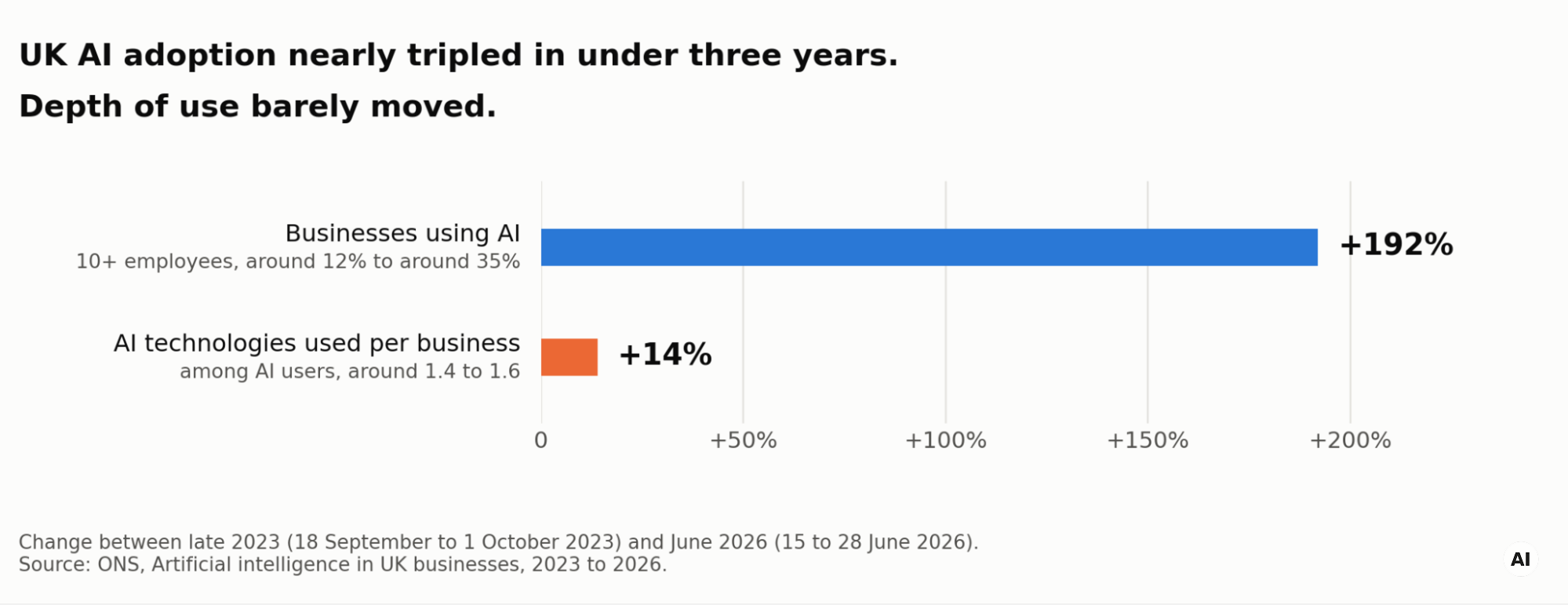
The gap is evident in the adoption data of the UK, where the Office for National Statistics reports that adoption among businesses with ten or more employees rose from around 12% in late 2023 to around 35% by June 2026. Over the same period, the average number of AI technologies used per adopting business moved only from around 1.4 to around 1.6. Adoption grew by roughly 192%. Depth of use grew by roughly 14%.
Businesses are just beginning. There are far fewer who finish. Having spent the last two years building the pieces into small business operations, a lot of the reasons are predictable, mostly organisational, and rarely the model.
The failure rate is real, but the headline numbers need to be treated with care
In July 2024, Gartner predicted that at least 30% of generative AI projects would be abandoned after proof of concept by the end of 2025. Gartner has since reported that at least half were. A report that was circulated in July 2025 under the MIT NANDA name went much further, claiming 95% of organisations were getting zero return, and has been repeated constantly since.
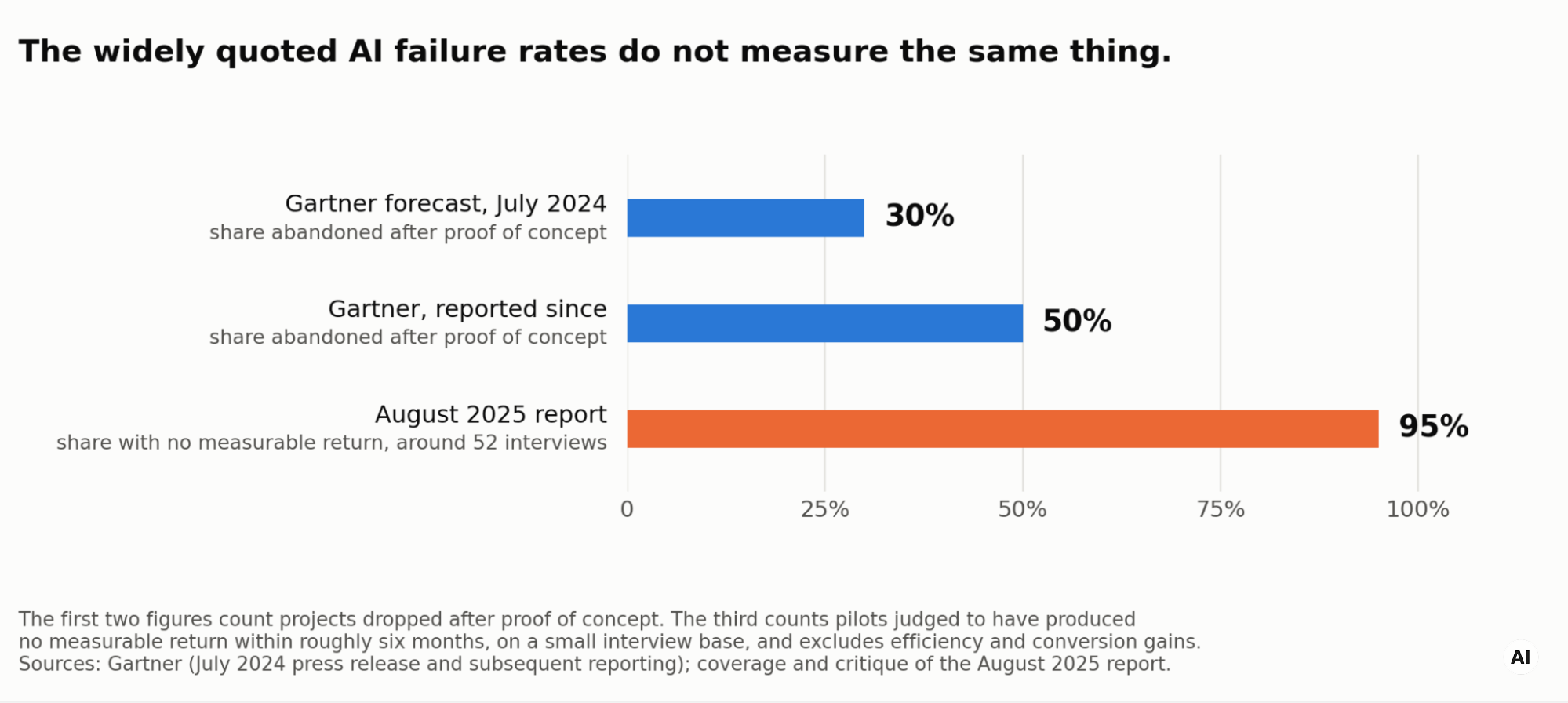
It should be taken less seriously than it is. The 95% was based on interviews with 52 organisations and a survey of 153 senior leaders, and defined success narrowly as deployment beyond the pilot stage, with measurable KPIs assessed roughly six months out. They did not include efficiencies, reduced handling time, or improved conversion. As a directional signal, it is interesting. As a measurement, it is not sound.
Scale is not the constraint
The assumption is that larger organisations handle it better due to being able to budget, specialise, and have the time for adoption, which in most cases holds. Around 49% of UK businesses with 250 or more employees use at least one AI technology, against 28% of those with fewer than 10 employees. On depth of use, it reverses. Of businesses already using AI, 17% of those with 0 to 9 employees report using it extensively, compared with 9% of those with 250 or more.
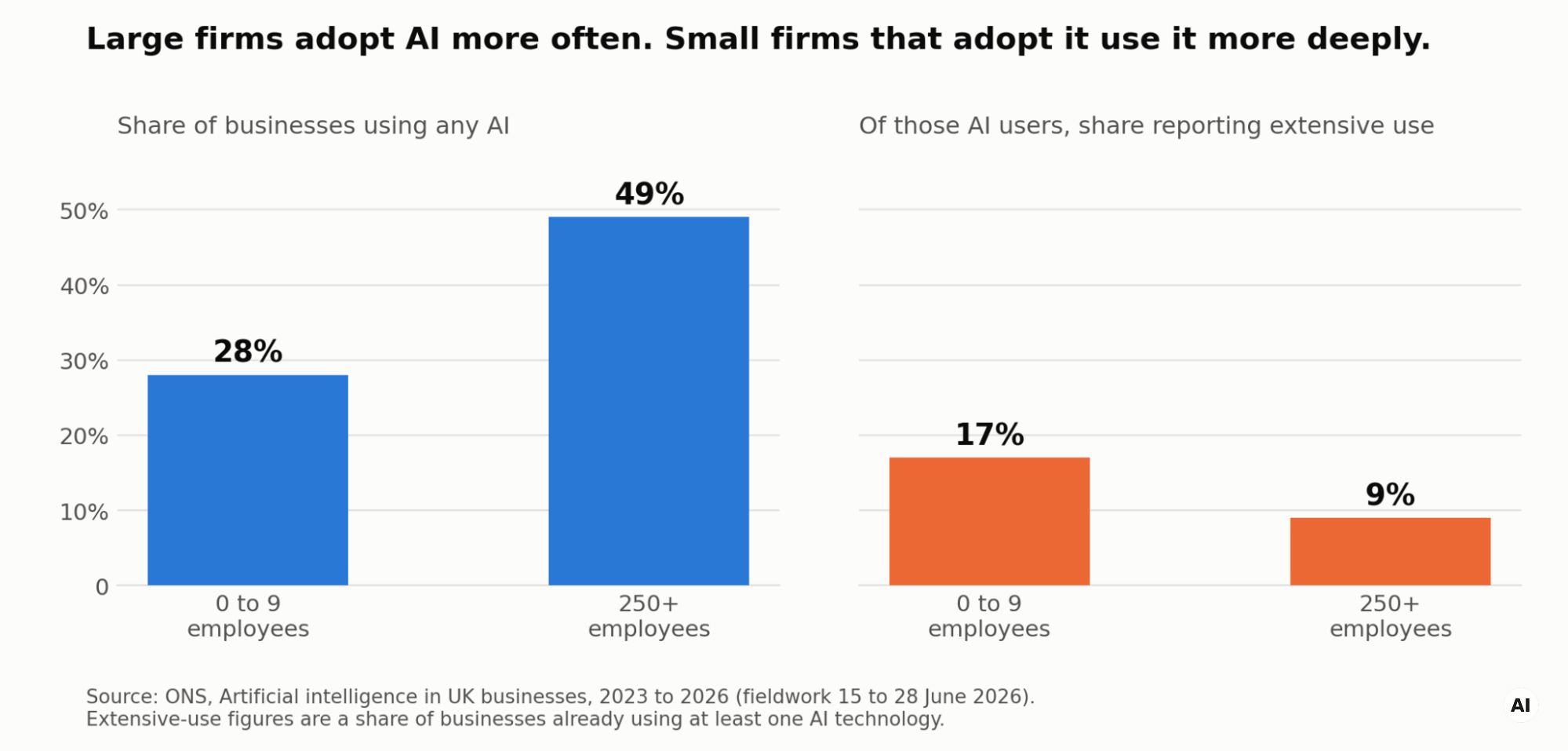
I would read this as structural, rather than cultural. A large organisation can run a pilot alongside the existing process indefinitely, funded and reported on, without ever replacing anything. A business of fifteen people has no spare capacity to run a parallel process, and the person approving the project is usually the person whose work changes. It either becomes the way the job is done, or it stops early. Both are cleaner outcomes than a pilot that runs for a year and lands nowhere. In terms of a useful conclusion for an SME owner, it is that budget and headcount do not decide this, something else does.
Start with the problem, not the technology
Another failure mode is less talked about: automating something simply because it can be automated. A business might spend weeks building a system around a process that was never the real bottleneck.
Before asking if AI can handle a task, ask why it exists, how often it happens, and what it currently costs the business.
If a team receives hundreds of enquiries but takes two days to respond, reducing the time spent copying information between systems may not solve much. The more useful starting point may be getting the first response out within minutes. The technology comes after that decision, and you can end up with an automated process that works perfectly and solves very little.
Fix the process before automating it
AI can follow a process, but cannot turn a completely undefined process into a reliable one by itself.
This becomes obvious if the same job is handled differently depending on who is doing it. One person checks three things before replying to an enquiry. Another checks five, and a third relies on information they keep in their head. There is no single process there to automate.
The process does not need to become rigid. You just need to understand the important decisions first.
If the people doing the work can't explain those decisions, an automation project starts on an unstable foundation.
What actually stops these projects
The blockers are unglamorous. Rarely technical in the way people expect.
On one engagement, the client's site ran on managed hosting with no SSH or cron access, so anything scheduled had to be rebuilt around an external runner rather than the obvious approach. On the same project, a fortnight went by waiting for a DNS record that only the IT manager could add. Quoting itself ran through a custom PHP and SQL system maintained by one internal developer, so any automation carried a single point of dependency.
None of that is a model failing; it is access, permissions, and system ownership. A large organisation has a platform team that absorbs this work and never reports it upward. A smaller business experiences it directly as the project stalling, and it gets recorded afterwards as AI not working.
The things to establish before implementation follow directly. Who controls the hosting, the domain records, and the accounts. Which systems have usable interfaces and which do not. Whether any part of the process depends on one person. If the underlying records are clean enough to act on.
Not every automation needs AI
There is a tendency to call every new workflow an AI project, which can lead businesses towards unnecessary complexity.
If a task doesn’t change or never needs judgement, plain automation will do the job. There is little value in introducing a language model to move a number between systems, or send an email when a known condition is met.
AI becomes more useful when the input is less predictable. That could mean reading an enquiry written in natural language, extracting information from an unstructured document, classifying requests, or summarising information. It is useful when the system needs to interpret something rather than simply follow a fixed rule. Use AI where it actually gives you something a simpler system can't.
Most of the ambiguity comes from measurement
Before any automation work starts, I ask what the current numbers are. How quickly are they responding to enquiries, and how many turn into quotes? It is common for nobody to know.
Without a baseline, "the system did not deliver a return" and "we never measured the starting position" are indistinct afterwards. Most of what gets reported as AI failure is unmeasured, rather than unsuccessful.
One client in renewables runs live performance monitoring across its installations, and will not publish a figure that has not been independently verified. Automation there starts with numbers you can already trust. Readiness is mostly about whether a business already measures itself.
Decide the approval boundary before you build
A quoting workflow can read an enquiry, extract the requirements, match items against a catalogue, apply current pricing, and produce a draft. A human then checks it, which is a fraction of the work of writing one from scratch. That is a lower ceiling than full automation, and a higher floor, and it is achievable in weeks.
Anything touching money, pricing, or a document a customer will read should remain behind human approval until you know how often the workflow gets it wrong. How many cases that takes depends on how varied the inputs are. Setting that boundary deliberately, rather than discovering it after a bad quote reaches a customer, often defines a system that stays in use, rather than one that gets switched off.
Conclusion
The failure statistics are noisy, but the causes underneath them are constant, and almost all of them are knowable in advance.
Before choosing a platform, an SME should be able to name the bottleneck the project is meant to move, and say what it currently costs. The process needs to be documented well enough for a new employee to follow without asking the owner. Someone inside the business, not a supplier, should control hosting, domains, and accounts. Measure the starting position before anything changes, or you'll have no way to assess the result later. And decide where a person signs off before the system goes live, not after.
You don't have to automate everything. You just need to automate the right things.
What is the biggest barrier to AI automation in your business?
Harry Norris is the Founder of Aucta AI, a UK-based AI automation consultancy. He started building automations and AI systems in early 2023. Harry's drawn to the friction inside a business, the process held together by habit rather than design, and treats each one as worth taking apart and rebuilding properly. What matters most to him is that AI actually gets used long after the demo, which means understanding how a business really works before changing anything. He pays close attention to the parts most people skip past, because that's usually where the real problem sits.
Discover more TechBehemoths Insights
Learn practical tips and insights about IT Companies, how to find the right company for your projects.
Read the latest news about Market Trends and fresh Interviews.