
There are 1 Companies in Cyprus
that provide Recruiting Services!
Cyprus is well-known for being headquarters for several international ICT corporations, the island is a hub for software development, digital marketing or service integration companies. Some of the world’s most famous companies have offices in this country such as Microsoft, IBM or Oracle, and it has also been a common location also for the fintech industry.
Discover Top IT Companies in Cyprus specialized in Recruiting and other related services. Find the best IT service providers for your projects.
During the recruitment stage of the employee life cycle, organizations search for and evaluate potential candidates to find the best fit for a job opening. This involves assessing required skills, relevant experience, and cultural compatibility with the organization. Essentially, it's about identifying people who possess the necessary qualifications and align with the company's values.
Recruitment is currently going through many changes. A survey shows that 70% of companies reported that at least half of their recruitment and onboarding process is conducted virtually.
Handpicked companies • No obligation to hire • 100% risk-free
Explore Top Recruiting Companies in Cyprus

The company accelerates tech careers with hands-on learning and direct recruitment pathways to employers.
Filter Recruiting Companies in Cyprus by Cities
Find the right tech company near you or from a specific city. Some of the best companies might be located in smaller cities.
Find more Recruiting companies around the world
TechBehemoths is the world's most advanced and user-friendly platform to match IT Companies with real clients without hustle.
The ICT Industry in Cyprus: Data & Insights
Cyprus is well-known for being the headquarters for several international ICT corporations. The island is a hub for software development, digital marketing, and service integration companies. Some of the world’s most famous companies have offices in this country, such as Microsoft, IBM, and Oracle, and it has also been a common location for the fintech industry. This country has also integrated the online services, at the point of having 160 e-government services available for the population of this country. Because of the pandemic situation, this can give us a point of view of how dynamic the government is in this country.
Also, Cyprus is a member of the European Union since 1 May 2004, when they joined together with other 9 countries, and this means that European agreements and laws are working on this country, but not in the Northern part of this country, where the EU legislation is suspended until a final settlement of “The Cyprus issue” between the Greek Cypriots and the Turkish Cypriots.
The Cypriot ICT market reached a value of €856 million in the year 2025, with an annual rate of growth of 2.5% for this sector of the Cypriot economy, with other aspects such as inflation and unemployment remaining positive. This country is also working on the 5G high-speed Broadband, which, of course, is great news for the ICT industry as well. The number of software developers and other IT-related jobs has been rising quickly over the last years, and Cyprus is becoming a small but powerful country when it comes to IT services.
Why Should You Work With Companies From Cyprus?
The importance of low salaries in Cyprus can be found interesting for companies in the EU that are looking to outsource their services or products to other countries to have better profitability, but still want to have the security of working with a company that is under the same legislation as they are, and this is important because it gives companies a greater warranty of having a successful business process outsourcing. With this country being in the EU, it means more than that they are under the same legislative agreements. It is easy to travel there, but it is important to point out that Cyprus isn’t a Schengen country yet.
Also, this country has a good talent pool of skilled professionals in fintech, IT, and business-related topics. The education sector is adapting to reality, introducing courses and degrees to supply more skilled graduates to the job market. For example, the University of Nicosia broke a big barrier in adopting blockchain technology, and now they offer the first certified online blockchain course (MOOC) and also the world’s first master’s degree for digital currencies, which seems very promising for the IT industry of the country.
About foreign startups, Cyprus is trying to attract these kinds of companies to its country because it is the best way to secure its digital future industry. They have created a startup visa, which is a very revolutionary way to boost their local industry, having professionals from outside the country who can help their sector to grow in the long term.
Another positive point to choose Cyprus is the favorable taxation in an EU member country, which can be found very interesting for global companies that want to be present in as many countries as possible. This country is having a strong transformation, they are doing many things to transform the country into a more digital-friendly Cyprus, accordingly with their development in this type of industry.
What Should You Be Aware of When Working With IT Companies From Cyprus?
Cyprus is a great country in some aspects, but it also has its disadvantages. For example, its costs can be found to be too high for some countries in Europe, for example, Portugal has a similar minimum wage and cost-of-living prices. Another big disadvantage is that nearly 46% of the new jobs created in the EU require STEM skills, which means Science, Technology, Engineering and Mathematics, and Cyprus doesn’t have a very high number of professionals that can fill this job offer, probably because there are only 1.35 million people in this country, and it’s not a specially high number also for the country’s size which is 9.251 square kilometres.
Also, Cyprus is not a Schengen country, so it is more difficult to travel there to meet with other companies to work with or do business. The personal taxes in this country are up to 35% but with the corporate tax being 12% it is something you have to be aware of when making deals with companies from Cyprus.
The majority of the work in Cyprus is focused on the tourism sector and agriculture, so it is not a very big tech hub like other countries, like Germany, Sweden, or the UK, and they are also a bit behind in technology and digitalization when compared to the rest of Europe, especially the most developed countries.
Personal Income taxes can go from 0 to 35%, from an income of 0 to €19500, it is 0%, from 19501 to 28000 it is 20%, from 28001 to 36300 it is 25%, from 36301 to €60000 it is 30% and over this amount, it is a fixed 35%. But corporate taxes are only 12%.
The last thing it is important to point out is that Cyprus is generally a safe country, but the problem of corruption and bribery is important, with a rate of 60 out of 100. Also, crime rates have been increasing since 3 years ago are important.
How Reliable Are IT Companies From Cyprus?
Cyprus is a country where, mostly speaking, it is safe to do business because they are under the same law as the rest of the European Union, and that makes business safer and easier. Another strong point is that they are not a dangerous country in other aspects and don’t have a social situation that can make this place suspicious. As with every country, it is recommended to follow business best practices and not take anything for granted when doing business. Following the law, looking for reliable companies with proven experience will make deals much safer and successful while avoiding scams or unwanted situations.
We can say that, generally speaking, IT companies from Cyprus are reliable, but following this recommendation will make the possibility of successful business much better.
How is the IT Industry in Cyprus in Relation to the Neighboring Regions/Countries?
Cyprus is surrounded by Turkey, Syria, Lebanon, Israel, and Egypt. The unstable situation in the countries from the southeast due to the war situation that made people run away from their homes is a big problem for Syria, Lebanon, and Turkey in one way or another.
In Turkey, the ICT industry is valued at $30 billion in 2025, the average growth of this sector in the last 5 years is a great 17% and there are more than 2000 companies in this sector in the country, with more than 140.000 people involved. This gives a general idea of the good situation of the country that surrounds Cyprus.
On the other hand, in Israel, there is a big science and technology center, which also has its own name, “Silicon Wadi”, which started in the 1990s with high-tech companies. Tel Aviv ecosystem has ranked fifth worldwide due to its accessibility to the global market with twice as of international customers as the famous American “Silicon Valley''.
So we can say that Cyprus is surrounded by big tech centers or potential tech centers, as well as by an unstable situation very near this island.
Tech Industry in Cyprus in 2025
With already Tech Behemoths like Microsoft and SAP present in Cyprus, the ICT stage looks stable for now. Moreover, most IT companies have already gotten used to the COVID-19 situation, and in 2 years, everyone will be flexible enough to work either from home or the office. Other than what 2021 has brought to the local ICT, there is no big news that could change the game in Cyprus, and the tech industry can proudly say it stands on solid ground.
In 2025, Cyprus is evolving as a tech hub powered by government investment in digital transformation and R&D spending, with its ICT market growth of 10.1 % in IT services. Many tech companies are relocating to Cyprus due to its strategic location, tax advantages, simple registration process, and supportive government and funding network.
Conclusion
Even with the situation not being very stable in the area near Cyprus, and being surrounded by big tech centers, Cyprus is a good technology hub where you can find good companies to work with, it has a lot of tax advantages, and a competitive market that makes the companies become better.
It has very few disadvantages because, like Malta, it is a great destination for outsourcing services, but still inside Europe, with the protection that it gives to the companies.
If you follow the recommendations and the guidelines that we talked about, you’ll find this country to be a good place to outsource your services and products, with so many advantages and strong points, very few weak points, and a good geopolitical position, even with some instability in the area.
What is Recruiting and what are its benefits for your projects?
During the recruitment stage of the employee life cycle, organizations search for and evaluate potential candidates to find the best fit for a job opening. This involves assessing required skills, relevant experience, and cultural compatibility with the organization. Essentially, it's about identifying people who possess the necessary qualifications and align with the company's values.
Recruitment is currently going through many changes. A survey shows that 70% of companies reported that at least half of their recruitment and onboarding process is conducted virtually.
Recruiting typically follows this process:
-
Job analysis - Conducted to document the necessary knowledge, skills, abilities, and other characteristics required or desired for the position. This information is then included in a person specification.
-
Sourcing - Attracting or identifying candidates.
-
Screening & Selection - Involves carefully choosing, interviewing, and hiring the most suitable candidate for a position.
Let's explore the benefits of implementing a strategic recruitment process:
-
Hiring the right fit: The key to finding the ideal candidates lies in dedicating time and effort to a well-organized recruitment process. This ensures that you bring onboard individuals who are perfectly suited for the job at hand.
-
Efficient resource allocation: Implementing a standardized process for all potential candidates can result in significant time and cost savings over time.
-
Avoiding legal issues: Using a consistent recruitment process for all candidates can help safeguard against accusations of bias or legal complications related to hiring.
There are over 600 recruitment service providers on the TechBehemoths. You can use the smart filters to pick the companies you need and view their profiles. Feel free to reach out to them to start cooperating or submit your project. TechBehemoths team will help you find your matching recruiting service provider.
Hirig talent in 2026: challenges and how to adapt
According to World Economic Forum reports, by 2030, it is estimated that 170 million jobs will be created globally due to structural transformations of the labor market.
This represents approximately 14% of all existing jobs, and the main factors determining this change are:
-
Digitalization
-
Automation
-
Green transition
A major factor that is worth mentoning is the current trend in implementing AI and automating processes in companies, that can lead to layoffs, but at the same time can create new hiring opportunities in the long term.
How can businesses adapt and hire efficiently?
Here are some key strategies to consider:
-
Prioritize AI and specialized job roles - prioritize strategic and AI-focused roles over administrative and support ones
-
Implement AI-driven hiring - use AI to automate technical and/or administrative HR tasks.
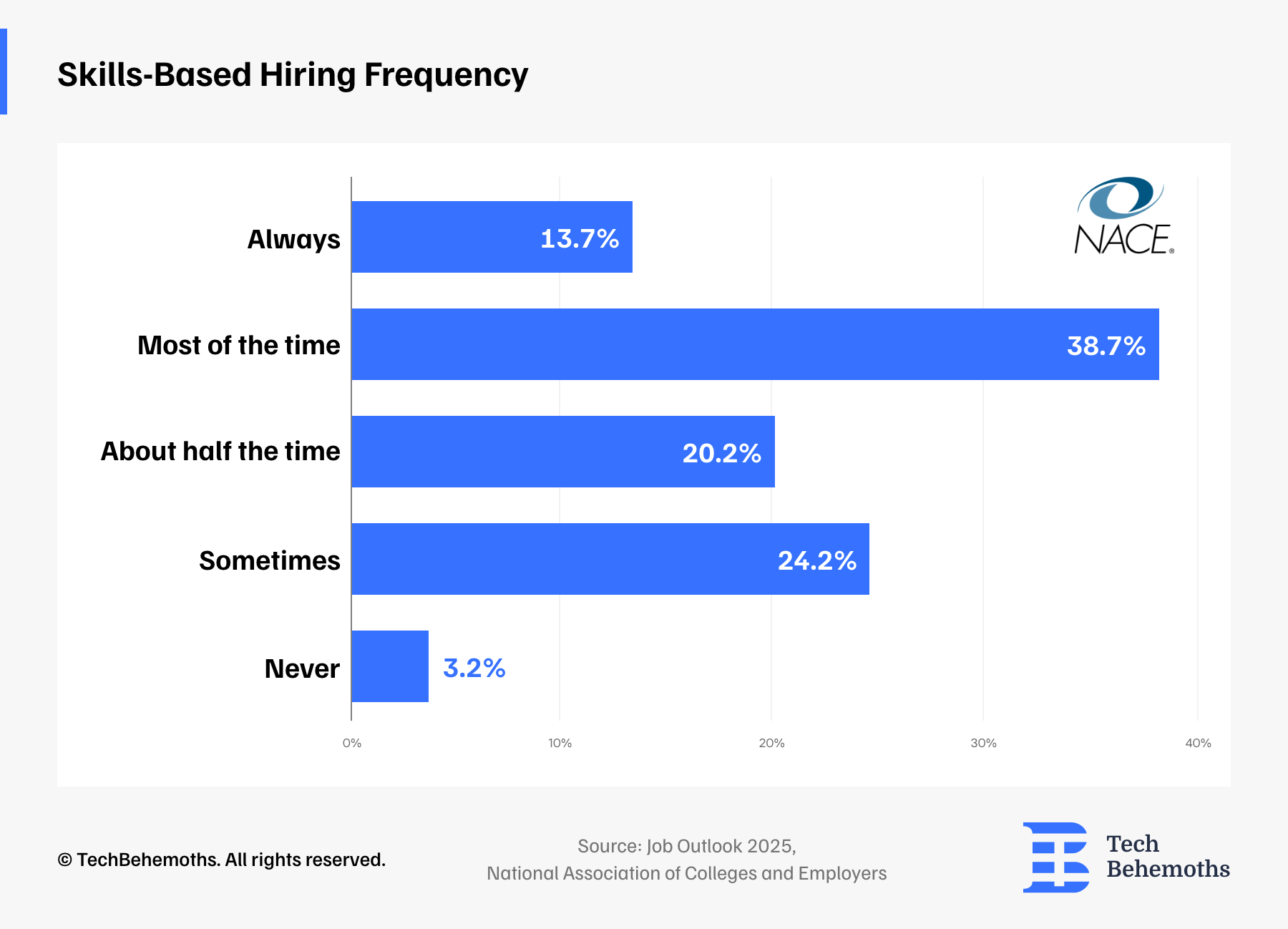
- Adopt skills-based hiring - don't solely rely on traditional CVs. Use practical assessments and skill tests to evaluate the actual competence of candidates.
-
Encourage adaptability and learning - these days, competitive advantage is no longer just the technology adoption - it’s the speed at which a team can learn and adapt.
-
Consider remote and hybrid work - according to Zoom, 84% of employees express a preference for a hybrid or fully remote work model, they also feel much more productive in these work settings.
- Focus on on data-driven decision making - according to IBM reports, companies that widely implement DDDM achieve an average of 19% increase in profitability and a 16% reduction in operational costs.
Common mistakes to avoid when hiring tech talent/providers
Try to avoid these common mistakes that may put at risk your project’s success. Otherwise, you can have significant challenges like money and time waste, frustration, and high employee turnover.
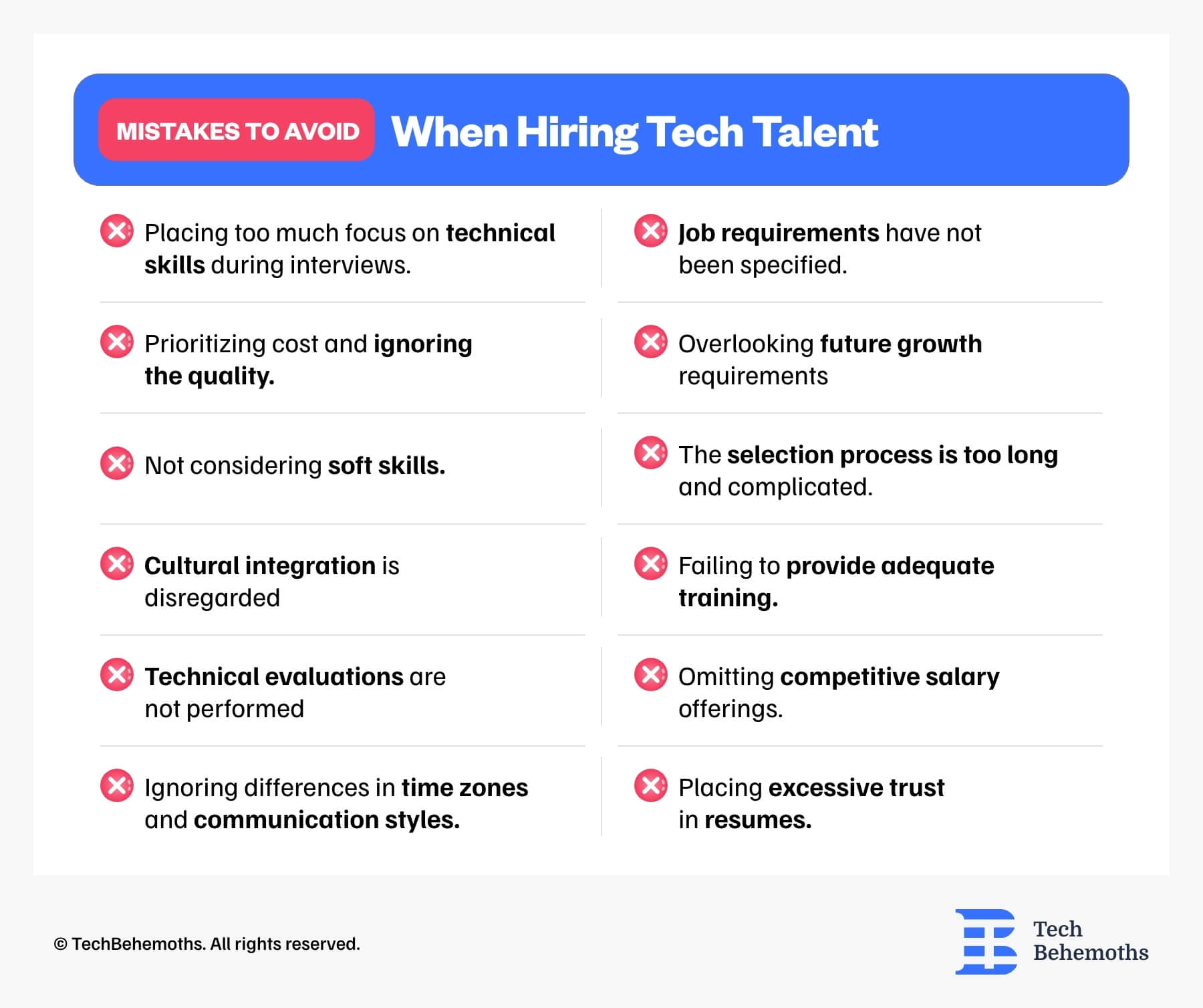
1. Trusting the CV too much
How to avoid? Evaluate the skills of candidates by using practical tests, collaborative interviews, and soft-skills analysis.
2. Too much focus on tech skills
How to avoid? Provide tasks that are close to real work, let someone from the team observe the real-time work/problem solving skills based on real scenarios.
3. Not including exact job requirements
How to avoid? Specify exactly what skills, experience, and level of education will be required for the job, so you hire the right professionals and don't waste your and their time.
4. Choosing cost over quality
How to avoid? Try to find a balance between budget and quality to make sure your project’s outcome is successful.
5. Ignoring soft skills
How to avoid? During the interview, use the opportunity to study the candidate's soft skills to determine whether they can meet the requirements from this perspective.
6. Selection process is too long
How to avoid? Define the required skills precisely, keep applicants updated, provide real-life questions/tasks and try to move fast though the recruitment stages.
7. Ignoring the cultural aspect
How to avoid? Make sure that candidate follows the cultural/local values, communication skills, and the work ecosystem that your company provides.
8. Remuneration is too low
How to avoid? Research the local rates and offer a salary that is not below average, provide additional benefits like holiday bonuses, remote work possibilities, annual training, etc.
9. Ignoring time zone differences
How to avoid? Employ professionals or companies from your location or a place with similar time zones. Don't go too far, as a 6-8 hour difference can be disruptive for your team.
10. Not providing training
How to avoid? Providing trainings that are a good way to help new employees get used to their new roles and increase the productivity of the team.