
There are 1 Companies in Slovakia
that provide Recruiting Services!
Slovakia's ICT sector is dynamically expanding, especially in relation to telecommunication, computer programming, or internet information services, and presents why Slovakia is an outstanding destination for setting up ICT businesses.
Discover Top IT Companies in Slovakia specialized in Recruiting and other related services. Find the best IT service providers for your projects.
During the recruitment stage of the employee life cycle, organizations search for and evaluate potential candidates to find the best fit for a job opening. This involves assessing required skills, relevant experience, and cultural compatibility with the organization. Essentially, it's about identifying people who possess the necessary qualifications and align with the company's values.
Recruitment is currently going through many changes. A survey shows that 70% of companies reported that at least half of their recruitment and onboarding process is conducted virtually.
Handpicked companies • No obligation to hire • 100% risk-free
Explore Top Recruiting Companies in Slovakia

Union Smart Technology: Global IT firm specializing in software development and web design solutions worldwide.
Filter Recruiting Companies in Slovakia by Cities
Find the right tech company near you or from a specific city. Some of the best companies might be located in smaller cities.
Find more Recruiting companies around the world
TechBehemoths is the world's most advanced and user-friendly platform to match IT Companies with real clients without hustle.
The ICT Industry in Slovakia: Web Agencies Information and Insights
Slovakia's ICT sector is dynamically expanding, especially in relation to telecommunication, computer programming, and internet information services, which is why Slovakia is an outstanding destination for setting up ICT businesses.
The ICT sector contributes 4.6% to Slovakia's GDP and has significant potential for growth. Due to a favorable combination of business advantages, Slovakia has become an attractive destination for ICT investors. Slovakia belongs to the top 3 countries with the lowest reported online security incidents.
Among the number of globally well-known products, the most successful were presented by brands ESET, Resco, Soitron, Pixel Federation, and Sli.do or Innovatrics.
Why You Should Work With Slovakian IT Companies
One of the biggest advantages Slovakian IT companies have is a qualified IT workforce. The Slovak labor force is perceived by foreign investors as educated, motivated, adaptable to culturally different management styles, with great multilingual competencies, and a very positive attitude to work habits.
In addition, 80% of Slovaks speak at least one other language than their mother tongue. Multilingualism is also praised among the young generation. Students learn at least one foreign language already at primary school and pursue these studies at higher levels.
The most common foreign languages taught in Slovakian secondary schools are as follows: English, German, Russian, and Spanish. For this reason. Working with Slovakian companies is easier, at least from language and cultural perspectives.
Prices are another reason why Slovakian IT companies and software agencies are attractive on the international market. This, of course, refers to average wages, but still, it makes a good deal for quality per price. Although salaries in the ICT sector are above the Slovak average, in comparison with the rest of the Western EU countries, they remain significantly lower and are still competitive in the CEE region.
What You Should Be Aware of When Working With Slovakian IT Companies
The majority of IT services in Slovakia are provided by outsourcing centers and software houses. From the perspective of IT customers, the largest share of the segment is represented by the public sector.
This still makes Slovakia a BPO country, where most of the IT companies provide services for the external market. The lack of clients from the international market creates difficulties for local IT companies to get known abroad.
How Reliable Are Slovakian IT Companies
Slovakian IT companies are at an early stage of creating their reputation on the global market. Since not so many IT companies located in Slovakia managed to highlight their performance, it is challenging to relate to how reliable they are. But taking into account that in the XXI century all companies have a chance to create a name for themselves, most probably Slovakian IT companies will manage to break the ice, and why not - make their country an important regional IT hub.
How Well Does the Slovakian IT Industry Relate to the Neighboring Countries?
In the regional background, the Slovakian IT industry is neither a shiny country nor an underdeveloped IT environment. But it is one of the promising destinations for international clients and foreign companies ready to invest or work with Slovakian IT companies, and bring the entire region closer to what the Western European IT industry is.
What is Recruiting and what are its benefits for your projects?
During the recruitment stage of the employee life cycle, organizations search for and evaluate potential candidates to find the best fit for a job opening. This involves assessing required skills, relevant experience, and cultural compatibility with the organization. Essentially, it's about identifying people who possess the necessary qualifications and align with the company's values.
Recruitment is currently going through many changes. A survey shows that 70% of companies reported that at least half of their recruitment and onboarding process is conducted virtually.
Recruiting typically follows this process:
-
Job analysis - Conducted to document the necessary knowledge, skills, abilities, and other characteristics required or desired for the position. This information is then included in a person specification.
-
Sourcing - Attracting or identifying candidates.
-
Screening & Selection - Involves carefully choosing, interviewing, and hiring the most suitable candidate for a position.
Let's explore the benefits of implementing a strategic recruitment process:
-
Hiring the right fit: The key to finding the ideal candidates lies in dedicating time and effort to a well-organized recruitment process. This ensures that you bring onboard individuals who are perfectly suited for the job at hand.
-
Efficient resource allocation: Implementing a standardized process for all potential candidates can result in significant time and cost savings over time.
-
Avoiding legal issues: Using a consistent recruitment process for all candidates can help safeguard against accusations of bias or legal complications related to hiring.
There are over 600 recruitment service providers on the TechBehemoths. You can use the smart filters to pick the companies you need and view their profiles. Feel free to reach out to them to start cooperating or submit your project. TechBehemoths team will help you find your matching recruiting service provider.
Hirig talent in 2026: challenges and how to adapt
According to World Economic Forum reports, by 2030, it is estimated that 170 million jobs will be created globally due to structural transformations of the labor market.
This represents approximately 14% of all existing jobs, and the main factors determining this change are:
-
Digitalization
-
Automation
-
Green transition
A major factor that is worth mentoning is the current trend in implementing AI and automating processes in companies, that can lead to layoffs, but at the same time can create new hiring opportunities in the long term.
How can businesses adapt and hire efficiently?
Here are some key strategies to consider:
-
Prioritize AI and specialized job roles - prioritize strategic and AI-focused roles over administrative and support ones
-
Implement AI-driven hiring - use AI to automate technical and/or administrative HR tasks.
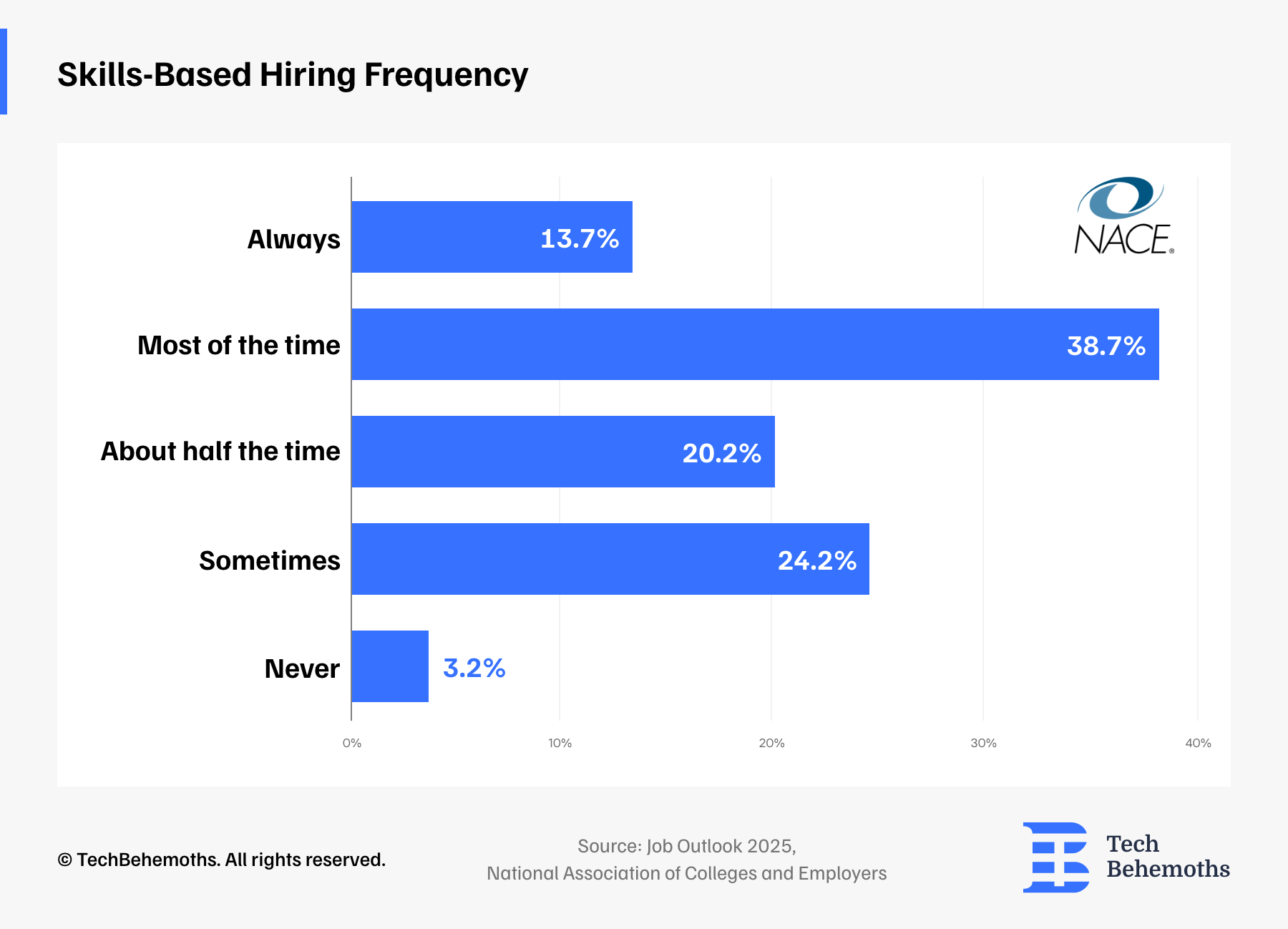
- Adopt skills-based hiring - don't solely rely on traditional CVs. Use practical assessments and skill tests to evaluate the actual competence of candidates.
-
Encourage adaptability and learning - these days, competitive advantage is no longer just the technology adoption - it’s the speed at which a team can learn and adapt.
-
Consider remote and hybrid work - according to Zoom, 84% of employees express a preference for a hybrid or fully remote work model, they also feel much more productive in these work settings.
- Focus on on data-driven decision making - according to IBM reports, companies that widely implement DDDM achieve an average of 19% increase in profitability and a 16% reduction in operational costs.
Common mistakes to avoid when hiring tech talent/providers
Try to avoid these common mistakes that may put at risk your project’s success. Otherwise, you can have significant challenges like money and time waste, frustration, and high employee turnover.
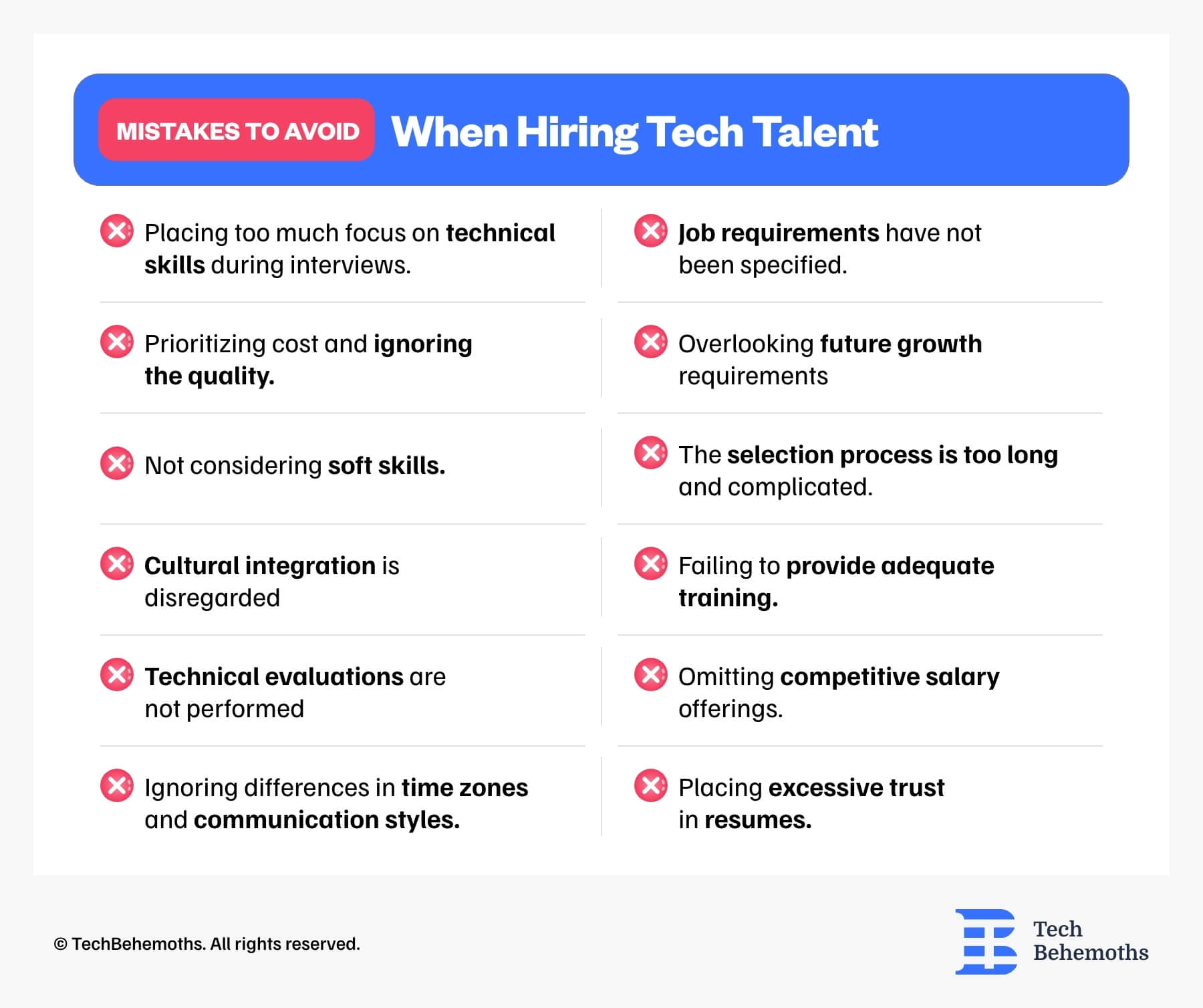
1. Trusting the CV too much
How to avoid? Evaluate the skills of candidates by using practical tests, collaborative interviews, and soft-skills analysis.
2. Too much focus on tech skills
How to avoid? Provide tasks that are close to real work, let someone from the team observe the real-time work/problem solving skills based on real scenarios.
3. Not including exact job requirements
How to avoid? Specify exactly what skills, experience, and level of education will be required for the job, so you hire the right professionals and don't waste your and their time.
4. Choosing cost over quality
How to avoid? Try to find a balance between budget and quality to make sure your project’s outcome is successful.
5. Ignoring soft skills
How to avoid? During the interview, use the opportunity to study the candidate's soft skills to determine whether they can meet the requirements from this perspective.
6. Selection process is too long
How to avoid? Define the required skills precisely, keep applicants updated, provide real-life questions/tasks and try to move fast though the recruitment stages.
7. Ignoring the cultural aspect
How to avoid? Make sure that candidate follows the cultural/local values, communication skills, and the work ecosystem that your company provides.
8. Remuneration is too low
How to avoid? Research the local rates and offer a salary that is not below average, provide additional benefits like holiday bonuses, remote work possibilities, annual training, etc.
9. Ignoring time zone differences
How to avoid? Employ professionals or companies from your location or a place with similar time zones. Don't go too far, as a 6-8 hour difference can be disruptive for your team.
10. Not providing training
How to avoid? Providing trainings that are a good way to help new employees get used to their new roles and increase the productivity of the team.