Why Most AI Startups Fail?


Summary
- The 2022-2023 period is notable for the generative explosion of AI (ChatGPT, Claude, Copilot, Gemini, etc.).
- By 2025, the proportion of investment in AI ($202 billion) has nearly equalized in 2025 with the rest of the funding ($203 billion).
- A MIT study shows that despite the $30-40 billion investment into GenAI, resulted with 95% of organizations having zero return.
- Almost 35% of startup failures are due to poor product-market fit, and over 40% of them don’t succeed because they can’t offer real market demand.
- Network reliability is critical for AI performance, as even a 1-2% failure rate in transceivers can increase job completion time by up to 60%.
From the early 2020s, a phenomenon called the AI boom began, which is a period of rapid growth in this field, including generative AI, large language models (LLMs), and AI image generators. According to Crunchbase data, AI startups raised over $200 billion in 2025, a 75% increase from the $114 billion invested in 2024. This surge in funding highlights how rapidly AI is being integrated into global business operations, expected to have a huge impact on the worldwide economy. Another study by McKinsey says that AI adoption has grown among companies to 72% from 50% for previous years, reinforcing the growing interest in this technology.
Despite the developed technologies, a controversy persists: the most funded tech industry is among the most prolific producers of failure. Startups focusing on Artificial Intelligence still face challenges, and in many cases, failure. But why so? This article discusses the factors that influence the success of a startup.
Every technology has its moment of popularity, and AI is no exception. The 2000s are known for broadband and the Wi-Fi expansion. The 2010s delivered Cloud computing & SaaS, smartphones, and early social media. 2022-2023 produced the generative explosion of AI (ChatGPT, Claude, Copilot, Gemini, etc.).
While AI had recently surged in popularity, it has actually been on the market for a few decades, from the 1950s specifically. Slowly, it had developed in 2020, in the era of the pandemic that accelerated its adoption, especially in vaccine development, drug discovery, and diagnostics. In 2022, OpenAI released ChatGPT, gathering 1 million users five days after its launch, and 57 million by the end of its first month, reinforcing the global interest in its applications for content creation, coding, education, and others. By 2023, more AI tools appeared, offering human-like texts, images, and videos. Major tech giants such as Google, Microsoft, and Meta are researching and developing AI-powered search, automated business tools, and personal assistance.
With the increased wave of popularity, more companies are actively investing in AI-driven solutions for various challenges, creating the idea that “every problem can be resolved with an LLM”. But the hype moved faster than the startups could prove their value, leading to cracks showing. This surge in interest didn’t just attract attention but contributed to unmatched levels of funding.
Solution: According to Forbes, the missing piece for the success of an AI startup is friction, also known as the beneficial force that can help these startups succeed by slowing processes just enough to promote high-quality input, thereby promoting adaptation. This will enhance accuracy, reduce risk, and differentiate their product in a crowded market.
More Funding, More (Undifferentiated) AI Startups
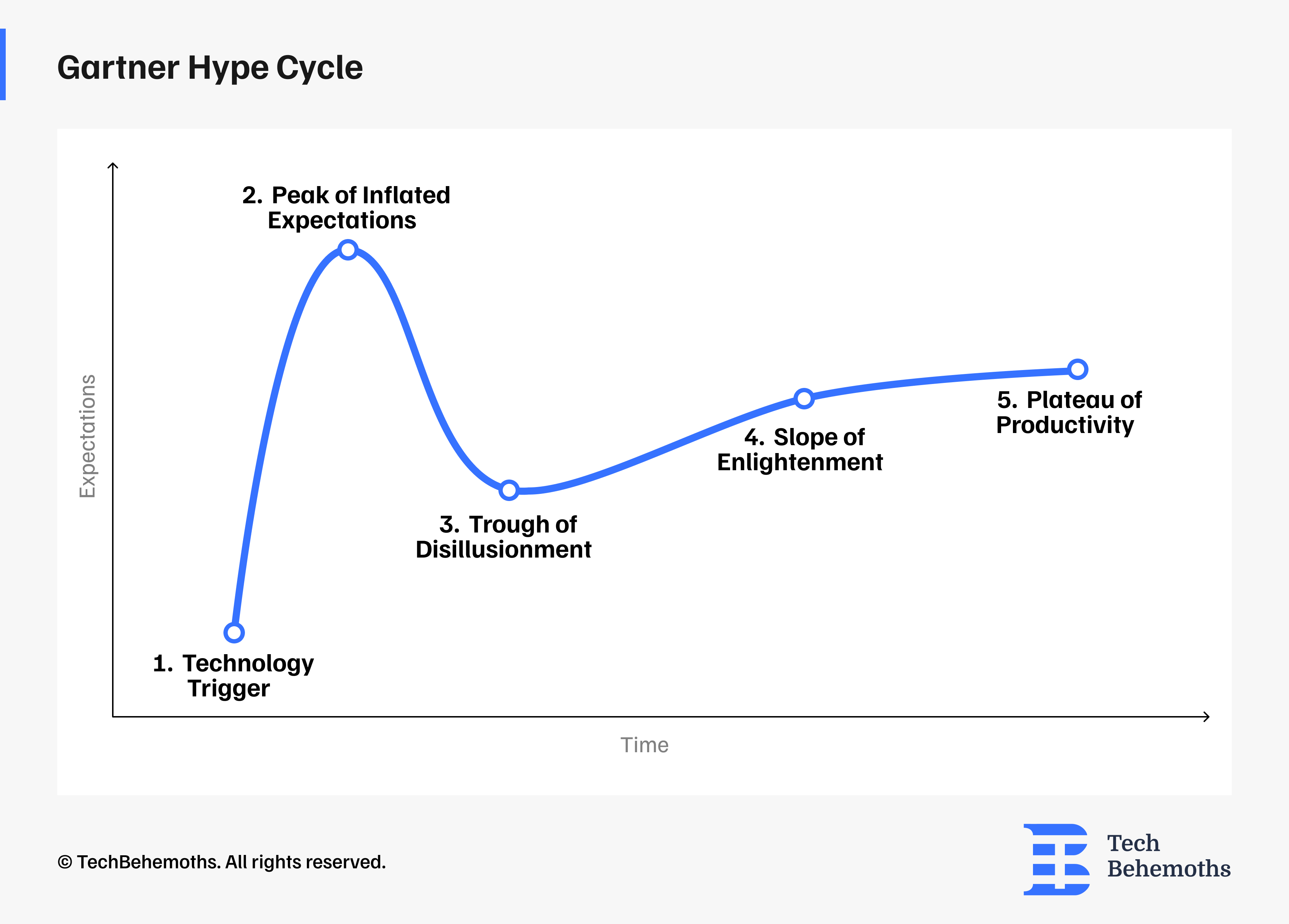
Over the past few years, billions have been poured into turning Artificial Intelligence into a successful strategy for business growth. By 2025, the proportion of investment in AI ($202 billion) has equalized in 2025 with the rest of the funding ($203 billion). However, later this year, a more realistic outcome has emerged.
A MIT study shows that despite the $30-40 billion investment into GenAI, it ended with 95% of organizations with zero return. This case shows that most AI startups are riding a hype wave rather than building sustainable businesses. And with increased investment, more startups based on AI are appearing, which leads to another problem: providing the same product with little to no difference. Competition is also intensifying, thanks to the possibility offered by AI tools, earlier available only for large organizations and at high costs.
In addition to undifferentiated products and hype-driven funding, many AI startups fail because they overlook fundamental business and tech realities. While AI investment surged into the billions, only a small fraction of projects produce real value, due to a poor integration with actual workflows and business needs. A major reason for this difference is that AI technology can not guarantee a viable business if the founders can’t offer solutions for a well-defined customer problem.
Solution:
- Build a proprietary data moat because it will create a defensible competitive advantage that competitors can’t easily copy.
- Develop true technical defensibility like model fine-tuning & RAG, hybrid models, or investing in technical expertise.
- Build specialized AI for specific industries, such as legal, fintech, or healthcare.
Thin Interfaces Over Third-Party AI Models
As more AI startups continue to appear on the market, it becomes clear that most of them are not truly building AI, but instead leveraging existing models. Among 200 funded AI startups surveyed by Medium, 73% of them are using third-party APIs, with OpenAI leading. These businesses rent intelligence rather than own it, making them dependent on external providers like OpenAI, Cloud infrastructure, and chip manufacturers.
These factors lead to the following consequences:
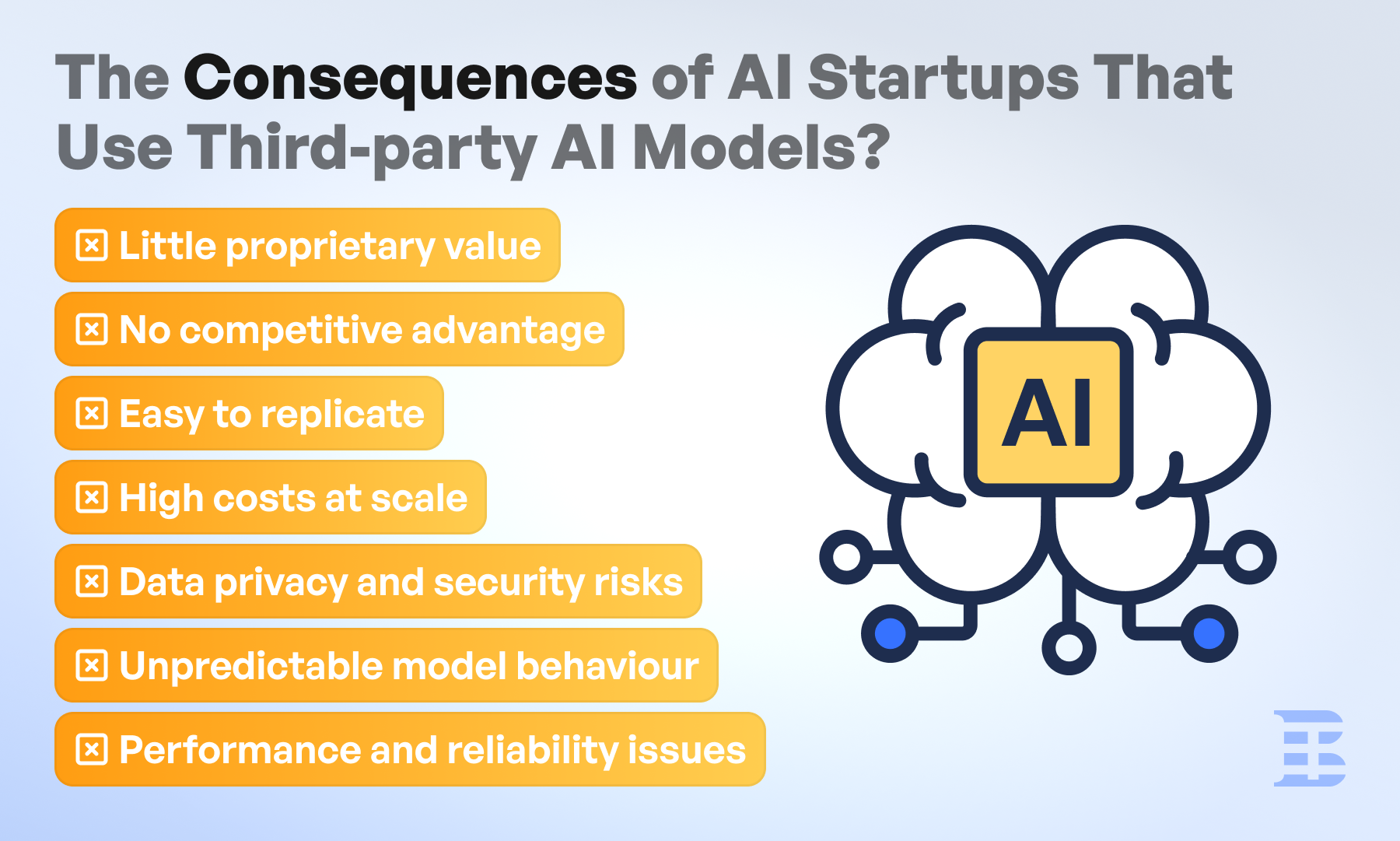
According to Medium, many AI startups' revenue doesn’t scale cleanly with their costs or what they pay for APIs. They charge customers using subscription tiers, such as Basic, Pro, and Premium, while they pay an API provider, like OpenAI. The difference here is that the client pays once a month but can use it as much it wants, but the startup pays the API provider every time the user sends a prompt. The customer payments are constant, while the startup payments for APIs are variable. It also means that the less the client uses the product, the more profit the startup gets, and conversely, the more the product is leveraged, the more the startup is forced to pay for APIs.
Solution:
- Combine external APIs for generic tasks alongside local models for specialized and niche functions, offering both flexibility and greater control.
- Implement an abstraction layer around API calls so that when moving from one model to another or to a self-hosted one, it will require updating one module rather than the entire base code.
- Ensure data security by evaluating the vendor’s terms regarding data handling, and scope API tokens to the minimum required permissions.
High Costs and Unsustainable Economics
When thinking of AI, many people imagine a team of engineers coding, but the reality is closer to running a small power plant. The high prices include AI’s infrastructure costs, due to its heavy dependence on powerful computing hardware. Startup founders often focus on models and software applications, but the real way to scale AI startups is in physical infrastructure, with the majority of AI projects being at least 80% a data project.
But there are more factors among the infrastructure, like the power and cooling. The power required for AI workflows is much higher. When data centers earlier drew 2-4 KW, now they are forced to offer 100KW and more. Network reliability is critical for AI performance, as even a 1-2% failure rate in transceivers can increase job completion time by up to 60%, meaning that a minor hardware fault can paralyze multi-million-dollar AI infrastructure. Additionally, data readiness can heavily influence the AI infrastructure, as even the best models can fail without high-quality, well-governed, and integrated data.
Investors are not funding every AI project anymore. Now they have shifted to a more sustainable and performance-based approach. While the companies expect to receive over $500 billion in 2026, investors are not funding every AI firm equally, as they become more selective. At the same time, capital is flowing toward companies that can connect their investments to real revenue and earnings growth.
Solution:
- Optimize infrastructure costs by leveraging FinOps to cut waste, including tracking unit economics (cost-per-token), adopting intelligent models for routing, terminate idle resources.
- Choose a Small Language Model (SLMs) that can deliver 80-90% of the performance at a fraction of the cost.
- Use model optimization techniques, such as quantization, pruning, or knowledge distillation, that reduce AI model size while maintaining performance.
Solutions for Non-Existing Problems
With many funds and tools, it seems that every problem can be solved using AI, but due to the large number of startups, the number of urgent issues that they can resolve is limited. This is a big reason many AI startups flop: they solve problems that are not urgent or painful enough for customers to care about, also known as the product-market fit trap.
Almost 35% of startup failures are due to poor product-market fit, and over 40% of them don’t succeed because they can’t offer real market demand. The reasons AI startups can’t find product-market fit include opting for prototypes instead of an MVP (Minimum Viable Product). These founders are attracted by the ease of having prototypes, no coding, and without much effort, which creates more of a wow factor. An MVP provides enough value to solve a specific problem, allowing for deployment and sale. Also, these two answer different questions:
Prototype: How will this work for users?
MVP: Will people actually use/pay for this?
According to ProQuantic, there are several important differences between a prototype and an MVP:
| Parameter | Prototype | MVP |
|---|---|---|
| Final goal | Showcase the core business idea | Reinforce its viability by collecting feedback to achieve product-market fit |
| Time for building | Weeks | Months |
| Revenue | Doesn’t bring sales but generates further investments | Sells to early customers and brings investment |
| Future use | MVP development | Complete development of a fully functional product |
Solution:
- Define a narrow ICP (Ideal Customer Profile), and solve an urgent pain for this audience.
- Focus on workflow integration and focus on how your product will integrate into the workflow of this audience.
- Use continuous feedback and track behaviour to improve the product based on real input from the customers.
Poor Management
While technical challenges are common, management-driven issues, like a strategic or financial misalignment, and team dysfunction, often prevent an AI project from succeeding. About 85% of AI projects fail due to leadership mistakes, and also due to the lack of cross-functional teams. Poor management in an AI startup can lead to the following consequences:
- Lack of a clear strategy, causing wasted effort and unclear success metrics when the startup founders don’t define a business goal.
- Weak sponsorship or executive misalignment can cause an AI startup to be abandoned when executives don’t align with priorities, timeliness, budget, and KPIs. Without strategic alignment, the startup risks losing funding.
- Unrealistic expectations can appear when leaders underestimate the complexity of AI technologies, creating pressure to deliver the planned results. Consequently, this results in rushed deployment, fragile systems, and an inability to produce business value.
- Weak resource planning is a result of inadequate leadership decisions about resource allocation, like an insufficient investment in data governance, infrastructure, or talent training.
Solution:
- Establish a clear vision, KPIs, and roles so every team member knows what to do. Strong leaders must encourage accountability, otherwise, the project loses focus, and progress slows.
- Adopt data-driven and structured decision-making to avoid failure. Many leaders make decisions based on assumptions and not facts, which can be dangerous for a successful future.
- An efficient cross-functional coordination will ensure AI projects' success due to collaboration between business leaders, data teams, and operations. This team should include different roles, including an Executive Sponsor, a System Architect, a Data Engineer, and others, according to IBM.
How TechBehemoths Can Help You Find the Best Team for Your New AI Startup
A good AI team that will reinforce a successful strategy for an AI project can include multiple job roles in different domains, such as Data Science, Development, and Business. The following roles can be included in an AI team.
- Data Analysts
- Data Scientist
- DevOps Engineer
- Business Analyst
- UX Designer
- ML Specialist
- Others
Finding the right teammates for your startup is a critical task that can become tiring when done alone. TechBehemoths is a platform that can help you save time and energy while connecting you with the best specialists in your field. To do so, you can take into consideration the following choosing criteria:
- Location
- Price
- Team size
- Previous experience
- Communication means
- Turnover time
On TechBehemoths, you can find thousands of reliable agencies and companies that offer multiple services required for your AI and tech projects. To narrow your choices, you can use the filter option to narrow down by location, team size, fees, and hourly rate. 1225 listed firms offer AI Strategy services, which will help you ensure your startup’s success in the future.
Conclusion
The AI bloom has shown that heavy investment and advanced technology do not ensure success for a startup. What they lack to progress on includes a lack of friction, poor product-market fit, a lack of differentiation, and a weak team. As AI tools have optimized and become more accessible, the challenge is no longer building AI but building real solutions while leveraging this technology.
Overall, the startups that succeed will be those that move beyond the hype wave and focus on clear problems, strong management strategy, competitive advantage, and sustainable economics. In an evolving landscape like AI, innovation is required for progress, but also clear goals, discipline, and execution.
Related Questions & Answers
To What Extent Should Startups Rely on Third-party AI Models vs. Proprietary Solutions?
How Can Companies Balance Rapid Innovation With “Friction”?
What Are the Most Effective Ways to Control and Optimize AI Costs?
How Can AI Startups Ensure Seamless Workflow Integration?
What Metrics Should Measure Real AI Business Impact?
I am an enthusiastic Biomedical Engineering Researcher and love learning about various domains. One of the biggest treasures that we, people, have is knowledge because it's hard to achieve and it depends only on human will. And it can be shared with others, that's why I like to find something new and share it with the world.
Discover more TechBehemoths Insights
Learn practical tips and insights about IT Companies, how to find the right company for your projects.
Read the latest news about Market Trends and fresh Interviews.