Why Hiring Freelance Developers Is Not a Good Idea


Summary
-
1 in 4 companies that use freelancers face concrete problems, such as delays, poor communication, extra administrative costs, incorrect reporting.
-
Reliance on freelance developers brings flexibility and access to rare skills, but it also comes with a real risk of instability, especially for critical, long-term projects.
-
Using freelancers requires management and infrastructure - for communication, monitoring, clear contracts - otherwise the risk of “project interruption” or “poor continuity” becomes notable.
Companies frequently run into a double-edged sword when deciding between a freelancer and a full-time developer on their team. What attracts founders or HR specialists more are the advantages that freelancers offer, such as flexibility, often cheaper labor, defined contractual responsibilities, and many others that seem to make a difference compared to a full-time employee.
What are the advantages and risks of this decision, and why hiring freelance developers is not such a good idea for companies, will be explained in this article.
Why Companies Choose to Hire Freelance Developers
To launch a business, especially in the IT industry, startups need to quickly and efficiently develop products or services for customers, while keeping costs under robust control. Mature companies, however, may face other problems, such as a lack of staff or specific expertise - when they need help on an ad-hoc basis, they see hiring freelancers as a perfectly valid option.
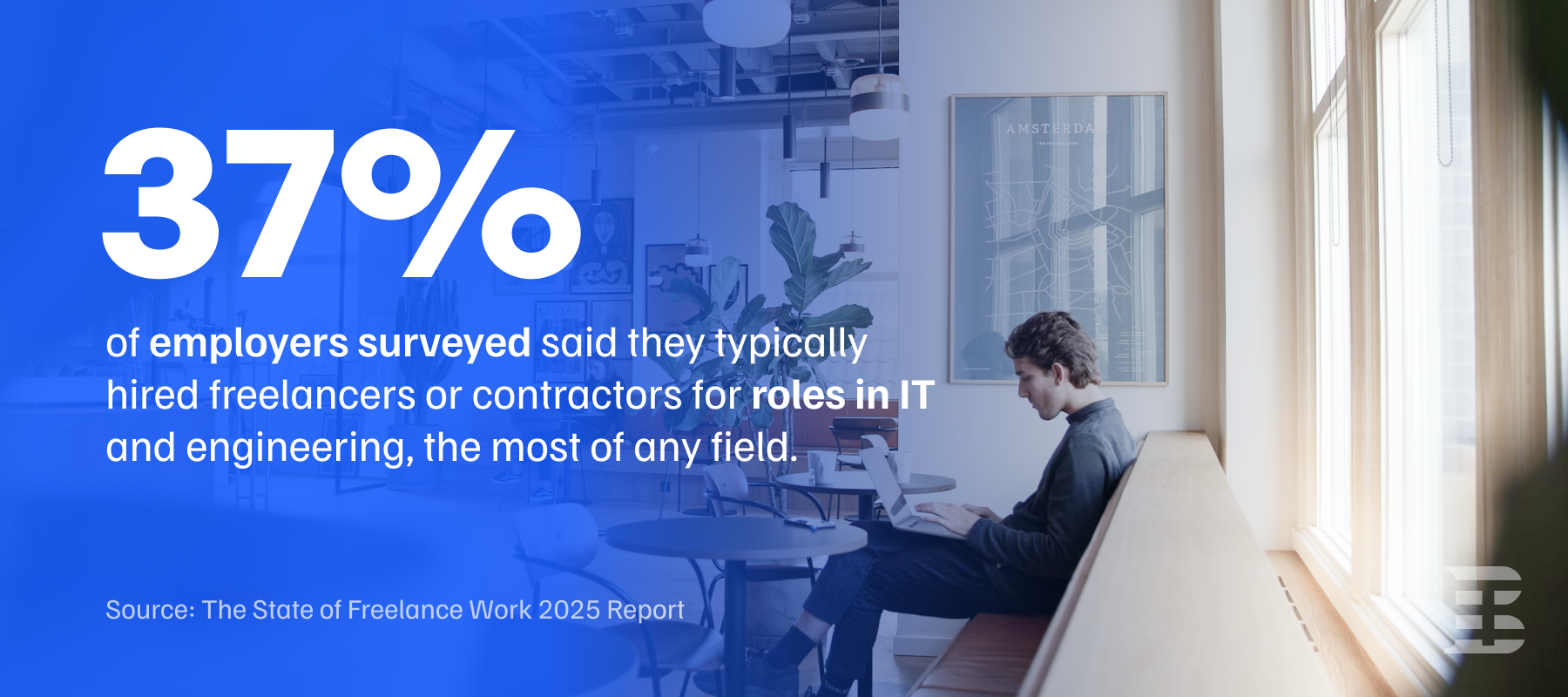
Interestingly, despite these risks, more and more companies are turning to freelancers: 52% of companies surveyed said they had increased their use of freelancers in the past 3 years.
At the same time, nearly 46% of companies say they are turning to freelancers because they can’t find permanent employees suitable for specific roles — so freelancers are becoming a “reservoir” for scarce skills.
In the last 5 years, it has been observed that the choice often falls on freelancers – 40% of businesses say independent talent provides a larger talent pool for recruitment. Hiring them presents visible advantages such as speed of hiring, lower costs, and access to various skills. At the same time, it also involves risks in terms of consistency, communication, loyalty, and project safety.
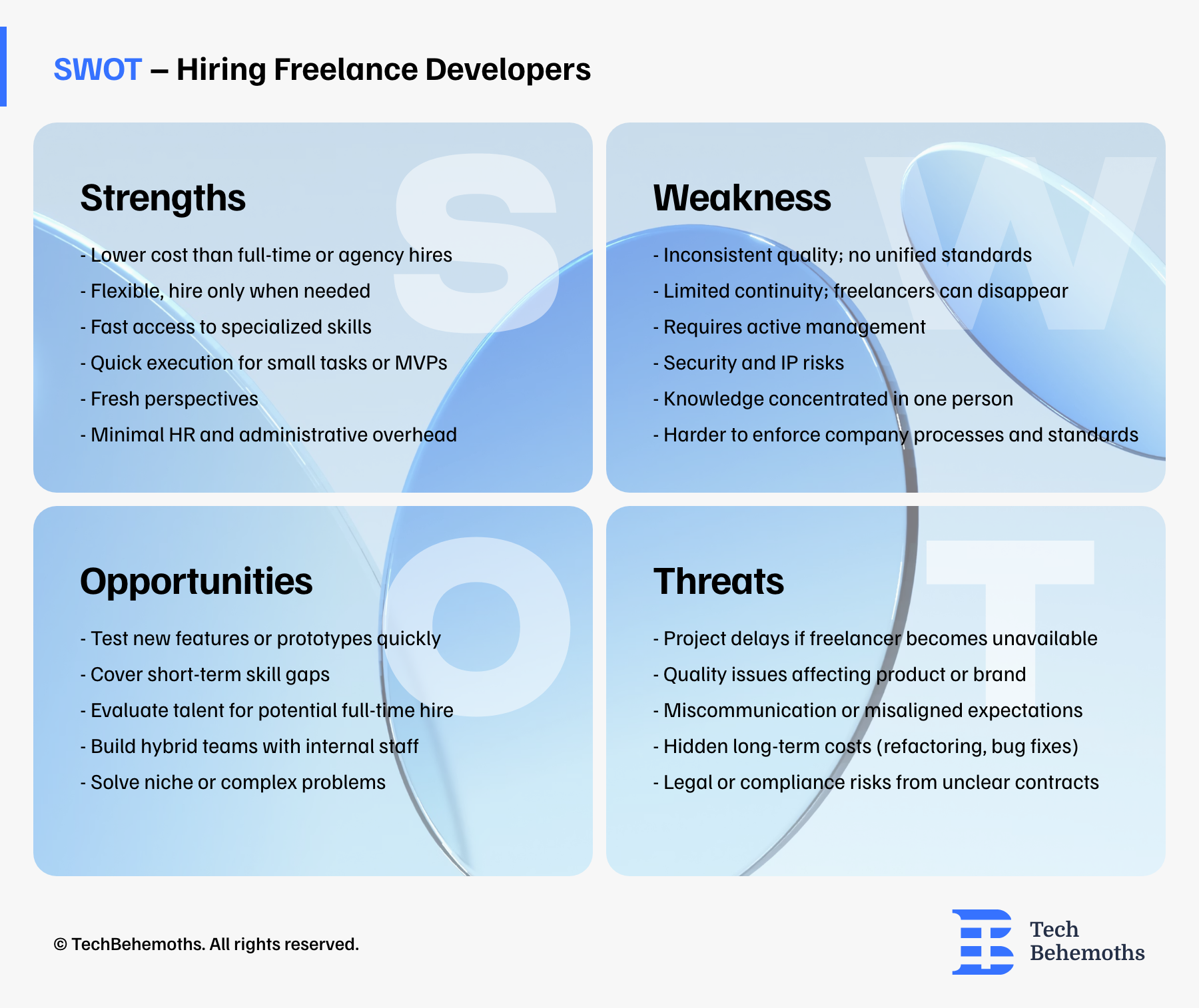
Based on the following SWOT analysis, we will more precisely define and structure what makes IT companies choose to hire freelance developers.
SWOT Analysis
The Hidden Risks of Freelance Developers
In The State of Freelance Work 2025 report – which surveys employers who use freelancers/contractors – 27% of companies say they have encountered communication issues when working with freelancers. The same percentage (27%) also cites increased administration (red tape, coordination) as a challenge.
Irregular Availability
Freelance developers are usually independent and manage multiple projects simultaneously to maximise their income. In practice, this means is that they often overload their agendas and misestimate the time required for each task. When faced with busy periods, prioritisation becomes simple: freelancers focus on more profitable projects, those with clients who pay urgently, or tasks with immediate deadlines.
-
For a company, this reality generates immediate risks:
-
Constant slippage in the development roadmap
-
Critical tasks postponed without notice
-
Inability to maintain the pace of sprints
-
Blocked dependencies for the rest of the internal team
Delays threaten project delivery, damage the company's reputation with its own customers, and increase operational costs. More often than not, companies end up “paying” twice — first for the delayed task and then to find another developer to complete what was started.
Communication Breakdowns
Successful software development depends on fast communication and constant alignment. In the case of freelancers, the dynamics are different: they work in different time zones, organize their own schedules, and manage their communication according to their workload.
This can lead to:
-
Slow responses to urgent requirements
-
Lack of availability at critical times (deployments, bugs, hotfixes)
-
Late feedback, which slows down QA and testing
-
Difficulty in clarifying requirements and scope changes
For companies, these problems translate into lost time and operational friction. For example, a minor specification change can be blocked for hours or even days, slowing down the entire project.
Another major risk: lack of proactive communication. Internal employees flag problems quickly; freelancers often do not.
Low Commitment & Project Instability
Freelancers are not employees, do not have the same strict contractual obligations, and can decide to reduce their involvement at any time — or even drop out of the project altogether.
The causes are multiple:
-
better-paying opportunities
-
lack of long-term relationship with the company
-
lack of motivation for difficult projects
-
burnout or low interest
The result?
-
Abrupt termination, without real notice
-
Unannounced breaks in the middle of sprints
-
Instability in code continuity
-
Additional costs to quickly find a replacement
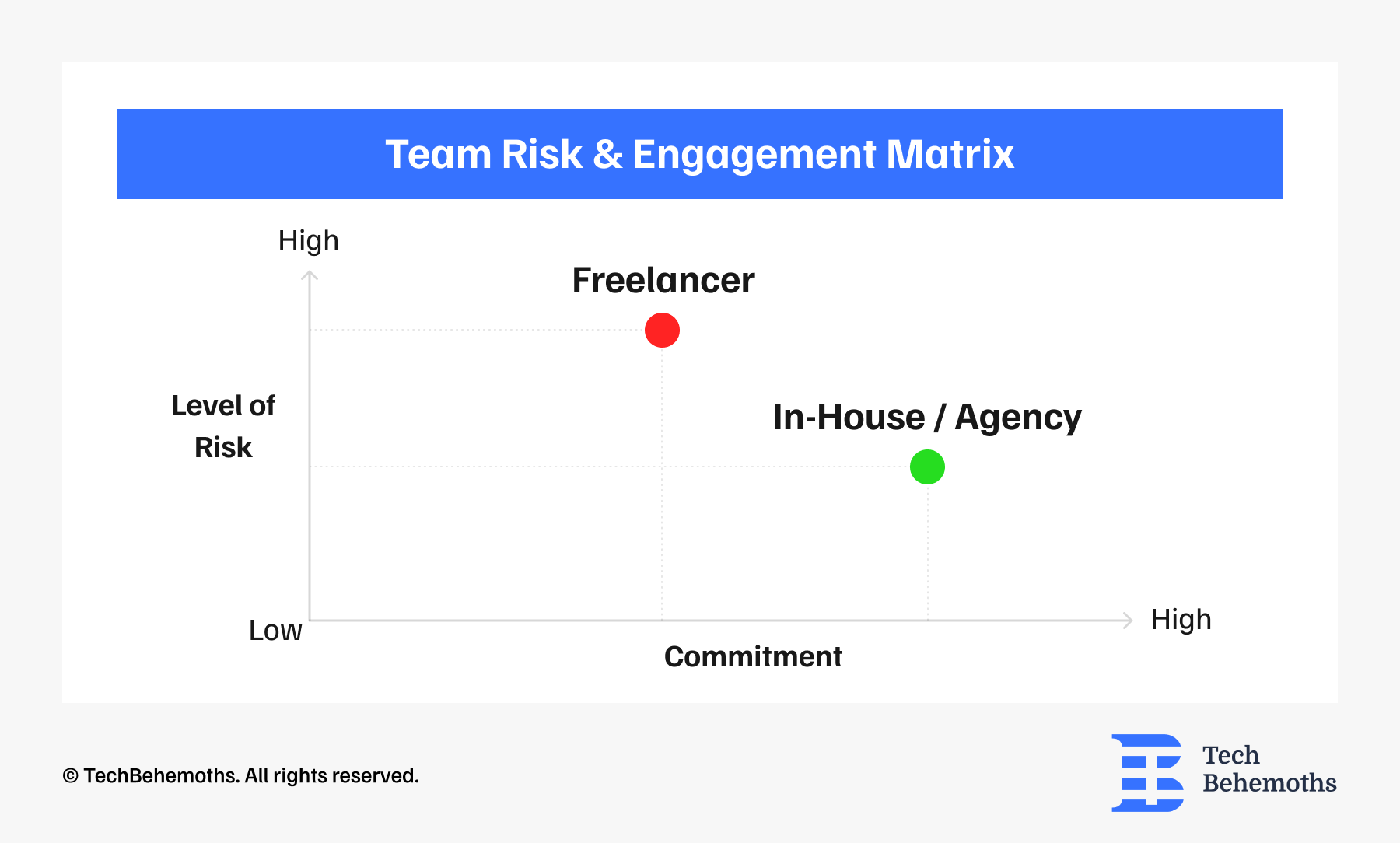
For critical or long-term projects, this risk is catastrophic. An in-house team or dedicated agency can maintain engagement; a freelancer is not obligated to.
Unstable Quality Standards
When you hire different freelancers, each one comes with their own standards, their own coding style, their own tools, and their own practices — sometimes good, sometimes very poor.
Common consequences:
-
Uneven, hard-to-maintain code
-
Lack of documentation
-
Different architectures for similar modules
-
Costly refactorings
-
Unnecessary dependencies or incompatible tools
In practice, companies are faced with inconsistent products that are impossible to scale and very expensive to maintain.
Worse still, many freelancers do not have the necessary licenses or professional software, which affects the final quality. This means excessive debugging, patching over patches, a lack of testing, and legacy technology from the start.
Data Security Vulnerabilities
Freelancers have direct access to source code, servers, databases, or internal documentation – but they are not integrated into the organizational culture and cannot be controlled as strictly as an employee.
Real risks:
-
working on unsecured personal devices
-
logging in from public spaces
-
storing data on insecure platforms
-
reusing the same passwords
-
transmitting files over unencrypted channels
All of these massively increase the risk of a breach.
In addition, freelancers have no “loyalty” to the brand; if they leave, it is difficult to track exactly what data they have left in their possession.
Even companies with solid processes find it difficult to:
-
limit access
-
audit activity
-
control permissions
-
revoke access after collaboration ends
Knowledge Gaps & Poor Collaboration
Freelancers work in isolation, are not included in the rhythm of the internal team and do not participate in all discussions or updates.
This generates:
-
Silos – everyone works on their own piece, without full context
-
Lack of visibility into project changes
-
Conflicts in development (tasks implemented according to old specifications)
-
Additional time lost by the internal team to realign
For companies, knowledge loss is one of the most costly problems. If the freelancer leaves, part of the context is lost – sometimes irreparably.
Budget Uncertainty & Hidden Costs
Hiring a freelancer may seem like a “cheap” solution, but the hidden costs add up quickly:
-
additional revisions
-
delays that affect the final delivery
-
costs to bring in a second freelancer
-
lost time on the part of the internal team
-
refactoring to fix weak code
And because freelancers work by the project or by the hour, any adjustment to requirements becomes a negotiation. Without a strict contract, costs can become unpredictable.
Insufficient Documentation
Most freelancers focus on delivering the task – not on the process, not on best practices, not on knowledge transfer.
The most common shortcomings:
-
insufficient or non-existent documentation
-
zero onboarding for future developers
-
neglect of unit tests or automated testing
-
lack of long-term maintenance
For companies, the lack of ownership means:
-
dependence on a single developer
-
inability to continue the project if they leave
-
increased transition costs to another team
Limits to Project Growth
A freelancer can only work a limited number of hours per week. When the company needs to grow quickly or the project becomes complex, obvious limitations appear:
-
the freelancer cannot cover 2–3 roles simultaneously
-
cannot scale the project at an accelerated pace
-
cannot take on emergency tasks in parallel
-
cannot cover QA, DevOps, architecture and development at the same time
Internal teams or dedicated agencies can scale in a few days; freelancers cannot.
Other issues reported by companies were that 24% of them mentioned team culture conflicts, 21% – inaccurate reporting of billable hours, and 18% – risks of misclassification of contractors, which can generate legal or compliance risks.
Avoid the Risks of Freelancers. Choose Expertise.
Check our curated list of leading development firms on TechBehemoths.
Real Cost vs Expected Cost
According to the Global Freelance Income Report, the worldwide average hourly rate for a freelancer is $28 – significantly higher than the $21 average two years ago – yet still lower than what you would typically pay an employee for the same role. By comparison, the fully loaded cost of an employee in a similar role, including salary, benefits, bonuses, health insurance, office setup, and paid leave, is typically higher, often exceeding $40 per hour.
Well, many companies choose freelance developers because the expected cost seems low: quick work, flexible billing, minimal commitment. But when it comes to software development, the cheapest option often becomes the most expensive one.
Expected Cost:
A low hourly rate and a fast, affordable build delivered by a freelancer.
Real Cost:
What companies actually face after choosing a freelancer:
-
Inconsistent code quality leading to expensive refactoring
-
Missed deadlines that slow down product launches
-
Lack of documentation, making future work costly and time-consuming
-
Security gaps that require specialists to fix
-
Project abandonment, forcing companies to start over
-
Hidden costs from debugging, cleanup, and rework
In the end, the “budget-friendly” freelancer often results in:
-
Higher long-term expenses
-
Delays that impact revenue and growth
-
Paying twice - first for poor execution, then for someone to fix it
When building something critical, quality isn’t a cost - it’s an investment. And with freelancers, the real cost usually shows up when it’s already too late.
When Are Freelancers Actually a Good Fit?
Interestingly, despite the risks, more and more companies are turning to freelancers: 52% of companies surveyed said they had increased their use of freelancers in the past 3 years.
At the same time, nearly 46% of companies say they are turning to freelancers because they can’t find permanent employees suitable for specific roles — so freelancers are becoming a “reservoir” for scarce skills.
Freelancers are ideal for short-term, highly specialized, or non-critical tasks. For example:
-
Quick fixes, prototypes, or MVPs
-
Niche expertise your internal team lacks
-
Peripheral work like UI/UX tweaks, graphic design, or marketing automation
-
Temporary support during peak workloads
Key takeaway: Use freelancers for temporary or specialized projects, but rely on a dedicated team for core product development, scaling, and long-term growth.
Best Alternatives to Freelancers
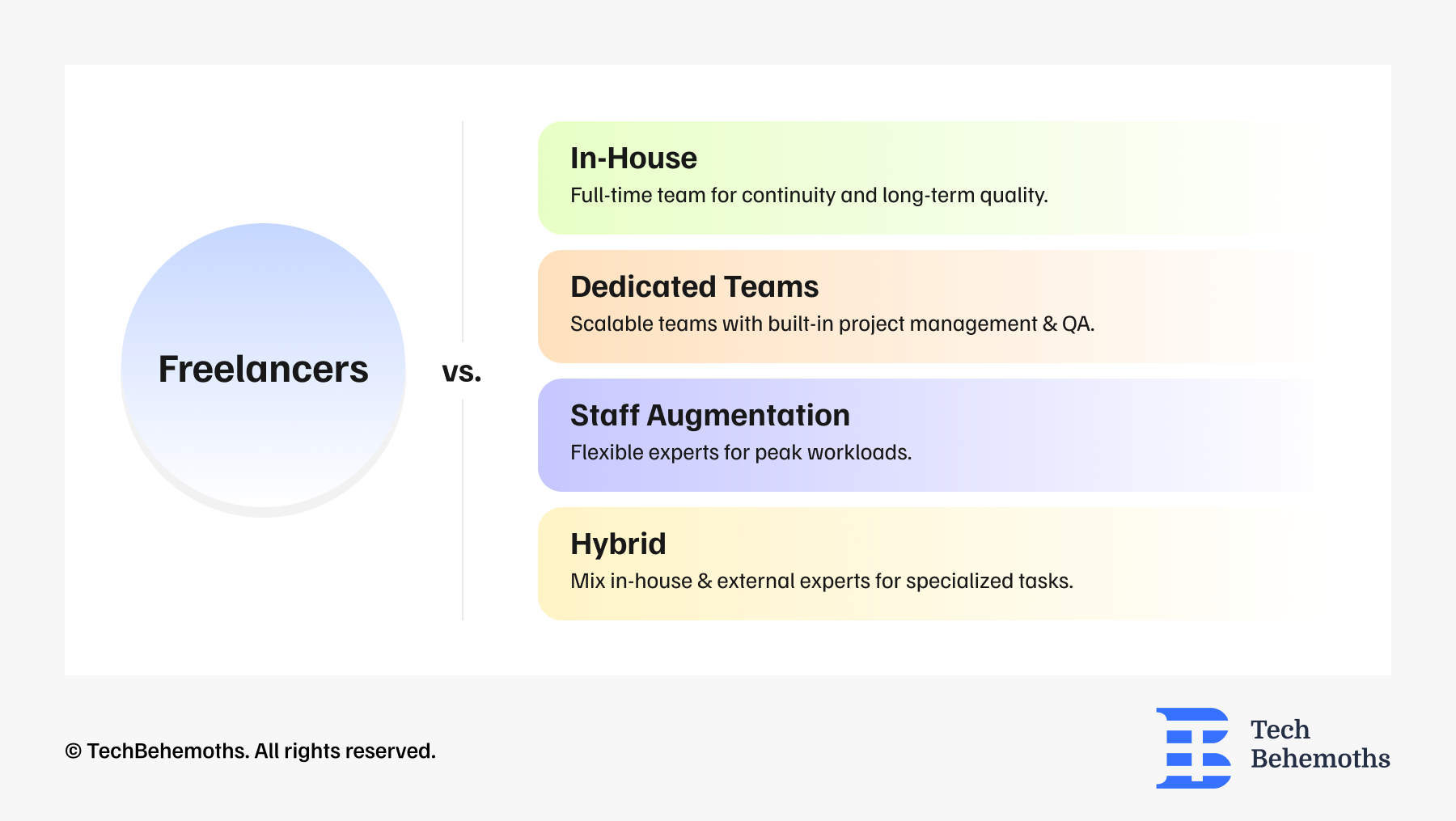
When freelancers aren’t the right fit, there are other viable alternatives, depending on your expectations, the importance of the project (core vs. non-core), the need for special expertise, and the estimated budget for the software development or IT project.
-
In-House Team, full-time employees who develop and maintain the internal product. It is the ideal option when it comes to critical and long-term projects.
-
Dedicated Development Teams involve specialized, scalable external teams, with project management and QA included, to the agency. They can be considered a valuable alternative for freelancers, due to the fact that they could take on entire projects without overloading the internal team.
-
Staff Augmentation or Contractors through Agencies represent temporary experts for periods with high volume of work or specific skills, and the advantage is that their management is done through the agency for reliability.
-
Hybrid Model is a combination of an internal team and external experts for specialized tasks. It maintains control over critical work internally and optimizes costs and flexibility.
Key: All of these options offer stability, continuity, and better quality than a single freelancer, especially for critical projects, core products, or long-term development, so the company will need to make its choice primarily based on the project's duration and complexity, existing internal resources, costs, and scalability.
Wrapping Up
As stated above, hiring a freelance developer is not always the best solution, but can also be a viable option for unique cases, for small tasks or very well-defined projects, when the company or development does not require commitment and long-term partnership.
On the other hand, for continuous, scalable and secure implementation, the risks are too high:
-
instability
-
lack of continuity
-
inconsistent quality
-
hidden costs
-
security vulnerabilities
Alternatives such as in-house development, dedicated teams, staff augmentation or hybrid models offer predictability, stability and scalability - exactly what a growing IT business needs.
Related Questions & Answers
Is the global freelancer market projected to grow in the coming years?
Are knowledge gaps a top challenge when hiring freelancers?
How many employers plan to increase their collaboration with freelancers?
Is the freelance workforce growing faster than traditional employment?
I tend to create digital content that captures, inspires, and generates impact. I resonate with the idea that less is more. My approach combines strategy, creativity, and analysis to build authentic and relevant messages. Beyond the digital space, nature is my sanctuary - a place of inspiration and balance. Exploring landscapes, I find clarity in nature's simple beauty.
Discover more TechBehemoths Insights
Learn practical tips and insights about IT Companies, how to find the right company for your projects.
Read the latest news about Market Trends and fresh Interviews.