Product Manager vs Product Owner: Key Differences, Salaries, and Skills


Summary
Product Managers and Product Owners are often confused. While both roles share a common goal of building successful products, they focus on different sides of the process.
This article breaks down their key differences: how Product Managers shape the vision and strategy, and how Product Owners turn that vision into action and delivery. It’s a complete guide to understanding how PMs and POs work together — one defining the “why” behind a product, the other driving the “how.”
Is a Product Manager (PM) the same as a Product Owner (PO)? These two terms may sound similar, but when it comes to roles and responsibilities, as well as the focus on the work, both terms are far too different from each other.
So, in this article, we will discuss what is the difference between a product owner and a product manager, who earns more, and even whether a product manager can become a product owner and vice versa.
Who is a Product Manager?
A Product Manager is the person who defines what a product’s success looks like and rallies the team to turn the vision into reality. They do this by understanding the customer’s needs and the most important business objectives that a product will meet.
The primary responsibilities of a product manager are the creation, launch, maintenance, and continuous improvement of a company’s products. This involves several steps:
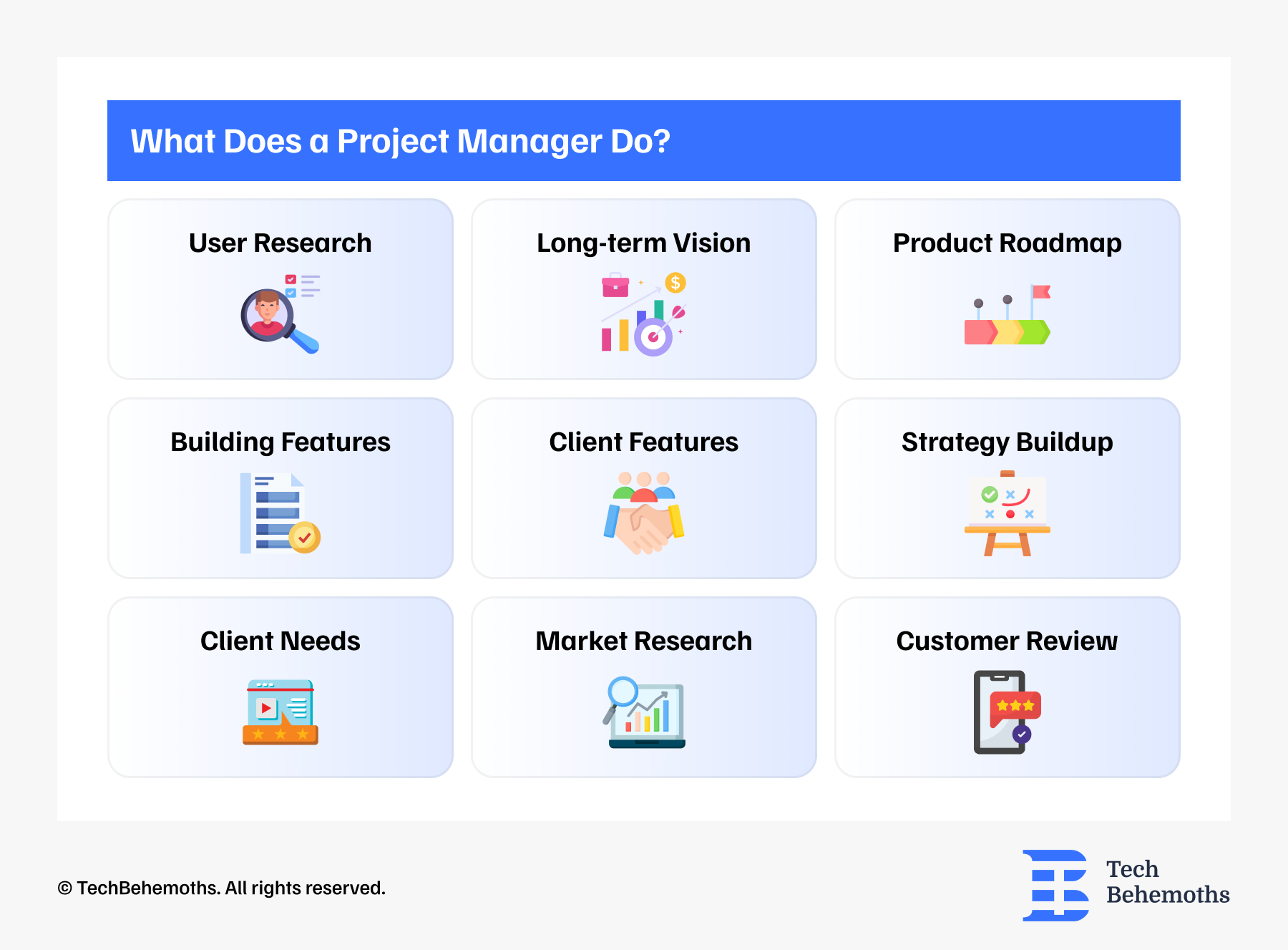
- Define the product vision and decide on its features
- Establish a long-term strategy and create a product road map
- Set and achieve product goals
- Conduct user and market research
- Analyze market trends
- Monitoring competitors
- Discover new opportunities.
Product managers continuously monitor the market and conduct competitive research. To ensure a successful product launch, product managers oversee various tasks and coordinate the efforts of all teams working on a product, including engineering, design, marketing, and sales, to ensure it meets quality standards and customer expectations.
PM is the main point of contact between the company’s business team, the development team, and its customers.
A product manager can be anyone who possesses the right mindset, curiosity, and willingness to learn.
Who is a Product Owner?
A Product Owner is a specialist who focuses specifically on executing the strategy developed by the Product Manager. This role is derived from Scrum project management, a framework that establishes team dynamics and responsibilities for a project.
The main responsibilities of a product owner are defining, prioritizing, and managing the product backlog, which is a list of required work items. The product owner ensures that the development team completes tasks that improve the product, while acting in the best interest of customers and consumers. This involves a few steps to follow:
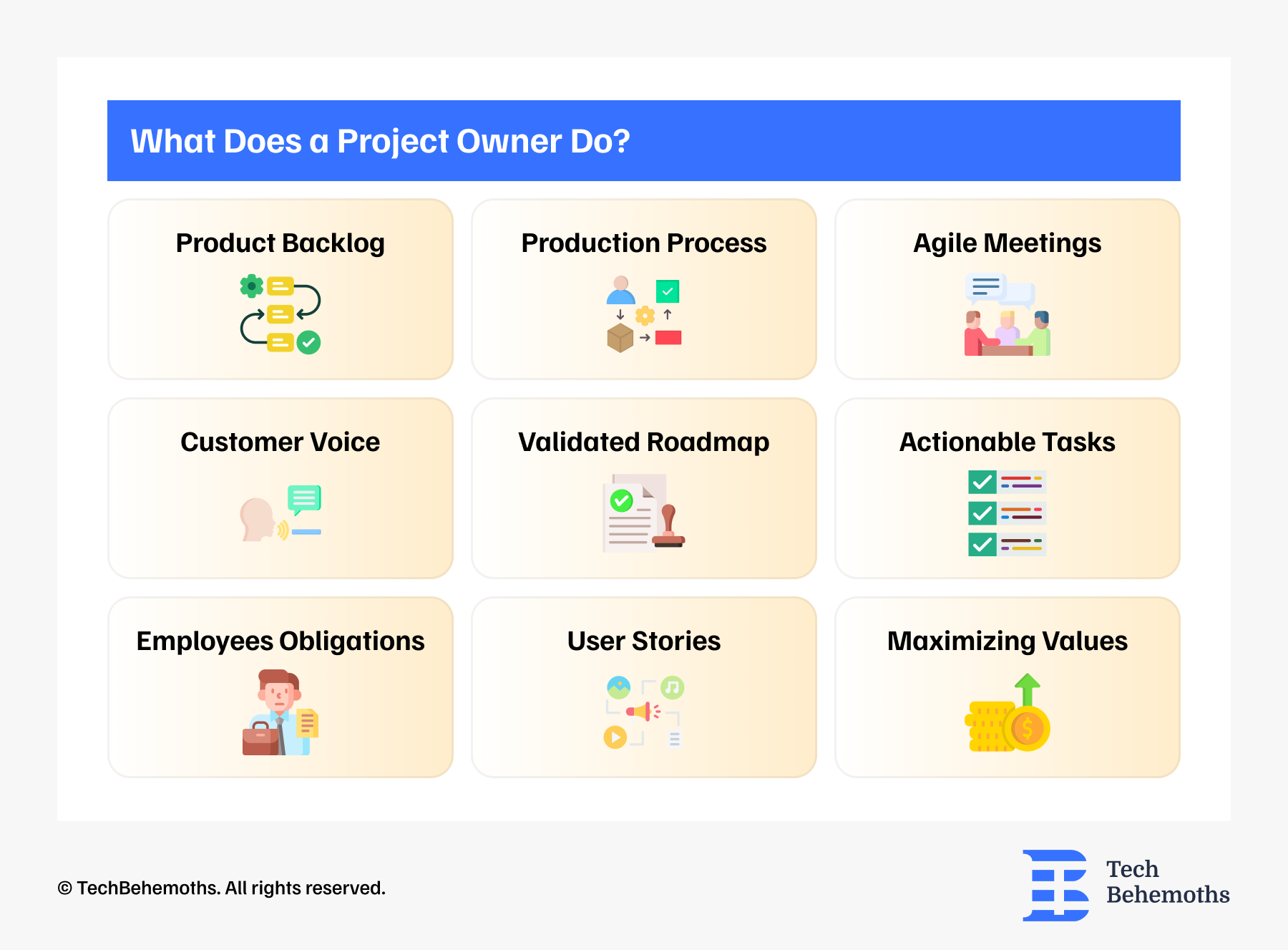
- Analyzing customers to understand their needs and preferences.
- Engaging with stakeholders, gathering data from various sources to improve user stories in the backlog.
- Educating all team members about client and consumer perspectives
- Managing the product backlog, helping the team focus on priority items
- Observing the development stages and overseeing the creation of the product, which includes planning, fine-tuning, reviewing, and sprinting
- Represents the development team’s interests to the client
- Handling daily operations and obligations to keep deliveries smooth.
Product owners concentrate more narrowly on small-scale activities. They may oversee the manufacturing team in creating a backlog, collaborate with warehouses, and work with designers to assist in developing mock-ups or prototypes.
The PO is the main contact in the organization. They keep all departments updated on the product backlog, ensure that a user advocate is present at development meetings, and manage the product roadmap to maximize value.
A Product Owner can be anyone who combines clear communication, analytical thinking, and a drive to turn ideas into real, valuable outcomes.
Now that we’ve clarified the main responsibilities of each role and how they contribute to the product’s success, the next step is to understand the skills required to perform these roles effectively.
Product Manager vs Product Owner: Strategic vs Execution-focused Skills
| Product Manager (Strategic) | Product Owner (Execution-focused) |
|---|---|
|
Strategic vision Market & customer insight Leadership & alignment Product-level prioritization Communication of vision Analytical skills (strategic) User empathy High-level decision-making Stakeholder-level conflict navigation Continuous learning (market-focused) |
Task translation Backlog refinement Team collaboration Sprint-level prioritization Communication of requirements Analytical skills (tactical) User story detailing Day-to-day decision-making Team-level conflict resolution Continuous learning (execution-focused) |
Product Manager Skills
A product manager should have strategic thinking and analytical skills as they must understand their market position, analyze data, make informed decisions based on that analysis, focus on goals, and identify opportunities, which can help plan and build tactics.
They need leadership skills to inspire and motivate others in the team to work together towards common objectives. PM should manage time effectively so that a product can be delivered within the allotted time frame.
As a product manager, it is important to understand and appreciate the thoughts and feelings of others, to have strong communication skills.
Product Owner Skills
For a product owner, cooperation skills are essential, as they often engage in involvement, delegation, and ongoing interaction with people who have diverse temperaments and emotions. A product owner should feel comfortable collaborating with designers and developers to create an effective design environment.
Additionally, the ability to resolve conflicts is crucial for a product owner. This can involve using established techniques or developing new strategies. Decision-making is another fundamental skill, as product owners make numerous choices each day that affect both the product and the team.
Last but not least, a willingness and ability to learn continuously is important for adapting and improving.
With these skills in mind, the distinction between the two roles becomes much clearer. Each role contributes to the product’s success in a different way, which brings us to the core differences between a Product Manager and a Product Owner.
What is the Difference Between a Product Manager and a Product Owner?
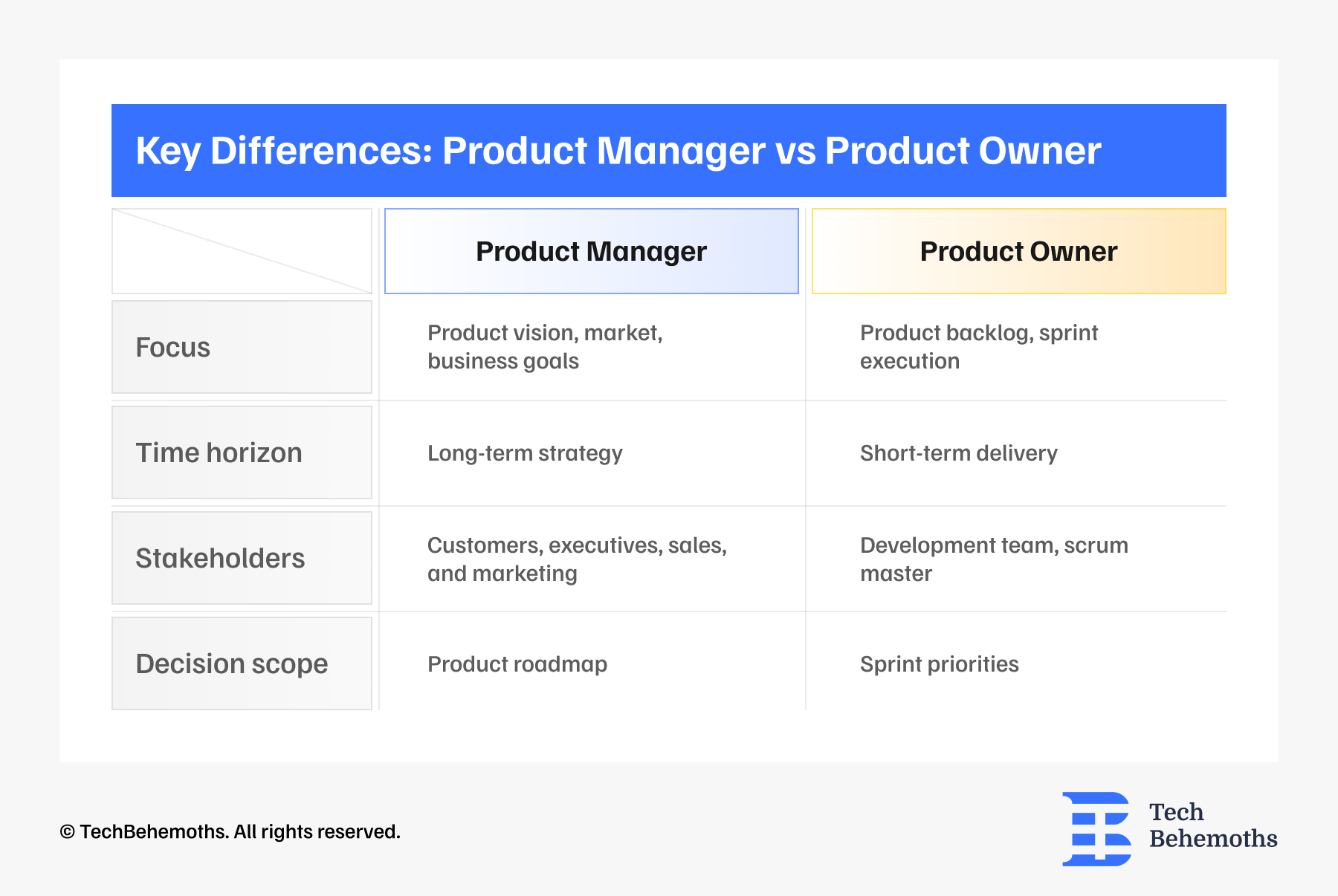
A product manager has a greater strategic role, defining and mapping the product management process across the product lifecycle. They focus on the "why, "what," and "when" of the product, from early ideation, customer research, and concept through to launch and market delivery
The product owner takes on a more proactive role, translating the product vision into actionable user stories. They focus on the "how" and "doing" part of product delivery, ensuring that the product built meets quality standards, timelines, and customer expectations.
Product Owner: Execution, focuses on how to deliver it within the team.
Can a Product Manager also be a Product Owner — and vice versa?
A Product Manager can indeed serve as a Product Owner and vice versa, especially in small or mid-sized companies where the structure is more streamlined. However, in larger organizations, the distinction becomes essential to maintain clarity between strategic direction and tactical execution.
While the titles may appear interchangeable, they represent different mindsets. A Product Owner is focused on maximizing product value, whereas a Project Manager is responsible for ensuring timely delivery, managing budgets, and overseeing resource allocation.
Despite these differences, both roles share a common objective: understanding clients' needs and translating them into technological requirements.
What Are the Risks When One Person Acts as Both Product Manager and Product Owner?
Combining the roles of Product Manager and Product Owner can simplify communication and speed up decision-making. However, it also brings several risks associated with:
- Conflicting Priorities — they might prioritize urgent tasks over long-term goals. This can lead to quick decisions that lack direction.
- Cognitive Overload — managing stakeholders, conducting user research, organizing the backlog, and planning sprints can overwhelm even experienced professionals and cause burnout, missed details, and delays.
- Lack of Checks and Balances — if only one person sets the vision and implements it, there is no one to provide feedback. Without a second opinion, important choices can go unchallenged, increasing the risk of bias.
- Reduced Team Clarity — with one person handling both roles, team members may be unclear about whom to consult for different issues.
When does it work?
Combining these roles can work well when the company is in an early stage (startup or MVP phase) and needs rapid alignment between vision and execution.
The product scope is narrow, allowing a single person to handle both strategic and delivery responsibilities without overload.
The team is small and cross-functional, allowing for direct communication and fast feedback loops.
Product Owner vs. Product Manager: Who Earns More?
In terms of salary, product managers typically earn more than product owners in most organizations.
According to Indeed Salaries, product owners in the United States earn an average of $114,796 per year, plus around $7,500 in annual cash bonuses. Product managers, on the other hand, earn a higher average base salary of $121,164 per year, with a slightly lower yearly bonus of about $5,000.
In Germany, product owners typically earn between €67K and €89K per year in base salary, plus an additional €5K–€10K annually in bonuses or extra pay. Product managers earn €68K–€87K annually, plus €5K–€12K in extra yearly compensation, according to Glassdoor.
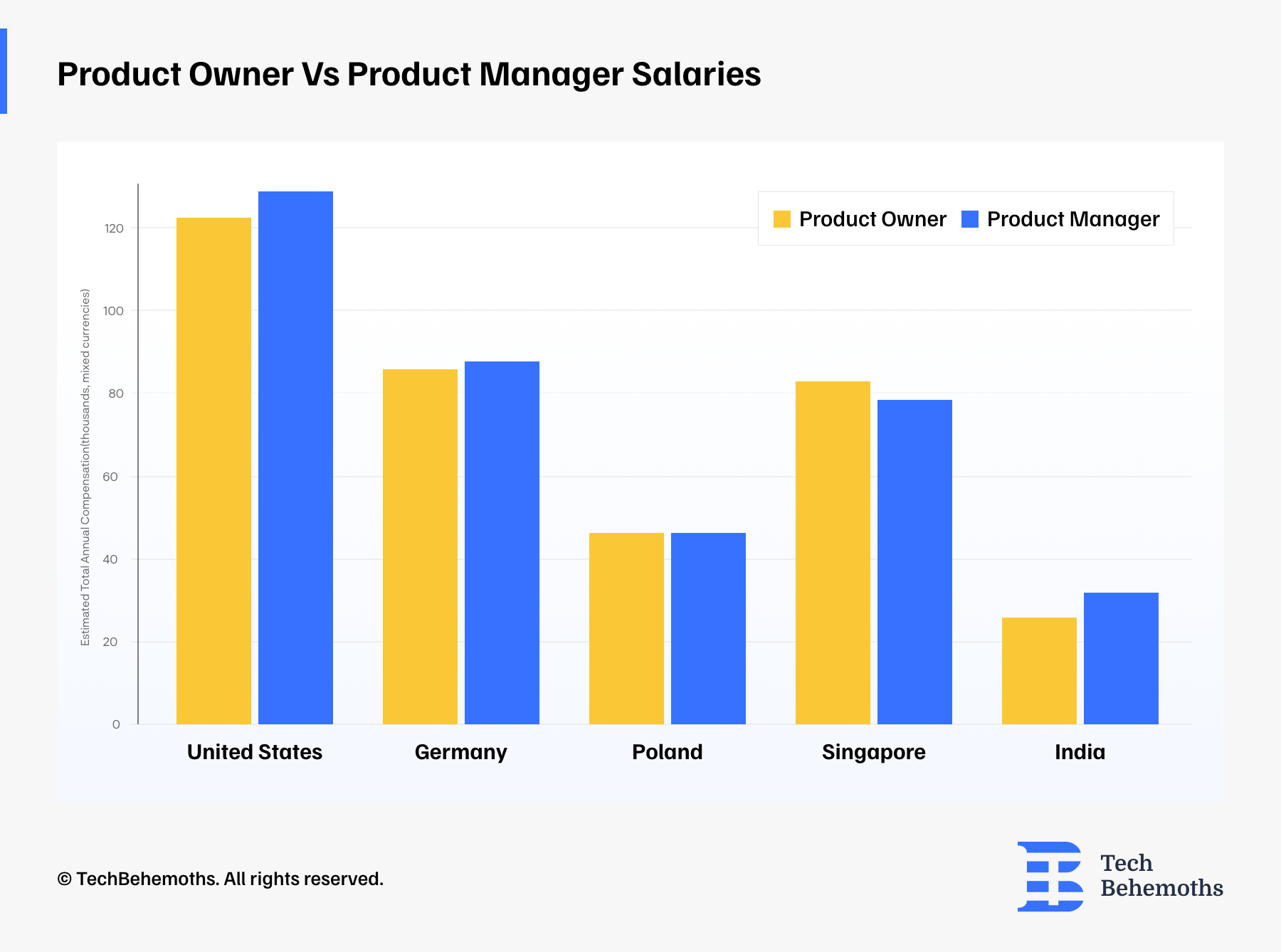
In Poland, both product owners and product managers earn €30,360–€55,660 per year, with a median annual pay of about €45,540, which includes €27,720–€50,400 in base salary and €2,300–€5,520 in additional yearly compensation.
In Singapore, product managers earn €47,880–€87,780 per year, with an additional pay of €5,640–€15,960 per year, while product owners earn €47,880–€95,760 per year with an additional pay of €3,960–€15,960 per year.
In India, product owners earn €14,300–€30,800 per year, and €1,100–€3,300 in additional pay annually, while product managers earn €18,700–€38,500 per year, with €2,200–€4,400 in yearly additional compensation.
However, salaries can vary greatly depending on industry, company size, location, and experience. In startups or small companies, both roles may be compensated similarly, while in large technology organizations, an experienced product manager could earn an average of 15-30% more.
Conclusion
In reality, the distinction between Product Manager and Product Owner isn’t about titles; it’s about what the business needs. Companies should begin by clarifying the product outcomes they want to achieve: Do they require long-term strategic vision, or do they need stronger execution and backlog ownership?
In smaller organizations, one person can successfully handle both roles. But as products grow and complexity increases, separating the positions brings clearer focus, better accountability, and a smoother flow between strategy and delivery. Ultimately, the question isn’t who holds which title, but how well the product functions to support business value.
Related Questions & Answers
Who is higher, Product Owner or Product Manager?
Does a Product Owner report to a Product Manager?
What does career growth look like for Product Owners compared to Product Managers?
What certifications can help accelerate the career growth of Product Managers and Product Owners?
I absolutely love embracing new opportunities and connecting with people. Every project is a chance to analyze, create, and work until I am satisfied with the results. Bringing creativity into every aspect of my work offers a fresh perspective on turning ideas into reality. Paying attention to the details is key because it's the little things that truly make all the difference.
Discover more TechBehemoths Insights
Learn practical tips and insights about IT Companies, how to find the right company for your projects.
Read the latest news about Market Trends and fresh Interviews.