How Structured Technical Interviews Improve Team Performance: A Real Example


Summary
Structured technical interviews, where each candidate faces the same job-focused questions with clear scoring criteria, can boost team performance by improving hiring quality. Research indicates that structured interviews are about twice as predictive of success in the workplace as unstructured conversations.
This essay illustrates the importance of structure, its practical application, and insights relevant to engineering leaders.
Why Structured Technical Interviews Matter
Structured technical interviews matter because they create a fair and reliable way to evaluate candidates. In my experience at Mobilunity, moving from ad hoc interviews to a consistent, data-driven interview process has led to measurably stronger engineering teams and better retention of our new hires.
Such hires mean every developer candidate answers identical technical and behavioral questions. The U.S. Office of Personnel Management notes that adding structure (same questions, same order, same evaluation) “increases interviewers’ agreement” and yields higher validity and reliability. In other words, we reduce randomness - one interviewer’s opinion doesn’t overly sway the outcome - and select candidates who actually have the skills we need.
What “Structured” Actually Means in Practice
At Mobilunity, we transitioned from flexible, interviewer-led technical conversations to a structured interview framework across engineering roles. The goal was not bureaucracy, but clarity. We have a structured technical interview with a rigid script, that means the system with four essential components:
-
Defined competencies aligned with real job requirements
-
Standardized questions mapped to those competencies
-
Anchored scoring rubrics describing what “good” looks like
-
Evidence-based debriefs focused on data, not impressions
Each interviewer assesses the same signals, making results comparable across candidates and interviewers.
“If an interview cannot be scored consistently, it cannot be trusted as a hiring signal. Structure turns interviews from subjective conversations into measurable predictors of real job performance.”
— Yulia Borysenko, Staff Services Director, Mobilunity
Diagram: Structured Interview Process
.png)
A Real Example from Mobilunity
In our technical interviews at Mobilunity, we often include real-world coding tasks (sometimes as live coding or take-home projects) and then review solutions with candidates. This is similar to a pair-programming interview, where a candidate codes alongside an interviewer. It not only tests technical skill but also how developers communicate and reason. Research and industry experience suggest that task-based assessments like coding exercises better approximate job performance than abstract puzzles or brainteasers. (Indeed, Google famously found brainteasers “don’t predict anything” about on-the-job success.) After GitLab adding identical coding problems and a scoring rubric to all interviews allowed managers to know candidates’ baseline skills in advance. We saw the same effect: using a unified coding exercise gave our engineering leads confidence that each hire met the bar.
Structured interviews at Mobilunity also include behavioral and situational questions. For example, we might ask every candidate: “Describe how you handled a conflict in a previous team project.” Each answer is scored against a benchmark (e.g. problem identification, solution implemented, result). This aligns with federal HR research showing that competency-based questions, when scored with proficiency benchmarks, significantly boost validity.
One benefit is consistency across panels: whether candidate A talks to Senior Dev X or Dev Y, they will be asked the same questions and evaluated similarly. This consistency “cuts through the noise,” as one HR blog puts it, by focusing on work-relevant answers and not on irrelevant chatter. Our colleagues have noticed this fairness. Svitlana Skalova, Recruitment Team Lead at Mobilunity, often says that when every interview uses the same rubric, hiring decisions rely on evidence instead of gut feel. In fact, using multiple calibrated interviewers and a rubric has been linked to more objective selection and even faster hiring decisions. At Mobilunity, involving two or more engineers per interview and pooling their standardized scores helps catch any outlier ratings, ensuring we make balanced decisions.
In summary, the structured approach has made a clear difference. By standardizing every step - from question design to scoring - we increased the reliability of hiring decisions. This has led to smoother onboarding (new team members have clearer expectations) and better team chemistry. When developers join with the right skills and mindset, the whole team delivers more efficiently.

Step 1: Defining the Bar
We started by clearly defining what success looked like for each role. For example, a mid-level backend developer role included competencies such as:
-
Problem decomposition
-
Code readability and maintainability
-
Debugging approach
-
Collaboration and communication
These competencies became the backbone of the interview process.
Step 2: Standardizing Technical Assessments
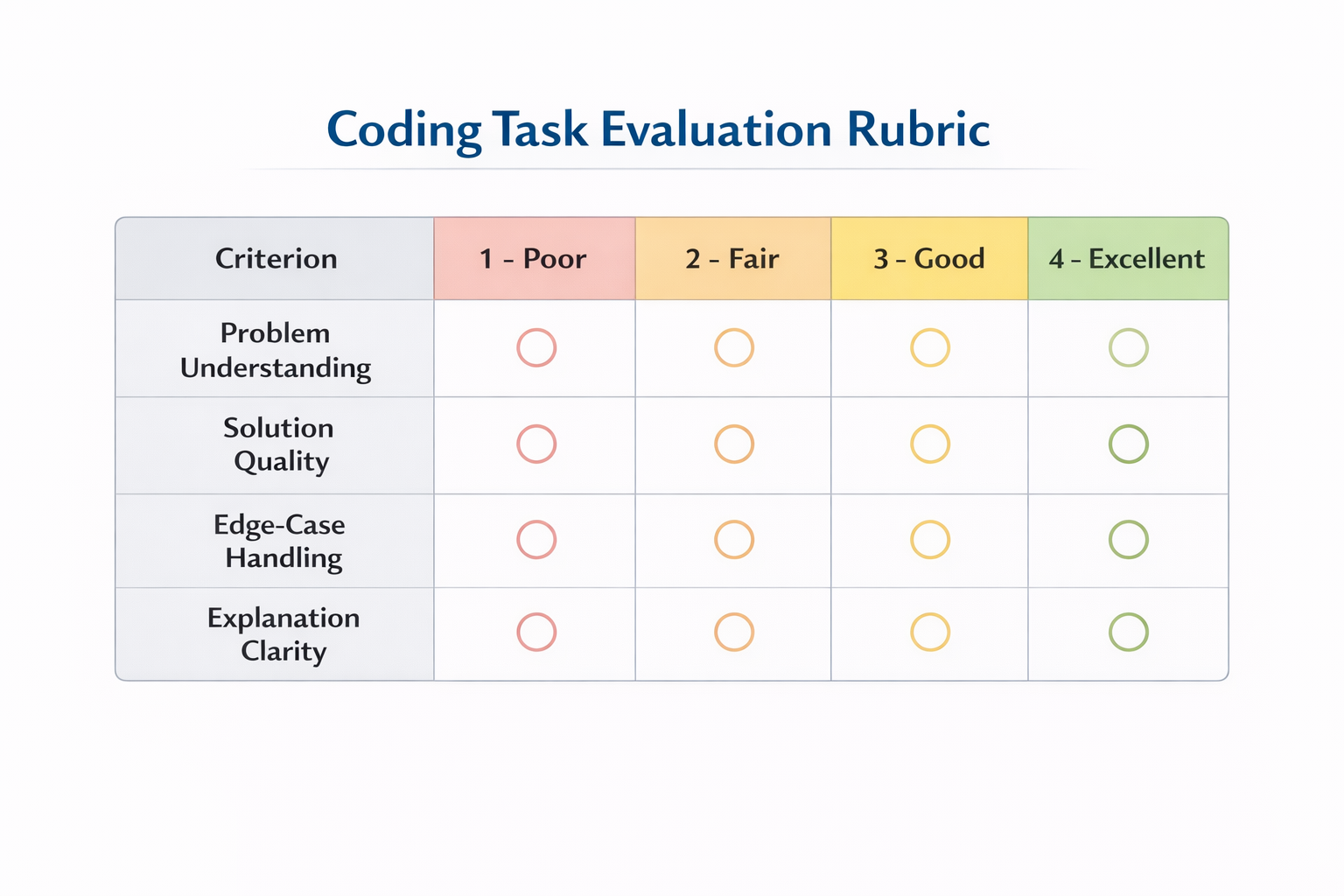
We introduced a single coding exercise per role level. Candidates could complete it live or as a short take-home assignment, followed by a structured review discussion. Every solution was evaluated using the same rubric, covering correctness, structure, and reasoning.
This removed ambiguity. Engineering leads no longer debated whether a task was “hard enough” or whether one candidate was tested more rigorously than another.
Coding Assignment Evaluation Criteria
Step 3: Behavioral Consistency
Technical skills alone do not drive team performance. We added structured behavioral questions tied to real scenarios, such as handling production issues or resolving disagreements during code reviews. Each response was scored against predefined indicators rather than personal impressions.
Step 4: Structured Debriefs
After interviews, interviewers scored candidates independently before discussing results. Debriefs focused on evidence: specific answers, decisions made during coding, and observable behaviors. This prevented early opinions from influencing others and led to more balanced decisions.
Practical Takeaways for Engineering Leaders
“Always align each question with the role’s core competencies and use a clear scoring rubric. This builds a fair process that truly measures the skills your team needs.”
— Yulia Borysenko, Staff Services Director, Mobilunity
Structured technical interviews can greatly improve the hiring process by enhancing the level of detail and objectivity. To begin, it is important to outline the essential competencies and ask identical role-specific questions to each applicant. Following this, assessing responses using precise scoring standards is crucial in making informed recruiting decisions. Research and practical experience have shown that this approach not only improves recruiting choices but also reduces bias and ultimately enhances team performance.
Teams that have implemented structured technical interviews have quickly noticed significant improvements. For example, an engineering manager at GitLab expressed increased confidence in evaluating candidates after adopting a consistent interview approach. Similar positive effects have been observed at Mobilunity, where the use of a more organized, data-driven methodology has led to the development of stronger and more effective engineering teams.
For companies scaling distributed or dedicated development teams, structured interviews aren’t a “nice to have.” They’re a proven way to hire better and move faster.
Conclusion
Structured technical interviews are not about limiting flexibility or turning hiring into a mechanical process. Instead, they are about making better, fairer decisions based on evidence rather than intuition. When interview questions, evaluations, and debriefs are aligned with real job requirements, teams gain clarity, consistency, and confidence in their hiring choices.
Our experience demonstrates that a well-designed interview structure directly contributes to stronger onboarding, improved collaboration, and higher long-term team performance. For engineering leaders navigating growth, distributed teams, or competitive hiring markets, investing in structured technical interviews is a practical step toward building reliable, high-performing development teams.
Related Questions & Answers
Are structured interviews too rigid for senior engineers?
Do structured interviews slow down hiring?
Can structured interviews reduce hiring bias?
How many interviewers should be involved?
Are coding tasks always necessary?
Mobilunity’s Staff Services Director, Yulia Borysenko, with over a decade of IT HR leadership, offers data-driven strategies for keeping dedicated development teams engaged, productive, and loyal.
Discover more TechBehemoths Insights
Learn practical tips and insights about IT Companies, how to find the right company for your projects.
Read the latest news about Market Trends and fresh Interviews.