Is Innovation Critical in a Tech Startup?


Summary
- More than 80% of established companies say that innovation is a foundation pillar for their success.
- Studies show that companies that focus on innovation report up to 30% higher revenue growth than those that do not.
- Slack reduces meetings by 27% and improves productivity by 38% through smooth workflows.
- There are two main types of innovation: sustaining and disruptive.
- Market changes directly drive the demand for innovation by creating unmet needs, altering consumer preferences, and intensifying competition.
- Advanced Financial Planning and Analysis (FP&A) tools, alongside forecasting software and business reports, help firms encourage trust within a new startup.
Innovation is the process of turning creative, new ideas into valuable, practical, and implemented solutions, such as improved products, services, processes, or business models. Innovations are based on new technological developments, combinations of technologies, or other forms of knowledge.
Over 80% of established companies cite it as a fundamental strength. Innovative startups experience higher survival rates, better financial performance, and 65% of fast-growing companies boost growth by collaborating with customers on new products.
For a new tech startup, innovation is crucial because it will define its growth trajectory. Other important factors include securing a competitive advantage, enabling them to differentiate their products, and attracting both customers and investors. This article discusses why innovation is crucial for both new and established tech startups.
Why is Innovation a Key Factor for Successful Startups?
Innovations for a business are not only a way to stay competitive but also to unlock all the advantages a startup has, and they are the following:
- Increased revenue
Innovation can be a driver of revenue growth through new products, smarter services, and AI-driven upselling. Studies show that companies that focus on innovation report up to 30% higher revenue growth than those that do not.
- Possibility to be a trendsetter
New technologies enable organizations to set trends by defining new market categories and reshaping clients' expectations. Rather than following market trends, firms that set new categories are the ones that people remember. For example, everyone recognizes Apple’s iPhone, but few know about the first smartphone, IBM’s Simon, introduced in 1994.
- Improved work operations
Operational processes can also benefit from new inventions, leading to increased efficiency, lower costs, streamlined processes, and higher productivity. AI is used to automate various operations, saving time and fostering better collaboration. Apps like Slack automate routine tasks, centralize communication, and integrate with thousands of tools. Slack also replaces fragmented emails with organized channels, reduces meetings by 27%, and improves productivity by 38% through smooth workflows.
- Attractive for top talent
The digital world relies on new technologies and advancements, and top tech experts recognize this, which is why they prefer companies with modern tools and technologies. Tech talent is also attracted to a dynamic environment where professionals can engage with challenging, cutting-edge tools while continuously learning. They look for firms that offer professional growth, autonomy, and the ability to participate in impactful projects.
Different Types of Innovation
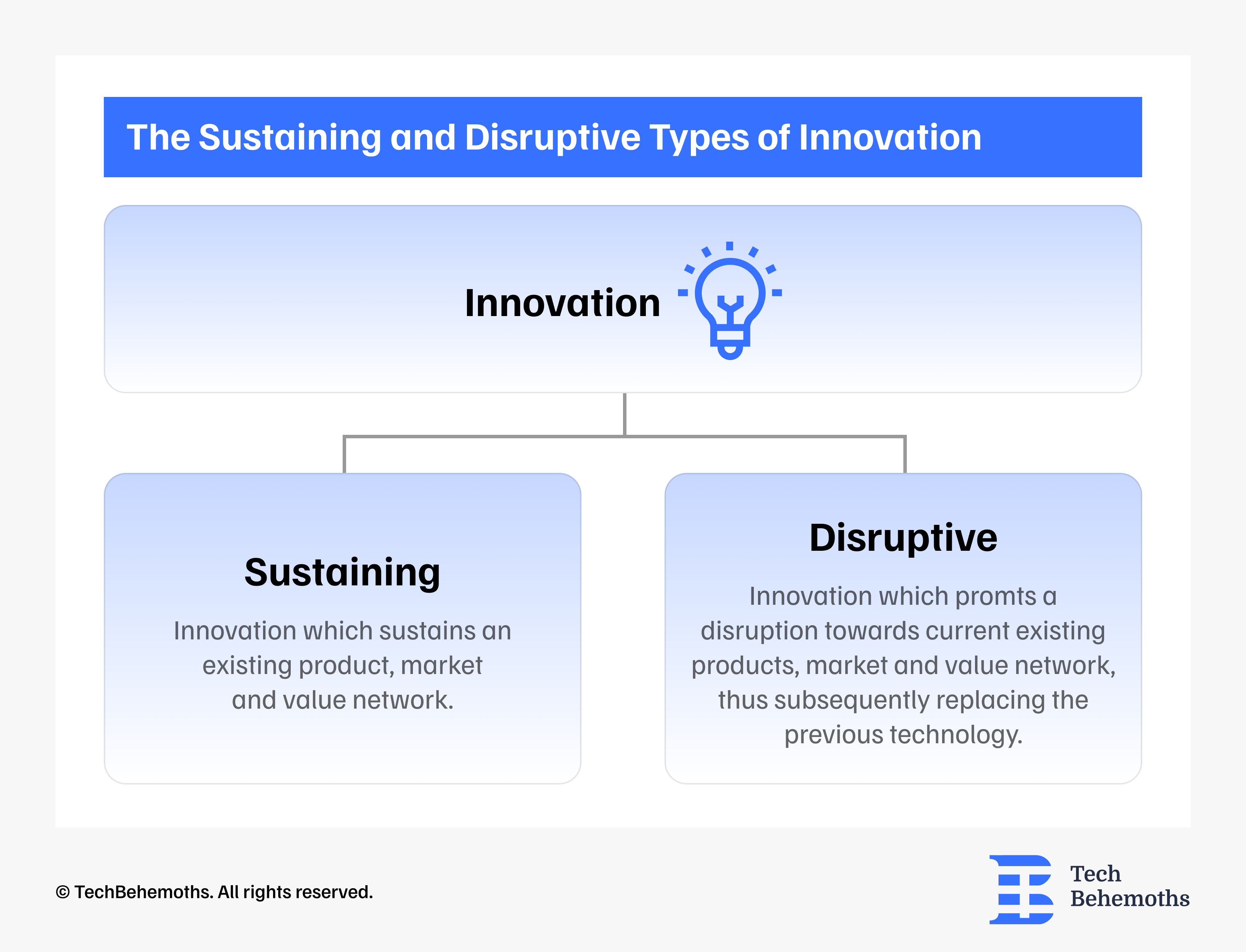
There are two main types of innovation, ranging from small, gradual change to AI-driven transformation. This spectrum ranges from steady improvements to industry breakthroughs. For businesses, it is important to understand these categories to make investment strategies.
Sustaining innovation: This innovation is about upgrading what already works, for example, how Apple is elevating its new phones every year. AI-driven analytics optimizes these iterations, such as recommendation algorithms that keep users engaged by constantly offering new upgrades.
Sustaining innovation is often used for:
- Incremental improvements
- Better performance for existing customers
Disruptive innovation: This is another possibility for businesses, as it introduces simpler, cheaper, or entirely new solutions that shock markets. Generative AI tools enable individuals to innovate and create without relying on large corporations.
Disruptive innovations are leveraged for:
- Simpler or cheaper solutions
- Initially targeting overlooked segments
What Drives the Need for Innovation in Startups?
After learning what innovation is and why it is crucial for various tech organisations, it is now time to identify the factors that drive it.
- Constant market changes
Businesses that fail to adopt innovations risk becoming outdated. Innovation helps startups adapt seamlessly to market changes, including shifts in market choices, economic conditions, and emerging technologies.
- Competitive advantage
In an increasingly competitive market, innovation helps companies become leaders. Customers are more likely to be attracted to firms that offer unique products or services; as a result, firms can build a loyal customer base and strengthen their market position.
- Cost efficiency
Innovations can help a company develop new processes that streamline operations, improve profitability, and reduce costs. Automating repetitive tasks and finding more efficient ways are examples of how innovation can improve a startup.
- Increased customer satisfaction and loyalty
Startups that keep up with innovations can better anticipate customers' needs and provide solutions that meet their requirements. By continuously evolving, firms can offer products and services that address customers' ever-changing needs, increasing customer loyalty.
How Can Market Changes Influence the Demand for Innovation?
Market changes directly drive demand for innovation by creating unmet needs, altering consumer preferences, and intensifying competition, forcing firms to adopt new technologies or business models to survive.
To survive these changes through innovation is a performative strategy for tech startups. Investing in R&D to explore new services and business models fosters innovation and encourages a culture of creativity and experimentation within a company.
Market research is an important process for analyzing dynamic changes, identifying new trends, and understanding consumer behaviour. Methods to stay informed about market changes include surveys, social listening, and analytics tools.
How Can Startups Foster Innovation?
Innovation is the primary driver of survival, growth, and competitiveness in a rapidly changing market. Without continuous innovation, startups risk becoming outdated as established companies and other startups quickly adopt new technologies. To maintain a competitive edge, new startups must follow some methods represented in the table below:
| Strategy | Explanation |
|---|---|
| Identify customer needs at an early stage | Understanding clients’ issues is important for effective solutions brought by innovation. One example is combining human intelligence with machine learning to provide comprehensive decision support. |
| Create continuous and effective feedback | By establishing systematic methods for collecting user and team input, startups can create a powerful mechanism for continuous improvement. |
| Leverage strategic partnerships | A collaborative network can transform a struggling startup into a major company. An Entrepreneurship Ecosystem means that interconnected networks are fundamental to driving breakthrough innovations. |
| Promote an environment of experimentation | Innovation often comes from experimenting and learning from failure. A culture of experimentation is a systematic approach to discovery in which every attempt yields valuable insights. |
| Support diverse perspectives | Variety in the startup environment can bring diverse perspectives, which are critical to generating innovative ideas. Creativity can be fostered by encouraging the participation of people with diverse backgrounds and skills. |
| Encourage rapid learning | It is important to let employees try new ideas without fear of negative repercussions, creating an environment where ideas can be refined as they develop. |
| Inspire original thinking | There are multiple methods startups can use to increase creativity, including brainstorming, design thinking, provoking challenging questions, creating spaces for reflection, and fostering a work ecosystem that inspires creativity. |
Attracting Investments and Increasing Trust With Investors
Investors are more likely to fund startups that demonstrate a clear innovation strategy, strong product differentiation, and measurable traction. Startups can attract investors by clearly showing that they solve an important problem. They should support their idea with real data, such as user growth or revenue, and demonstrate that people are already interested in their products. Having an experienced team also helps build confidence and trust with investors.
To build a strong relationship with investors, it is essential to adopt a transparent, trust-based approach. Understanding how the company’s priorities align with market perceptions is also critical to this aspect. Strategies to start establishing this type of relationship include:
- Cold emailing
- Track engagement
- Communicate transparently
- Analyse feedback from investors
- Personalize follow-ups using engagement information
Advanced Financial Planning and Analysis (FP&A) tools, along with forecasting software and business reports, help firms build trust. Firms that adopt FP&A are shifting toward greater automation to improve accuracy, attract investors, and enhance the company’s reliability.
Companies That Become Successful Through Innovation
Many of today’s most successful companies began as small startups that prioritized innovation from the outset. By introducing new ideas and technologies, these startups challenged the tech industry and became global leaders.

What innovation did Google introduce?
Google started as a Stanford project in 1995 as a search engine and has continuously introduced new features. It introduced the PageRank algorithm that revolutionized how information was indexed and ranked on the internet, based on links rather than keyword matching. This algorithm offered more accurate results and quickly made Google the dominant search engine. Another innovative product from Google is AdWords(now Google Ads), a pay-per-click system that ranks ads based on relevance to the search query. It made advertising effective for businesses and unintrusive for users.
Impact
These innovations helped Google become one of the most recognized and widely used browsers in the world, reshaping information organization and setting tech trends.
Netflix

What innovation did Netflix introduce?
Netflix started as a DVD-by-mail service and later transitioned to video streaming in 2007. What sets this company apart from its competitors is its personalized recommendation system, which helps users find movies from its large catalog. This algorithm analyzes viewer behaviour and preferences to recommend relevant titles. The original content production began in 2013 through investments in high-quality, exclusive content, reducing reliance on licensing and building a strong brand identity.
Impact
By introducing these innovations, Netflix has become one of the most popular streaming platforms, with over 260 million paying subscribers worldwide.
YouTube

What innovation did YouTube introduce?
YouTube was founded in 2005 by former PayPal employees. Its goal was to enable friends to easily share videos, and it has become one of the most-visited websites globally. One innovation YouTube introduced was browser-based streaming without downloads. Early competitors required users to download video files, whereas YouTube used Adobe Flash, allowing users to play videos directly in web browsers. Another feature of this firm is the YouTube Partner Program, which allows creators to monetize their content through advertising, splitting revenue 50/50.
Impact
YouTube, thanks to technological advancements, has become one of the most widely used platforms due to its seamless experience. It also enabled creators to pursue their hobbies as full-time careers.
How Can TechBehemoths Help Find the Best Innovation Strategy?
One way startups can accelerate innovation is by collaborating with specialized technology partners. Platforms like TechBehemoths help founders discover experienced agencies. This platform features multiple companies offering a range of services, including UX/UI Design, AI, Web and Software Development, and more. By comparing portfolios, expertise, and client feedback, startups can identify the right partner to support their innovation roadmap.
On TechBehemoths, you can find thousands of companies offering a wide range of solutions to enhance your ecosystem's scalability, security, and transparency. Explore their profiles and feel free to contact them.
Final Thoughts
Most startups fail not because they lack funding, but because they fail to innovate fast enough. A good strategy for ensuring success in the early stages is to create a culture that fosters innovation and attracts not only clients but also top tech talent. Partnerships with other organisations are another way to foster innovation, leading to increased efficiency and progress.
Related Questions & Answers
How Can Founders Measure Whether Their Innovation Efforts Are Truly Creating Value?
What Are the Risks of Innovating Too Fast, or Not Fast Enough?
How Can Startups Identify Emerging Trends Before Competitors Do?
What Signals Indicate That a Market is Ready for Disruptive Innovation?
What Metrics Best Track Innovation Performance Inside a Startup?
I am an enthusiastic Biomedical Engineering Researcher and love learning about various domains. One of the biggest treasures that we, people, have is knowledge because it's hard to achieve and it depends only on human will. And it can be shared with others, that's why I like to find something new and share it with the world.
Discover more TechBehemoths Insights
Learn practical tips and insights about IT Companies, how to find the right company for your projects.
Read the latest news about Market Trends and fresh Interviews.