Cloud Migration vs. Application Modernization: What Your Business Needs


Summary
- Cloud migration and application modernization are two distinct strategies that enterprises consistently confuse - and the cost of that confusion is real.
- Cloud migration is about where your applications run. Application modernization is about how well they are built.
- Choosing the wrong approach leads to higher cloud bills, slower delivery, and transformation projects that never pay off. Learn the key differences, the signals that indicate which strategy your business actually needs, and the most common failure patterns to avoid.
Cloud transformation has stopped being a neat, one‑off IT project and turned into a permanent, messy background process for most enterprises. Leadership teams sign multi‑year cloud commitments, yet still struggle with slow delivery, brittle legacy systems, and rising infrastructure bills, and the louder the pressure gets, the more “cloud migration” and “application modernization” start sounding like the same thing. In that noise, it becomes dangerously easy to pick the wrong playbook and only discover it after the budget is spent and the data center is already decommissioned.
This article explains the real difference between moving workloads to the cloud versus rebuilding how applications are designed and delivered, and how to tell which one your business actually needs right now. It also lays out practical signals, examples, and failure patterns so you can avoid a costly, trend-driven transformation that never quite pays off.
The 2026 Cloud Market: Modernization Over Migration
Most large enterprises have already been through at least one wave of cloud migrations. Plenty of them are now sitting with the aftermath: bloated AWS or Azure bills, monolithic applications that relocated to new servers without a single line of code changing, and engineering teams unsure what to do next.
The recognition that technical debt is a real financial liability (not just an inconvenience) keeps growing. Companies that take this seriously have moved away from generic lift-and-shift playbooks toward multi-stage strategies based on the actual state of a company's application portfolio. A more detailed look at application transformation approaches can be found here.
IDC forecasts global cloud spending to exceed $1 trillion by 2027, and the share of application modernization projects is growing faster than straight migration work.
A few technology shifts have changed the conversation itself. GitHub Copilot, Amazon CodeWhisperer, and Google Gemini Code Assist have made legacy code refactoring automatable at scale — that's a fundamental change in the economics of the whole exercise. FinOps platforms (Apptio Cloudability, VMware's CloudHealth) have become their own discipline, which is a pretty clear signal that migration without modernization often ends in billing chaos. And Spotify's Backstage, open-sourced in 2020, became the de facto standard for Internal Developer Platforms; Zalando, American Airlines, and Expedia all run on it now.
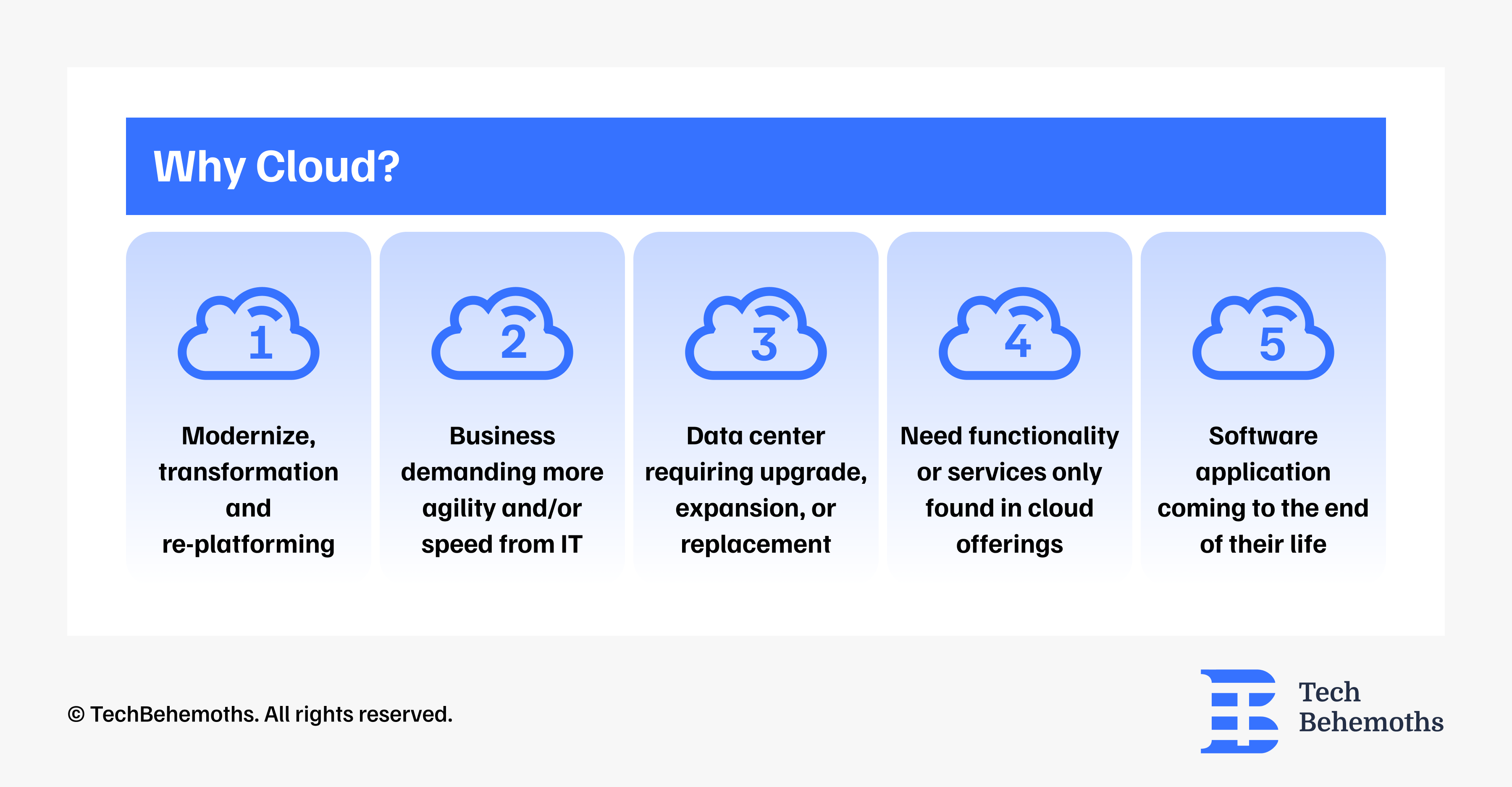
Two Strategies That Keep Getting Confused
1. Cloud Migration Is About "Where"
Cloud migration means moving existing applications and workloads to a cloud environment. AWS laid out a useful classification (the 6Rs) that covers the range of how that can actually happen:
-
Rehost (lift-and-shift): move everything as-is, no code changes. Fast, cheap, and almost no benefit from the cloud beyond not paying for your own hardware.
-
Replatform: small adjustments to get some cloud advantages: switching from a self-managed database to AWS RDS, for example.
-
Repurchase: swap out a custom-built app for SaaS. Salesforce instead of an in-house CRM, ServiceNow instead of a homegrown ITSM system.
-
Refactor/Re-architect: rebuild around cloud-native patterns: microservices, serverless, event-driven architecture. Most expensive up front, but the biggest payoff long-term.
-
Retire / Retain: shut down what's no longer needed, or leave alone what's not worth moving yet.
2. Application Modernization Is About "How"
Modernization is a broader concept and doesn't require a cloud move at all. It covers the shift from monolithic architecture to microservices, refactoring legacy code (COBOL, PL/I, Assembler, RPG) and replacing outdated databases, introducing DevSecOps and CI/CD pipelines, or migrating off mainframes entirely.
The core distinction: migration answers the question of where an application runs. Modernization answers how well it's built. An app can move to AWS and stay a terrible monolith. It can also get completely rearchitected and stay in a private data center.
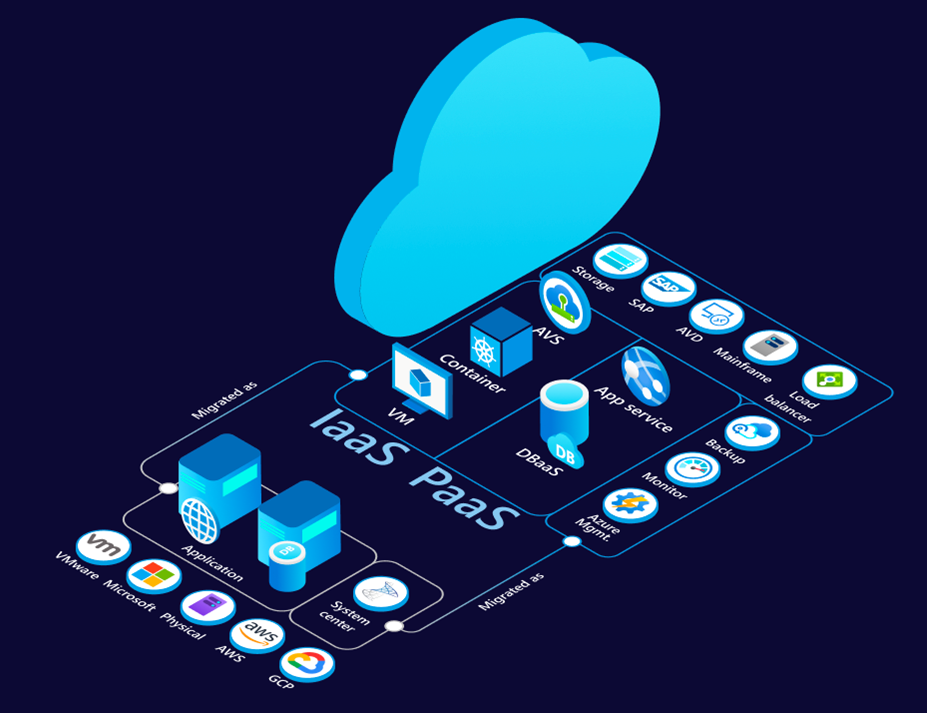
source: techcommunity.microsoft.com
Picking the Right One
Signs It's Time to Migrate
-
The data center lease or hardware support contract is running out
-
Servers are running at 20–30% capacity but still cost full price
-
The business needs regional presence without building new infrastructure
-
End-of-life deadlines are approaching - Windows Server 2012, SQL Server 2012
A concrete example: UK-based Talent worked with DXC to move its Oracle ERP to Oracle Cloud and the remaining applications to Microsoft Azure. Clean replatform, no major rewrites. The company got out of the server business without interrupting operations.
One myth worth clearing up right away: lift-and-shift isn't always a mistake. For banks, insurers, and government entities sitting on billions of lines of COBOL, a three-year refactoring program without a clear business case simply isn't on the table. Rehosting is a tactical move. The problem only shows up when it becomes the final destination rather than a stepping stone.
Signs Modernization Is the Real Need
-
Developers are afraid to touch certain parts of the codebase because "it somehow works"
-
Getting a new feature to production takes weeks or months
-
The system can't scale horizontally — the only option is bigger hardware
-
Competitors are shipping new products two or three times faster
-
Libraries and frameworks the system depends on are no longer maintained
Mainframe systems are a separate and more nuanced conversation. IBM's Z-series still processes more than 95% of the world's bank card transactions. That's not going away quietly. The American Airlines–DXC engagement shows what a measured approach looks like: API layers over legacy systems, new functionality built in the cloud, core business logic staying where it handles millions of transactions a day without incident.
DXC completed one of the most complex projects in the Spanish energy sector — moving 180 terabytes of data and more than 30 million lines of code off a legacy mainframe and onto Azure, without stopping operations.
Making the Call
The most common mistake technical teams make is starting with architecture instead of business questions. The first thing to ask is always: what business problem are we actually trying to solve?
"We're paying too much for hardware" or "the data center contract ends in December" - that's a migration conversation. "Engineering ships features once a quarter" or "we've had three major outages this year" - that's a modernization conversation.
Practical steps before committing either way:
-
Application portfolio audit. How many applications are there? Which are business-critical? Who actually understands them? A 360° assessment looks at each one across business value, technical health, and risk.
-
6R classification. Not every application needs the same treatment - some are fine with rehost, others genuinely need a full refactor.
-
Dependency mapping. Integrations, databases, APIs - all of it needs to be mapped before anything moves. An old Oracle database can have 200 applications talking to it, and not all of them are documented anywhere.
-
A business case with real numbers. X% cost reduction, release cycle down from Y weeks to Z days, SLA floor of 99.9%. Vague goals produce vague results.
-
Phased execution. Start with a pilot project on non-critical systems, then scale from there. The biggest failures in this space almost always come from attempting to transform everything in twelve months. Here are the recommended steps for migrating to the cloud:
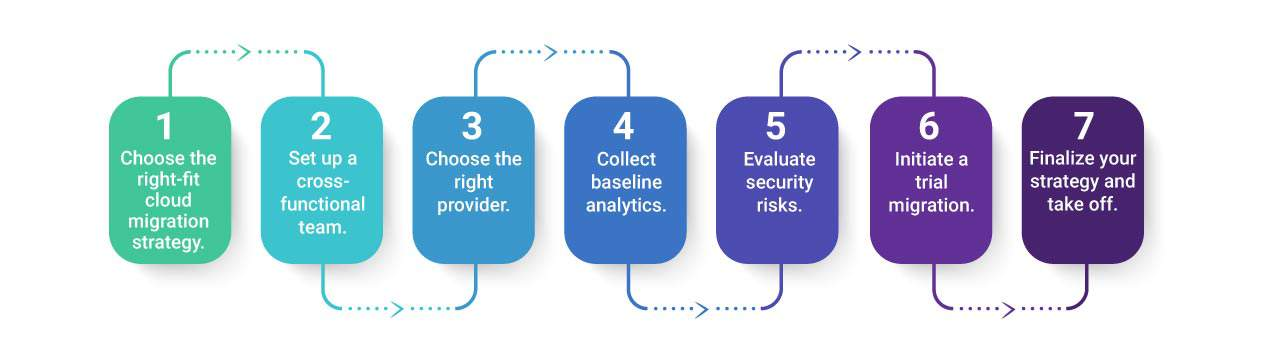
source: www.fingent.com
The Hybrid Path - and the Mistakes That Cost the Most
In practice, large organizations do both at the same time. Non-critical apps get rehosted and gradually replatformed. New products get built cloud-native from day one. Critical legacy systems go through incremental modernization - API layers first, module-by-module refactoring later. Mainframe code either gets integrated through APIs or converted in stages.
Skanska (the construction company behind London's 30 St Mary Axe ("the Gherkin"), the Øresund Bridge connecting Denmark and Sweden, and LaGuardia's Terminal B) signed an agreement in 2025 for exactly this kind of hybrid setup: managing Azure cloud and on-premises environments in parallel. Not "everything to the cloud." The right approach for each workload.
Mistakes that end up costing the most:
-
Lift-and-shift with no follow-through. Bills went up. Speed didn't change. Teams are frustrated.
-
Modernization as an end in itself. "We'll rewrite everything as microservices" without a business case results in years of development and unclear outcomes.
-
Underestimating the people side. The best architecture doesn't help if the team hasn't changed how it works. “DevOps is a culture shift, not just a toolchain.”
-
No observability. Moving to the cloud and not setting up Datadog or Dynatrace is flying blind.
-
No FinOps. Companies without cloud cost management processes routinely end up with bills several times over budget.
The numbers from real projects tell the story: 30% reduction in application costs through automation, up to 50% faster release cycles after adopting DevOps practices, more than $40 million saved over five years by US grocery chain Northeast Grocery after optimizing its mainframe infrastructure - without rewriting the codebase.
Final Thoughts: What Your Business Actually Needs
Migration or Modernization?
The question doesn't pit two approaches against each other. It forces a clearer conversation about what the actual goal is.
Getting off physical infrastructure and reducing operational costs - migration is the right first step. Slow delivery, unstable systems, and a codebase nobody wants to touch - that's a modernization problem. The worst decisions in this space get made under pressure from trends rather than from a clear-eyed look at the current situation. Cloud transformation isn't an event; it's a process. And that process rarely looks the same for any two companies.
Related Questions & Answers
Is cloud migration the same as application modernization?
Can I migrate first and modernize later?
How do I know if I need migration or modernization more urgently?
Is lift‑and‑shift always a bad idea?
What are the biggest mistakes companies make in cloud migration and modernization?
Anastasiia Pastukh is an IT professional with 10 years of experience, specializing in technical copywriting for the last five years. She focuses on how modern software tools and testing practices drive efficiency across specialized industries.
Discover more TechBehemoths Insights
Learn practical tips and insights about IT Companies, how to find the right company for your projects.
Read the latest news about Market Trends and fresh Interviews.