Does Your Business Need a Mobile App in 2026? Survey Insights


Summary
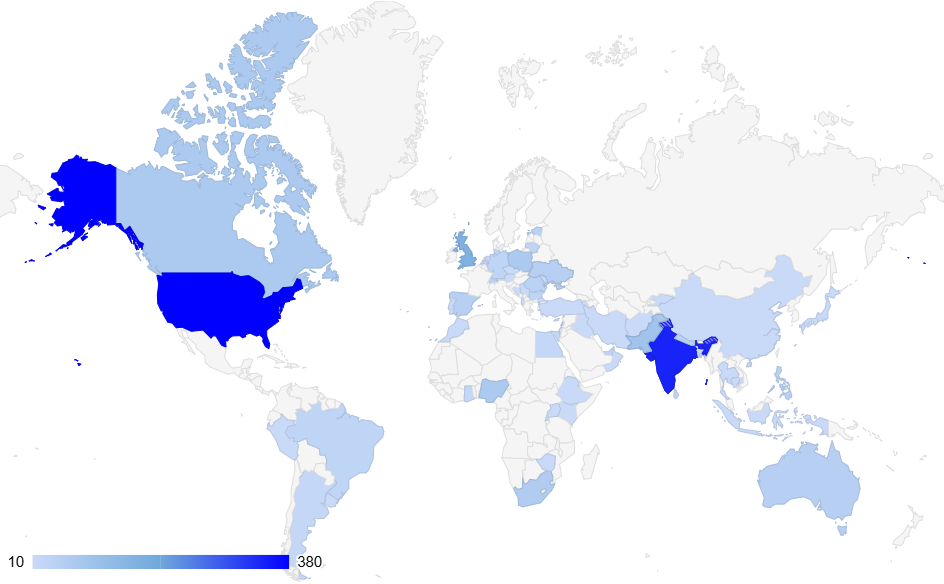
To understand how companies really think about mobile development in 2026, we surveyed IT firms across 96 countries.
The findings show that mobile apps are no longer a universal priority. Most companies either maintain web-only strategies or are still evaluating the need for one.
Among those that do invest in mobile, the primary goals are customer acquisition and revenue growth, with in-house teams and cross-platform frameworks being the preferred approach.
Budgets remain modest for most, and AI integration stands out as the defining trend shaping mobile strategies in the year ahead.
Before most people say good morning, they've already checked their phone. Data from data.ai shows that ordinary people check their smartphones around 50–100 times per day, responding to messages, notifications, emails, and social media updates. At the same time, global users spend around 4–5 hours daily on mobile devices, with most of that time taking place inside mobile apps.
This user behavior raises an important question for companies: if customers spend a large part of their day on mobile devices, should companies create dedicated mobile apps to reach them more effectively?
To better understand how companies approach this decision, we conducted a global survey of IT companies across 96 countries between February 24 and March 5, 2026. This research explores whether companies plan to build mobile apps in the coming years, what budgets they allocate, and what factors influence their strategy.
Survey Respondents’ Profile
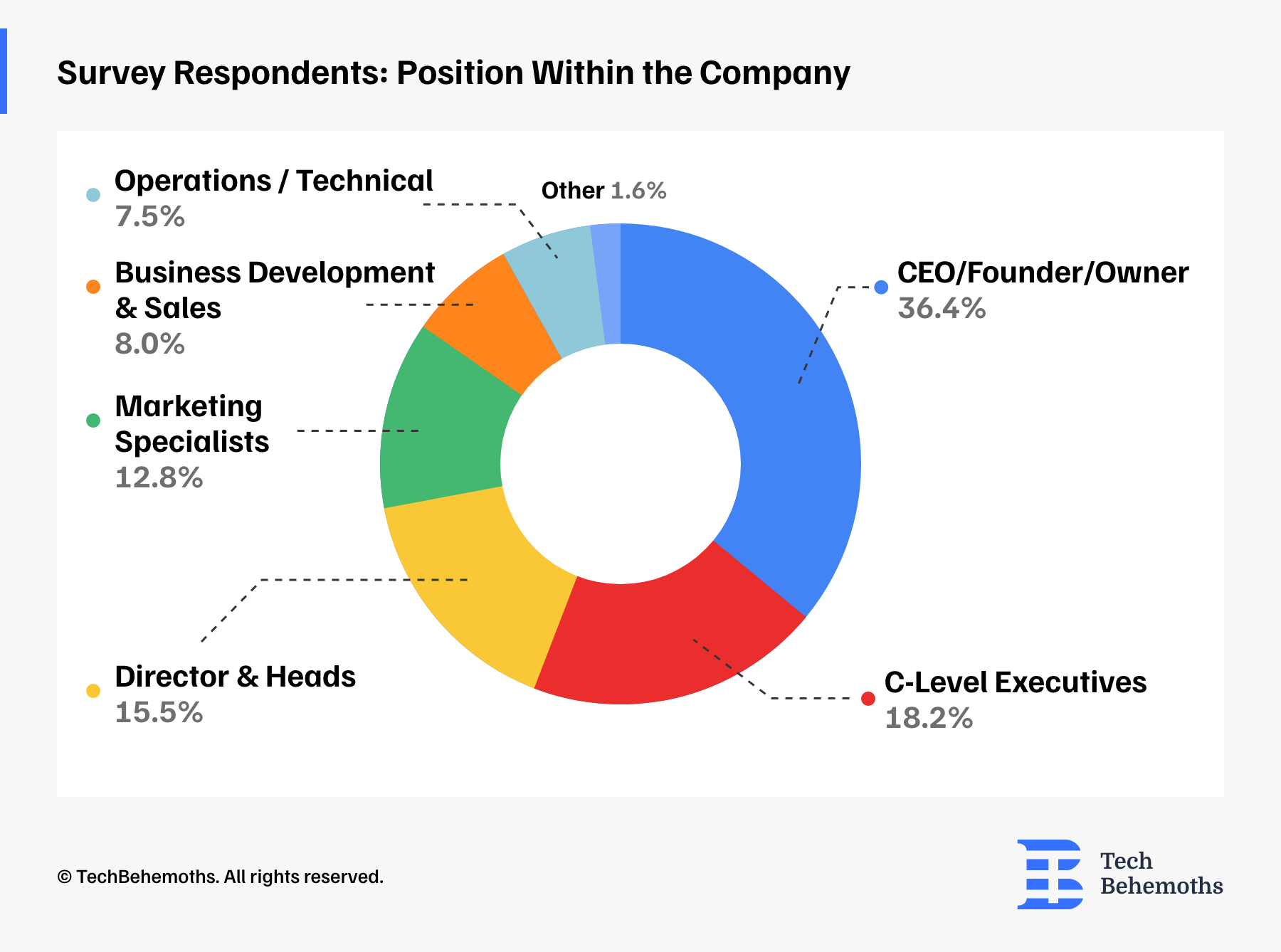
Position Within the Company
Respondents to the survey represent a wide range of roles, but clearly that most are professionals involved in strategic decision-making.
CEOs, founders, and owners account for 36.4%, followed by C-level executives (18.2%) and directors or department heads (15.5%).
Operational roles are also represented, including marketing specialists (12.8%), business development and sales professionals (8.0%), and operations or technical roles (7.5%), while 1.6% fall into other positions.
Company Size of Respondents
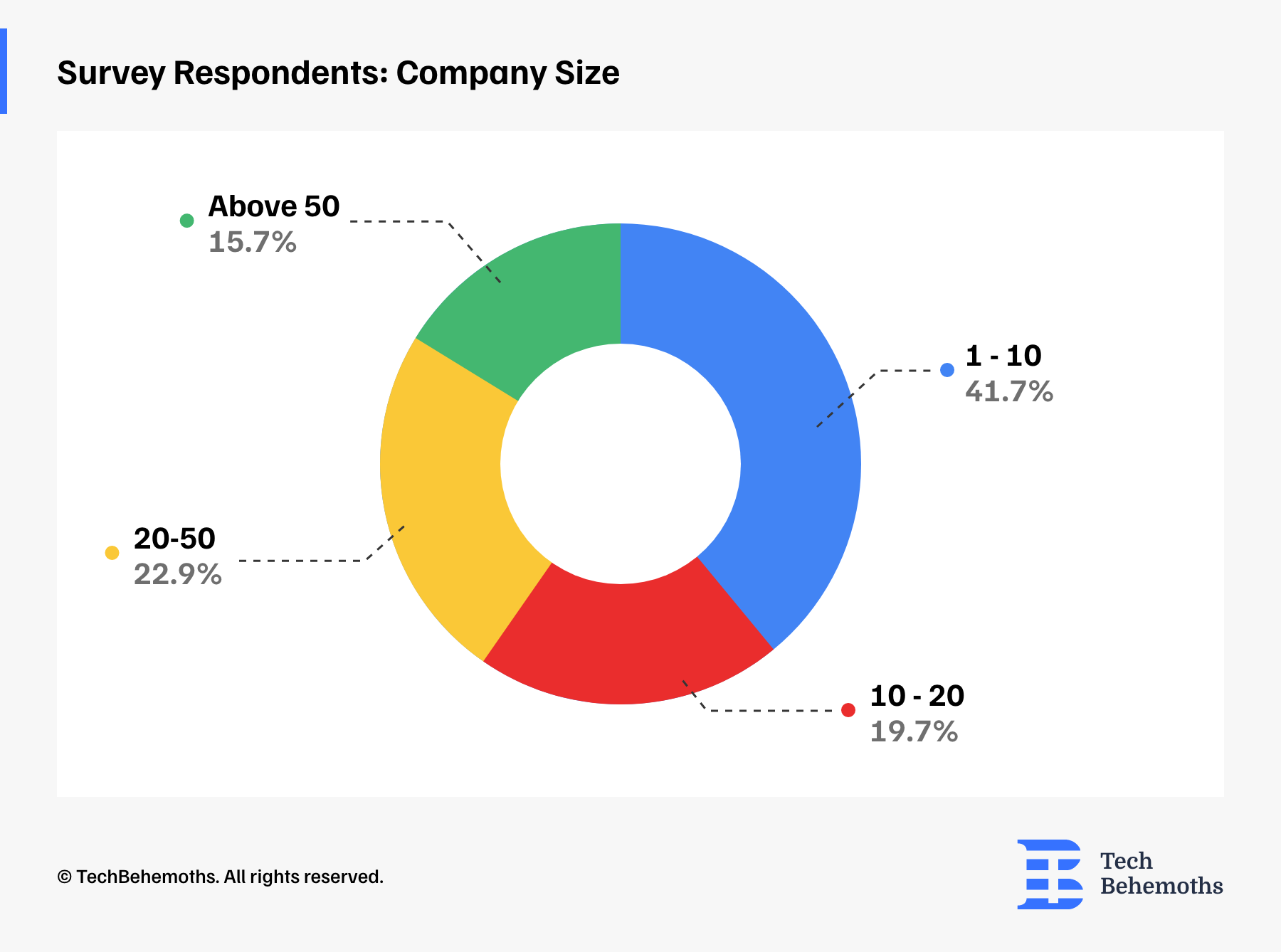
Survey respondents come from companies of various sizes, with a strong representation of small businesses. The largest group (41.7%) represents companies with 1–10 employees.
Companies with 20–50 employees account for 22.9%, followed by 10–20 employees (19.7%). Meanwhile, 15.7% of respondents represent companies with more than 50 employees.
Company Industry Distribution
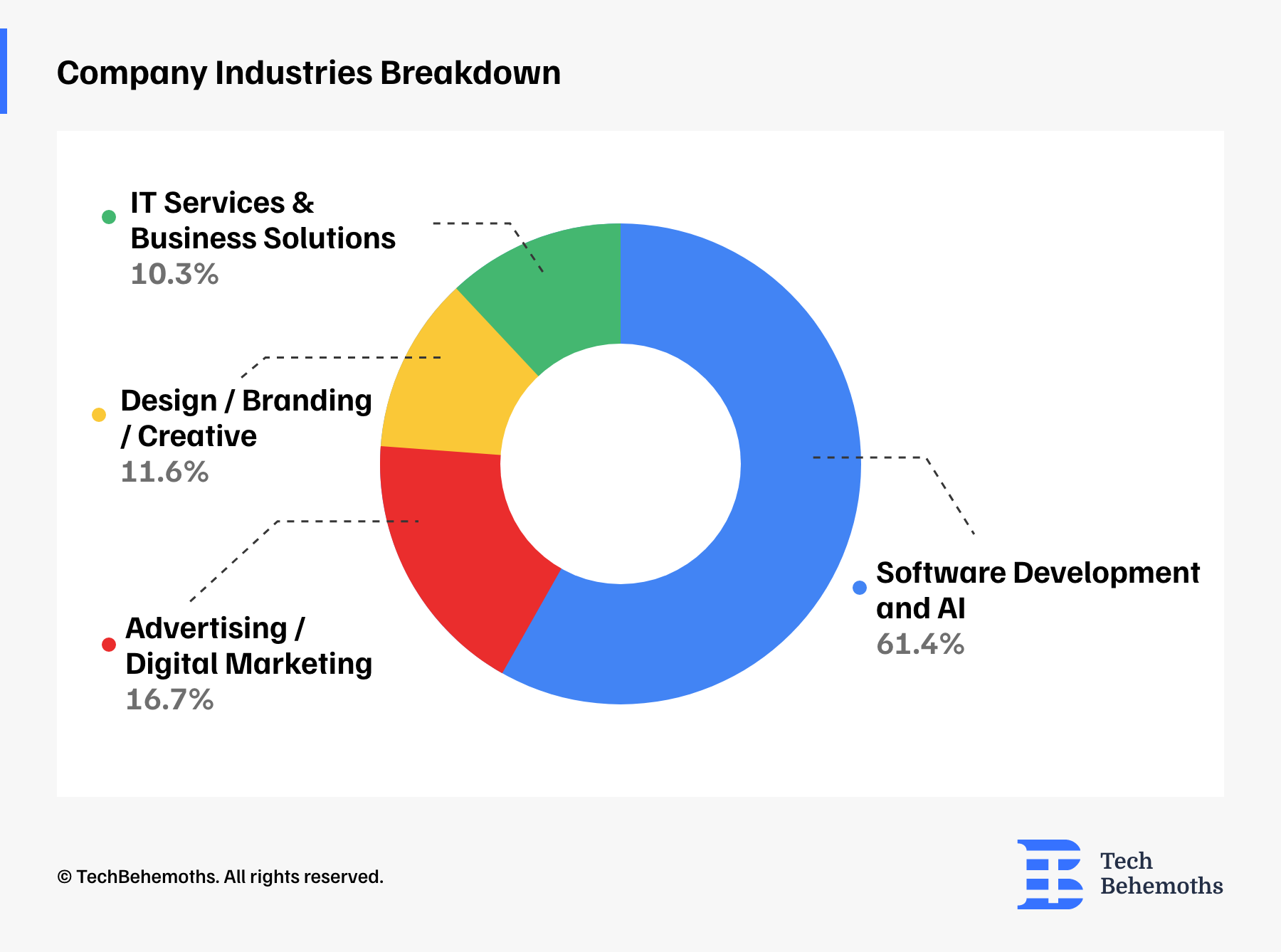
Most respondent companies come from the software development and AI sector (61.4%), followed by advertising and digital marketing (16.7%), design, branding, and creative services (11.6%), and IT services and business solutions (10.3%).
Considering the focus of this survey on mobile app development in 2026, the strong presence of software and digital service companies reflects the perspectives of professionals directly involved in building, designing, or supporting mobile applications.
Primary Market Focus
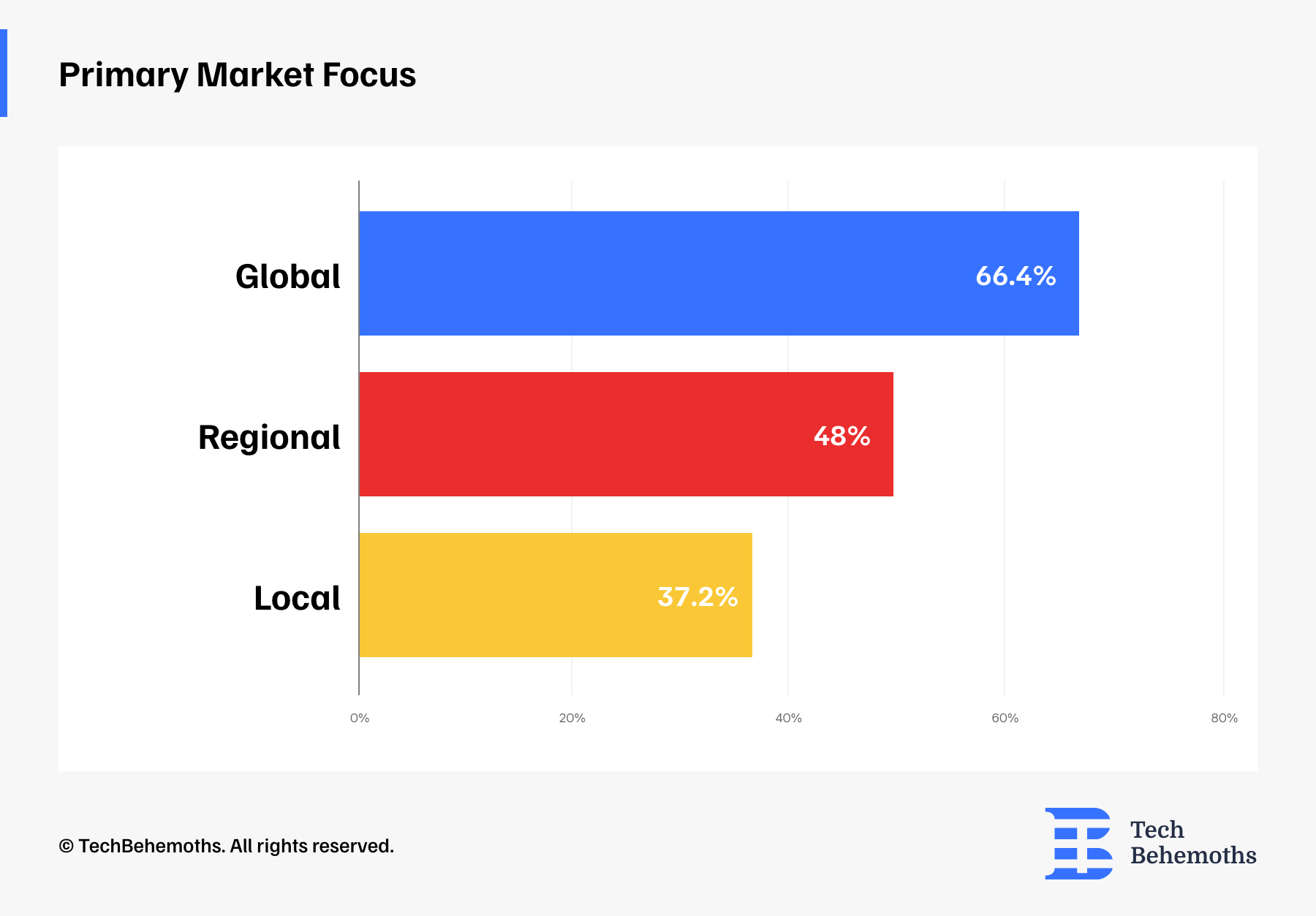
Survey shows that most respondent agencies operate internationally, with 66.4% indicating a global market focus. Meanwhile, 48% target regional markets, and 37.2% primarily focus on local markets.
This suggests that many companies participating in the survey build digital products and mobile applications for broader, international audiences, not only for local markets.
Now that we understand the profile of participating companies, we can explore how businesses approach mobile app development.
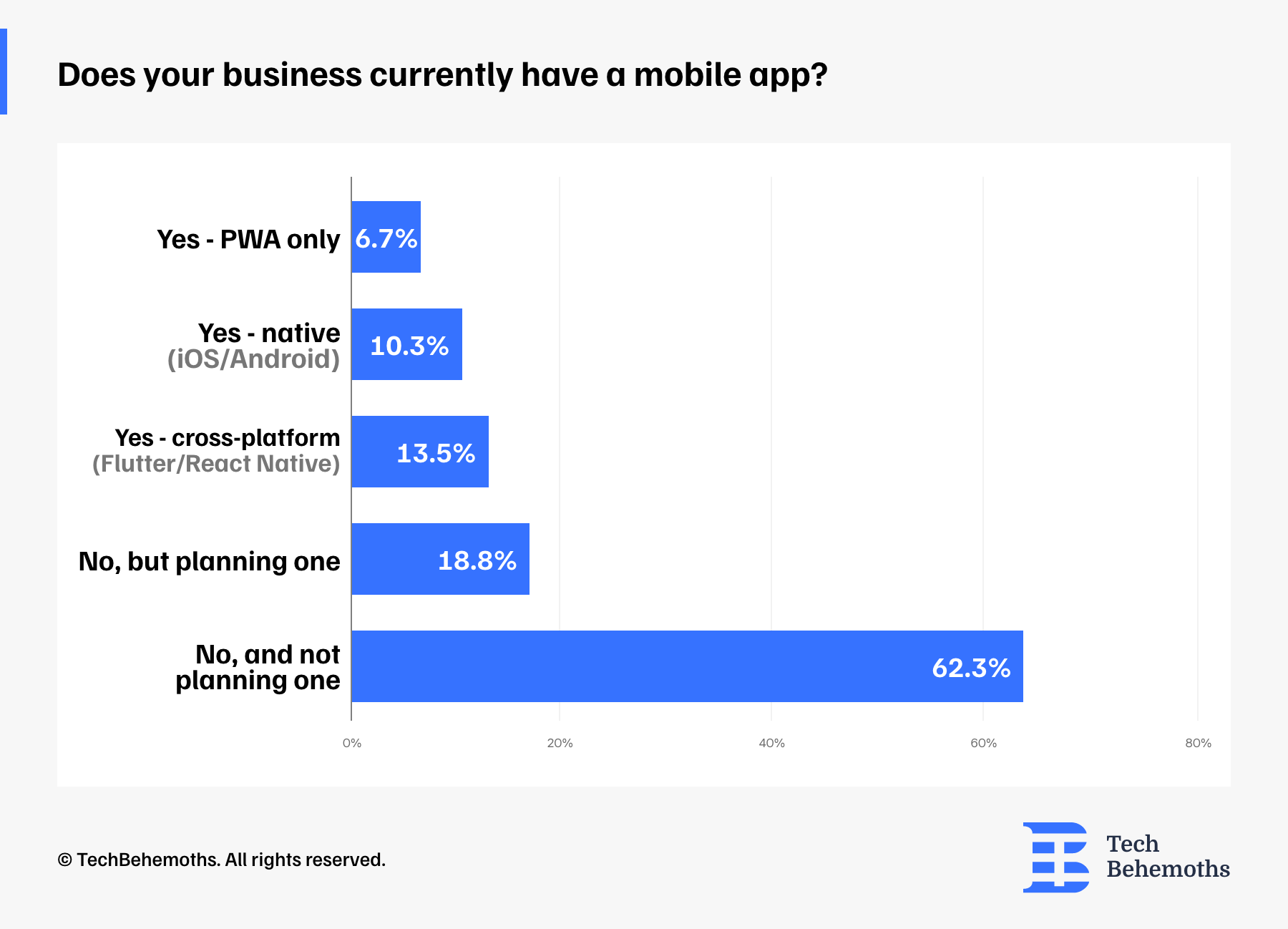
Does Your Business Currently Have a Mobile App?
When asked whether their business currently has a mobile app, 62.3% of respondents said they do not have one and are not planning to build one. Meanwhile, 18.8% reported that they do not currently have an app but are planning to develop one.
Among companies that already have a mobile application (30.5%), 13.5% use cross-platform technologies, 10.3% rely on native apps (iOS/Android), and 6.7% use PWA solutions.
These results point out that while many companies still operate without a mobile app, many businesses still rely primarily on websites or other digital channels. Another notable share is considering mobile development as part of their future digital strategy.
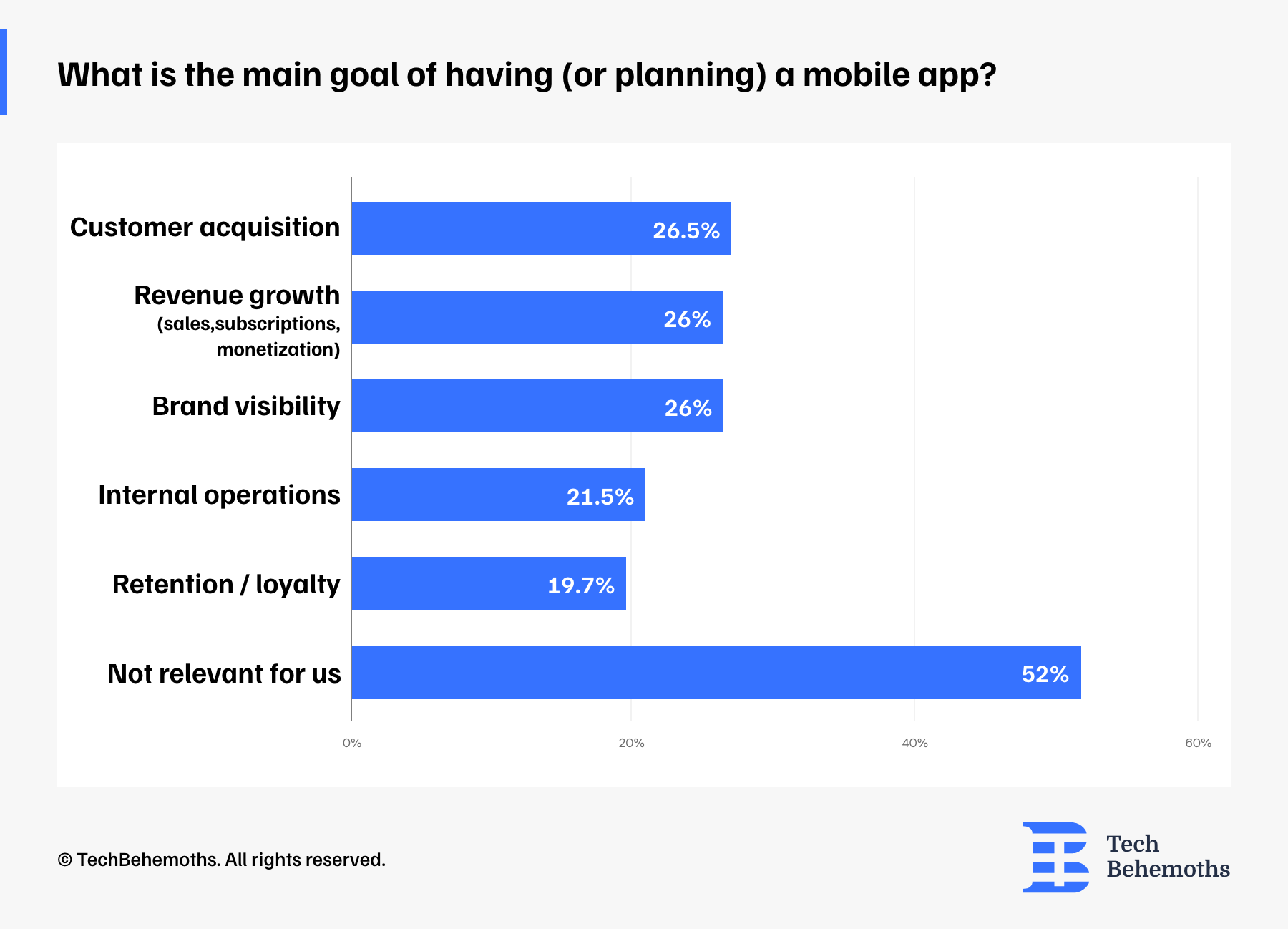
26.5% of Companies Build Mobile Apps for Customer Acquisition
According to our survey, the main goal of having or planning a mobile app is customer acquisition, with 26.5% of respondents indicating it as their primary objective. Revenue growth and brand visibility follow closely, each at 26%, indicating that many companies view mobile apps as tools to expand their reach and generate new business opportunities.
Other goals include improving internal operations (21.5%) and strengthening customer retention and loyalty (19.7%). These results indicate that companies tend to prioritize mobile apps when they see clear value in growth, customer acquisition, or revenue generation.
However, 52% of respondents said a mobile app is not currently relevant to their business.
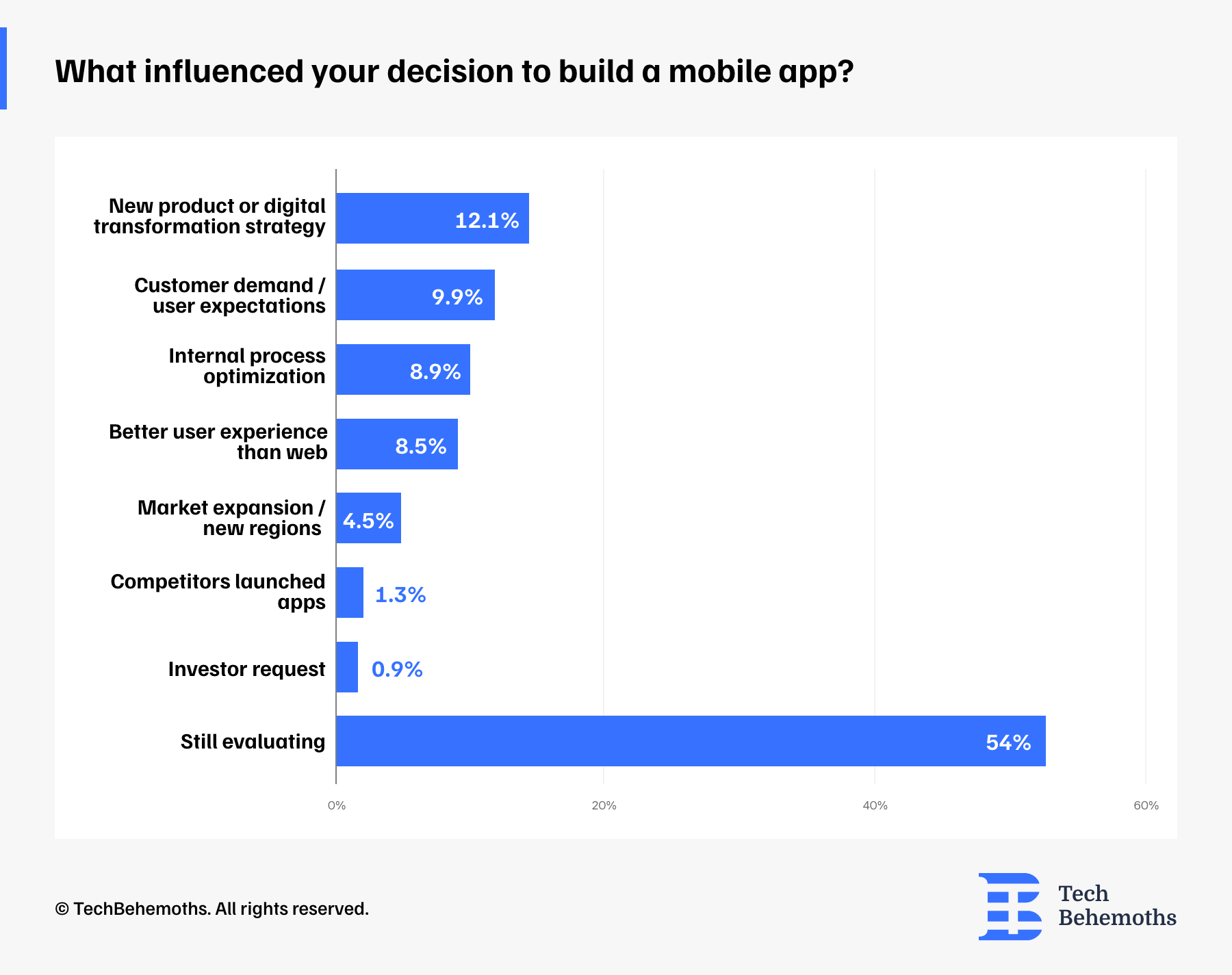
54% of Companies Are Still Evaluating the Need for a Mobile App
When asked what influenced their decision to build a mobile app, 54% of respondents said they are still evaluating whether a mobile app is necessary for their business.
Among companies that have already identified reasons for mobile development, 12.1% pointed to launching a new product or digital transformation strategy, while 9.9% cited customer demand or user expectations. Other motivations include internal process optimization (8.9%) and the need for a better user experience than what websites currently provide (8.5%). Smaller shares mentioned market expansion (4.5%), competitor apps (1.3%), and investor requests (0.9%).
These results highlight that many companies recognize the potential benefits of mobile apps, but a large proportion are still evaluating whether a mobile app aligns with their long-term digital strategy.
Websites Still Replace Mobile Apps for Many Businesses
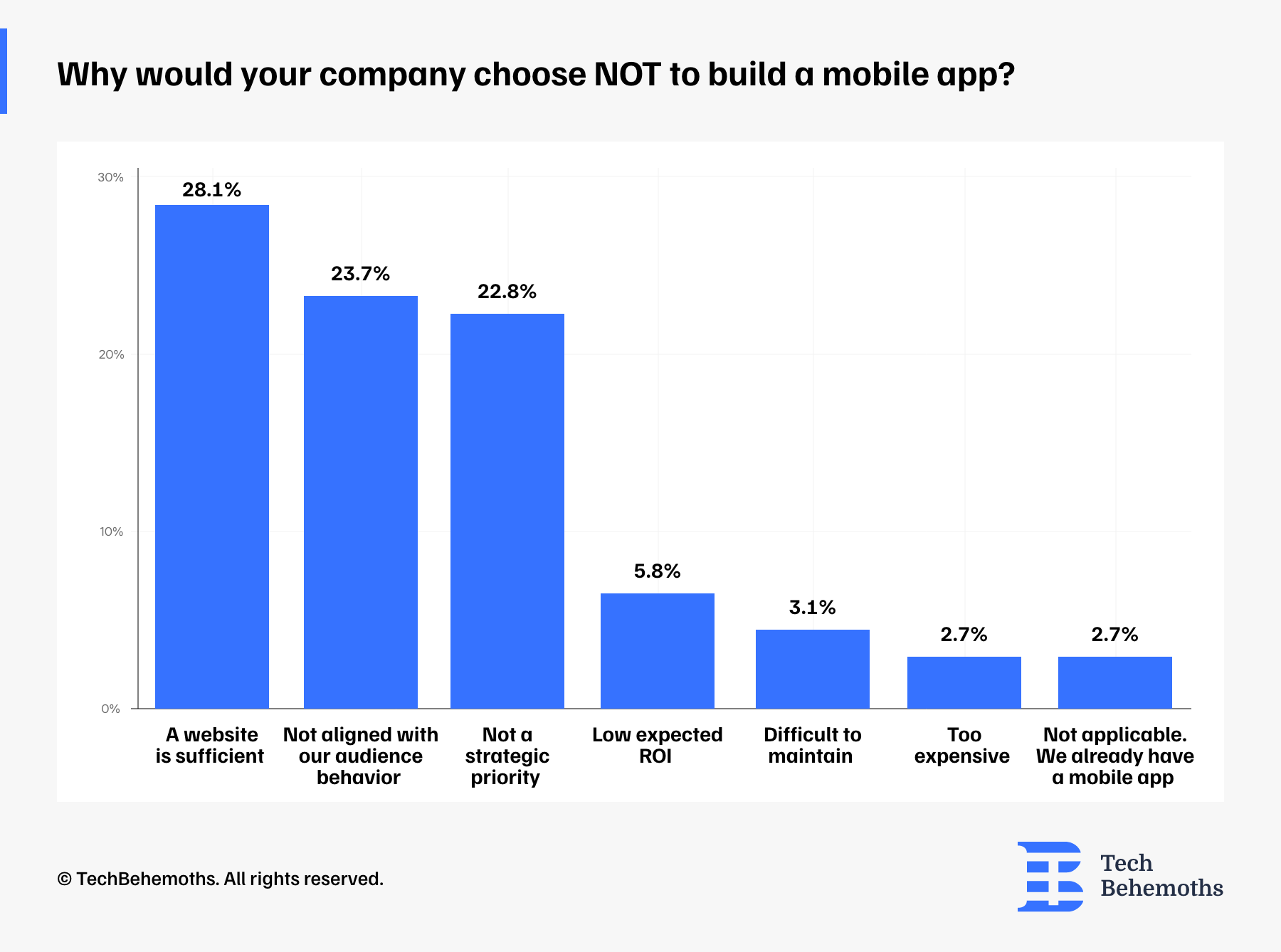
The survey data shows that some companies choose not to build a mobile app, and the most common reason for that is that a website is sufficient, cited by around 28% of respondents.
Other frequent reasons include the app not aligning with audience behavior (23.6%) and mobile development not being a strategic priority (22.7%). A smaller share mentioned low expected ROI, maintenance challenges, or high development costs.
This way, we can conclude that for many companies, web platforms still meet their current digital needs, reducing the necessity to invest in dedicated mobile applications.
Prefer a Web-First Approach?
Check our list of top Web Development Companies
For 57.6% of Companies, Mobile Apps Are Not a Priority in 2026
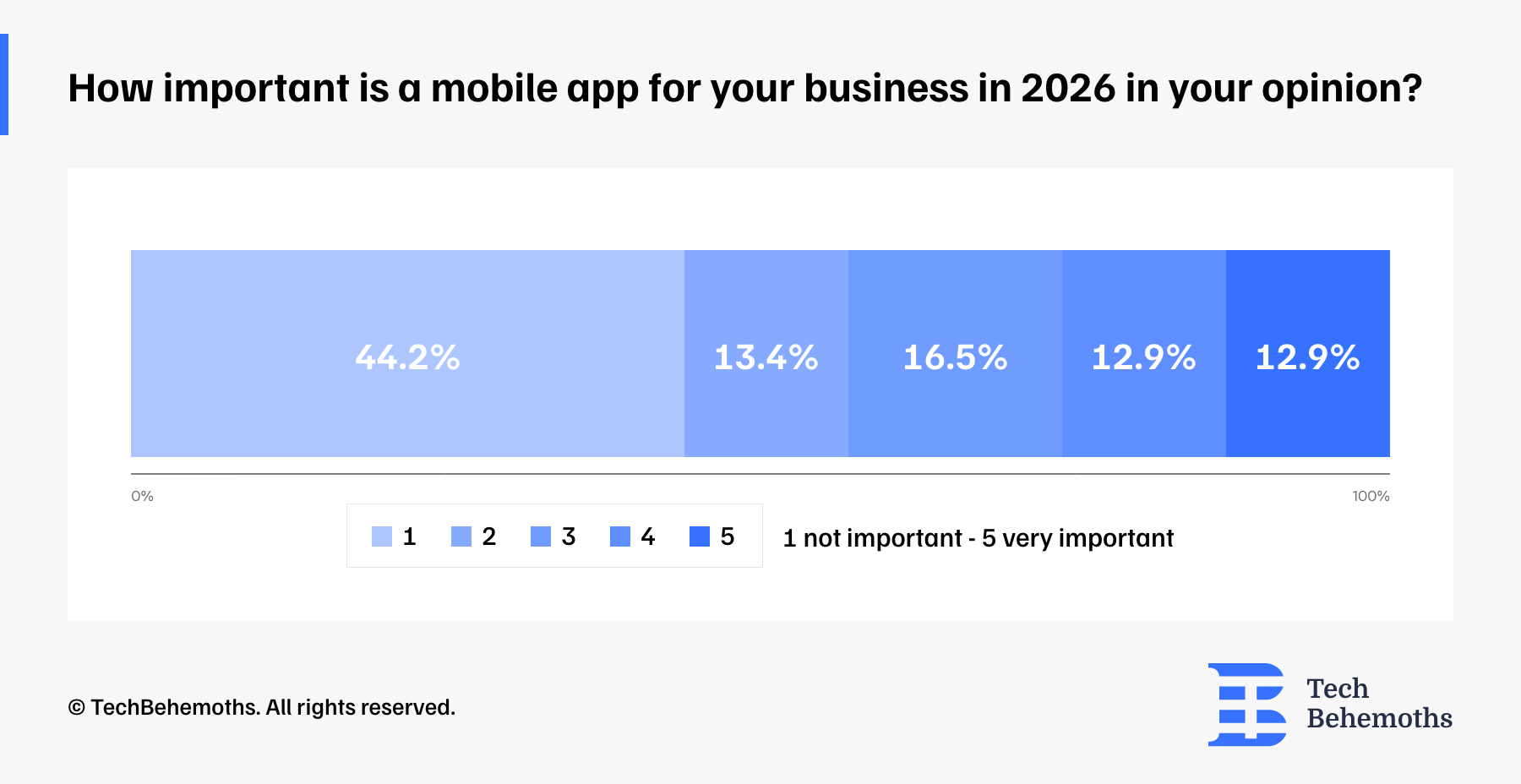
When asked how important having a mobile app will be for their business in 2026, the majority of respondents (57.6%) rated its importance as low (1–2).
Meanwhile, 16.5% expressed a neutral view, while 25.8% consider mobile apps highly important (ratings 4–5) for their business.
While a significant group of companies believes mobile apps have great value, the majority of companies still do not consider them a critical priority for their digital strategy in 2026.
Nearly 60% of Companies Build Mobile Apps In-House
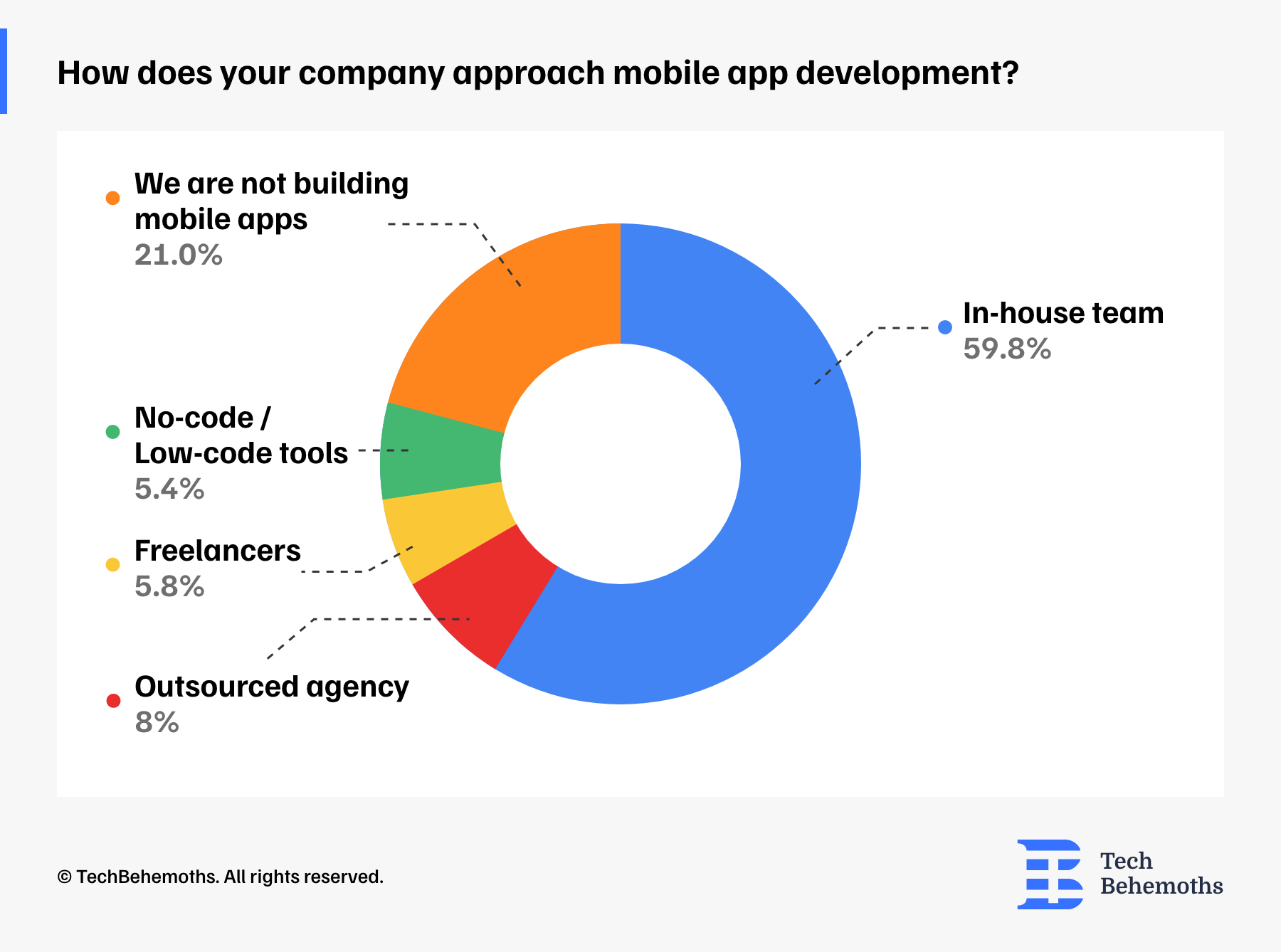
To see how companies approach mobile development in practice, we asked respondents how their organizations typically build mobile apps.
According to the survey data, 59.8% of companies develop mobile apps using in-house teams, suggesting that many agencies prefer to keep development and product control internally.
Other approaches are less common. 8% rely on outsourced agencies, 5.8% work with freelancers, and 5.4% use no-code or low-code tools.
When companies invest in mobile applications, internal teams remain the preferred development approach.
Which Technologies Do Companies Prefer for Mobile App Development?
React Native and Flutter Lead Among Preferred Technologies
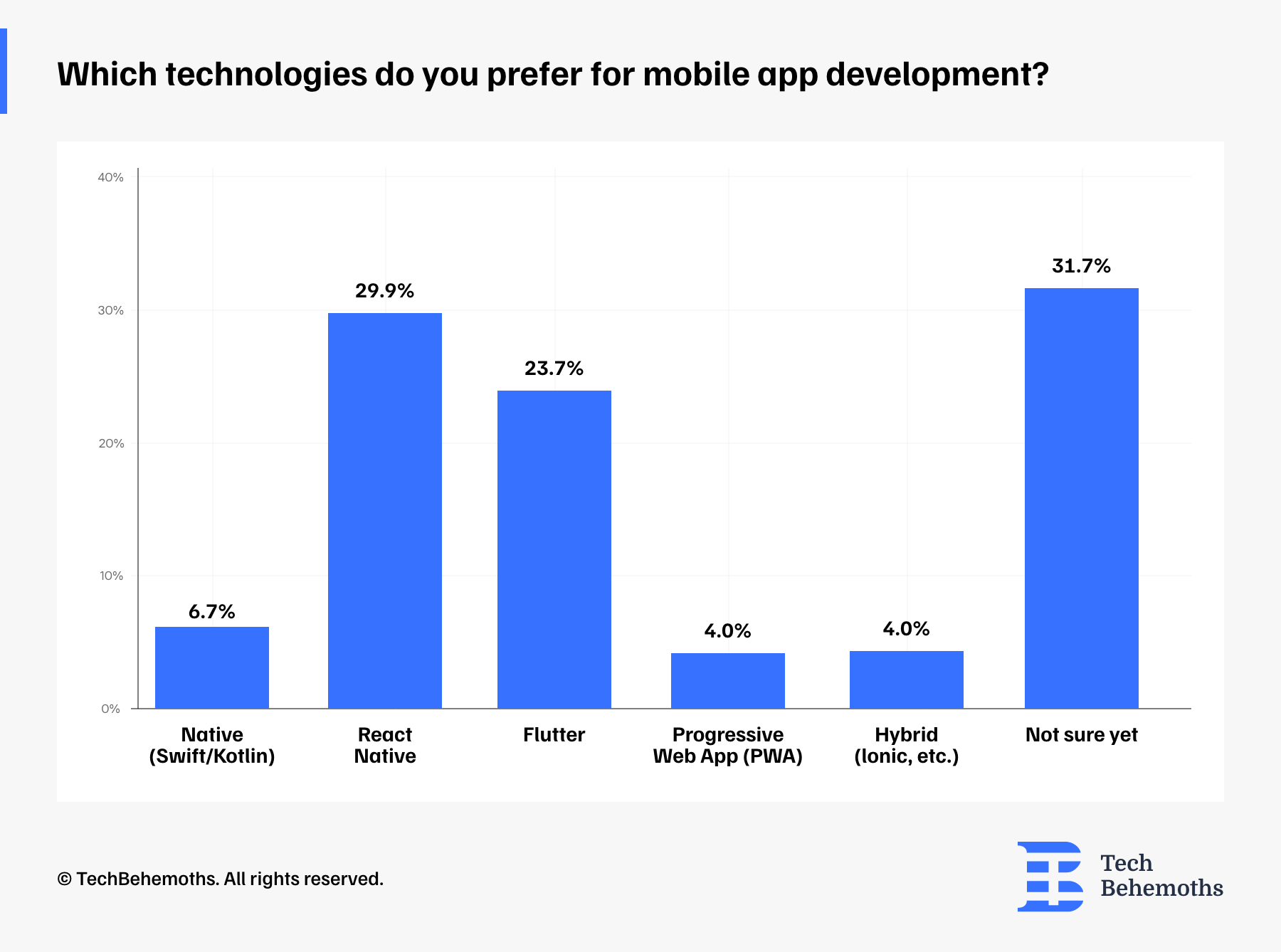
When asked which technologies they prefer for mobile app development, 29.9% of respondents chose React Native, making it the most popular framework among those with a clear preference. Flutter follows with 23.7%, confirming the strong adoption of cross-platform technologies.
Native development (Swift/Kotlin) accounts for 6.7%, while Progressive Web Apps (4%) and hybrid frameworks such as Ionic (4%) represent smaller shares.
Interestingly, 31.7% of respondents said they are not sure yet, indicating that many companies are still exploring the best technological approach for their mobile strategy.
In this way, a strong preference is observed for cross-platform frameworks, which allow companies to build applications for multiple platforms while reducing development time and costs.
What Matters Most When Choosing a Mobile App Development Partner?
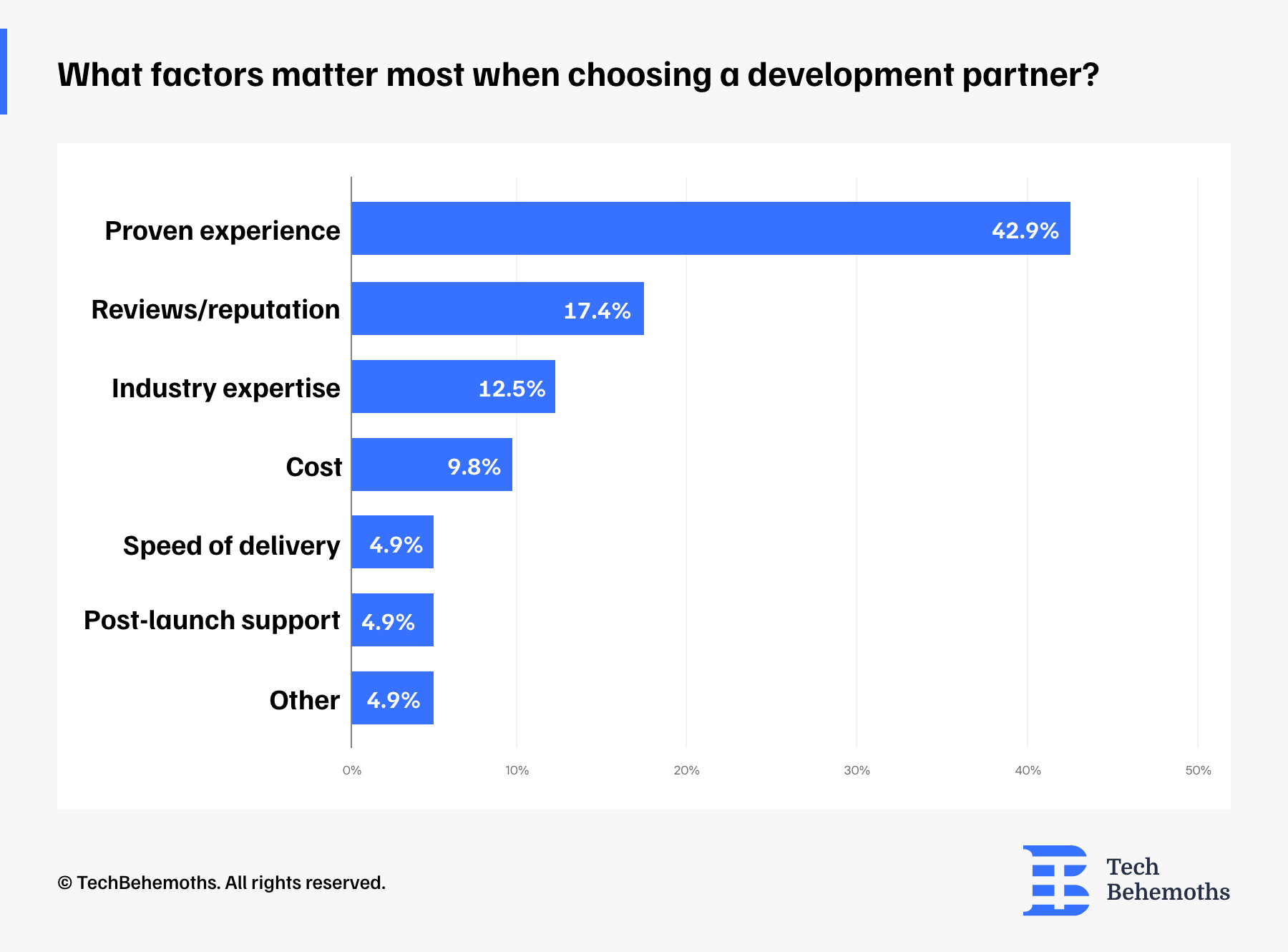
The survey results show that 42.9% of respondents chose the most important criterion when choosing a development partner to be proven experience.
Other relevant factors include reviews and reputation on platforms such as TechBehemoths (17.4%) and industry expertise (12.5%), showing that companies value credibility and specialization when selecting a partner.
Cost accounts for 9.8%, while speed of delivery, post-launch support, and other factors each represent 4.9% of responses.
Thus, companies prioritize trust, proven results, and industry knowledge over decisions based solely on cost when choosing a development partner.
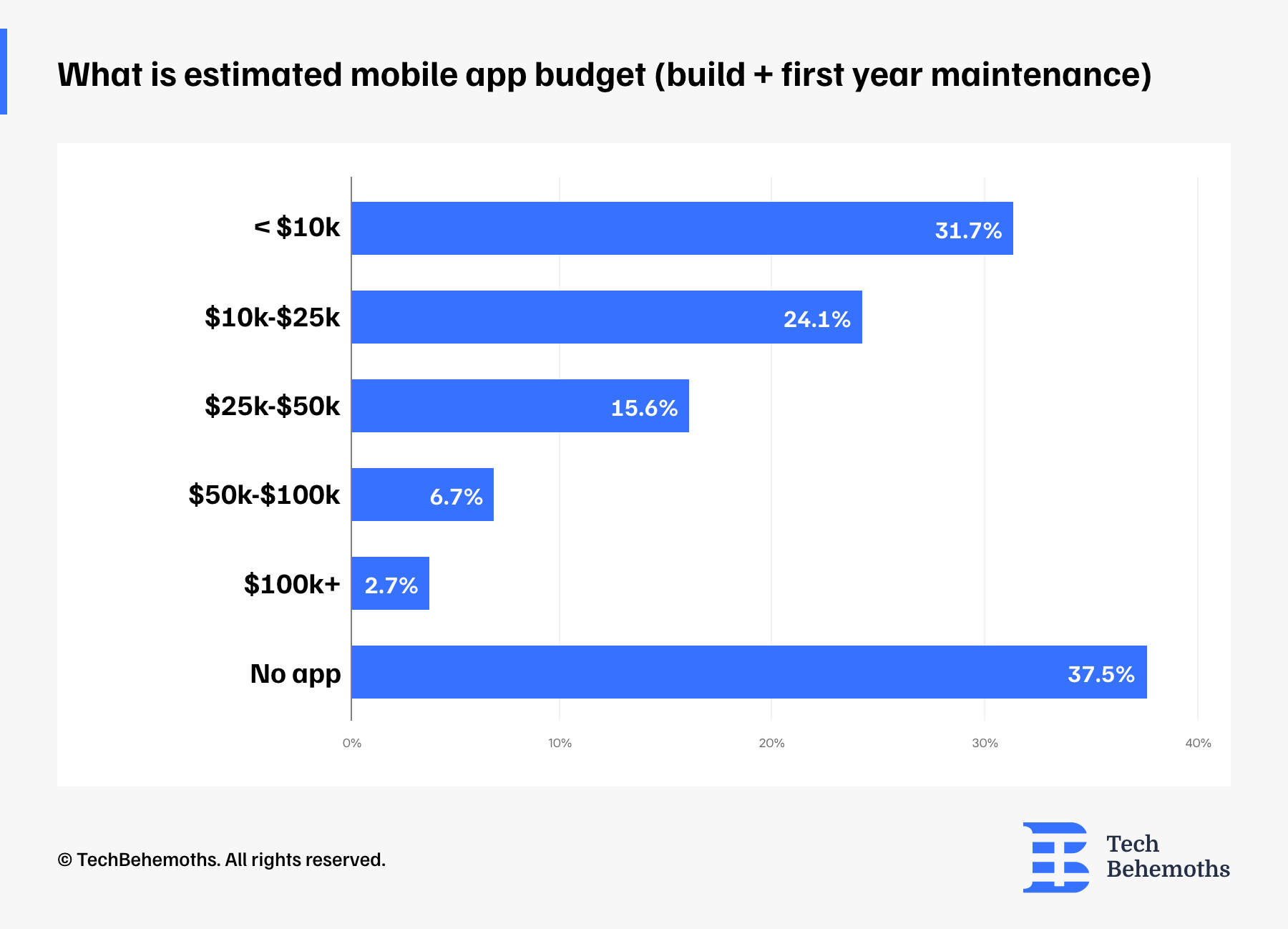
Over 55% of Companies Estimate Mobile App Budgets Below $25,000
Companies considering mobile app development often expect relatively moderate budgets, especially for initial builds or smaller-scale applications.
31.7% of respondents indicated a budget below $10,000, while 24.1% estimated a budget between $10,000 and $25,000 for building and maintaining a mobile app during the first year.
A smaller share reported higher budgets, with 15.6% allocating between $25,000 and $50,000, 6.7% between $50,000 and $100,000, and only 2.7% expecting budgets above $100,000.
Additionally, 37.5% of respondents indicated that they do not estimate a mobile app budget because they do not currently have a mobile app.
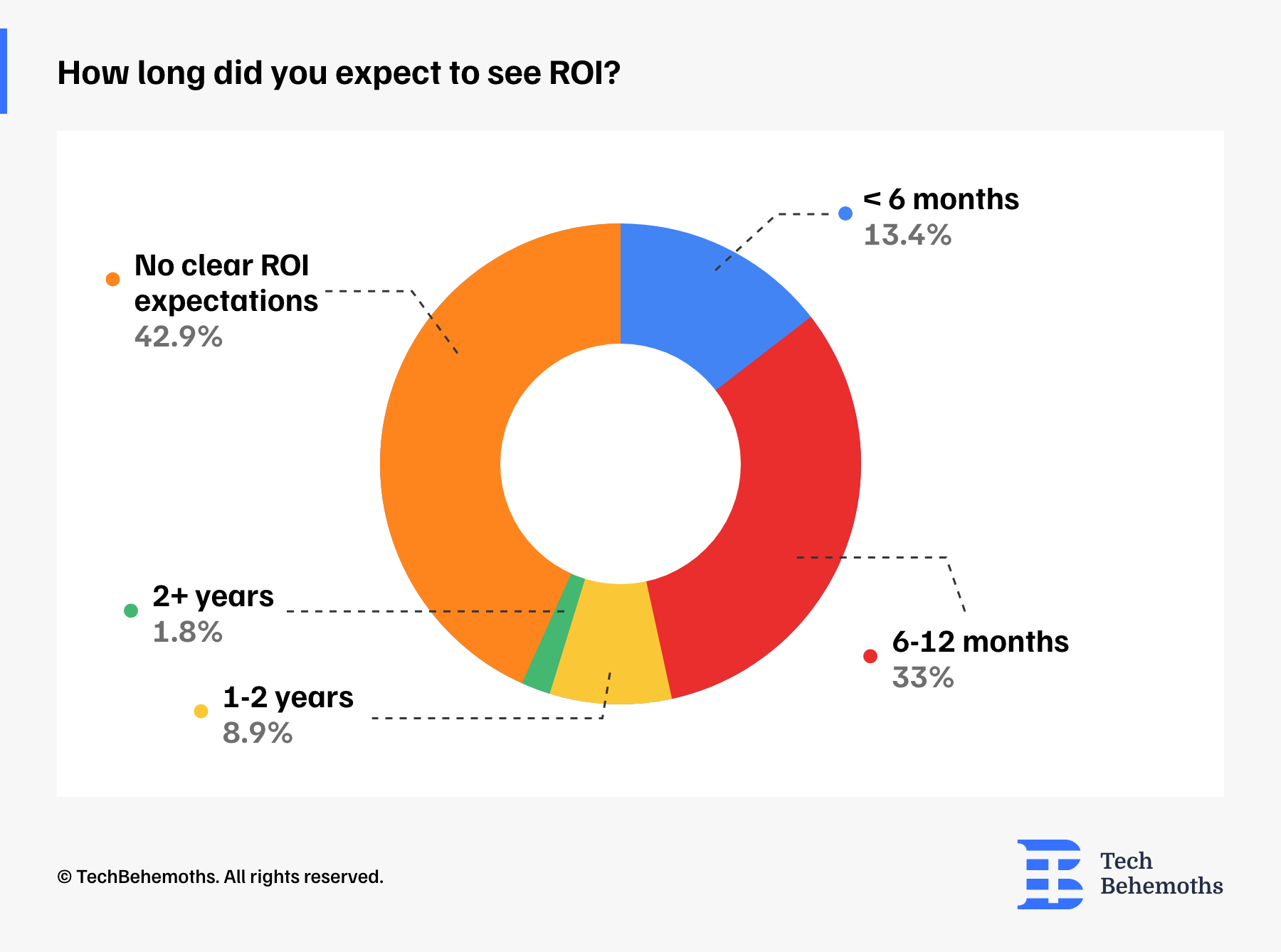
42.9% of Companies Have No Clear ROI Expectations for Mobile Apps
When asked how long they expect it to take to see a return on investment (ROI) from a mobile app, 42.9% of respondents indicated that they have no clear ROI expectations.
Among those with defined expectations, 33% expect to see results within 6–12 months, while 13.4% anticipate ROI in less than 6 months. A smaller share expects longer timelines, with 8.9% estimating 1–2 years, and only a small percentage expecting ROI after more than two years.
Some companies expect relatively fast returns from mobile applications, but many businesses still lack clear benchmarks for measuring ROI.
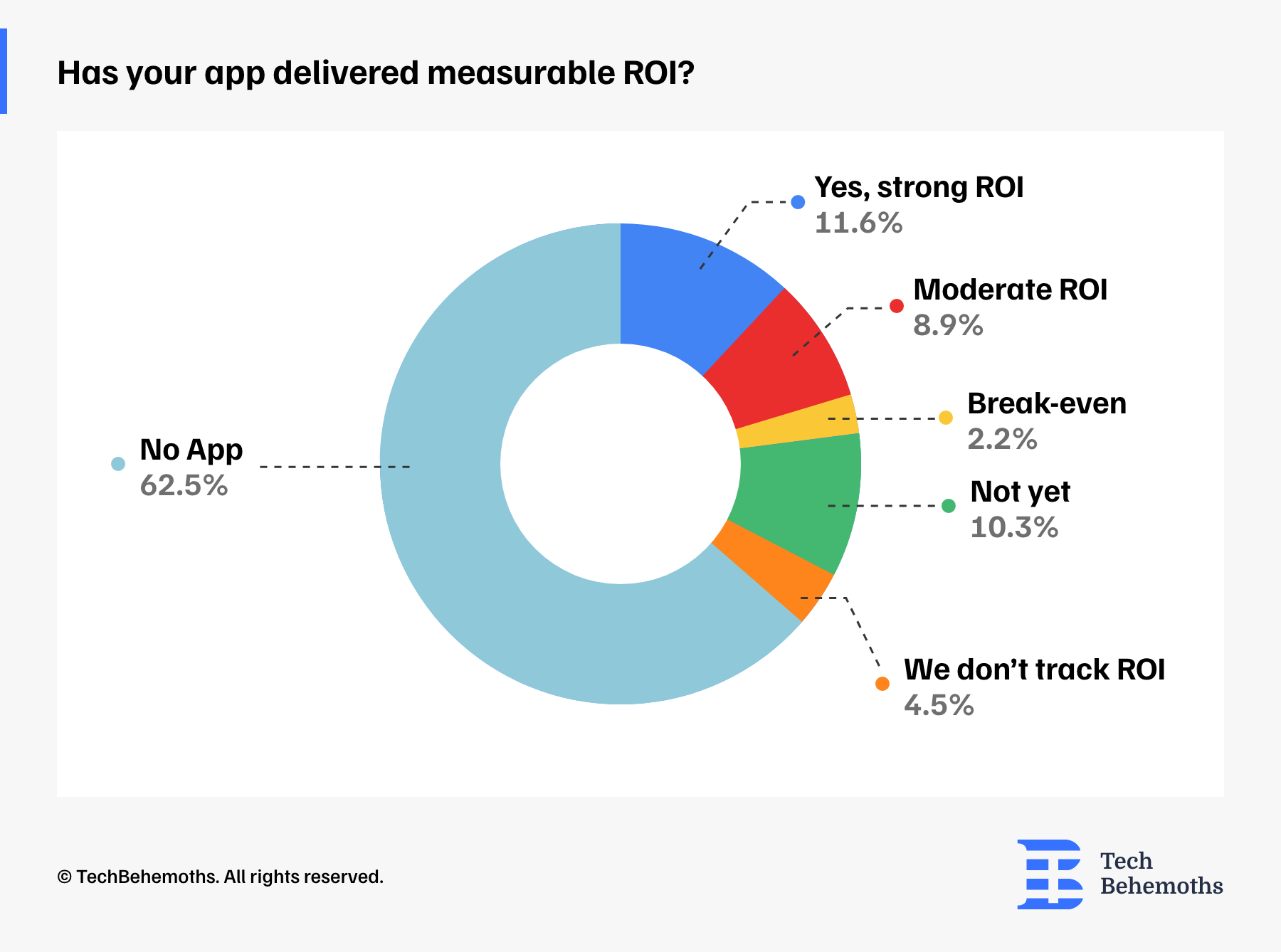
To better understand the real outcomes, we asked respondents whether their mobile apps have already delivered measurable returns.
11.6% of Companies Report Strong ROI from Their Mobile Apps
Companies that invest in mobile apps can achieve measurable returns, although adoption and ROI measurement practices still vary widely.
When asked whether their mobile app has delivered measurable ROI, 11.6% of respondents reported strong returns, while 8.9% indicated moderate ROI.
A smaller share (2.2%) reported breaking even, and 10.3% said their app has not yet generated measurable returns. Meanwhile, 4.5% of companies stated that they do not track ROI for their mobile applications.
Notably, 62.5% of respondents indicated that they do not have a mobile app, which aligns with earlier findings showing that mobile development is still not a priority for many businesses.
What Are the Biggest Challenges Companies Face with Mobile Apps?
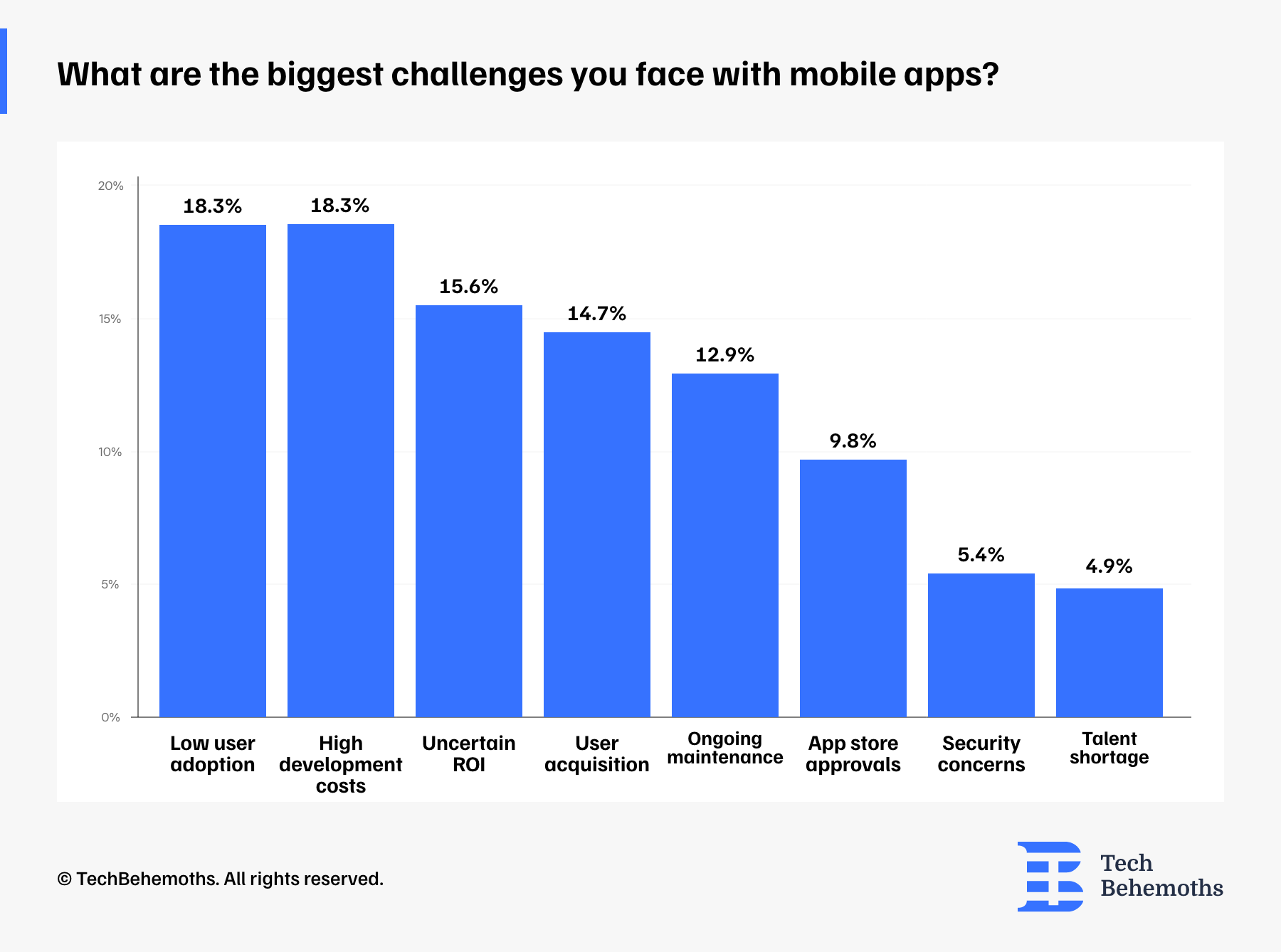
The biggest challenges companies face when it comes to mobile apps are low user adoption and high development costs, each mentioned by 18.3% of respondents.
Other common challenges include uncertain ROI (15.6%), customer acquisition (14.7%), and ongoing maintenance (12.9%), highlighting that both financial and operational factors influence mobile app success.
Additional concerns, such as app store approvals (9.8%), security issues (5.4%), and talent shortages (4.9%), were mentioned less frequently.
Companies see mobile apps not only as a development challenge, but also as a long-term investment that requires strong user adoption and sustainable business value.
AI Integration Is the Top Mobile App Trend for 2026
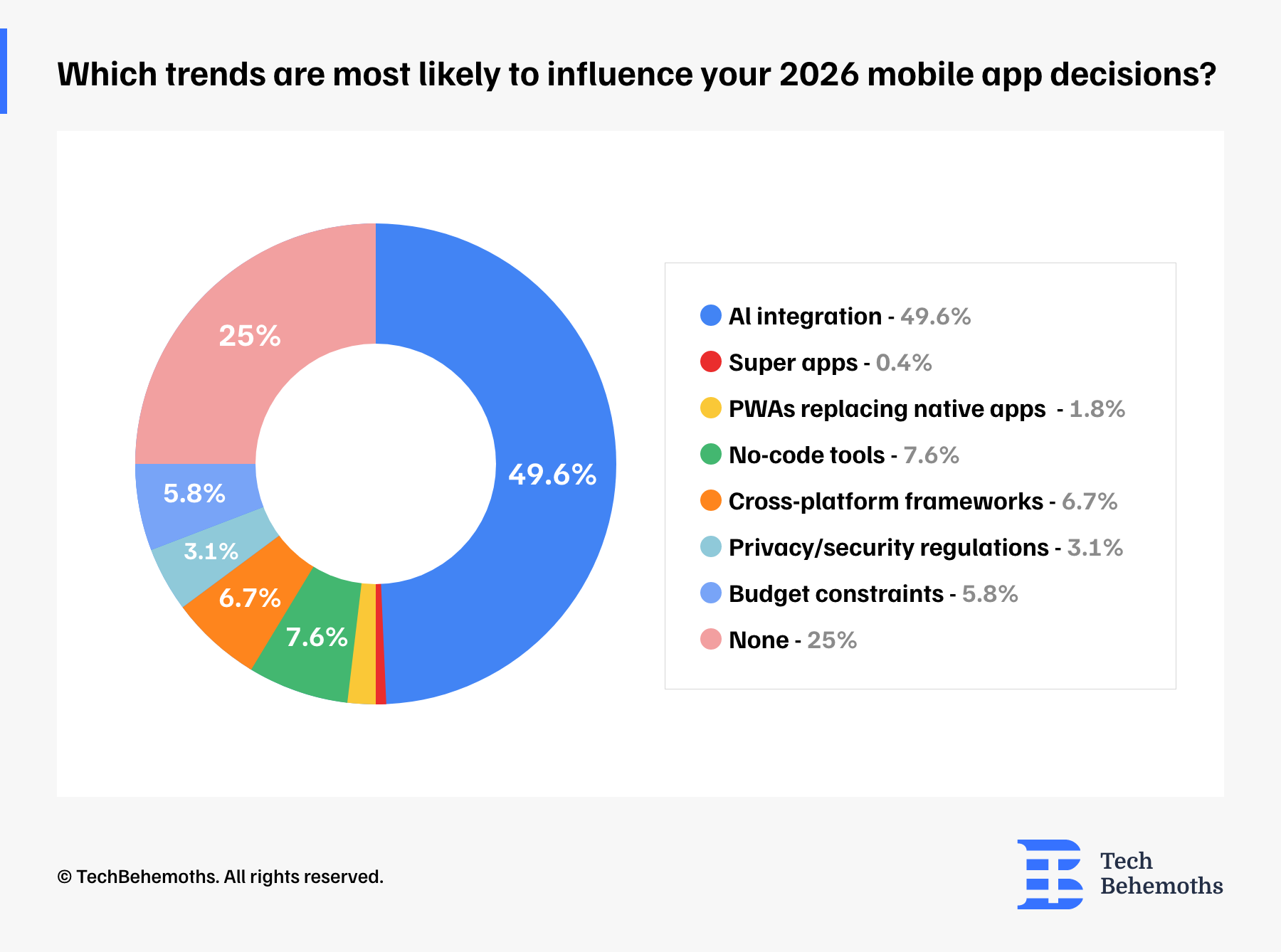
When asked which trends are most likely to influence mobile app decisions in 2026, AI integration clearly stands out, cited by 49.6% of respondents.
Curiously, the second largest group (25%) indicated that none of the listed trends significantly influence their mobile app decisions, suggesting that many companies still rely on established development strategies rather than emerging trends.
Other trends mentioned include no-code tools (7.6%), cross-platform frameworks (6.7%), and budget constraints (5.8%), while privacy and security regulations (3.1%) and PWAs replacing native apps received smaller shares.
The result denotes that artificial intelligence is expected to play a major role in shaping mobile app strategies in the coming years.
How Companies Plan to Approach Mobile Apps in 2026
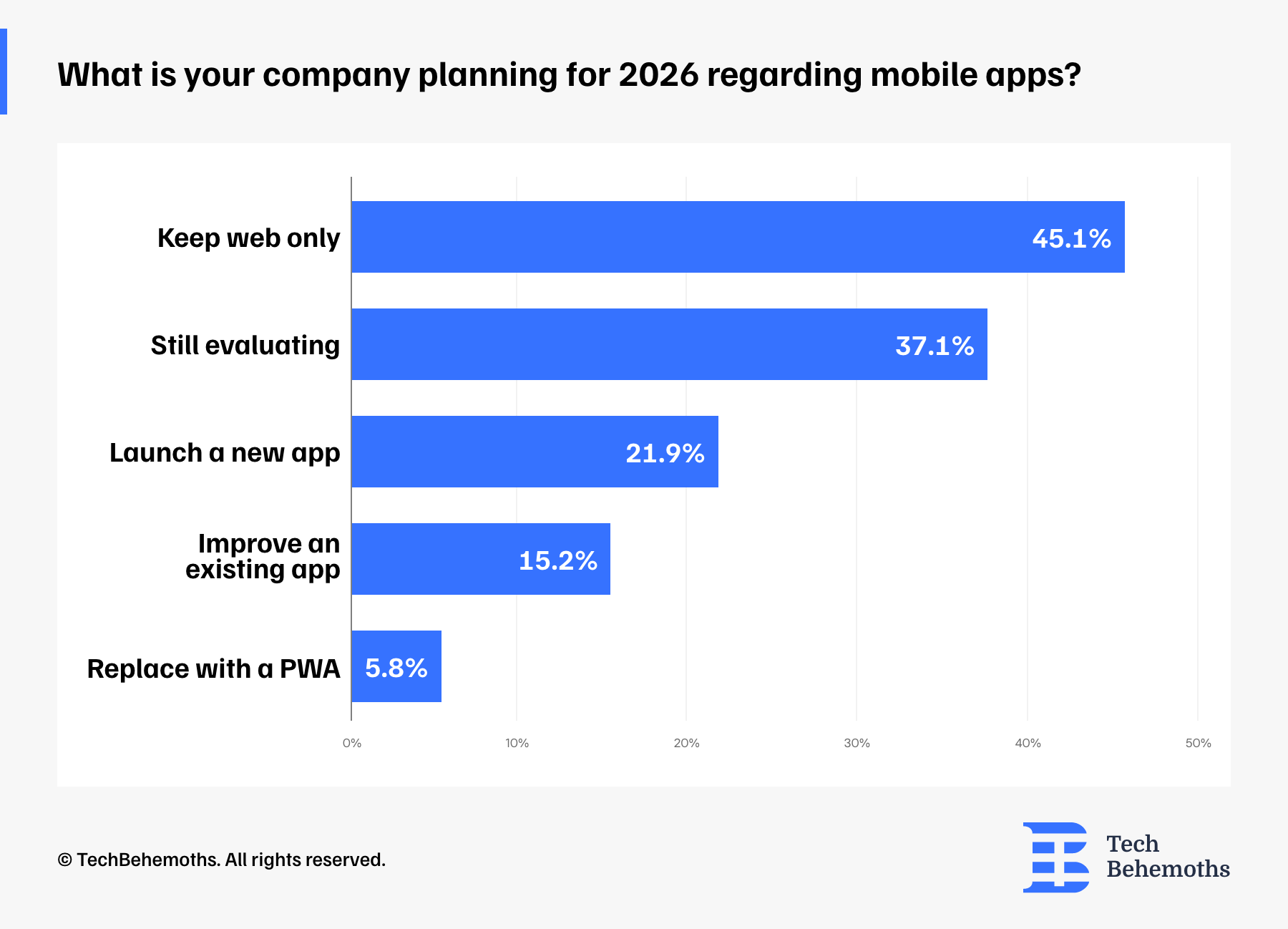
According to the TechBehemoths survey, 45.1% of respondents indicated that they plan to maintain a web-only strategy in 2026, continuing to rely primarily on websites rather than launching dedicated mobile apps.
At the same time, 37.1% of companies reported that they are still evaluating their mobile strategy, suggesting that many businesses remain undecided about whether a mobile app fits their future digital plans.
Among companies planning to invest in mobile, 21.9% intend to launch a new mobile app, while 15.2% plan to improve an existing one. A smaller share (5.8%) is considering replacing their app with a Progressive Web App (PWA).
Many businesses are either maintaining web-first strategies or still assessing the role mobile apps will play in their digital strategy for 2026.
Mobile Apps Are Recommended Mainly for Specific Industries
More than half of respondents (53.1%) believe that mobile apps should be recommended only for specific industries, rather than for every type of business.
At the same time, 37.9% consider mobile apps beneficial for most companies, suggesting that a significant share of businesses still see strong value in mobile platforms. A smaller group expressed more cautious views, with 10.7% recommending mobile apps only rarely and 9.4% not recommending them at all.
These results highlight an important takeaway: mobile apps are not a universal solution, but a strategic tool that delivers the most value when aligned with the right industry, user behavior, and business goals.
Key Insights from the Survey
| Main Finding | Survey Supporting Data | What It Means for Businesses |
|---|---|---|
| Mobile apps are not a universal necessity | 57.6% say mobile apps are not a priority in 2026, and 45.1% plan to keep web-only strategies. | Many businesses still rely on websites as their primary digital channel. |
| Mobile apps are mainly used as growth tools | Customer acquisition (26.5%), revenue growth (26%), and brand visibility (26%) are the top goals. | Companies invest in mobile apps primarily to expand their reach and grow their customer base. |
| Most businesses prefer internal development | 59.8% develop mobile apps with in-house teams. | Companies want greater control over their products and development processes. |
| Cross-platform technologies dominate | React Native and Flutter are the most preferred frameworks. | Businesses prioritize speed, efficiency, and lower development costs. |
| Budgets for mobile apps are often limited | Over half of companies estimate budgets below $25,000. | Many mobile apps are developed as smaller-scale projects or MVPs. |
| ROI expectations remain unclear | 42.9% of companies have no clear ROI expectations for mobile apps. | Businesses are still learning how to measure the real business value of mobile applications. |
| Adoption challenges remain significant | Low user adoption and high development costs are the top challenges. | Launching an app is not enough; long-term engagement and user growth are critical. |
| AI will shape future mobile strategies | Nearly half of the respondents see AI integration as the most important trend for 2026. | Mobile apps are increasingly expected to include intelligent features and automation. |
Looking for Mobile App Development Services?
Explore our list of top mobile app development companies
Conclusion
After conducting this survey, we concluded that mobile apps have evolved from being a “must-have” digital asset to a strategic business decision.
For some industries, mobile apps remain essential, especially sectors such as e-commerce, fintech, marketplaces, on-demand services, and SaaS platforms that rely on frequent user interaction.
For others, particularly consulting firms, B2B service providers, agencies, or project-based businesses, well-optimized websites, progressive web apps, or other digital solutions may deliver greater value.
Instead of creating apps merely to keep up with industry trends, companies are now adopting a more strategic approach to determine when mobile development is worthwhile for their specific business.
The real question for businesses is no longer “Should we build a mobile app?” but rather “Does a mobile app truly support our business goals and customer needs?”
In 2026, companies will build mobile apps not because they can, but because they truly need them.
Partner Companies
Our survey reached IT companies and web agencies all around the world, with no limits on region or country. In total, 2361 companies from 93 countries took part. A big thank you to our partner companies who helped spread the word and made these valuable insights possible.
- Mobiteam - Germany
- KeenEthics - Ukraine
- ikontent digital Europe - Hungary
- Collaborator - Estonia
- Omnes - Italy
- Freshcode - Bulgaria
- Hobrista - Oman
- Vegatecg - South Africa
- SinzerAD - Andorra
- Enstacked Technologies - India
- Orange Tulip Studio - United States
- WE are the missing link Ltd - United Kingdom
- Differenzsystem - United States
- MindCentrix - India
- IOTAIY LLC - United States
- PodMarketing - Spain
- Wuzzon - Netherlands
- Minicode SRL - Republic of Moldova
- Budventure Technologies Pvt. Ltd. - India
- Ortem Technologies llc - United States
- Labnify - United States
- Baltic Amadeus - Lithuania
- Yeni Nesil Kreatif - Turkey
- Dalma Media - Spain
- Initiative Tech Solutions - ITS Ltd - Rwanda
- Software Orca - United States
- NetClubbed - India
- JAM-Forte Technologies Ltd - Nigeria
- Eastern Peak - United Kingdom
- Zintix - Pakistan
- Bulb Studios - United Kingdom
- IT Consulting - Indonesia
- LoquiSoft - United Kingdom
- Codefia - Poland
- Ultrabyte International Pvt Ltd - Nepal
- Upracoreteam - Nigeria
- artxtreme.biz - Philippines
- Atlyx - India
- Alpha IT Solutions - Ethiopia
- Datum Decipher Analytics - India
- SunHouse Marketing - Canada
- Upcasted - Romania
- European IT Firm - Germany
- dev.family - Portugal
- 2N Consulting Group - United States
- Elites - Lebanon
- icube events - Singapore
- DH Solutions - United States
- NexCrafters Ltd - United Kingdom
- Hipopotesis - Spain
- Lollie's Handmade - South Africa
- wowmoon - Lithuania
- Palnode - Uganda
- Timspark - United Kingdom
- Cre8 IOT Sdn. Bhd. - Malaysia
- Fulminous Software - India
- Exology for Smart Solutions and Consulting - Egypt
- findyIoT - Bulgaria
- Reliable IT Services - United Kingdom
- Leoceros - Lebanon
- CTO - India
- Appsylvania - Romania
- THEY.dev - United Kingdom
- ROCHEGRUP SOFTWARES - Andorra
- ctrlweb - Canada
- Boostenx - Singapore
- Hithlaksh Solutions Private Limited - India
- Lets Collaborate - South Africa
- Commerce Pundit - United States
- TechDoodles - India
- division5 - Albania
- The Ecom Mentors LTD - Nigeria
- Bravado Solutions - Pakistan
- Accelate AI Labs - India
- BIN Outsourcing (bpo in nepal) - Nepal
- Wireless Computer Services - Nigeria
- Eyetech Ltd - Malta
- neWwave - Cambodia
- Visium SA - Switzerland
- Liquid Studio SL - Spain
- ACW Soft Solutions - Ukraine
- Eco-Soft Economic Software GmbH - Switzerland
- Doois - Brazil
- Tech4LYF Corporation - India
- Green Group Studio - United States
- MOON LINES - Lebanon
- PAZ - Israel
- Brand Poets - United States
- Titan Blue Australia - Australia
- RETLM BPO - Pakistan
- Tranarc solutions - Nigeria
- Codezela Technologies - Sri Lanka
- Celadonsoft - Poland
- A-Devgroup - Ukraine
- Marketing - Saudi Arabia
- Yovista - Morocco
- Devehope Technologies - Czechia
- Technostacks - United States
- Hussain - Pakistan
- Seedium - Estonia
- IT Services - India
- Biashara Softwares - Kenya
- Voodoochilli - United Kingdom
- Fatcow Digital - Lebanon
- Regent Branding - United Kingdom
- Makeitfuture - United Kingdom
- Mediatropy - Singapore
- eobiont - Germany
- Thunderstrike Marketing - United States
- Chapters Digital Solutions - Egypt
- Monk Outsourcing - United States
- WRKFORC - Egypt
- My Left Foot - Canada
- RamScript - India
- iWEBAPP Agency Inc. | Web Design Company & Online Marketing Agency - Canada
- Naturaily - Poland
- Regalia Solutions - Sri Lanka
- GTS Translation Services - United States
- Solcre Software & StaffAugmentation - Uruguay
- Scarfaze - Pakistan
- New Perspective Design - South Africa
- Wild Creek Web Studio - India
- Teqrox Solutions LLP - India
- Williams Web Solutions - United States
- launchOptions - Cyprus
- Zoolatech - United States
- Rocket House Pictures - United States
- MAX Digital - Bulgaria
- Beach Chair Marketing - Canada
- Mightily - United States
- Marketing 720 - United States
- ZH it Solutions - Pakistan
- 5w155 SA - Switzerland
- Solar Digital - United Kingdom
- Revolute X Digital - United States
- LimaRank | Agencia de Marketing Digital - Peru
- Codebrit Digital LTD - United Kingdom
- Venworld Global LTD - Nigeria
- Graphica Studios-CDO - Philippines
- ND Labs - Poland
- Sigli - Lithuania
- American Design Hub - United States
- Matcha Design - United States
- Elegant Digital Solutions (Pvt) Ltd - Sri Lanka
- Web Design - United Kingdom
- Muse Marketing Group - Canada
- Triophore Technologies LLP - India
- CUB3 SL - Andorra
- Kodescape LLC - United States
- Aqaba Digital - United States
- WISEPIM - Netherlands
- BlackTruck Media + Marketing - United States
- BellMedEx - United States
- The New Standard - Brazil
- ORIL - United States
- Thinkogic - India
- Chisoution Inc - South Africa
- Sam King Web Design - United Kingdom
- JBE Digital - Australia
- Boylen Media Pty Ltd - Australia
- Mega Wolf Network - Iraq
- Conversion Perk - India
- big orange planet - United States
- LOOMOX TECHNOLOGIES - Ghana
- Multivrse Digital - Australia
- SEO Expert Gold Coast - Australia
- Mythology Labs SRL - Uruguay
- iFoundries - Singapore
- KANVID - China
- Neo Software Pvt. Ltd. - Nepal
- Business Development & IT Project Manager - India
- AskGalore.com - India
- Forward Training and Consulting - United Arab Emirates
- SerpTale - Bangladesh
- ZAPTA Technologies - United States
- Software & Mobile App Development - India
- Danilix - United Arab Emirates
- Tech Inject - India
- pep.digital GmbH - Germany
- Web and App Development Services - Pakistan
- WEBIMA - Iran
- Abstract Infosys - Nepal
- BRND WGN - Malta
- ISGroup S.r.l. - Italy
- SimbirSoft - United States
- BeeWeb - Armenia
- AllianceTek - United States
- morphsites - United Kingdom
- KNOWN DESIGN - South Africa
- Elint - Brazil
- Ministry of Programming - Bosnia and Herzegovina
- Graphica Studio CDO - Philippines
- Clicta Digital Agency - United States
- Polymath Solutions - Zimbabwe
- Element Media - Palestine, United States
- Chill Byte - Serbia
- COMPU-VISION SARL - Lebanon
- HaulMar LLC - Kyrgyzstan
- Bubo Branding - Argentina
- Exemplifi - United States
- Studio Five - Japan
- Encrypted Infoweb - India
- Aroasis Softech - India
- Boutique SEO ltd - United Kingdom
- Evonicsoft FZE LLC - United Arab Emirates
- YAS Agency - Czechia
- The Tech Labs - Pakistan
- iZND Services - Malaysia
- DarkM Solutions - Serbia
- Kinsh Technologies - India
- Macovin Web Co. - Philippines
- Relia Software - Vietnam
- NEOGENIO SRL - Romania
- Saerin Tech LLC - United States
- iMiMDesign™ Co. - India
- Command Base Creative Design Inc - Canada
- wukonig.com - Austria
- Sand Studio & Co. - Thailand
- Epahubb Consult - Ghana
- Mobil and Web Development - India
- Graphiters - Pakistan
- LogicLabz - India
- BEON.tech - Argentina
- Pendoah - United States
- Double Dot Solutions Sdn Bhd - Malaysia
- IT Brick - Uzbekistan
- Fusion Tech LLC - United States
- Coderfy - Ukraine
- Softellar - Poland
- ClickySoft - United States
- Tecziq Solutions - India
- SMARTWEB BALTIC OU - Latvia
- Easify Technologies - Hungary
- Cassiopea - Canada
- App Gurus - Australia
- H16M AGENCY - Morocco
Does your business actually need a mobile app?
I absolutely love embracing new opportunities and connecting with people. Every project is a chance to analyze, create, and work until I am satisfied with the results. Bringing creativity into every aspect of my work offers a fresh perspective on turning ideas into reality. Paying attention to the details is key because it's the little things that truly make all the difference.
Discover more TechBehemoths Insights
Learn practical tips and insights about IT Companies, how to find the right company for your projects.
Read the latest news about Market Trends and fresh Interviews.