
There are 3 Companies in Uganda
that provide Blockchain Services!
Uganda’s IT Services market is predicted to reach UGX US$335.98m in 2025, with a CAGR 2025-2030 of 8.48%. The IT Outsourcing segment accounts for the vast majority of this, at around UGX US$123.71m in 2025. Other important contributors are broadcasting, data center services, cloud, IT, and BPO.
Discover Top IT Companies in Uganda specialized in Blockchain including Initial Coin Offering Consulting, Smart Contract Development, NFT and more.
Blockchain Service gives companies the ability to develop, host, and use their own blockchain apps, smart contracts, and other features on the blockchain infrastructure built by a vendor via cloud-based solutions.
Blockchain is one of the most rapidly evolving IT technologies. There are over 83 Million blockchain wallet users worldwide, according to Buy Bitcoin Worldwide report.
Handpicked companies • No obligation to hire • 100% risk-free
Explore Top Blockchain Companies in Uganda

End-to-End Custom Software, Mobile App, Game Development Studio in Uganda. Shipping production ready digital products for startups and enterprises.

For creative graphics, websites that sell, business cards they'll actually keep and pixel clear large format printing.

We develop responsive websites, cross-platform mobile applications, blockchain (decentralized) applications, and training among others.
Filter Blockchain Companies in Uganda by Cities
Find the right tech company near you or from a specific city. Some of the best companies might be located in smaller cities.
Find more Blockchain companies around the world
TechBehemoths is the world's most advanced and user-friendly platform to match IT Companies with real clients without hustle.
The IT Industry in Uganda: General Snapshot
Uganda’s IT Services market is predicted to reach UGX US$335.98m in 2025, with a CAGR 2025-2030 of 8.48%. The IT Outsourcing segment accounts for the vast majority of this, at around UGX US$123.71m in 2025. Other important contributors are broadcasting, data center services, cloud, IT, and BPO.
Uganda’s combination of relatively stable governance, strategic location, and young and innovative population has made it an attractive destination for multinational companies. Several notable firms, such as Google, Microsoft, and SAP, have offices in Kampala, and some have based their entire African operations from these offices.
Why You Should Work With Ugandan IT Companies
Digital service providers in the cloud and BPO markets are primarily involved in the provision, rather than the development, of services, whereas Ugandan firms are more prevalent in the fintech and e-commerce markets. The physical technology required for the delivery of digital services is typically imported, and it is not clear that Uganda could produce these products more efficiently.
A key strength in the digital services market is the acceptance of mobile services. Any consumer solution entering the market would have to be mobile-compatible. Mobile healthcare services are expected to grow particularly rapidly as the sophistication of these offerings increases.
What to Pay Attention to When Working With Ugandan IT Companies And Web Agencies
On the consumer side, it is vital that any proposed digital service offering be mobile-compatible due to the prevalence of mobile usage in Uganda. Furthermore, smartphone penetration in the region is steadily increasing, thus increasing the sophistication of viable digital service offerings.
Given the acceptance of fintech by the Ugandan population, a possible route to entry in the consumer market is to acquire one of the many smaller fintech firms in the industry. This would resolve some of the primary barriers to entry, most specifically bureaucratic red tape and a lack of local knowledge.
On the corporate side, the most effective route to entry is likely through partnerships with smaller local resellers. This model is already popular in the Ugandan market. A key differentiating feature here will be how well the service adapts to the Ugandan market.
How Reliable Are Ugandan-based IT Companies?
Considered to be one of the biggest African IT hubs, Ugandan web agencies and IT companies compete only with Ethiopian ones in terms of reliability. As many foreign companies have already invested and thus developed the local IT infrastructure and industry overall, Ugandan IT companies find it easier than other neighboring countries to enter the global market and provide their services at accessible prices.
How Does the Ugandan IT Industry Relate to the Neighboring Countries?
Uganda is actively trying to establish itself as a key ICT hub in the East African region. The country appears to be making good progress in this regard, helped by having a strong connectivity infrastructure and a young, innovative population. Despite this, the country currently faces considerable political uncertainty, and issues surrounding the transparency of tenders remain a major barrier to growth.
Although Uganda’s score for the metric measuring the economic impact of ICT is not high in absolute terms, it ranks 54th in the world. This supports the conjecture that businesses, government, and consumers will be receptive to new technologies, as ICT has already had a substantial impact on the Ugandan economy.
How will ICT Impact Uganda in 2025?
Uganda has lost one of the telecom investors and operators on the market, Africell. The change has an immediate effect on the labor market and telecom industry. The reasons behind leaving Uganda are in limited possibilities the country offers to the telecom operator. For Uganda, 2022 is a challenging year in ICT, with a low internet penetration rate, tech education, and competitiveness.
In 2025, the ICT in Uganda has a goal of becoming a digitally driven society in the economic and public services sectors. The government implemented the Digital Transformation Roadmap (2024-2028) with a focus on digital agriculture, mHealth solutions, youth skilling, and scaling Uganda’s BPO sector, leading to more jobs and unlocking economic resilience.
What is Blockchain and what are its benefits for your projects?
Blockchain Service gives companies the ability to develop, host, and use their own blockchain apps, smart contracts, and other features on the blockchain infrastructure built by a vendor via cloud-based solutions.
Blockchain is one of the most rapidly evolving IT technologies. There are over 83 Million blockchain wallet users worldwide, according to Buy Bitcoin Worldwide report.
Blockchain boosts business competitiveness without investing in research, planning, or infrastructure and the advantages to choose blockchain service providers for your company are:
- Improved safety
- Increased accountability
- Real-time tracking
- Automation
- Enhanced productivity
It's not simple to pick the best blockchain service providers to deal with. There are several things to think about:
- Location
- Price
- Team size
- Previous experience
- Turnover time
- Communication means
Blockchain technology solves urgent problems in a variety of industries, including healthcare, logistics, manufacturing, and information technology. Businesses across a range of sectors may undergo substantial transformations by combining blockchain with disruptive technologies like AI, Big Data, and Cloud.
There are almost 1,900 blockchain service providers on our platform which offer a wide variety of solutions that will enhance your ecosystem's scalability, security, and transparency. Explore their profiles and feel free to get in touch with them.
Is Blockchain Still a Trend?
Blockchain was initially created for Bitcoin, but in recent years it serves other purposes beyond cryptocurrency. It has the capabilities to provide increased safety, and minimize fraud. The security and transparency are ensured because every transaction in the Blockchain industry is grouped into blocks, then they are connected into a secure chain, creating a tamper-proof record.
The Blockchain industry has applications in multiple areas like cryptocurrency, asset management, IoT, cross-border payments, and more. Additionally, it has the potential to define the world of tech through its:
-
Interoperability and cross-chain solution
-
Decentralized Finance (DeFi)
-
NFTs in intellectual property
-
Sustainability & green blockchain
-
Integration with IoT
Blockchain applications have prioritized personal privacy, made it possible for smart contracts, the integration of IoT, and can be leveraged by the government, showing its potential for the future tech world.
What is a Blockchain Developer?
A Blockchain Developer is a software developer who works with Blockchain technologies for programming, developing, and testing software and systems. There are two main types of Blockchain Developers:
-
Core Blockchain Developer - develops and maintains the architecture of Blockchain systems
-
Blockchain Software Developer - builds applications onto existing Blockchain platforms
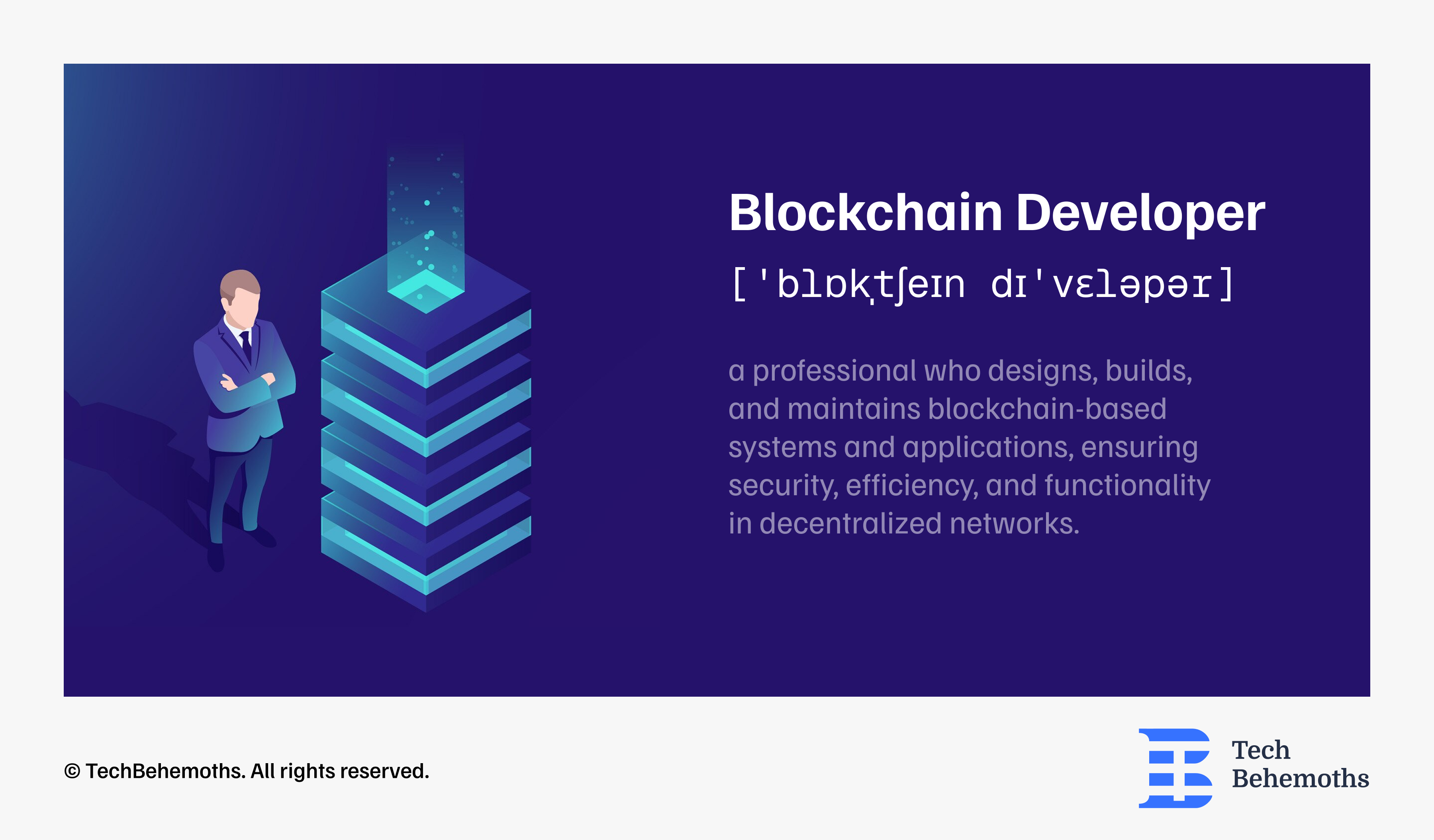
Some of the responsibilities of of a Blockchain Developer are:
-
Keeps the data related to digital transactions secure
-
Uses programming languages for building applications
-
Works in the development and deployment of smart contracts
-
Engages in the design and creation of Blockchain network architecture
-
Troubleshot the issues in the Blockchain network
What is the Cost of Hiring Blockchain Developers in Different Countries?
The cost is dependent on the country, in Europe for example expect to pay at least $30-70 / hour for blockchain development services. TechBehemoths lists hundreds of blockchain development companies from all over the world. You can easily filter the companies by price or region.
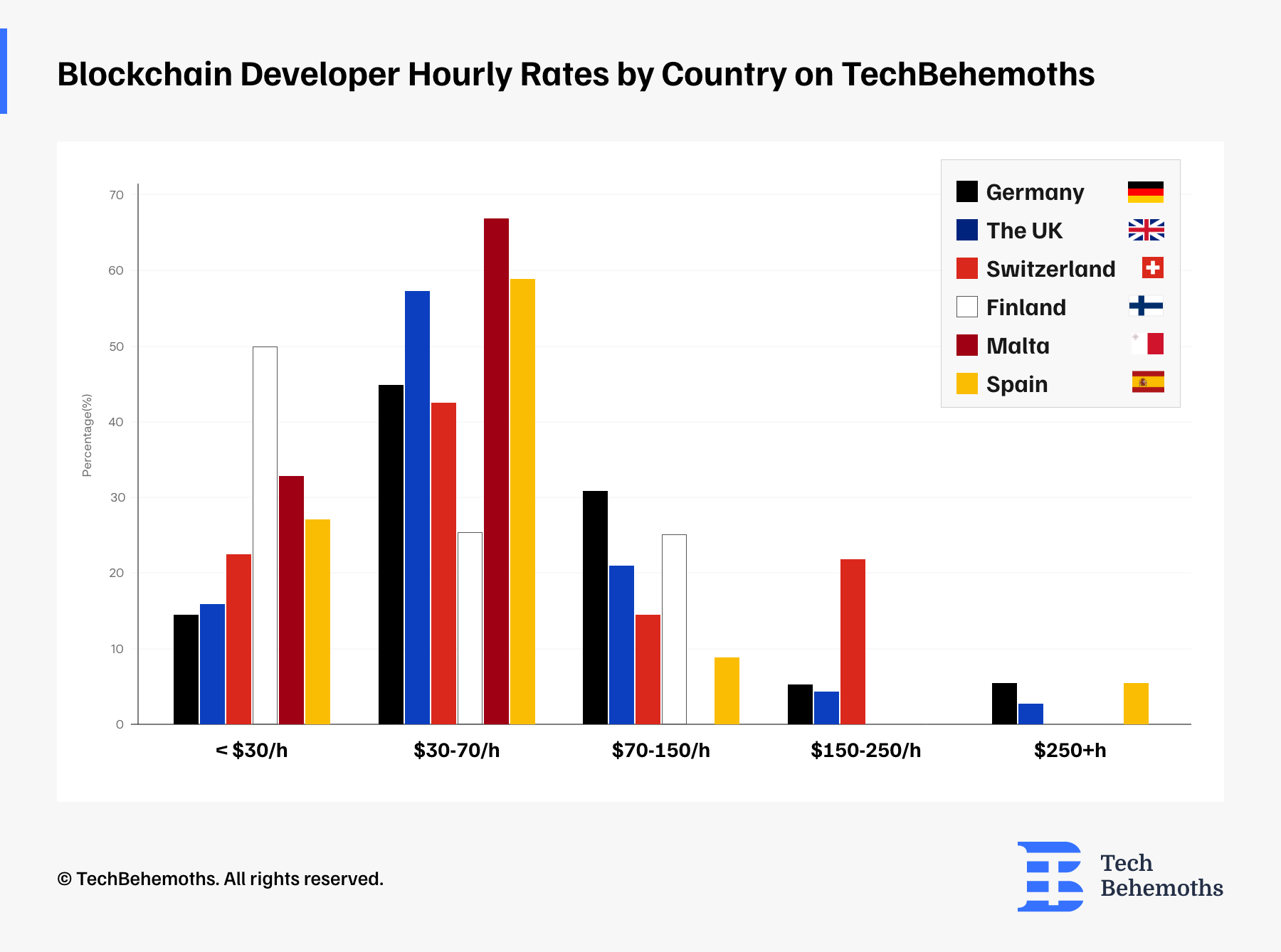
The hourly rate it’s just one criterion to keep in mind when you look for a blockchain service provider for your business needs. There are many other aspects to consider like company location, services, team size, portfolio, etc.
TechBehmoths has an advanced matching system to help you find the right blockchain service provider for your projects.