TechBehemoths Artificial Intelligence Expert Insights 2026


Summary
Adopting AI is no longer the biggest challenge - adopting it effectively is.
We asked two AI experts what separates successful projects from expensive experiments and where companies should focus their investments.
Artificial intelligence is no longer a question of if but where and how it should be applied.
To explore what separates successful AI initiatives from costly mistakes, we spoke with two industry experts. They share practical insights on the biggest misconceptions around AI adoption, how to determine whether AI is the right solution, where companies often overspend, and what it takes to build AI projects that deliver lasting business impact.
Meet the Experts
Egor Zaleski is the Business Development Operations Director at Oxagile, a New York, United States-based custom software development company specializing in AI, video streaming, AdTech, EdTech, big data, and business intelligence solutions. With over eight years of experience in SAP cloud technologies, he specializes in SAP Business Technology Platform (BTP), cloud-native application development, and enterprise software solutions.
Mohit Kaura is the AVP of Data Science & Data Engineering at MoogleLabs, a pioneering AI development company delivering artificial intelligence, machine learning, and low-code solutions for businesses worldwide. He specializes in Generative AI, LLMs, RAG, Voice AI, and cloud-native AI systems, helping organizations automate complex workflows and deploy scalable enterprise AI solutions.
Let's start with our first question.
What is the biggest misconception companies have about AI adoption?
Egor Zaleski, Oxagile
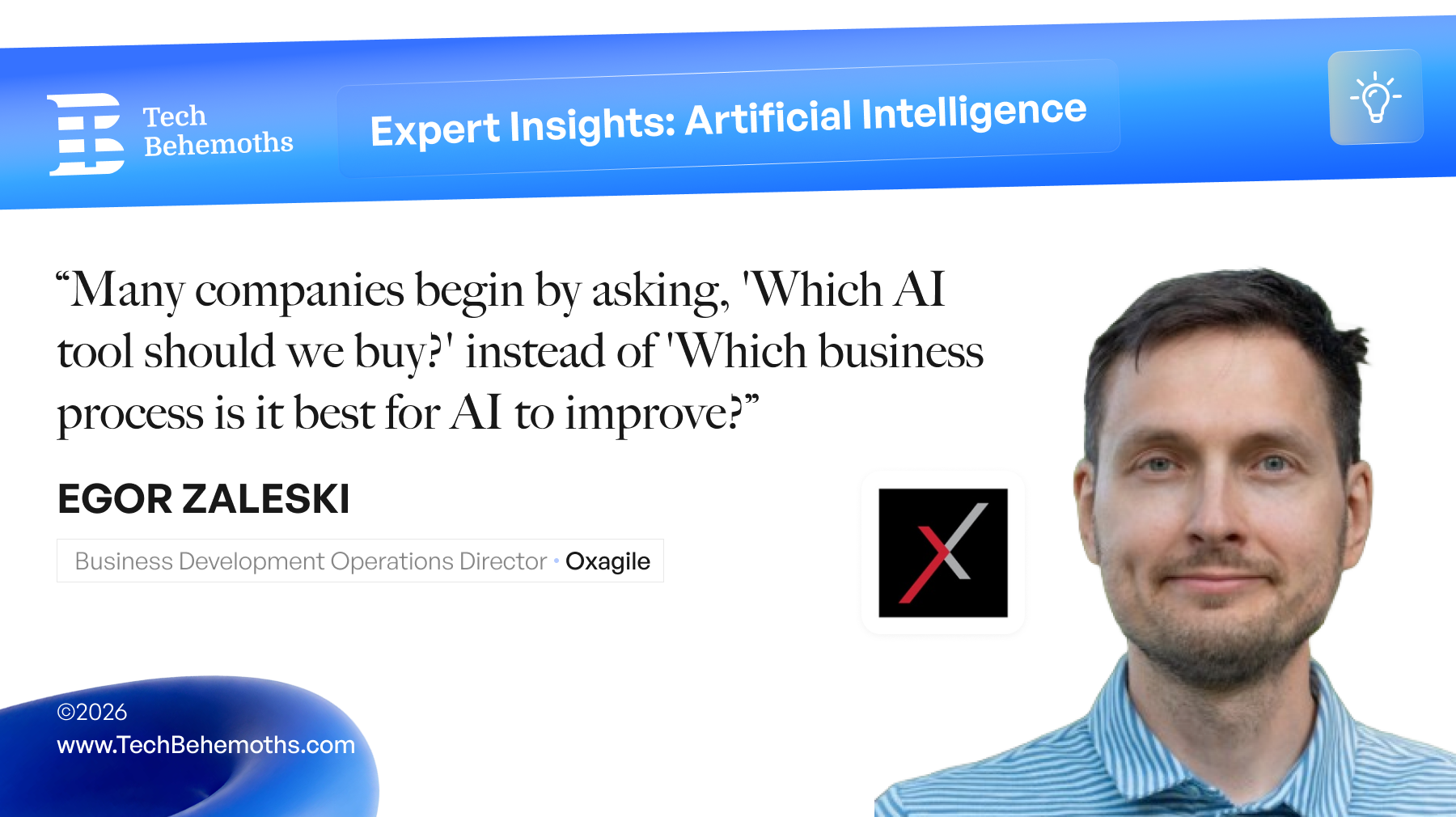
The biggest misconception is that AI adoption is primarily a technology decision. Many companies begin by asking, “Which AI tool should we buy?” instead of “Which business process is it best for AI to improve?” The model is only one part of the equation. The real work is use-case selection, data readiness, workflow integration, and clear ownership.
AI will not fix a poorly defined process or problem. In many cases, it will simply amplify its weaknesses. Successful adoption starts with a measurable business outcome: reducing processing time, improving personalization, lowering manual effort, increasing accuracy, or accelerating decision-making.
Mohit Kaura, MoogleLabs
One of the biggest misconceptions is that AI adoption is as simple as connecting an LLM API. Many people still believe AI is not reliable enough for production. While that can be true in certain domains, AI is rapidly improving and is already highly effective for many real-world tasks.
The real challenge is that successful AI adoption is not about making a few LLM calls and asking them to perform a task. It is about designing the entire system in which AI operates: defining what information an agent needs, where it comes from—another agent, a function call, a data pipeline, or user input—how long it should retain that information, and how it flows through the system. It is this overall agentic architecture that makes AI reliable in production, not simply connecting to an LLM.
How can a company determine whether it truly needs an AI solution?
Mohit Kaura, MoogleLabs
Not every problem requires AI. Companies should start by identifying the business challenge and determining whether AI can deliver meaningful value beyond traditional software solutions. If the problem involves large-scale data analysis, prediction, automation, or complex decision-making, AI may be the right choice. The decision should always be driven by measurable business outcomes and expected return on investment
What AI brings to the table is time saving, efficiency to do a task, scale it to 5x,10x or more while doing the same task which a huge human workforce is required to do like providing information over voice or chat as ai will more commercialize you’ll see more things in those spaces also a lot of work can be toned towards AI with the human supervision at commercial scale like – designing, content generation etc.
So you need to find your space: what is the thing which you can improve and automate.
Egor Zaleski, Oxagile
A strong signal that a company may need AI is when employees spend a disproportionate amount of time reconstructing context before they can make a decision or take action. This happens when knowledge is fragmented across emails, tickets, CRM notes, documents, call transcripts, policies, reports, or internal systems.
In those cases, the business problem is not just manual work. It is cognitive overhead. People are not necessarily slow because they lack tools; they are slow because they need to read, compare, interpret, and connect too much information. AI can help by compressing that context into summaries, recommendations, extracted fields, next-best actions, or risk signals.
If the process is structured, stable, and rule-based, classic automation may be a better fit. But if the process depends on understanding messy, changing, unstructured information, AI becomes much more relevant.
Where do companies most commonly overspend on AI initiatives?
Egor Zaleski, Oxagile
The most common overspend is not always the model itself. It is “AI theater”: expensive pilots, overlapping tools, broad Copilot-style rollouts, custom models, or agentic experiments launched before the company has a clear way to measure quality, risk, adoption, and business impact. Many organizations spend heavily on making AI generate outputs, but not enough on checking whether those outputs are accurate, useful, safe, and trusted by the people who depend on them.
Another major source of waste is solving a narrow business problem with an unnecessarily complex architecture. A company may not need a strong model or a fully autonomous agent. It may need better retrieval, better data pipelines, human-in-the-loop review, or a smaller workflow-specific AI layer. The best AI teams control spend by validating the cheapest architecture that can reliably solve the problem, then scaling only when the value is proven.
Mohit Kaura, MoogleLabs
The most common area of overspending is technology itself. Companies often invest heavily in platforms, infrastructure, or complex models before proving business value. In reality, successful AI projects depend more on quality data, clear objectives, and user adoption. Starting with targeted pilots and scaling based on results is usually far more cost-effective than making large upfront investments. Choosing the wrong tool or infrastructure for your problem – a problem can be solved using an SLM or a simple LLM using Heavly or most expensive tools for smaller tasks, understanding where inference is more important or where you should go with API’s.
What separates successful AI projects from unsuccessful ones?
Mohit Kaura, MoogleLabs
I think data and success metrics are the most important factors. You first need to define what "success" actually means. For some tasks, success is simply getting the correct answer, whether it takes 30 seconds or five minutes. For others, success means completing the task within five or ten seconds, where latency becomes more important, even if some accuracy can be compromised.
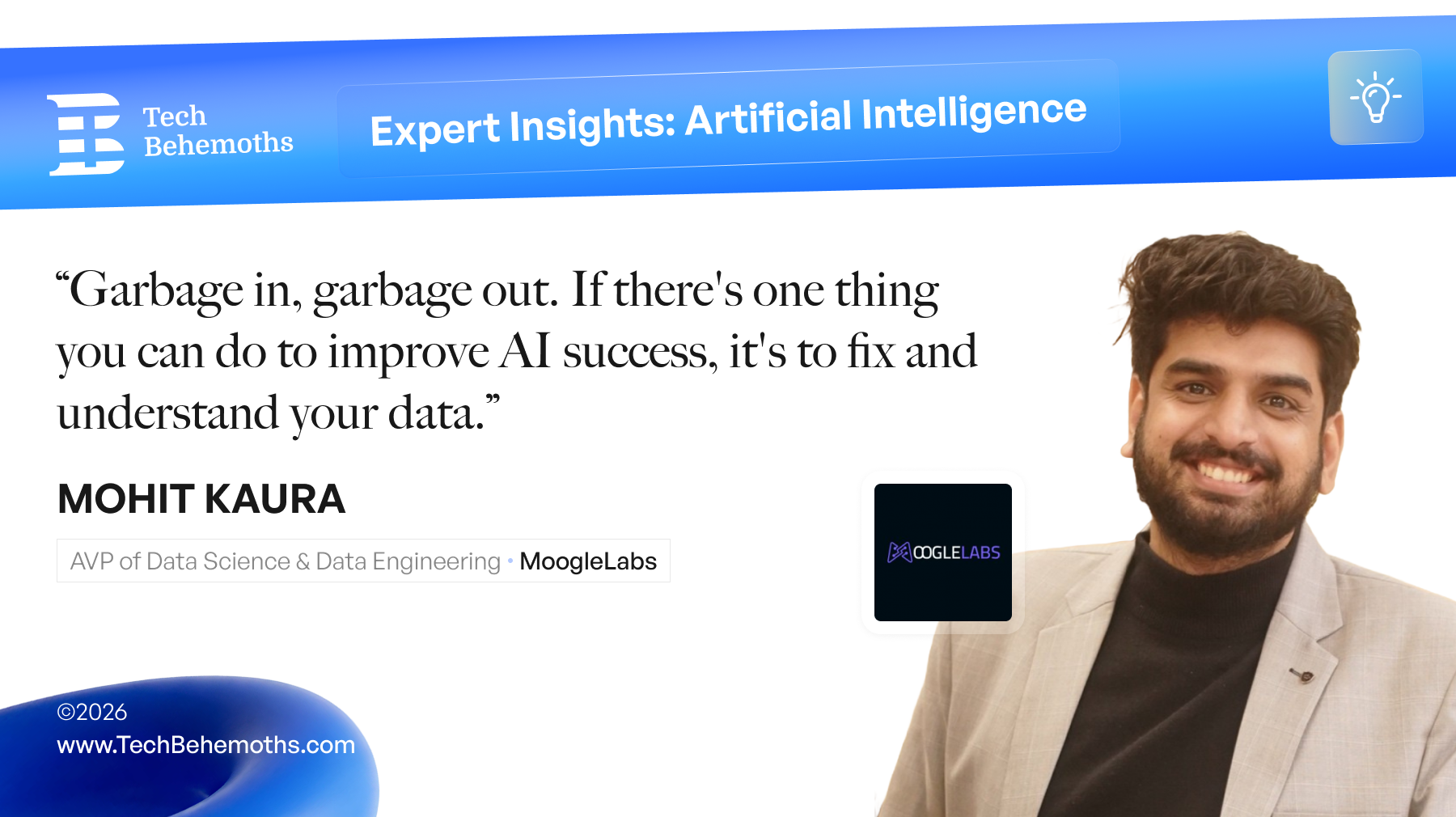
Most people don't realize that it's a trade-off when you start building AI systems. The second critical factor is data. Unless you're building an application that relies entirely on public data, the quality of your own data is the most important thing. It's the classic principle of "garbage in, garbage out." If there's one thing you can do to improve your AI's success rate, it's to clean, understand, and continuously improve your data.
What separates successful AI projects is a clear business objective, high-quality data, and strong organizational commitment. The most successful projects solve a specific business problem, deliver measurable value, and scale gradually. Failed initiatives often suffer from unclear goals, poor data quality, or unrealistic expectations. Equally important is user adoption—AI only creates value when people trust it and integrate it into their daily workflows.
Egor Zaleski, Oxagile
One major difference between successful and unsuccessful AI projects is the level at which value is measured. Weak AI initiatives often rely on surface-level metrics: number of users, number of prompts, time spent with the tool, or general productivity sentiment. Those numbers may be interesting, but they do not necessarily prove business impact.
Successful projects measure whether AI changes the economics of a workflow. Did it reduce cost per support case? Did it shorten underwriting or compliance review? Did it improve sales conversion? Did it reduce manual QA effort? Did it lower the number of escalations? Did it increase the capacity of expert teams without increasing headcount?
The strongest AI projects do not simply add a tool to the existing process. They redesign how the process works and measure whether the new process is faster, cheaper, safer, or more scalable. That is where AI moves from experimentation to operational advantage.
Both Experts Agreed That:
AI should solve a real business problem.
Companies should define clear objectives, identify where AI can create measurable value, and avoid implementing AI simply because it's a trend.
Data quality is a critical success factor.
Even the most advanced AI models cannot compensate for poor or fragmented data, making data readiness essential for reliable outcomes.
Successful AI initiatives focus on measurable business outcomes.
The goal is to improve efficiency, reduce costs, accelerate decision-making, or enhance customer experiences—not to experiment for the sake of using AI.
Start with a focused use case and scale gradually. Technology alone does not guarantee success.
Lasting results come from combining the right processes, high-quality data, and user adoption, making AI a practical part of everyday workflows rather than a standalone experiment.
Thank you to Egor Zaleski (Oxagile) and Mohit Kaura (MoogleLabs) for sharing your expertise and contributing to TechBehemoths Artificial Intelligence Expert Insights Edition 2026
Looking for AI Development Services?
Check our list of top AI development companies
Did you enjoy reading the interview?
I absolutely love embracing new opportunities and connecting with people. Every project is a chance to analyze, create, and work until I am satisfied with the results. Bringing creativity into every aspect of my work offers a fresh perspective on turning ideas into reality. Paying attention to the details is key because it's the little things that truly make all the difference.
Discover more TechBehemoths Insights
Learn practical tips and insights about IT Companies, how to find the right company for your projects.
Read the latest news about Market Trends and fresh Interviews.