Explore Top UX/UI Design Companies in Albania
AGJENCI DIXHITALE DHE QENDËR TRAJNIMESH PROFESIONALE NË DURRËS. Çertifikohu në gjuhë të huaja, programim, marketing dixhital, SEO, dizenjim grafik ...
7th Block Technology & Communications is a marketing and software development company operating in Albanian & international market.

Professional sites, e-commerce websites and custom development

Rubik Technologies is a digital agency based in Tirana, specialized in offering Web and Mobile Development Services, IT Recruiting and Body Rental.
Services:
- 1
- 2
Filter UX/UI Design Companies in Albania by Cities
Find the right tech company near you or from a specific city. Some of the best companies might be located in smaller cities.
Find more UX/UI Design companies around the world
TechBehemoths is the world's most advanced and user-friendly platform to match IT Companies with real clients without hustle.
The Albanian ICT Industry: Data & Insights
IT is the fastest-growing sector of the republic’s economy. Hardware is the largest segment, with 55% percent, the ICT market in Albania is the second-largest segment with 30% and software represents 15% of the ICT market.
Some of the advantages of Albania are the skilled and low-cost workers with high English skills and ICT-related education, a good infrastructure, and low taxes for corporations. The sector has constant growth, and it supplies other countries with well-educated IT professionals.
Also, Albania’s outsourcing industry is expected to reach $57,42 million in 2025, and today there are over 40,000 professionals in the ICT and BPO sector. Information technology sourcing (ITO) will continue to offer the majority of the employment in the industry.
Why Should Somebody Work With Albanian Companies?
There are many reasons to work with Albanian companies, from the highly qualified professionals, the low salaries, with software engineers' median salary being $1,260 - $2,508 a month with 1 to 2 years of experience, the low taxes for companies, to the constant growth of the industry, and being near the European Union.
These are some of the advantages of working with Albanian companies: the low cost while still being a country near the EU, also the transit is easy with Albania because of the advantage of having a Schengen Visa and no need to have a national entry visa, which makes business easier.
There’s a good cost-safety relation with outsourcing IT projects to this country, which is why there are companies in over 37 countries, including Europe, North America, Asia, Australia, the Middle East, and the Scandinavian countries. There are also a good number of international companies, such as Switzerland, Sweden, France, the UK, and Malta that are developing IT products in Albania for other markets and providing cheaper costs to multinational IT companies.
What Somebody Should Be Aware of When Working With IT Companies From Albania.
The first thing you have to be aware of is that Albania is not in the European Union, so there may be different rules and laws, and of course, you are not under the protection of some EU Agreements or laws; this also applies to some international agreements. It is important to say that Albania is a generally speaking safe country, but there are a few things to take into account when working with IT companies. If you plan to have a meeting, there’s a high risk of natural disasters. Unfortunately, the country has some geographical features that make earthquakes, floods, torrents, and droughts something normal. In addition to this, some terrorist attacks have happened since the year 2000 (8). Organized criminal groups are active, particularly in the northern areas at the border with Kosovo, but shooting incidents can also happen in Skopje, which is the capital of the country. Also, gunfire can be heard as part of a celebration.
In other aspects, fake companies' scams can occur, but they are not too common. The safety is compromised in some parts of the region, but while working with this industry as outsourcing services, there are no more risks than in other countries in the region. It is important to find companies with proven experience. There are a lot of big companies that work as usual from other countries in the region without any noticeable incidents. Be sure that the company follows international best practices and everything is according to the law.
How Reliable Are IT Companies From Albania?
With the fast growth of the IT industry in the country, scams grow too, but generally speaking, Albanian companies are certainly reliable. Some laws can help with this, some of the industry-specific laws are the following:
- Agreement between Albania and the EU for the “Horizon 2020” program.
- Law of Copyrights.
- Methodology for Assessing the Value of Information Technology.
The ICT industry is really an important piece of the general economic situation of the country, even if it’s not its main driver. Also, Albania is ranked #41 on the Mobile SpeedTest Global Index 2025. And for desktop, mobile, and tablet median speed was 104.11Mbps download and 17.53Mbps upload speed.
How Does the IT Industry in Albania Relate to the Neighboring Regions/Countries?
In relation to this, we will analyze the IT industry in Albania, Kosovo, and other countries.
Albania has a very young working population, with 69% of the employees being between 25 and 29 years old. Their major market to export to is Italy, with 24% of IT services. Also, this country has the lowest corporate tax rate for those companies whose activity is software development, and the country has a very strong entrepreneurial potential, while the government continues to boost laws and strategies to help with this.
The ICT sector in Kosovo has a positive trade balance, where 78% of the companies export services, being 27% to Switzerland and 23% to Germany. Also, the government works with laws and opportunities to offer strong learning in IT and English skills.
Bulgaria is a very attractive country for IT and business production outsources, with its software development outsourcing sector rising significantly to $900 million and the expansion of the ICT industry by 300% valued at 2.5 billion euros. We can also see its good development, as in 2024 it was ranked 38th by the Global Innovation Index.
After bad performances from 2014 to 2016, Greece has stabilized the IT sector and, from 2017, started to show slow but steady growth. In 2025, the software market is expected to reach $446.9 million, with the dominant segment Enterprise Software with a market value of $189.02 million the same year, according to Statista. Their internet connection is up to standards, having a solid 4G network and ranked the 32nd globally with a download speed of equal to 123.93 Mbps and an upload 16.29 Mbps.
We also need to have a look at Romania’s industry to finish this section. This country has particularly well-qualified management and technical workers; the current trends in outsourcing in Eastern Europe have allowed Romanian IT service providers to establish themselves in a high position when compared with other European competitors. This country is the 6th in the world, regarding IT certified specialists per capita, ahead of Germany, the UK, and Canada, because of their multilingual and technical skills.
Albanian ICT in 2025
It's 2025 already, and Albania is still not an EU member state, which makes the country's ICT sector lose multiple opportunities for its tech industry. However, things don't look so bad after all - between 2021-2024, the EU is financing Albanian tech capabilities with more than 455 million euros. The funds will be used to power up the startup ecosystem and encourage tech entrepreneurship. So, with some funds and a lot of ambition, the Albanian tech industry has all the chances to shine on the European stage.
Conclusion
Albania is a good country in terms of IT industry development. You can find qualified professionals and companies with cheap prices for outsourcing services. The law and the taxes are also favorable, and there are a lot of companies from other countries that develop their companies and services in this country. It’s needed to be aware of some aspects that we already discussed in the relevant section, as it’s generally a safe country, there are some things you have to be aware of such as the possibility of natural disasters, scams or terrorist attacks, if you are trying to outsource your products or services to this country, the majority of these aspects will not affect you as you don’t have to be there, but be aware of the scams and always choose companies and professionals with proven experience to work with, and then you’ll be able to get all the benefits of outsourcing your services to this country and also helping them to boost their ICT industry.
What is UX/UI Design and what are its benefits for your projects?
Have you ever noticed how some websites and apps just feel easier to use than others? That's because of the UX/UI design - basically, the people who make sure everything looks good and is easy to navigate.
UX/UI design services are closely connected, but they are not the same. They are actually about different parts of the design and to be effective they must work together.
-
UI (user interface) design concentrates on visual elements. It is all about how things look and work on a product, like colors, fonts, and buttons.
-
UX (user experience) refers to the overall experience a person has with a product - how easy it is to use the product, how it makes the user feel, and whether it is possible to easily get what is needed from it.
According to research conducted by Forrester, a well-designed user interface (UI) can increase a website's conversion rate by 200%, whereas a better user experience (UX) design could raise it by up to 400%.
In this connection, the importance of UX/UI Design cannot be overstated. Nowadays users have high expectations for the products they use, if a product is not easy to use or enjoyable, users will quickly abandon it.
UX/UI design can help:
-
Enhance user satisfaction
-
Reduce bounce rates
-
Lead to higher customer retention and revenue
UX Design has also an important role in Inclusive Government Design, which makes government services accessible and user-friendly for diverse and marginalized communities.
But how do choose the right UX/UI Company?
-
Review the company's portfolio and make sure they have experience in your industry
-
Look for companies that understand your target audience to meet their needs.
-
Inquire about their design process: research, wireframing, prototyping, and testing.
-
Choose a company that maintains transparent and open communication and keeps you involved throughout the design process.
-
Read client reviews to check their reputation and client satisfaction.
-
A good design company should be up-to-date with the latest design trends and technologies.
Taking into consideration all these tips you will manage to select the right UX/UI Design Company that will help to achieve your goals.
There are over 13,800 UX/UI Design companies on TechBehemoths platform. Check their profiles, their strong portfolios, and previous clients' reviews before you make a decision. With the help of smart filters, you can easily find suitable partners to deliver exceptional digital experiences. Alternatively, you can submit your project, and the system will find the best match on your behalf.
UI/UX design in the AI era
As AI tools evolve and become more capable of prototyping and designing layouts, the human/emotional aspect will become even more important. AI can't experience and tell and illustrate personal stories, while UI/UX designers can. This human/personal touch will become a valuable part of UI/UX work.
You can interact with the web in multiple ways: using text, voice, images, videos, VR, etc. All these require user interfaces adapted to different needs and scenarios. Professional design agencies should be able to deliver interfaces and UX for multiple interaction modes and devices like smartphones, VR headsets, smart glasses, etc.
The importance of UI/UX for your leads/sales
Lots of websites lose their visitors without a single click. Poor UX design is almost always the reason, and most business owners don't even know where the problem is.
On average, websites convert only 2–3% of visitors. This means the majority of visitors land on a site, browse for a few seconds, and leave without taking any action. Business owners express this as one of their most common frustrations.
How to solve this problem?
The answer is simple: make it easy for visitors to take desired actions on your website, such as viewing a product page or service, completing a purchase, or downloading a resource.
Your website should communicate effectively, guide users, and convince them to take a specific action.
Why your website doesn't convert
There might be multiple reasons, but here are the most common ones + some tips on how to improve your UX to convert visits into leads/conversions.
1. The first seconds count
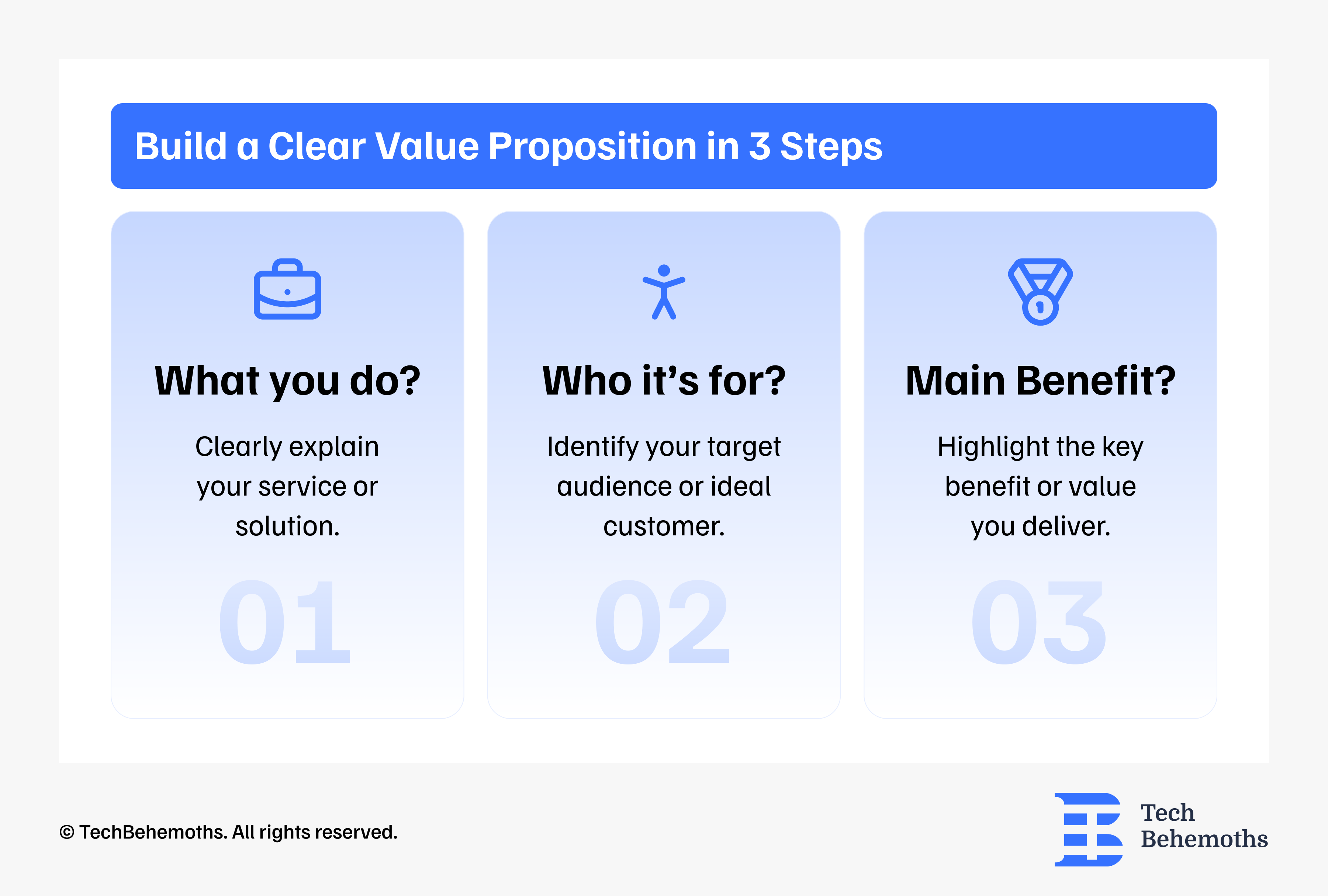
How to fix? Start with a clear value proposition that shows the benefits and answers these three questions right away.
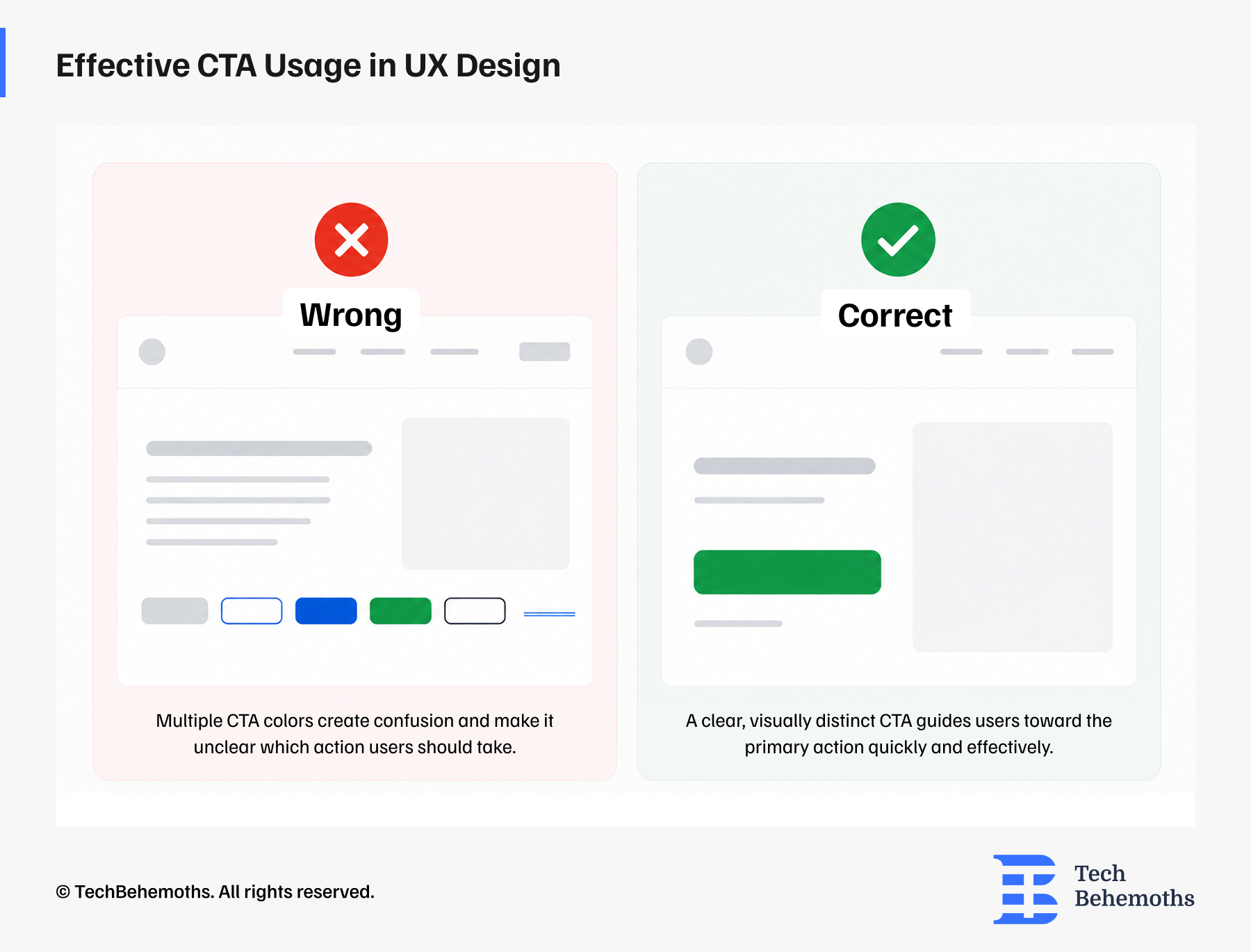
2. No call to actions (CTAs)
How to fix? Your service/product and other important pages should have one primary CTA, and it should be: specific, prominent, smooth/short. Example: Get a free quote.
3. Poor mobile UI/UX
How to fix? Focus on mobile-first UX design, which means designing the mobile experience first and then adapting it for the desktop experience.
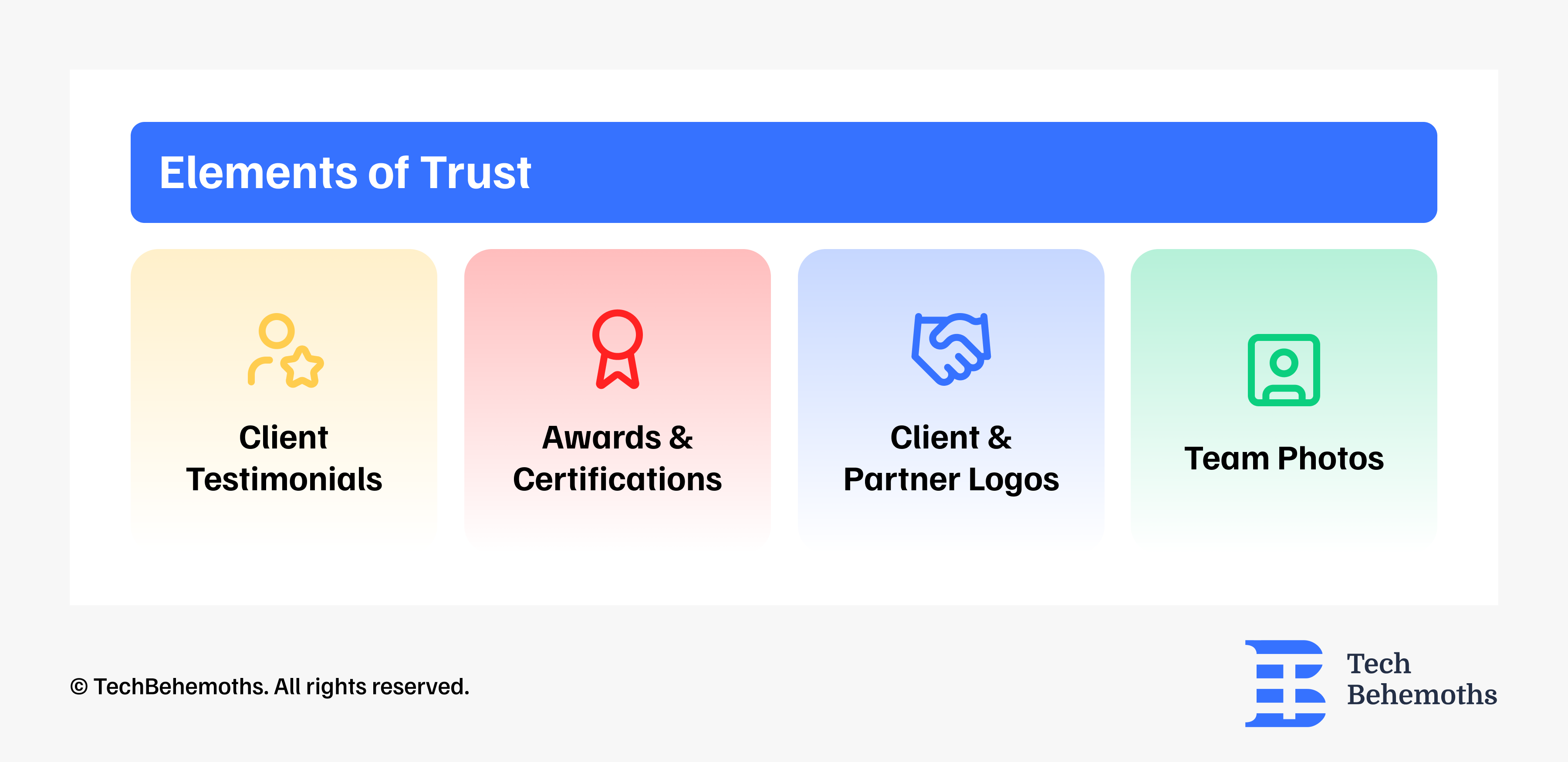
4. No social proof
How to fix? Place trust signals throughout the conversion path: client testimonials, reviews, awards, certifications, team photos, etc.
5. Complex navigation/structure
How to fix? Simplify your navigation and content structure by limiting menu items, using plain language, making contact options visible and accessible from everywhere, using proper visual hierarchy.
6. Slow loading time
How to fix? Optimize your web pages for speed, especially for mobile devices. Use modern image formats like webp, compress images, use reliable/fast hosting, minify JavaScript/CSS, don't usee too many 3rd party services.
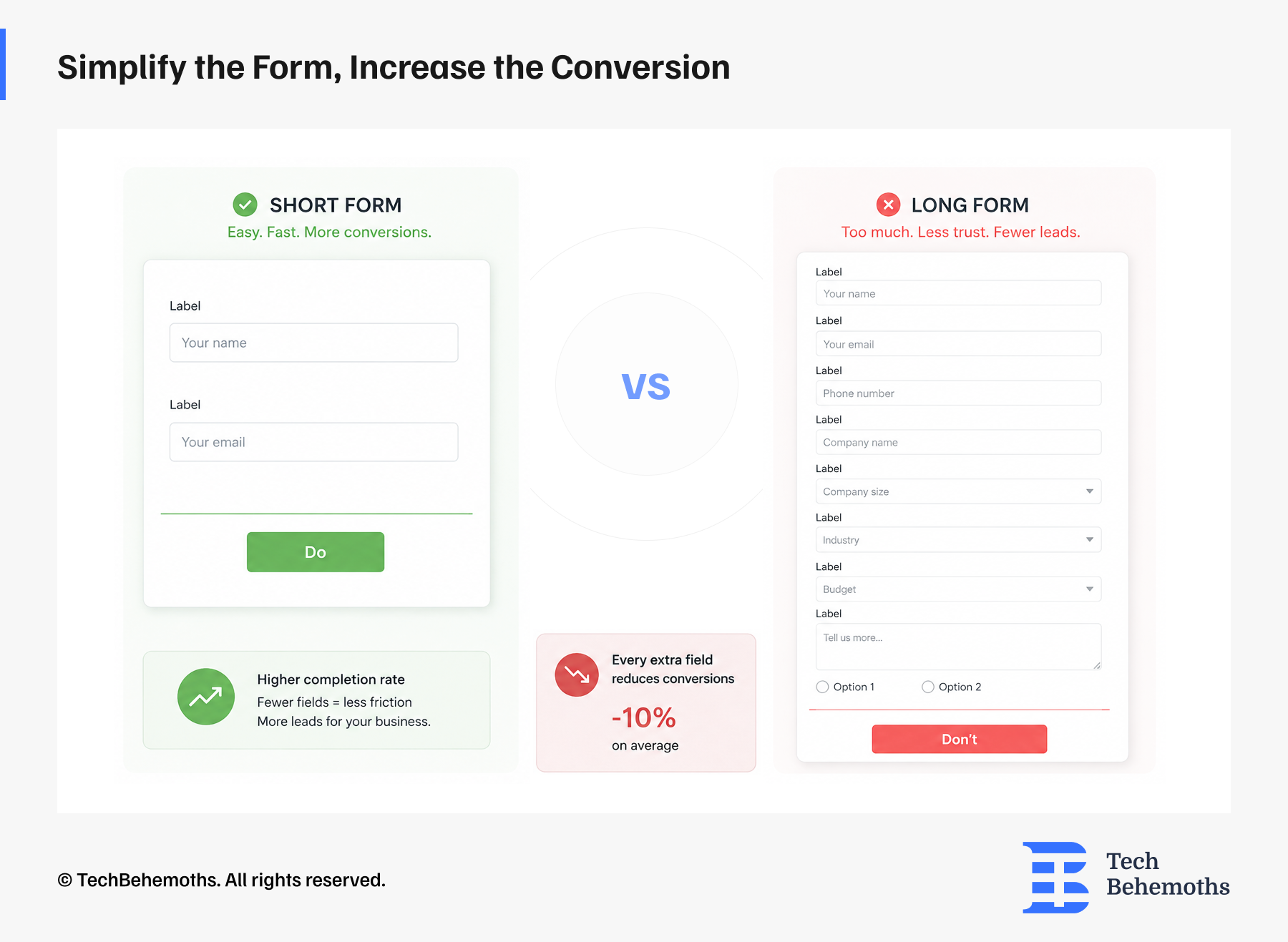
7. Too long forms
How to fix? Use the minimum required number of input fields: name, email, and one open field. Don;t overwhelm users withh too many questions and options.
How to choose the right UX/UI agency?
Choosing a UX/UI agency is a business decision with consequences that show up months after the contract is signed. Most companies evaluate agencies based solely on portfolios and presentations, which are the things easiest to polish and hardest to verify.
What separates a good hire from an expensive mistake is usually visible before you sign anything. You just have to know where to look.
How to do research UX/UI agencies, the right way
Most users go straight to the portfolio, and that's ok, but it's not the whole picture. Here are the criteria that actually matter before you reach out to anyone.
1. Portfolio, look past the aesthetics
Good UX agencies solve different problems differently.
2. Research, visuals are not enough
Any agency can show you Figma files. Ask them to walk you through how they got there. If there's no mention of user interviews, usability testing, or data, the work is decoration, not design.
3. Industry experience is useful, but not mandatory
For fintech, healthcare, or anything with compliance layers, prior domain experience saves valuable time. Sometimes, an agency coming in fresh can be the better bet, having a different perspective
4. Negative client reviews
A profile with an ideal five stars rating is worth questioning.
5. Who's exactly working on your project
The number one complaint in the agency world is the bait-and-switch, a senior partner sells the deal, but junior interns do the work. Before moving forward, ask who's actually doing the work. Thirty minutes of reference calls can save you thousands in wasted fees.
6. Not all UX/UI projects are the same
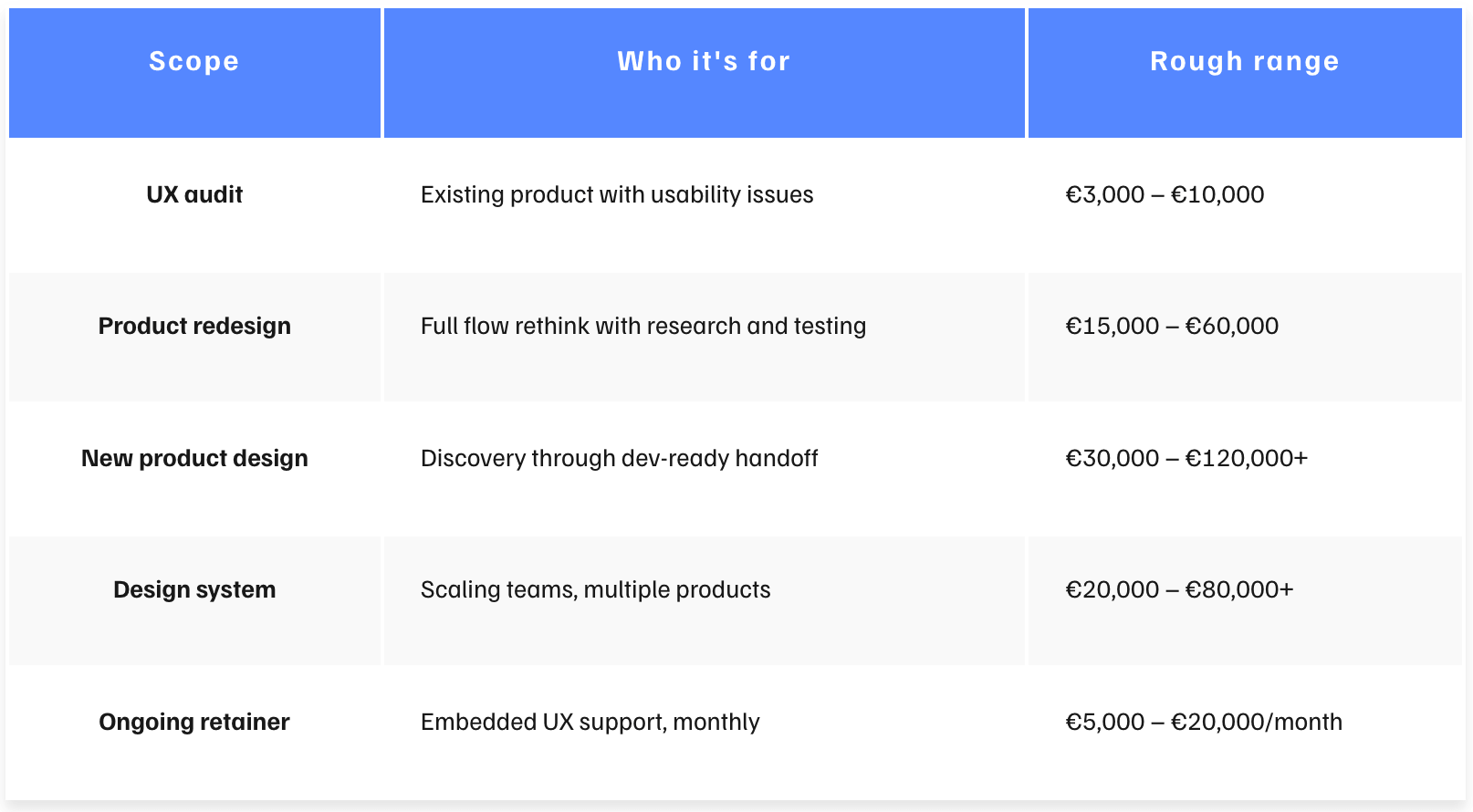
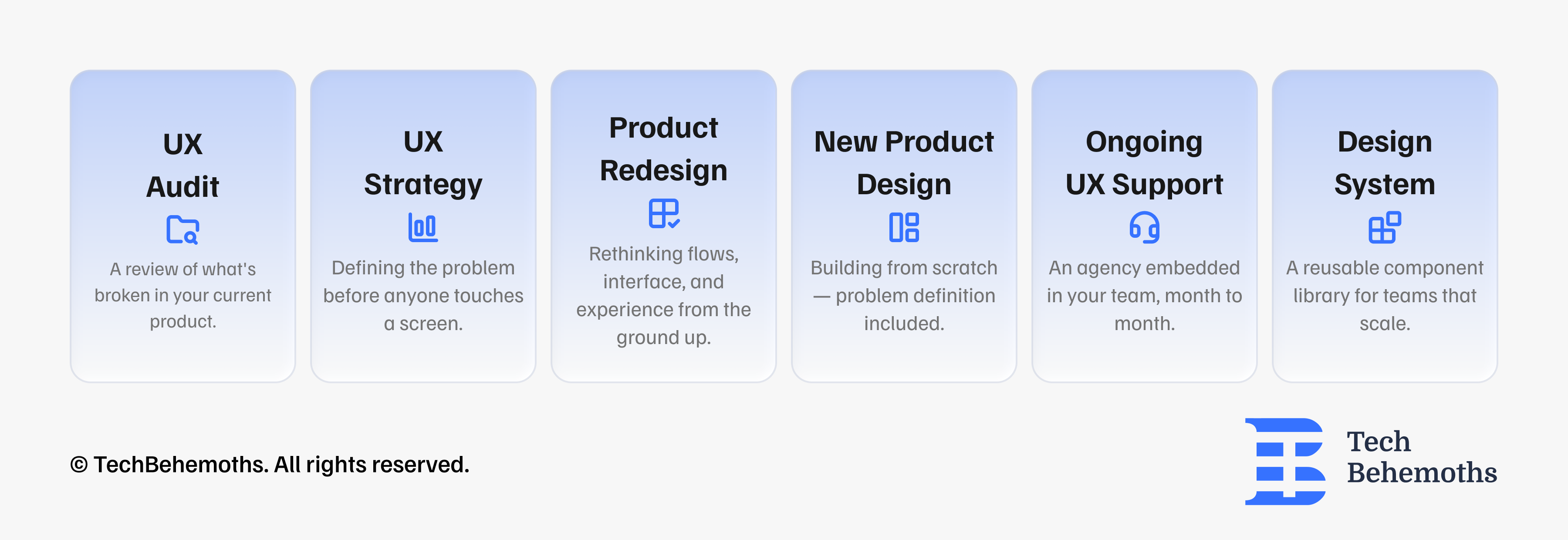
Before you talk to anyone, get specific about what you're buying. UX covers a wide range of work, and the type of agency you need depends on what the actual problem is.
Here is a set of common UX/UI tasks to keep in mind.
How to shortlist the right agencies?
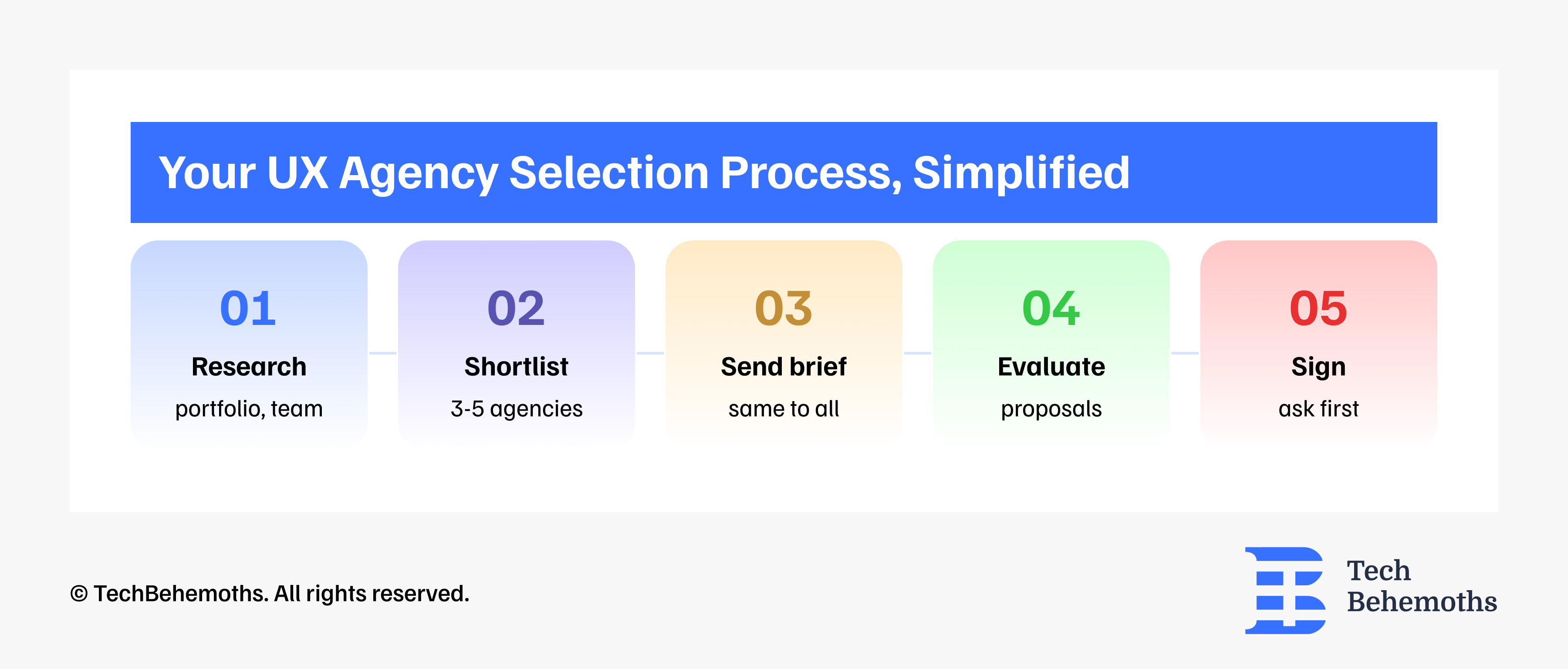
Many clients speak with 15 - 20 agencies and end up more confused than when they started. A practical approach looks like this:
-
Start with a larger pool of companies
-
Narrow it to around 10 agencies
-
Shortlist 3-5 agencies
-
Send the same brief to everyone
-
Compare proposals and communication styles
-
Choose one partner
A poorly scoped engagement can lead to a bad return/outcome. A bad agency hire costs approximately €115,000 when you calculate wasted fees, the cost of a redo, and months of lost market time.