Explore Top Mobile App Development Companies in Uganda

Flex your Brand

Sofdas is your partner in navigating the complex landscape of modern technology, ensuring your business remains competitive and secure.

For creative graphics, websites that sell, business cards they'll actually keep and pixel clear large format printing.

Deepcode Innovations Limited is an ICT service provider base in Uganda aiming at providing her customers with innovative solutions to her customers
Superior in Cloud Computing, Cyber Security, Digital Forensics, Network Solutions, Systems Development, ICT Consultancy, Technology and Innovation

Empowering the Businesses by Providing Customised AI software solution, AGI, ML and Robotics.
Kiri Cyber Services is a cybersecurity, web development and web designing company. Basically, we focus on the Information Technology niche.

We are a software development company in Kampala, Uganda. We develop websites, mobile apps and custom software solutions.
GICT AFRICA TECHNOLOGIES is a leading Software development, website design and hosting company in Uganda The Mobile Apps and Software that we develop

Developing Business Through Technology

We specialize in business technology solutions most especially Website designing and Development for companies and individuals in all Kampala.

Cost-effective Enterprise Cloud services, Managed IT services, Web solutions, Cyber Security, IT consultancy and Software development in Uganda.
Nobicom Technologies Ltd Trading as NobicomLabs is A software Company based in Kampala to provide Software Solutions & ICT Consulting

We develop responsive websites, cross-platform mobile applications, blockchain (decentralized) applications, and training among others.

we are a full, ICT service company, data analytics, system development, networking, hardware installation, maintenance, web design, and hosting.

Web Development Ug is a Digital Agency based on creative and result-driven solutions.
- 1
- 2
Filter Mobile App Development Companies in Uganda by Cities
Find the right tech company near you or from a specific city. Some of the best companies might be located in smaller cities.
Find more Mobile App Development companies around the world
TechBehemoths is the world's most advanced and user-friendly platform to match IT Companies with real clients without hustle.
The IT Industry in Uganda: General Snapshot
Uganda’s IT Services market is predicted to reach UGX US$335.98m in 2025, with a CAGR 2025-2030 of 8.48%. The IT Outsourcing segment accounts for the vast majority of this, at around UGX US$123.71m in 2025. Other important contributors are broadcasting, data center services, cloud, IT, and BPO.
Uganda’s combination of relatively stable governance, strategic location, and young and innovative population has made it an attractive destination for multinational companies. Several notable firms, such as Google, Microsoft, and SAP, have offices in Kampala, and some have based their entire African operations from these offices.
Why You Should Work With Ugandan IT Companies
Digital service providers in the cloud and BPO markets are primarily involved in the provision, rather than the development, of services, whereas Ugandan firms are more prevalent in the fintech and e-commerce markets. The physical technology required for the delivery of digital services is typically imported, and it is not clear that Uganda could produce these products more efficiently.
A key strength in the digital services market is the acceptance of mobile services. Any consumer solution entering the market would have to be mobile-compatible. Mobile healthcare services are expected to grow particularly rapidly as the sophistication of these offerings increases.
What to Pay Attention to When Working With Ugandan IT Companies And Web Agencies
On the consumer side, it is vital that any proposed digital service offering be mobile-compatible due to the prevalence of mobile usage in Uganda. Furthermore, smartphone penetration in the region is steadily increasing, thus increasing the sophistication of viable digital service offerings.
Given the acceptance of fintech by the Ugandan population, a possible route to entry in the consumer market is to acquire one of the many smaller fintech firms in the industry. This would resolve some of the primary barriers to entry, most specifically bureaucratic red tape and a lack of local knowledge.
On the corporate side, the most effective route to entry is likely through partnerships with smaller local resellers. This model is already popular in the Ugandan market. A key differentiating feature here will be how well the service adapts to the Ugandan market.
How Reliable Are Ugandan-based IT Companies?
Considered to be one of the biggest African IT hubs, Ugandan web agencies and IT companies compete only with Ethiopian ones in terms of reliability. As many foreign companies have already invested and thus developed the local IT infrastructure and industry overall, Ugandan IT companies find it easier than other neighboring countries to enter the global market and provide their services at accessible prices.
How Does the Ugandan IT Industry Relate to the Neighboring Countries?
Uganda is actively trying to establish itself as a key ICT hub in the East African region. The country appears to be making good progress in this regard, helped by having a strong connectivity infrastructure and a young, innovative population. Despite this, the country currently faces considerable political uncertainty, and issues surrounding the transparency of tenders remain a major barrier to growth.
Although Uganda’s score for the metric measuring the economic impact of ICT is not high in absolute terms, it ranks 54th in the world. This supports the conjecture that businesses, government, and consumers will be receptive to new technologies, as ICT has already had a substantial impact on the Ugandan economy.
How will ICT Impact Uganda in 2025?
Uganda has lost one of the telecom investors and operators on the market, Africell. The change has an immediate effect on the labor market and telecom industry. The reasons behind leaving Uganda are in limited possibilities the country offers to the telecom operator. For Uganda, 2022 is a challenging year in ICT, with a low internet penetration rate, tech education, and competitiveness.
In 2025, the ICT in Uganda has a goal of becoming a digitally driven society in the economic and public services sectors. The government implemented the Digital Transformation Roadmap (2024-2028) with a focus on digital agriculture, mHealth solutions, youth skilling, and scaling Uganda’s BPO sector, leading to more jobs and unlocking economic resilience.
What is Mobile App Development and what are its benefits for your projects?
Mobile app development is the process of creating mobile apps for popular mobile operating systems like Android and iOS.
There are about 7 billion smartphones worldwide, meaning that more than 85% of the world’s population has a mobile device at their disposal to perform various tasks online or offline.
Having a mobile app, businesses can reach a wider audience and have more control over their marketing activities. The benefits are obvious:
- Increases your brand awareness
- Creates a new marketing channel
- Creates a new feedback channel
- Improves your customer service
- Builds customer loyalty
- Improves your sales flow
Choosing the right mobile app development company to work with is not an easy task. There are multiple aspects to consider:
- Location
- Price
- Team size
- Previous experience
- Turnover time
- Communication means
You should also define your project specifications and set up clear goals and objectives, in order to get relevant offers and collaborate successfully with the companies you choose.
There are more than 9,600 service providers on our platform which offer a wide variety of mobile development solutions. Explore their profiles and feel free to get in touch with them.
To ease the selection process, we’ve created a powerful filter which you can use to narrow down the results based on your requirements and shortlist the companies.
Alternatively, you can submit your project and our team will select and send you the best matching companies in about 1 hour. It’s free and there is no obligation to hire.
Do Businesses Need Mobile Apps? The Answer is Obvious
Users are currently browsing and using different platforms and channels (AI chatbots, search engines, social media, email, etc.) to make a decision and ultimately purchase a product/service. Mobile devices became a significant part of their lives, so businesses need to adapt and deliver solutions for different kinds of devices and operating systems.
At minimum, businesses would need to offer a mobile app listed on Play Market (for Android) or App Store (for iOS), or offer a mobile first user experience on their websites.
The reality is that more than half of the companies don’t have a mobile app yet, or are just planning to develop one.
According to the latest survey on mobile apps conducted by TechBehmoths, 62% of businesses don’t have a mobile app and don’t plan to develop one, while around 19% of businesses don’t have one, but are planning to create one in the future, and 30% of businesses have a mobile app.
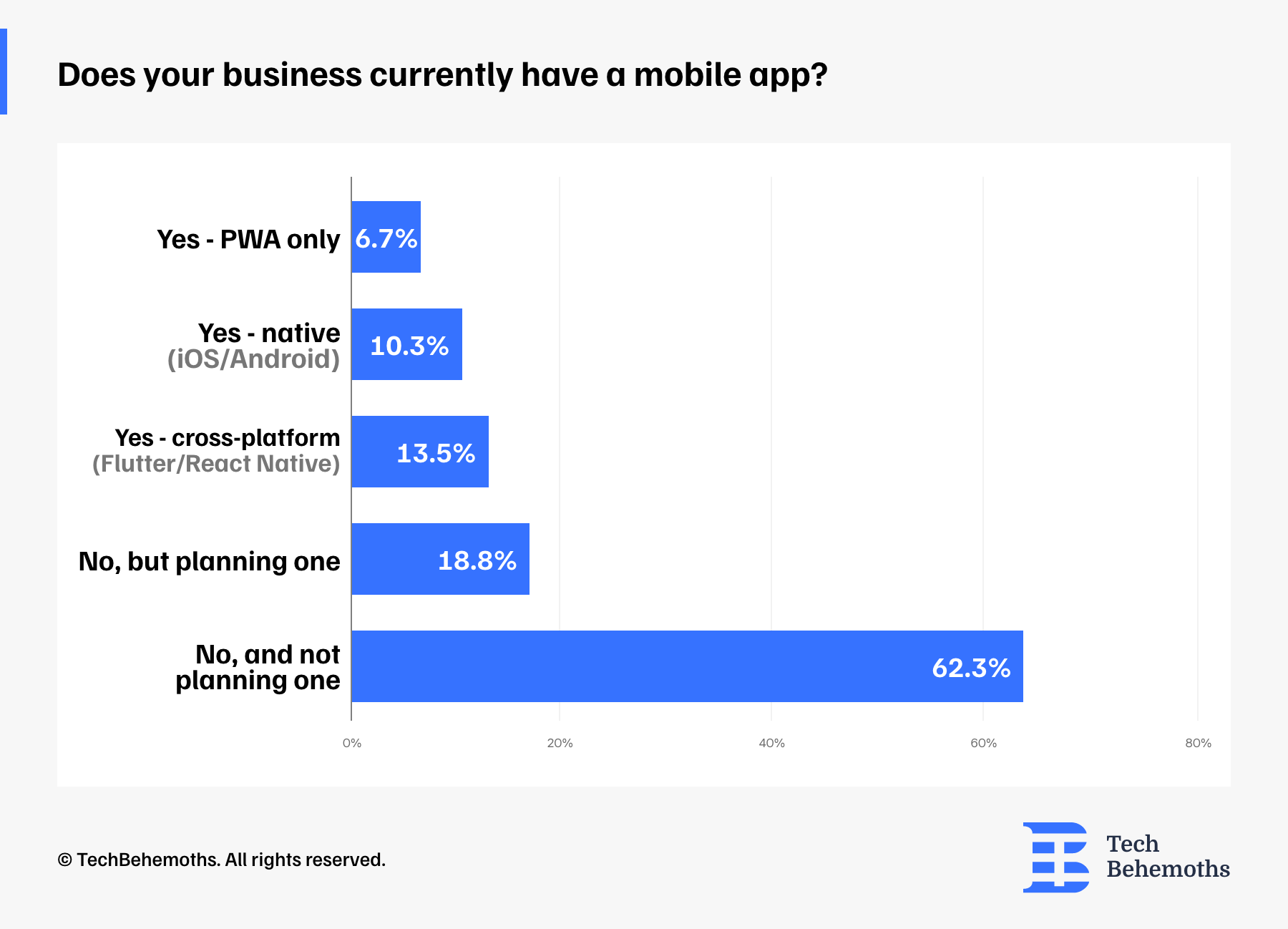
Of those firms that have one, the most popular mobile application types are the following:
-
Cross-platforms mobile apps - when mobile apps are coded once and compatible with multiple mobile operating systems like Android and iOS
-
Native apps - when mobile apps are specifically created for iOS, Android or any other mobile operating system
-
PWA (progressive web apps) - these are web applications that provide a mobile app like experience on web browsers (desktop or mobile)
Companies can benefit from mobile apps in multiple ways. Here are the main advantages:
-
Customer acquisition - there are billions of smartphone users worldwide, so it’s essential to reach your customers on the devices they use
-
Revenue growth - mobile apps provide an extra channel to grow your revenue. With the rise of mobile banking, payments and transactions are not happening solely on desktops devices anymore. Digital commerce spend is expected to reach around $34 Trillion by 2029 (source)
-
Brand visibility - mobile apps offer a consistent channel for brand awareness and marketing
-
Internal operations - some companies choose the convenience of mobile apps to run internal operations like education, onboarding, HR, logs/checks, etc.
-
Customer service - serving customers via mobile apps might be the fastest and most efficient way to keep them happy
-
Customer retention - mobile app push notifications is possibly the fastest way to keep clients engaged and offer promotions
-
Availability - mobile apps are there for users 24/7
Having a website might not be enough to acquire new customers and serve existing ones. Today's reality is that pretty much everyone is online and using a smartphone device for both entertainment and work.
Mobile apps will inevitably become a priority for most businesses in the next couple of years.
Companies have the option to build mobile apps in house or hire mobile app development providers. For less complex projects, low-code or no-code app tools might be worth considering.
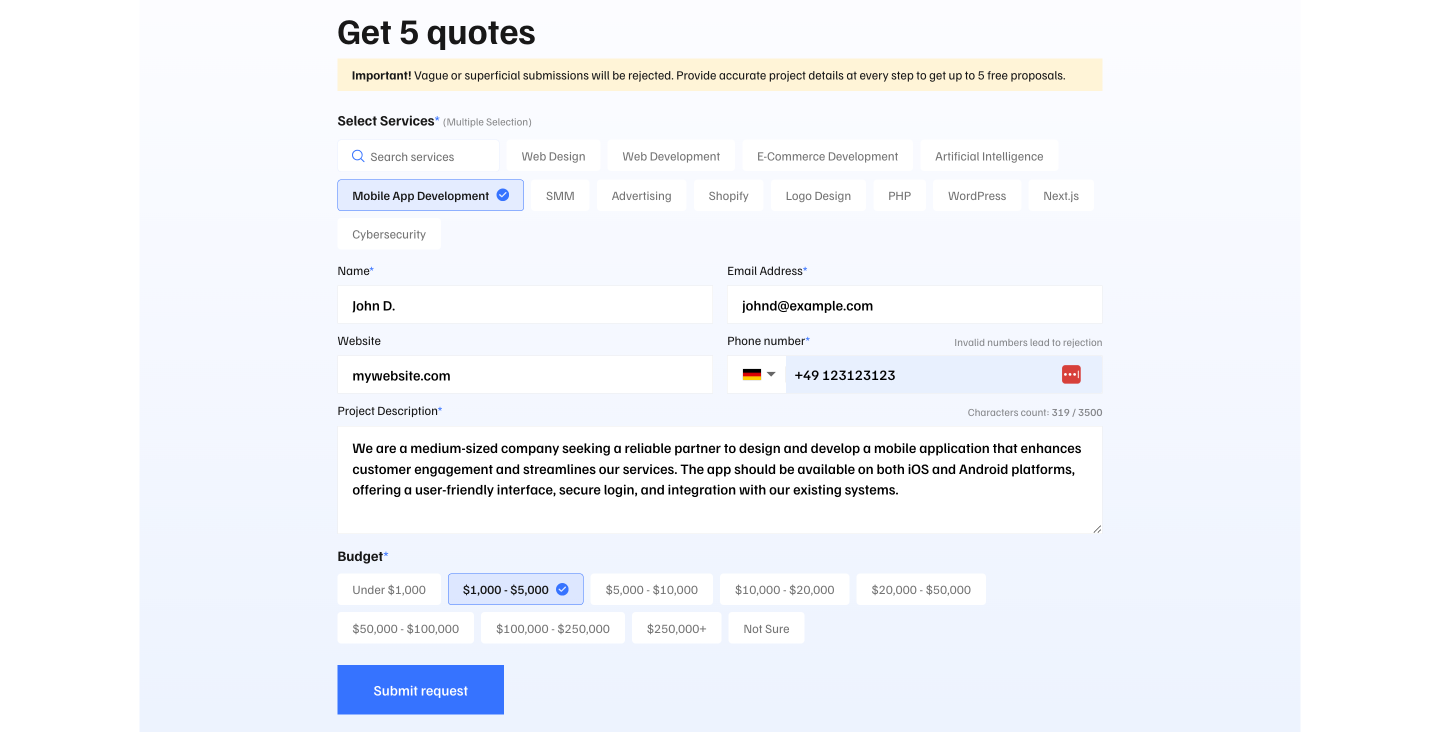
If you have a mobile app project and don’t know where to start, or have an established business and need to expand by launching a mobile app, TechBehmoths offers an easy and straightforward Project Submission tool.
Simply include the requirements of your project and our system will match it with the most appropriate mobile app development companies. You will then receive curated quotes, and be able to shortlist/get in touch with the right companies to execute your projects.