Explore Top Mobile App Development Companies in Brazil

Criação de Sites, Criação de Lojas Virtuais, Campanhas de Marketing Digital, Fábrica de Software.

We love technology and design and we turn this feeling into solid results for our customers. We do this through a methodology that combines good ideas...
DevSolutions Software has a qualified team to design and develop websites, virtual stores, e-commerce, mobile applications, administrative and commerc...

Movin 'is a results-driven digital marketing agency that connects people and brands with strategy, creativity and technology. We specialize in Digital...

AKM Agency is an innovative, strategic Digital Solutions agency. We make full use of the technology and creativity to develop strategic communication...
The company that seeks growth in a rapidly changing area needs to look at several fronts and keep up with market trends. Not just a profile in social...
We develop apps for events. We are so passionate about mobile that we develop native application for Android and iOS, taking seriously the best perfor...

Codein is a company with great social and economic awareness that aims to develop solutions that are always aligned to our customers’ needs. We develo...

Visionnaire is a Brazilian based Software House with more than 24 years of experience in software development. We developed and delivered more than 2...

Dextra is a software development company that sets innovation as the basis of their differentiation in the market. They create digital products using...

Headquartered in Brazil, Roga is a innovation and technology company with a broad range of solutions and services on web and mobile software developme...
Services:

We develop games, apps and interactive solutions to motivate through entertainment. We have a creative team and a very flexible production pipeline, a...

World Class Web & Mobile apps development!

A team of web and graphic designers

Communications and technology intelligence company

Communication to Empower.


We have done internet since the internet was made

Desenvolvimento de soluções de software com as mais recentes tecnologias do mercado e profissionais prontos para agir sob qualquer situação...
Filter Mobile App Development Companies in Brazil by Cities
Find the right tech company near you or from a specific city. Some of the best companies might be located in smaller cities.
Find more Mobile App Development companies around the world
TechBehemoths is the world's most advanced and user-friendly platform to match IT Companies with real clients without hustle.
ICT in Brazil: Data, Companies, and Predictions
The IT services market in Brazil is predicted to experience a remarkable increase in revenue, reaching about $21.46 billion by 2025, according to Statista. The dominating market segment is Business Process Outsourcing (BPO). The average monthly spend per employee in Brazil’s IT Services market is expected to reach almost $200 in the same year. This growth is caused by the high demand for digital transformation solutions in this country.
The growth of the ICT market in Brazil is caused by the expansion of the startup ecosystem, the increased demand for upgraded Data Analytics, and the utilization of Cloud Computing systems. For this sector, the deployment of 5G technology is crucial because it contributes to the expansion of the Internet of Things (IoT) and smart cities. Nokia announced in 2024 a partnership with TIM Brazil to expand its 5G RAN system across the country, providing high-tech 5G equipment and AI institutions.
Brazil’s focus on Cybersecurity is caused by the fast-growing economy and prioritization of data safety backed by Brazil’s General Data Protection Law (LGPD) to prevent cyber attacks. Cybersecurity is also important for the ICT market because it sustains customer trust and encourages investments.
The future of the ICT market is poised for future development driven by massive investment in AI, Cloud Computing, Big Data, and 5G expansion. This is driven by the country’s tech-savvy populace and the government’s initiatives.
What Are the Perks of Working With a Brazil-based Company?
Access to a growing tech company in Brazil is not the only benefit of collaborating with a tech company from this country. Among them, the skilled talent pool from this country is described as proactive with good communication skills and an entrepreneurial mindset, which can be helpful for your business or project.
Cities like São Paulo are important tech hubs offering many possibilities for Software Developers, Engineers, Data Scientists, and other tech professions. The majority of Brazil’s 16,000+ startups are located in this city, raising approximately $2.14 billion in 2024. Also, São Paulo fosters research facilities, top tech universities like Universidade de São Paulo (USP) and Universidade Estadual de Campinas (UNICAMP), which help maintain a strong culture of innovation.
Because Brazil is a major player in Latin America, collaborating with companies from this region can encourage access to regional markets, networks, and growth opportunities with the neighboring countries. Additionally, perks include cultural diversity at the workplace and an emphasis on work-life balance.
What You Need to Know When Working With Brazilian Tech Companies?
Working in the thriving and expanding IT industry of Brazil is helpful for your project, but before choosing a tech company to work with, you should consider some factors that could complicate the working process. The business environment in this country is described by a complex bureaucracy that can lead to several challenges for professionals working there. Brazil’s regulatory infrastructure includes intricate business registration, compliance procedures, and taxation, which can be pricey and time-consuming.
Brazil is experiencing economic instability that can affect job security. It is often caused by fluctuations in global commodity prices, varying monetary policies, and uncertain political climates. Industries can be negatively influenced, impacting job safety. In certain areas of Brazil is associated with high crime rates; for example, Rio de Janeiro and São Paulo are experiencing levels of violence and crime despite being tech hubs. These crimes include burglaries and several violent crimes affecting the daily life of the tech professionals in these cities.
Additionally, in Brazil is important to know Portuguese as it is the official language and commonly used in business communication. English is still widely used in business communications, but many local businesses, government dealings, and everyday interactions prefer Portuguese. These preferences limit the job and collaboration possibilities.
These challenges can be overcome by working with experts such as lawyers and professionals to help with acknowledging the official language. Despite the possible challenges, working with a tech firm from Brazil can offer possibilities for innovations and success for your projects.
Are Brazilian IT Companies Reliable?
The IT firms from this nation can be considered reliable due to their highly skilled developers, strong tech skills, adaptability, good English proficiency despite the preference for Portuguese, and alignment with the US time zones. Brazilian IT professionals have robust skills in programming, Software Engineering, Cloud Computing, AI, and Data Science.
The tech ecosystem fosters innovation with AI adoption by major firms, driving further digitalization and positioning Brazil as a tech leader in Latin America. The companies in this country show dedication to delivering high-quality solutions backed by international standards. Considering these factors and the growing advancements in the tech sector, strong IT skills make the firms in Brazil considerably reliable.
Brazil’s IT Industry versus Neighboring Countries
The IT industry in Brazil is a regional leader and also a major hub for nearshore outsourcing, attracting foreign investments and driving digitalization across South America. Its large talent pool and framework allow Brazil to make collaborations and tech exports. This country is both a potential partner and rival for its neighboring countries in outsourcing IT services. Often, smaller countries collaborate with Brazil on tech projects to leverage their abilities and cost advantages. Brazil’s tech standards, tech talent, and innovation culture set the example for other countries in Latin America that look to improve their own IT sectors.
What is Mobile App Development and what are its benefits for your projects?
Mobile app development is the process of creating mobile apps for popular mobile operating systems like Android and iOS.
There are about 7 billion smartphones worldwide, meaning that more than 85% of the world’s population has a mobile device at their disposal to perform various tasks online or offline.
Having a mobile app, businesses can reach a wider audience and have more control over their marketing activities. The benefits are obvious:
- Increases your brand awareness
- Creates a new marketing channel
- Creates a new feedback channel
- Improves your customer service
- Builds customer loyalty
- Improves your sales flow
Choosing the right mobile app development company to work with is not an easy task. There are multiple aspects to consider:
- Location
- Price
- Team size
- Previous experience
- Turnover time
- Communication means
You should also define your project specifications and set up clear goals and objectives, in order to get relevant offers and collaborate successfully with the companies you choose.
There are more than 9,600 service providers on our platform which offer a wide variety of mobile development solutions. Explore their profiles and feel free to get in touch with them.
To ease the selection process, we’ve created a powerful filter which you can use to narrow down the results based on your requirements and shortlist the companies.
Alternatively, you can submit your project and our team will select and send you the best matching companies in about 1 hour. It’s free and there is no obligation to hire.
Do Businesses Need Mobile Apps? The Answer is Obvious
Users are currently browsing and using different platforms and channels (AI chatbots, search engines, social media, email, etc.) to make a decision and ultimately purchase a product/service. Mobile devices became a significant part of their lives, so businesses need to adapt and deliver solutions for different kinds of devices and operating systems.
At minimum, businesses would need to offer a mobile app listed on Play Market (for Android) or App Store (for iOS), or offer a mobile first user experience on their websites.
The reality is that more than half of the companies don’t have a mobile app yet, or are just planning to develop one.
According to the latest survey on mobile apps conducted by TechBehmoths, 62% of businesses don’t have a mobile app and don’t plan to develop one, while around 19% of businesses don’t have one, but are planning to create one in the future, and 30% of businesses have a mobile app.
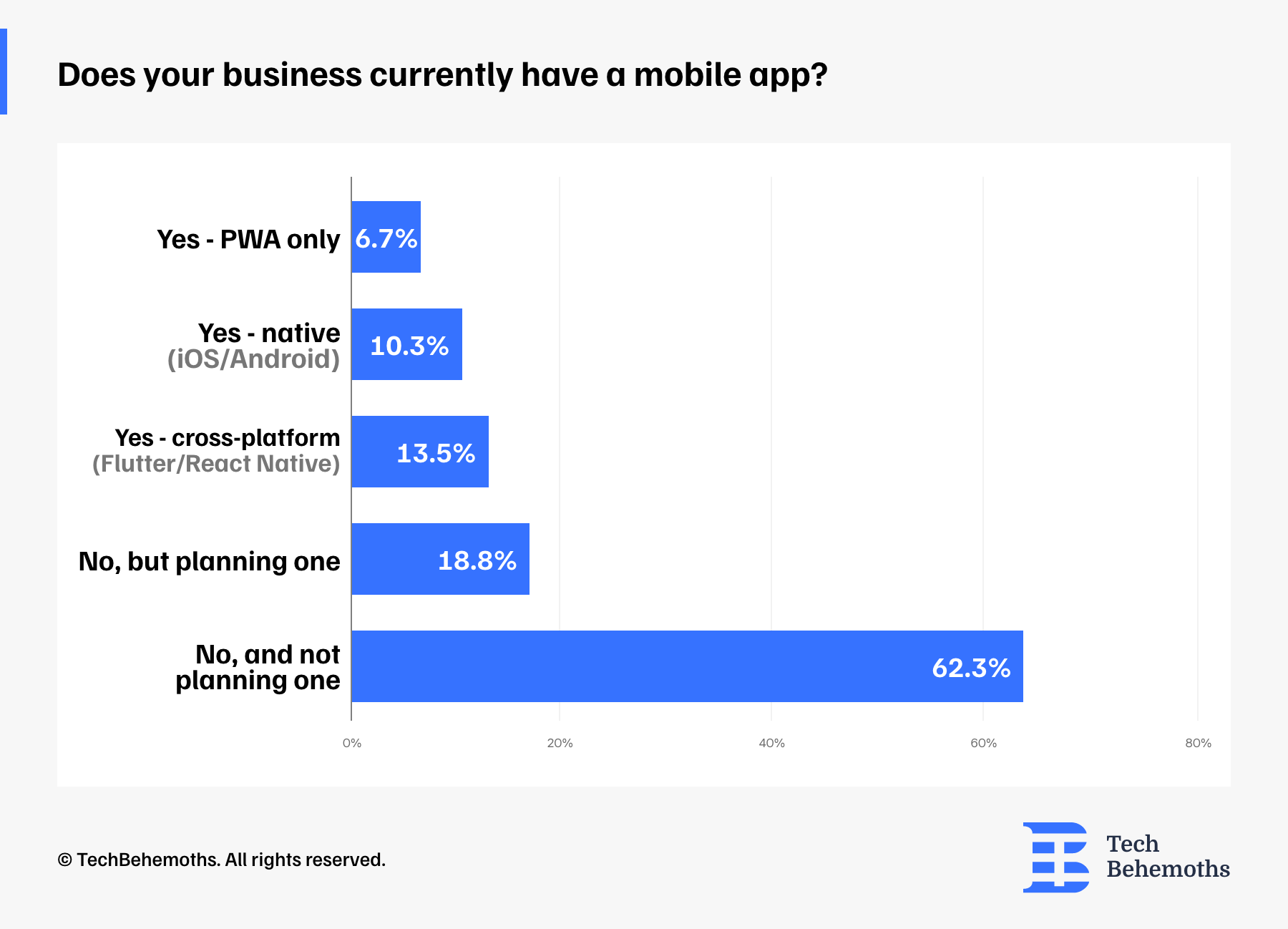
Of those firms that have one, the most popular mobile application types are the following:
-
Cross-platforms mobile apps - when mobile apps are coded once and compatible with multiple mobile operating systems like Android and iOS
-
Native apps - when mobile apps are specifically created for iOS, Android or any other mobile operating system
-
PWA (progressive web apps) - these are web applications that provide a mobile app like experience on web browsers (desktop or mobile)
Companies can benefit from mobile apps in multiple ways. Here are the main advantages:
-
Customer acquisition - there are billions of smartphone users worldwide, so it’s essential to reach your customers on the devices they use
-
Revenue growth - mobile apps provide an extra channel to grow your revenue. With the rise of mobile banking, payments and transactions are not happening solely on desktops devices anymore. Digital commerce spend is expected to reach around $34 Trillion by 2029 (source)
-
Brand visibility - mobile apps offer a consistent channel for brand awareness and marketing
-
Internal operations - some companies choose the convenience of mobile apps to run internal operations like education, onboarding, HR, logs/checks, etc.
-
Customer service - serving customers via mobile apps might be the fastest and most efficient way to keep them happy
-
Customer retention - mobile app push notifications is possibly the fastest way to keep clients engaged and offer promotions
-
Availability - mobile apps are there for users 24/7
Having a website might not be enough to acquire new customers and serve existing ones. Today's reality is that pretty much everyone is online and using a smartphone device for both entertainment and work.
Mobile apps will inevitably become a priority for most businesses in the next couple of years.
Companies have the option to build mobile apps in house or hire mobile app development providers. For less complex projects, low-code or no-code app tools might be worth considering.
If you have a mobile app project and don’t know where to start, or have an established business and need to expand by launching a mobile app, TechBehmoths offers an easy and straightforward Project Submission tool.
Simply include the requirements of your project and our system will match it with the most appropriate mobile app development companies. You will then receive curated quotes, and be able to shortlist/get in touch with the right companies to execute your projects.